Homepage Blank California Nc 410 Form
Outline

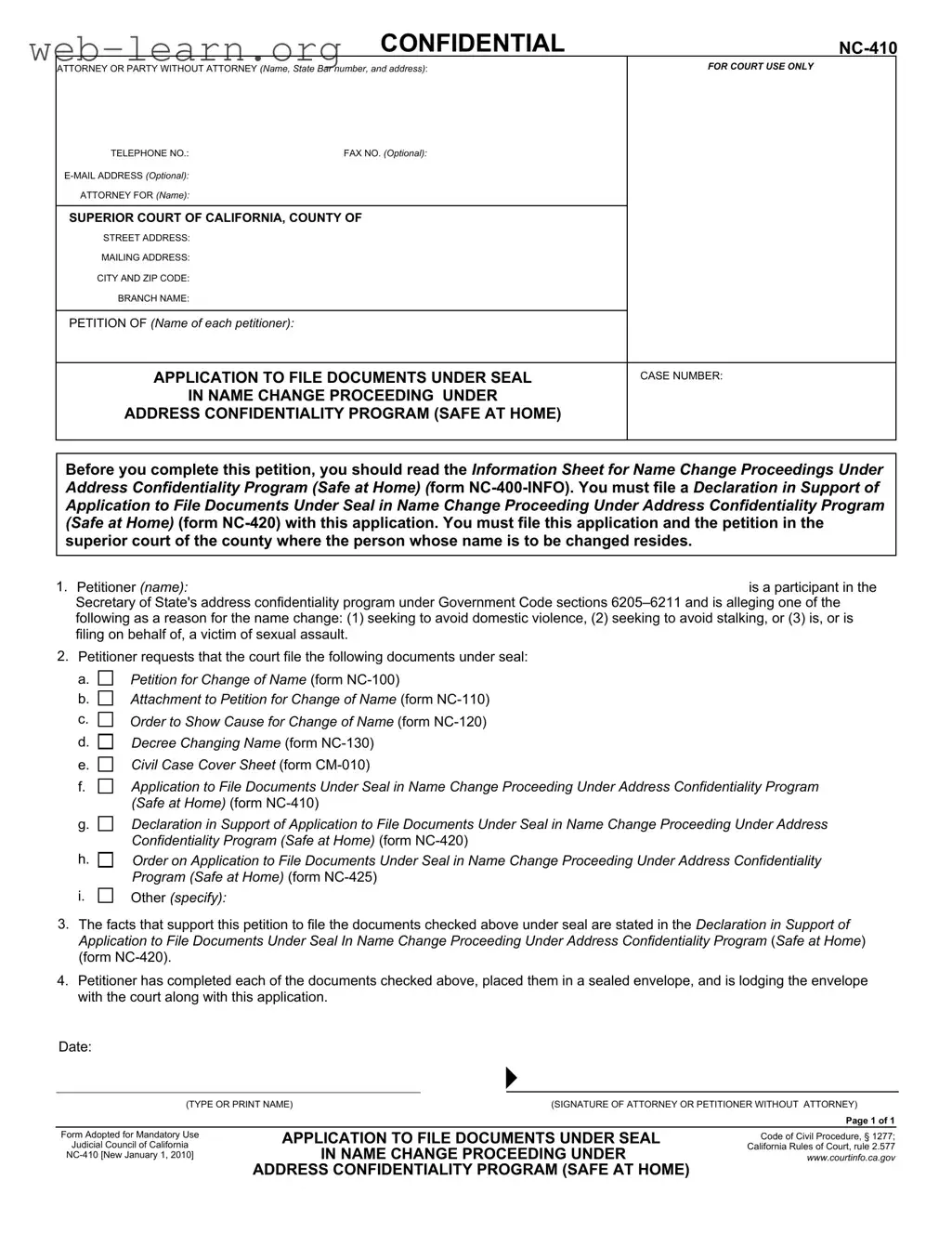
The California NC 410 form plays a crucial role in the name change process for individuals seeking protection under the Address Confidentiality Program, known as Safe at Home. This program is designed to assist those who are victims of domestic violence, stalking, or sexual assault by allowing them to keep their new names and associated documents confidential. When completing the NC 410, petitioners must provide their details, including name, contact information, and the specific reasons for their name change request. Additionally, the form requires the filing of various supporting documents under seal, such as the Petition for Change of Name and a Declaration in Support of the Application to File Documents Under Seal. By lodging these documents with the court, individuals can ensure their sensitive information remains protected throughout the legal process. This form is essential for maintaining privacy and security for those who have experienced trauma, highlighting the importance of careful preparation and adherence to the guidelines set forth by the court.

Sample - California Nc 410 Form

NC-410
FOR COURT USE ONLY
FAX NO. (Optional):TELEPHONE NO.:
E-MAIL ADDRESS (Optional):
ATTORNEY FOR (Name):
SUPERIOR COURT OF CALIFORNIA, COUNTY OF
MAILING ADDRESS:
CITY AND ZIP CODE:
BRANCH NAME:
PETITION OF (Name of each petitioner):
CASE NUMBER:
APPLICATION TO FILE DOCUMENTS UNDER SEAL
IN NAME CHANGE PROCEEDING UNDER
ADDRESS CONFIDENTIALITY PROGRAM (SAFE AT HOME)
Before you complete this petition, you should read the Information Sheet for Name Change Proceedings Under
Address Confidentiality Program (Safe at Home) (form NC-400-INFO). You must file a Declaration in Support of
Application to File Documents Under Seal in Name Change Proceeding Under Address Confidentiality Program
(Safe at Home) (form NC-420) with this application. You must file this application and the petition in the
superior court of the county where the person whose name is to be changed resides.
Petitioner (name):
APPLICATION TO FILE DOCUMENTS UNDER SEAL
IN NAME CHANGE PROCEEDING UNDER
ADDRESS CONFIDENTIALITY PROGRAM (SAFE AT HOME)
Form Adopted for Mandatory Use
Judicial Council of California
NC-410 [New January 1, 2010]
Code of Civil Procedure, § 1277;
California Rules of Court, rule 2.577
www.courtinfo.ca.gov
STREET ADDRESS:
1.
is a participant in the
a.
Petition for Change of Name (form NC-100)
b.
Attachment to Petition for Change of Name (form NC-110)
Order to Show Cause for Change of Name (form NC-120)
c.
g.
Declaration in Support of Application to File Documents Under Seal in Name Change Proceeding Under Address
Confidentiality Program (Safe at Home) (form NC-420)
i.
Other (specify):
Petitioner has completed each of the documents checked above, placed them in a sealed envelope, and is lodging the envelope
with the court along with this application.
4.
Secretary of State's address confidentiality program under Government Code sections 6205–6211 and is alleging one of the
following as a reason for the name change: (1) seeking to avoid domestic violence, (2) seeking to avoid stalking, or (3) is, or is
filing on behalf of, a victim of sexual assault.
Petitioner requests that the court file the following documents under seal:
2.
The facts that support this petition to file the documents checked above under seal are stated in the Declaration in Support of
Application to File Documents Under Seal In Name Change Proceeding Under Address Confidentiality Program (Safe at Home)
(form NC-420).
3.
(SIGNATURE OF ATTORNEY OR PETITIONER WITHOUT ATTORNEY)(TYPE OR PRINT NAME)
Date:
`
CONFIDENTIAL
h.
Order on Application to File Documents Under Seal in Name Change Proceeding Under Address Confidentiality
Program (Safe at Home) (form NC-425)
ATTORNEY OR PARTY WITHOUT ATTORNEY (Name, State Bar number, and address):
Page 1 of 1
f.
Application to File Documents Under Seal in Name Change Proceeding Under Address Confidentiality Program
(Safe at Home) (form NC-410)
e.
Civil Case Cover Sheet (form CM-010)
Decree Changing Name (form NC-130)
d.

Form Information

Fact Name Description
Form Purpose The California NC-410 form is used to apply for filing documents under seal in name change proceedings, specifically for participants in the Address Confidentiality Program (Safe at Home).
Governing Laws This form is governed by the California Government Code sections 6205–6211 and the Code of Civil Procedure, § 1277.
Required Accompanying Documents To complete the application, a Declaration in Support of Application to File Documents Under Seal (form NC-420) must also be filed.
Eligibility Criteria Petitioners must be participants in the Secretary of State's address confidentiality program and may be seeking to avoid domestic violence, stalking, or are victims of sexual assault.
Filing Location The application and petition must be filed in the superior court of the county where the person whose name is being changed resides.
Form Adoption The NC-410 form was adopted for mandatory use by the Judicial Council of California and has been in effect since January 1, 2010.

Detailed Guide for Filling Out California Nc 410

Filling out the California NC-410 form is an important step in the name change process under the Address Confidentiality Program (Safe at Home). This form allows you to request that certain documents be filed under seal, ensuring your information remains confidential. Here’s how to complete it effectively.

  1. Enter Your Information: At the top of the form, provide your name, State Bar number (if applicable), and your address. If you have a telephone number, fax number, or email address, include those as well.
  2. Specify Attorney or Party: Indicate whether you are an attorney or filing without an attorney. If you are an attorney, list your name and the name of the party you represent.
  3. Fill in Court Information: Write the name of the Superior Court of California and the county where you are filing. Include the street address, mailing address, city, and ZIP code of the court.
  4. Petitioners’ Names: List the names of all petitioners involved in the name change.
  5. Document Sealing Request: Check the box next to each document you wish to file under seal. This includes forms such as the Petition for Change of Name and the Declaration in Support of Application to File Documents Under Seal.
  6. State the Facts: Summarize the facts that support your request to file the documents under seal. This information should be detailed in the accompanying Declaration (form NC-420).
  7. Prepare Sealed Envelope: Gather all the documents you have checked off and place them in a sealed envelope. Ensure that this envelope is ready to be lodged with the court.
  8. Sign and Date: Finally, type or print your name, sign the form, and include the date.

Once you have completed the form and prepared the necessary documents, you will be ready to file them with the court. Make sure to keep copies for your records and follow any additional instructions provided by the court regarding the filing process.

Obtain Answers on California Nc 410

  1. What is the purpose of the California NC-410 form?

    The California NC-410 form is used to apply for filing documents under seal in a name change proceeding that falls under the Address Confidentiality Program (Safe at Home). This program is designed to protect individuals who may be victims of domestic violence, stalking, or sexual assault by keeping their personal information confidential.

  2. Who can use the NC-410 form?

    Only participants in the Secretary of State's Address Confidentiality Program can use the NC-410 form. To qualify, individuals must be seeking a name change for specific reasons, such as avoiding domestic violence, stalking, or if they are a victim of sexual assault. The form is part of a legal process that ensures their sensitive information remains protected.

  3. What documents need to be submitted along with the NC-410 form?

    When filing the NC-410 form, it is necessary to include several other documents. These include:

    • Petition for Change of Name (form NC-100)
    • Attachment to Petition for Change of Name (form NC-110)
    • Order to Show Cause for Change of Name (form NC-120)
    • Decree Changing Name (form NC-130)
    • Civil Case Cover Sheet (form CM-010)
    • Declaration in Support of Application to File Documents Under Seal (form NC-420)
    • Order on Application to File Documents Under Seal (form NC-425)
    • Any other relevant documents specified by the petitioner

    These documents must be placed in a sealed envelope and submitted to the court along with the NC-410 form.

  4. Where should the NC-410 form be filed?

    The NC-410 form must be filed in the superior court of the county where the person whose name is being changed resides. It is important to ensure that all forms are completed accurately and submitted to the correct court to avoid delays in the name change process.

Common mistakes

Filling out the California NC-410 form can be a straightforward process, but several common mistakes can complicate matters. Understanding these pitfalls can help ensure a smoother application experience.

One frequent error is failing to read the accompanying Information Sheet for Name Change Proceedings Under Address Confidentiality Program (Safe at Home). This document provides essential guidance and context for completing the form. Without this knowledge, applicants may overlook critical requirements or misunderstand the process.

Another mistake is neglecting to file the required Declaration in Support of Application to File Documents Under Seal. This declaration is a necessary component of the application. Omitting it can lead to delays or even rejection of the application.

Many applicants also struggle with accurately identifying their status as a participant in the Secretary of State's address confidentiality program. It is crucial to clearly state the reason for the name change, whether it is to avoid domestic violence, stalking, or sexual assault. Misrepresenting this information could jeopardize the application.

In addition, some individuals fail to include all the necessary documents that must be filed under seal. The NC-410 form requires specific attachments, including the Petition for Change of Name and the Order to Show Cause. Missing any of these documents can result in complications or a complete denial of the request.

Another common issue arises from improperly completing the contact information section. Providing accurate details for the attorney or party without an attorney is essential. Incomplete or incorrect information may hinder communication with the court.

Lastly, applicants sometimes overlook the requirement to place all completed documents in a sealed envelope before submitting them to the court. This step is vital for maintaining confidentiality and ensuring that the application is processed correctly. Failure to follow this instruction could lead to unnecessary exposure of sensitive information.

By being aware of these common mistakes, individuals can navigate the application process more effectively and enhance their chances of a successful outcome.

Documents used along the form

The California NC-410 form is an application used in name change proceedings, particularly for individuals participating in the Address Confidentiality Program (Safe at Home). Several other forms and documents are often used alongside this form to ensure a smooth process. Below is a list of these related documents, each described briefly.

  • Petition for Change of Name (form NC-100): This form initiates the name change process. It includes the petitioner’s details and the requested new name.
  • Attachment to Petition for Change of Name (form NC-110): This document provides additional information that supports the name change request. It may include reasons for the change and relevant circumstances.
  • Order to Show Cause for Change of Name (form NC-120): This form notifies interested parties about the name change request. It also sets a court date for the hearing.
  • Decree Changing Name (form NC-130): If the court approves the name change, this document serves as the official order reflecting the new name.
  • Civil Case Cover Sheet (form CM-010): This form provides the court with essential information about the case. It helps in categorizing the case correctly within the court system.
  • Declaration in Support of Application to File Documents Under Seal (form NC-420): This declaration supports the request to keep certain documents confidential. It outlines the reasons for sealing the documents.
  • Order on Application to File Documents Under Seal (form NC-425): This document is the court's decision regarding the request to seal documents. It indicates whether the application has been granted or denied.
  • Other (specify): Depending on individual circumstances, additional documents may be required. It’s important to specify any other forms that may be relevant to the case.

Using these forms in conjunction with the NC-410 can help ensure that all necessary information is provided and that the name change process is handled appropriately. Each document plays a specific role in supporting the petitioner's case.

Similar forms

The California NC-410 form is an important document used in name change proceedings under the Address Confidentiality Program (Safe at Home). It serves a specific purpose, but there are several other forms that share similarities with it. Below are four documents that are comparable to the NC-410 form, along with explanations of how they are alike:

  • Petition for Change of Name (form NC-100): Like the NC-410, this form initiates the name change process. It requires the petitioner to provide personal information and reasons for the name change, ensuring that the court has the necessary details to consider the request.
  • Order to Show Cause for Change of Name (form NC-120): This document is similar in that it outlines the reasons for the name change and sets a date for a hearing. It informs all interested parties of the proceedings, much like the NC-410 does for filing documents under seal.
  • Declaration in Support of Application to File Documents Under Seal (form NC-420): This form directly supports the NC-410 by providing the factual basis for why certain documents should be sealed. Both forms work together to protect sensitive information during the name change process.
  • Order on Application to File Documents Under Seal (form NC-425): This document is issued by the court after reviewing the NC-410 and NC-420 forms. It grants or denies the request to seal documents, similar to how the NC-410 seeks approval to keep specific information confidential.

Dos and Don'ts

When filling out the California NC-410 form, there are important steps to follow to ensure a smooth process. Here is a list of things you should and shouldn't do:

  • Do read the Information Sheet for Name Change Proceedings Under Address Confidentiality Program (Safe at Home) before starting.
  • Do ensure you are a participant in the Secretary of State's address confidentiality program.
  • Do clearly state the reason for the name change, such as seeking to avoid domestic violence, stalking, or being a victim of sexual assault.
  • Do complete all necessary documents, including the Declaration in Support of Application to File Documents Under Seal.
  • Do file the application and petition in the superior court of the county where the person whose name is changing resides.
  • Do place completed documents in a sealed envelope before lodging them with the court.
  • Don't skip reading the instructions or assume you know what to do.
  • Don't forget to include all required documents listed in the form.
  • Don't submit the application without ensuring all information is accurate and complete.
  • Don't file the application in the wrong county or court.
  • Don't leave out the date, your name, or signature on the form.
  • Don't forget to keep copies of all documents for your records.

Misconceptions

Misconceptions about the California NC-410 form can lead to confusion and missteps in the name change process. Below is a list of common misunderstandings:

  • The NC-410 form is only for victims of domestic violence. While many applicants may be victims of domestic violence, the form is also available for individuals seeking to avoid stalking or those filing on behalf of sexual assault victims.
  • Filing the NC-410 form guarantees a name change. Submitting the form does not automatically result in a name change. The court must review and approve the application based on the provided reasons and supporting documents.
  • All documents can be filed under seal without justification. The applicant must provide a valid reason for sealing documents. The NC-410 form requires a declaration that supports the request to keep documents confidential.
  • You can file the NC-410 form anywhere in California. The application must be filed in the superior court of the county where the person whose name is changing resides. It is crucial to file in the correct jurisdiction.
  • The NC-410 form is the only document needed for the process. In addition to the NC-410, applicants must complete and submit other forms, such as the NC-100 and NC-420, to successfully navigate the name change process.
  • Once documents are filed under seal, they remain confidential indefinitely. While the intention is to protect sensitive information, there may be circumstances under which the court can unseal documents, depending on legal requirements.
  • There is no need for legal representation when filing the NC-410 form. While individuals can represent themselves, having legal guidance can help ensure that all forms are completed correctly and that the process runs smoothly.
  • The NC-410 form is only for adults. Minors can also utilize this form, but the application must be filed by a parent or legal guardian on their behalf, following specific procedures.
  • Sealing documents is a quick process. The time it takes for the court to review and approve the application can vary. Applicants should be prepared for potential delays in the process.

Understanding these misconceptions can help individuals navigate the name change process more effectively and ensure they meet all necessary requirements.

Key takeaways

When dealing with the California NC-410 form, it's essential to keep several key points in mind to ensure a smooth process. Here are the takeaways:

  • Understand the Purpose: The NC-410 form is used to request that certain documents related to a name change be kept confidential. This is particularly important for individuals participating in the Address Confidentiality Program.
  • Eligibility Requirements: To use this form, the petitioner must be part of the Secretary of State's Address Confidentiality Program and have a valid reason, such as seeking to avoid domestic violence, stalking, or being a victim of sexual assault.
  • Supporting Documents: Along with the NC-410 form, you must submit a Declaration in Support of Application to File Documents Under Seal (form NC-420) and other relevant documents, all of which must be properly completed.
  • Filing Location: This application must be filed in the superior court of the county where the person whose name is being changed resides. Ensure you have all documents ready and in a sealed envelope for lodging with the court.