Homepage Blank California Nc 400 Form
Outline

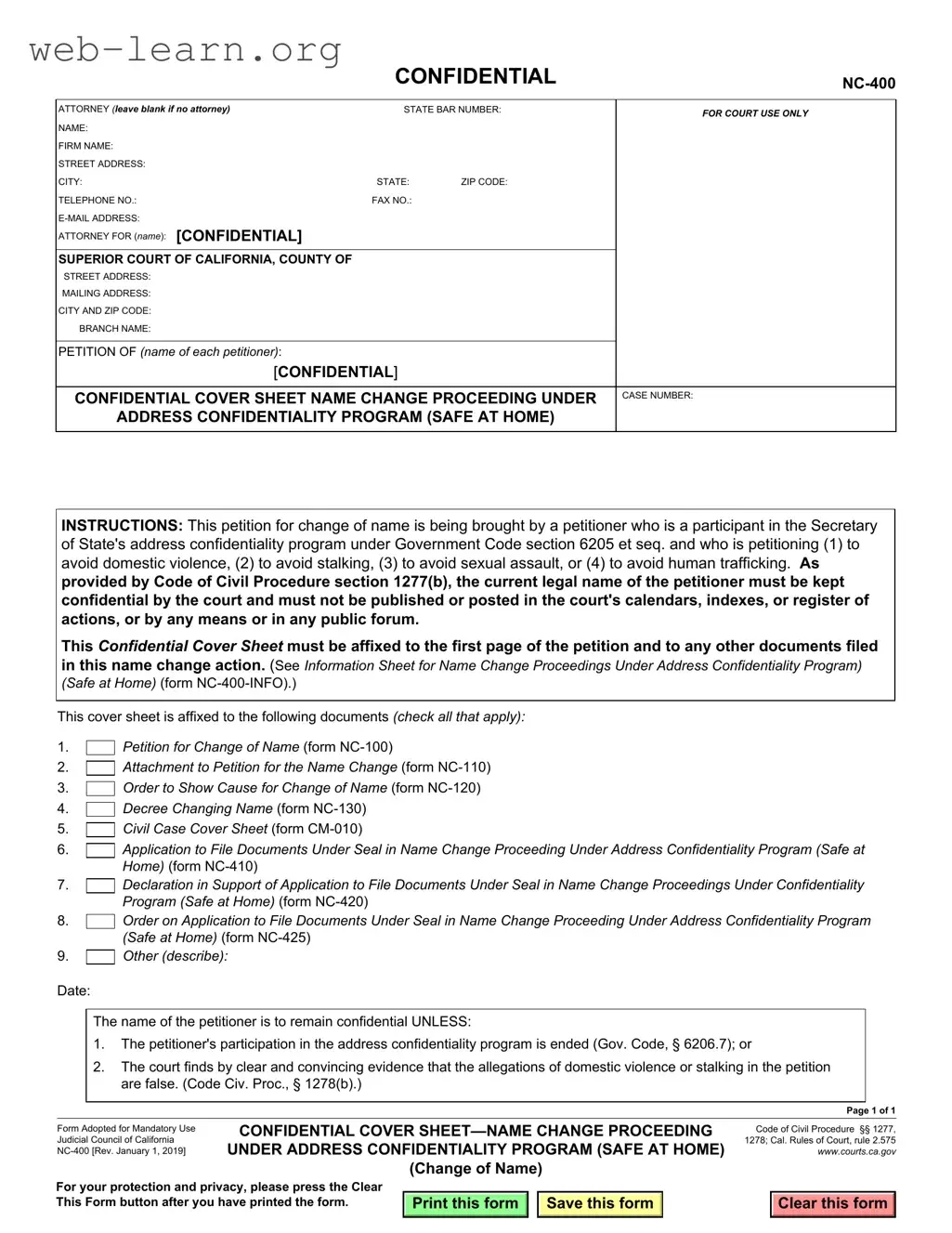
The California NC 400 form plays a crucial role in protecting the identities of individuals seeking a name change under sensitive circumstances. Designed for those participating in the Address Confidentiality Program, this form is essential for individuals looking to change their names to escape threats such as domestic violence, stalking, sexual assault, or human trafficking. It ensures that the current legal name of the petitioner remains confidential, safeguarding them from potential harm. The NC 400 must be attached to various documents related to the name change process, including the petition itself and any supporting declarations. This form emphasizes the importance of privacy, as it prohibits the court from disclosing the petitioner's name in public records or court calendars. It is vital for petitioners to understand the requirements and implications of using this form, as their safety may depend on it. The urgency of these situations cannot be overstated, and understanding the NC 400 is a critical step for those in need of protection.

Sample - California Nc 400 Form

INSTRUCTIONS: This petition for change of name is being brought by a petitioner who is a participant in the Secretary
of State's address confidentiality program under Government Code section 6205 et seq. and who is petitioning (1) to
avoid domestic violence, (2) to avoid stalking, (3) to avoid sexual assault, or (4) to avoid human trafficking. As
provided by Code of Civil Procedure section 1277(b), the current legal name of the petitioner must be kept
confidential by the court and must not be published or posted in the court's calendars, indexes, or register of
actions, or by any means or in any public forum.
This Confidential Cover Sheet must be affixed to the first page of the petition and to any other documents filed
in this name change action. (
See Information Sheet for Name Change Proceedings Under Address Confidentiality Program)
(Safe at Home) (form NC-400-INFO).)
This cover sheet is affixed to the following documents (check all that apply):
Page 1 of 1
Form Adopted for Mandatory Use
Judicial Council of California
NC-400 [Rev. January 1, 2019]
CONFIDENTIAL COVER SHEET—NAME CHANGE PROCEEDING
UNDER ADDRESS CONFIDENTIALITY PROGRAM (SAFE AT HOME)
(Change of Name)
Code of Civil Procedure §§ 1277,
1278; Cal. Rules of Court, rule 2.575
www.courts.ca.gov
NC-400
2.
3.
7.
9.
6.
The name of the petitioner is to remain confidential UNLESS:
The petitioner's participation in the address confidentiality program is ended (Gov. Code, § 6206.7); or1.
The court finds by clear and convincing evidence that the allegations of domestic violence or stalking in the petition
are false. (Code Civ. Proc., § 1278(b).)
2.
1.
5.
4.
8.
CONFIDENTIAL
SUPERIOR COURT OF CALIFORNIA, COUNTY OF
BRANCH NAME:
CITY AND ZIP CODE:
STREET ADDRESS:
MAILING ADDRESS:
PETITION OF (name of each petitioner):
[CONFIDENTIAL]
FOR COURT USE ONLY
CASE NUMBER:
CONFIDENTIAL COVER SHEET NAME CHANGE PROCEEDING UNDER
ADDRESS CONFIDENTIALITY PROGRAM (SAFE AT HOME)
STATE: ZIP CODE:CITY:
STREET ADDRESS:
FIRM NAME:
NAME:
TELEPHONE NO.: FAX NO.:
E-MAIL ADDRESS:
ATTORNEY FOR (name):
STATE BAR NUMBER:
ATTORNEY (leave blank if no attorney)
[CONFIDENTIAL]
Petition for Change of Name (form NC-100)
Attachment to Petition for the Name Change (form NC-110)
Order to Show Cause for Change of Name (form NC-120)
Decree Changing Name (form NC-130)
Civil Case Cover Sheet (form CM-010)
Application to File Documents Under Seal in Name Change Proceeding Under Address Confidentiality Program (Safe at
Home) (form NC-410)
Declaration in Support of Application to File Documents Under Seal in Name Change Proceedings Under Confidentiality
Program (Safe at Home) (form NC-420)
Order on Application to File Documents Under Seal in Name Change Proceeding Under Address Confidentiality Program
(Safe at Home) (form NC-425)
Other (describe):
Date:
Print this form
Save this form
Clear this form
For your protection and privacy, please press the Clear
This Form button after you have printed the form.

Form Information

Fact Name Description
Purpose The California NC-400 form serves as a confidential cover sheet for individuals participating in the Address Confidentiality Program, primarily aimed at protecting those seeking to change their names due to domestic violence, stalking, sexual assault, or human trafficking.
Governing Laws This form is governed by California Government Code section 6205 et seq. and Code of Civil Procedure sections 1277 and 1278, which outline the legal framework for name changes and confidentiality protections.
Confidentiality Under the Code of Civil Procedure section 1277(b), the current legal name of the petitioner remains confidential and must not be disclosed in any public forum or court documents, ensuring privacy for those in vulnerable situations.
Affixation Requirement The NC-400 cover sheet must be attached to the initial petition and any related documents filed in the name change action, reinforcing the confidentiality of the petitioner's information throughout the legal process.

Detailed Guide for Filling Out California Nc 400

Filling out the California NC-400 form is an important step in the name change process, especially for those participating in the Address Confidentiality Program. This form ensures that your personal information remains confidential while you navigate through the legal system. Here’s how to fill it out correctly.

  1. Obtain the Form: Start by downloading the NC-400 form from the California courts website or visiting your local courthouse.
  2. Fill in Attorney Information: If you have an attorney, write their name, firm name, state bar number, and contact details in the designated fields. If you don’t have an attorney, leave this section blank.
  3. Enter Court Information: Fill in the name of the Superior Court of California, the county, and the street address. Include the mailing address, city, and zip code of the court.
  4. Petitioner’s Name: Write the name of each petitioner in the space provided. This information is confidential.
  5. Case Number: If you have a case number, enter it in the appropriate field. If not, leave it blank.
  6. Check Document Types: Indicate which documents this cover sheet will be attached to by checking all applicable boxes, such as the Petition for Change of Name or the Order to Show Cause.
  7. Date: Write the date on which you are filling out the form.
  8. Confidentiality Reminder: Remember that the name of the petitioner will remain confidential unless specific conditions are met, as noted on the form.

After completing the form, make sure to review it for accuracy. Once you are confident that everything is filled out correctly, you can proceed to file it with the court along with the other necessary documents. Keeping your information secure is crucial, so take the time to ensure everything is in order.

Obtain Answers on California Nc 400

  1. What is the purpose of the California NC 400 form?

    The California NC 400 form serves as a Confidential Cover Sheet for individuals who are participating in the Secretary of State's Address Confidentiality Program, known as "Safe at Home." This program is designed to protect individuals who may be victims of domestic violence, stalking, sexual assault, or human trafficking. By using this form, petitioners can ensure that their current legal name remains confidential throughout the name change process, thereby enhancing their safety and privacy.

  2. Who needs to file the NC 400 form?

    This form must be filed by any individual who is seeking a name change while participating in the Address Confidentiality Program. It is essential for those who have been victims of situations such as domestic violence or stalking, as it helps to keep their identity protected from public records. If you are uncertain whether you qualify, it may be beneficial to consult with a legal professional or a local advocacy group.

  3. What documents should be accompanied by the NC 400 form?

    The NC 400 form should be affixed to the first page of the petition for a name change and any other related documents filed in the name change action. These documents can include:

    • Petition for Change of Name (form NC-100)
    • Attachment to Petition for the Name Change (form NC-110)
    • Order to Show Cause for Change of Name (form NC-120)
    • Decree Changing Name (form NC-130)
    • Civil Case Cover Sheet (form CM-010)
    • Application to File Documents Under Seal (form NC-410)
    • Declaration in Support of Application (form NC-420)
    • Order on Application to File Documents Under Seal (form NC-425)
    • Any other relevant documents
  4. What happens to the confidentiality of the petitioner's name?

    • The petitioner ends their participation in the Address Confidentiality Program.
    • The court determines, based on clear and convincing evidence, that the allegations of domestic violence or stalking are false.

    This measure ensures that individuals can seek protection without the fear of their personal information being disclosed.

Common mistakes

Filling out the California NC-400 form can be a daunting task, especially for individuals seeking to change their name under the Address Confidentiality Program. Mistakes can easily occur, and these errors may lead to delays or complications in the legal process. Here are eight common mistakes to avoid when completing this form.

One frequent error is failing to include all required personal information. The form asks for specific details such as the petitioner’s name, address, and contact information. Omitting any of this information can result in the form being rejected or delayed. It is essential to double-check that all fields are filled out completely and accurately.

Another mistake is neglecting to check the appropriate boxes regarding the documents being submitted. The NC-400 form requires that you indicate which documents are being filed alongside the petition. Failing to do so can create confusion and may lead to the court not processing the request as intended. Always ensure that you have checked all relevant documents before submission.

In addition, many people overlook the importance of confidentiality. The purpose of the NC-400 form is to protect the petitioner’s current legal name from being disclosed. If the confidentiality provisions are not clearly understood or followed, this could lead to unintended exposure of sensitive information. It is crucial to understand the implications of the Address Confidentiality Program and to adhere to its guidelines.

Another common oversight is not signing the form. A signature is required to validate the petition, and failing to provide one can render the submission invalid. Always ensure that you have signed and dated the form before filing it with the court.

Additionally, some individuals mistakenly believe that they can submit the form electronically without verifying the specific requirements for their case. While some courts may allow electronic submissions, others may require physical copies. It is advisable to check with the local court’s rules regarding submission methods to avoid any issues.

People often forget to keep copies of their submitted documents. Maintaining a record of what has been filed is essential for tracking the progress of the petition. In the event of any disputes or questions, having copies can provide clarity and support your case.

Moreover, failing to follow up with the court after submission is a mistake that can lead to complications. After filing the NC-400 form, it is wise to check in with the court to confirm that everything is in order and to understand the next steps in the process. This proactive approach can prevent potential delays in the name change proceedings.

Lastly, not seeking assistance when needed can be detrimental. Individuals may feel overwhelmed by the process and may benefit from legal advice or support. Consulting with an attorney who specializes in name changes or family law can provide valuable guidance and help navigate the complexities of the form.

By avoiding these common mistakes, individuals can better ensure that their experience with the California NC-400 form is smooth and efficient. Taking the time to carefully complete the form and understanding the requirements can lead to a successful name change process.

Documents used along the form

The California NC 400 form is an essential document for individuals seeking to change their name while participating in the Address Confidentiality Program (Safe at Home). Along with this form, several other documents are often required to complete the name change process. Each document serves a specific purpose and helps ensure the confidentiality and safety of the petitioner.

  • Petition for Change of Name (form NC-100): This form initiates the name change process. It includes the petitioner's current name and the desired new name, along with the reasons for the change.
  • Order to Show Cause for Change of Name (form NC-120): This document requests a court hearing to consider the name change petition. It informs the court and interested parties of the petitioner's request and sets a date for the hearing.
  • Decree Changing Name (form NC-130): If the court approves the name change, this document officially records the new name. It serves as legal proof of the name change for the petitioner.
  • Application to File Documents Under Seal (form NC-410): This application is used when the petitioner seeks to keep certain documents confidential. It is particularly important for those concerned about safety and privacy.

Each of these forms plays a critical role in ensuring that the name change process is handled with the necessary confidentiality and care. Understanding these documents can help petitioners navigate the legal landscape more effectively and protect their rights and safety throughout the process.

Similar forms

  • Petition for Change of Name (form NC-100): This form initiates the legal process for changing a person's name. Like the NC-400, it is used in name change proceedings and requires specific information about the petitioner.
  • Attachment to Petition for the Name Change (form NC-110): This document provides additional details that support the name change request. It is similar to the NC-400 in that it must be filed alongside the main petition.
  • Order to Show Cause for Change of Name (form NC-120): This form is issued by the court to schedule a hearing on the name change request. It serves a similar purpose to the NC-400 by facilitating the name change process.
  • Decree Changing Name (form NC-130): This is the official court order that grants the name change. Like the NC-400, it is a critical document in the name change procedure.
  • Civil Case Cover Sheet (form CM-010): This form provides basic information about the case for court records. It is similar to the NC-400 in that it is required for filing certain types of cases, including name changes.
  • Application to File Documents Under Seal (form NC-410): This application is used to request that certain documents be kept confidential. It shares the confidentiality aspect with the NC-400, particularly for sensitive cases.
  • Declaration in Support of Application to File Documents Under Seal (form NC-420): This document supports the request to keep records confidential. Like the NC-400, it emphasizes the importance of privacy in legal proceedings.
  • Order on Application to File Documents Under Seal (form NC-425): This order is issued by the court to grant or deny the request for confidentiality. It parallels the NC-400 in its focus on protecting sensitive information.
  • Information Sheet for Name Change Proceedings (form NC-400-INFO): This informational guide explains the name change process. It complements the NC-400 by providing additional context and instructions.
  • Request for Hearing (form FL-300): This form is used to request a court hearing on family law matters, including name changes. It shares similarities with the NC-400 in its procedural nature and need for court approval.

Dos and Don'ts

When filling out the California NC-400 form, it's essential to approach the process with care. Here are ten important do's and don'ts to keep in mind:

  • Do ensure all personal information is accurate and complete.
  • Do check the box next to each document you are submitting with the petition.
  • Do keep your current legal name confidential, as required by law.
  • Do include your attorney's information if you have legal representation.
  • Do follow the instructions carefully to avoid delays in processing.
  • Don't leave any sections blank unless instructed to do so.
  • Don't forget to sign and date the form before submission.
  • Don't share your petitioner's information publicly, as it must remain confidential.
  • Don't submit the form without reviewing it for errors.
  • Don't hesitate to seek assistance if you have questions about the process.

By following these guidelines, you can help ensure that your name change petition is processed smoothly and securely.

Misconceptions

Understanding the California NC 400 form is crucial for those seeking to change their name under the Address Confidentiality Program. Here are eight common misconceptions about this form:

  • The NC 400 form is only for victims of domestic violence. While many use it for this reason, it is also available for individuals seeking protection from stalking, sexual assault, or human trafficking.
  • All name change petitions are public. The NC 400 ensures that the petitioner's current legal name remains confidential, preventing it from being published or posted in public forums.
  • You can use the NC 400 without being in the Address Confidentiality Program. Participation in the program is a prerequisite for using this form. It is specifically designed for those enrolled in the program.
  • Filing the NC 400 guarantees name change approval. The form is a necessary step, but the court must still evaluate the petition and may require additional evidence or hearings.
  • Once filed, the confidentiality lasts forever. The confidentiality of the petitioner's name can end if their participation in the program is terminated or if the court finds the allegations false.
  • Only one NC 400 form is needed for all documents. The cover sheet must be affixed to each document filed in the name change action, including the petition and any attachments.
  • The NC 400 is the only form needed for a name change. It must be used in conjunction with other forms, such as the Petition for Change of Name (NC-100) and others listed on the cover sheet.
  • Confidentiality applies to all personal information. The NC 400 specifically protects the petitioner's name, but other personal details may still be required and could be part of the public record.

Being informed about these misconceptions can help individuals navigate the name change process more effectively. It is essential to understand the requirements and implications of the NC 400 form.

Key takeaways

When filling out and using the California NC-400 form, keep these important points in mind:

  • Confidentiality is Key: The NC-400 form is designed to keep your name confidential if you are part of the Address Confidentiality Program due to safety concerns.
  • Eligibility: You must be a participant in the Address Confidentiality Program to use this form, which is aimed at protecting individuals from domestic violence, stalking, sexual assault, or human trafficking.
  • Attach the Cover Sheet: Always affix the NC-400 cover sheet to the first page of your petition and any related documents to ensure confidentiality.
  • List of Documents: Check all applicable documents that the cover sheet will accompany, including the Petition for Change of Name and any supporting orders or applications.
  • Legal Name Confidentiality: Your legal name will remain confidential unless your participation in the program ends or the court finds the allegations of abuse are false.
  • File with the Court: Submit the completed NC-400 form along with your petition to the appropriate Superior Court in California.
  • Keep Records: Maintain copies of all documents submitted, as they may be needed for future reference or legal proceedings.
  • Consult Legal Help: Consider seeking assistance from an attorney, especially if you have questions about the process or your specific situation.
  • Review Instructions: Carefully read the instructions provided with the form to ensure you complete it correctly and understand the requirements.

By following these guidelines, you can navigate the process of changing your name while prioritizing your safety and privacy.