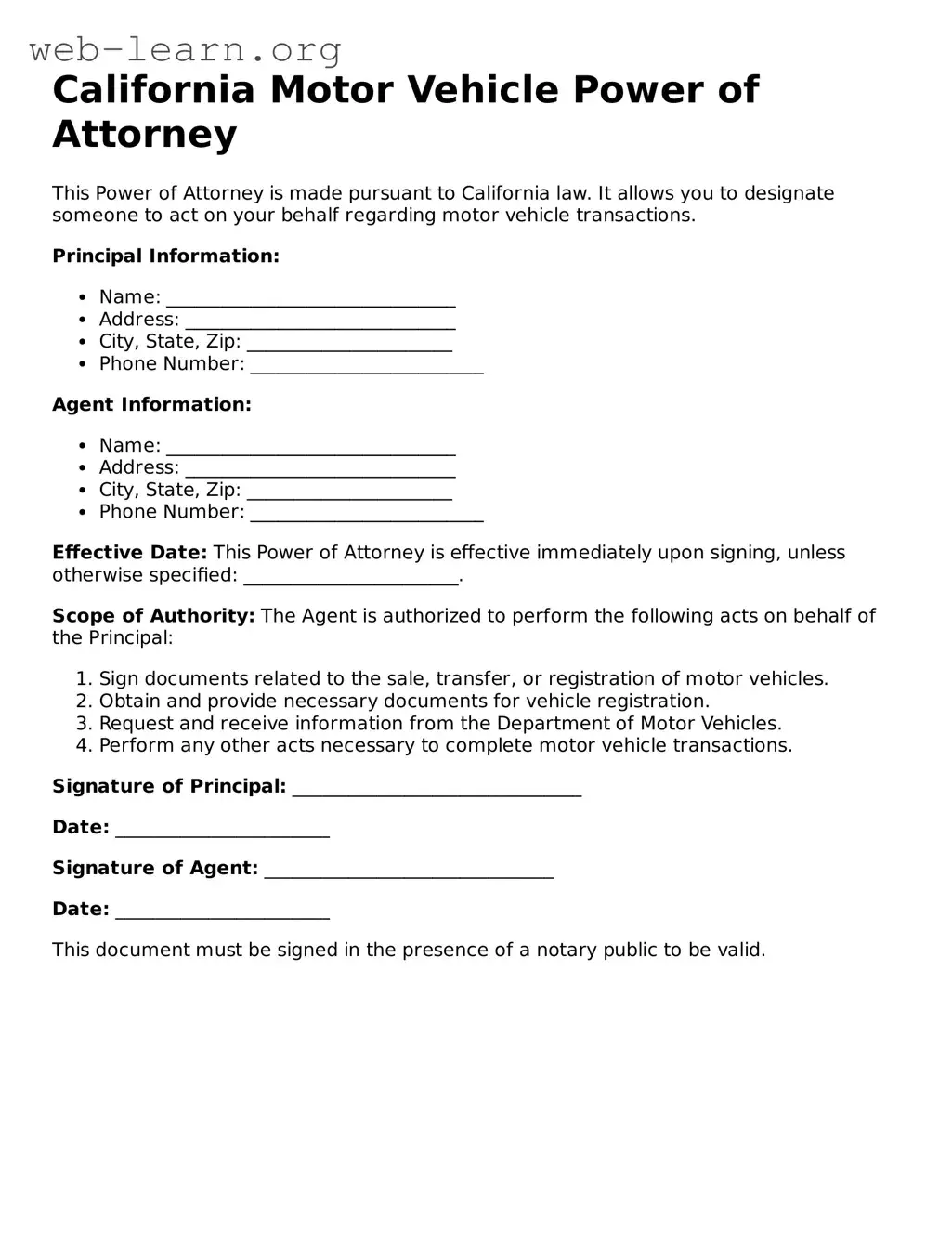
The California Motor Vehicle Power of Attorney form is an essential document that allows individuals to appoint someone else to handle specific vehicle-related transactions on their behalf. This form is particularly useful for those who may be unable to manage their vehicle affairs due to health issues, travel, or other commitments. It grants the designated agent the authority to perform various tasks, such as signing title transfers, applying for registration, and dealing with the Department of Motor Vehicles (DMV). By utilizing this form, vehicle owners can ensure that their interests are represented and that necessary actions can be taken promptly. The process of completing the form is straightforward, requiring basic information about the vehicle owner, the appointed agent, and the specific powers being granted. Understanding the implications and requirements of the Motor Vehicle Power of Attorney can provide peace of mind, knowing that vehicle-related matters can be handled efficiently, even in the owner's absence.
California Motor Vehicle Power of Attorney
This Power of Attorney is made pursuant to California law. It allows you to designate someone to act on your behalf regarding motor vehicle transactions.
Principal Information:
Agent Information:
Effective Date: This Power of Attorney is effective immediately upon signing, unless otherwise specified: _______________________.
Scope of Authority: The Agent is authorized to perform the following acts on behalf of the Principal:
Signature of Principal: _______________________________
Date: _______________________
Signature of Agent: _______________________________
Date: _______________________
This document must be signed in the presence of a notary public to be valid.
| Fact Name | Details |
|---|---|
| Purpose | The California Motor Vehicle Power of Attorney form allows an individual to authorize another person to act on their behalf regarding vehicle-related matters. |
| Governing Law | This form is governed by California Vehicle Code Section 5602. |
| Who Can Use It | Any vehicle owner in California can use this form to designate an agent. |
| Agent Responsibilities | The agent can perform tasks such as transferring title, registering a vehicle, or obtaining a duplicate title. |
| Signature Requirement | The form must be signed by the vehicle owner to be valid. |
| Revocation | The power of attorney can be revoked at any time by the vehicle owner. |
| Duration | There is no specific expiration date; it remains effective until revoked. |
| Notarization | Notarization is not required for this form in California, but it may be recommended for added security. |
| Availability | The form is available online through the California Department of Motor Vehicles (DMV) website. |
Filling out the California Motor Vehicle Power of Attorney form is straightforward. Once completed, this form allows someone to act on your behalf regarding your vehicle. Follow these steps to ensure you fill it out correctly.
The California Motor Vehicle Power of Attorney form is a legal document that allows an individual, known as the principal, to appoint another person, referred to as the agent, to act on their behalf in matters related to motor vehicles. This includes tasks such as signing documents for vehicle registration, transferring ownership, and handling other vehicle-related transactions.
Any competent adult can be designated as an agent. This could be a family member, friend, or professional, such as an attorney or a car dealership representative. It is important that the chosen agent is trustworthy, as they will have the authority to make decisions regarding the principal's motor vehicle.
To complete the form, the principal must provide their personal information, details about the vehicle, and the name of the appointed agent. The form must be signed by the principal, and in some cases, it may need to be notarized. Once completed, the form can be submitted to the California Department of Motor Vehicles (DMV) or used as needed for specific transactions.
Notarization is not always required for the California Motor Vehicle Power of Attorney form; however, it is recommended to ensure the document is valid and can be accepted by the DMV or other entities. If notarization is needed, the agent will typically need to present the notarized document when carrying out the transactions on behalf of the principal.
Yes, the principal has the right to revoke the Power of Attorney at any time. To do this, the principal should create a written notice of revocation and provide it to the agent and any relevant parties, such as the DMV. It is advisable to keep a copy of the revocation notice for personal records.
Filling out the California Motor Vehicle Power of Attorney form can be a straightforward process, but several common mistakes can lead to complications. One frequent error is not providing complete information about the vehicle. The form requires details such as the vehicle identification number (VIN), make, model, and year. Omitting any of these details can result in delays or rejection of the document.
Another common mistake is not signing the form correctly. The person granting power of attorney must sign the document in the designated area. If the signature is missing or does not match the name printed on the form, the document may be deemed invalid. It's essential to ensure that the signature is clear and legible.
People often forget to date the form. A date is crucial as it indicates when the power of attorney becomes effective. Without a date, the document may be questioned, leading to potential issues when trying to execute the powers granted within the form.
Additionally, individuals sometimes fail to choose the correct type of power of attorney. There are different types, including general and limited powers. Not specifying the appropriate type can create confusion about the authority granted, which may lead to disputes or complications when the agent attempts to act on behalf of the principal.
Another mistake involves not having a witness or notarization when required. While the California Motor Vehicle Power of Attorney form does not always need to be notarized, certain situations may necessitate it. Not adhering to these requirements can render the document ineffective in certain circumstances.
People also occasionally overlook the importance of communicating with the appointed agent. It is vital that the person designated to act on behalf of the principal understands their responsibilities and the extent of their authority. Failing to discuss this can lead to misunderstandings and potential legal issues.
Lastly, individuals may not keep a copy of the completed form. Retaining a copy is important for record-keeping and for reference in case any questions arise in the future. Without a copy, it may be difficult to verify the terms of the power of attorney or address any disputes that may occur.
When dealing with the California Motor Vehicle Power of Attorney form, it's essential to be aware of other documents that may accompany it. These forms help streamline the process of managing vehicle-related matters and ensure that all necessary permissions and information are properly documented. Below are four commonly used forms and documents that often go hand-in-hand with the Power of Attorney.
Understanding these accompanying documents can simplify the process of managing vehicle ownership and transfers in California. Being prepared with the right forms ensures a smoother experience and helps avoid potential complications down the road.
The Motor Vehicle Power of Attorney form allows you to designate someone else to handle specific tasks related to your vehicle. This document is similar to several other legal forms that grant authority or designate responsibility. Here are seven documents that share similarities with the Motor Vehicle Power of Attorney:
Each of these documents serves a unique purpose, yet they all involve the delegation of authority or responsibility in various contexts. Understanding these similarities can help you navigate the legal landscape more effectively.
When filling out the California Motor Vehicle Power of Attorney form, it's essential to approach the process with care. Here are some important do's and don'ts to keep in mind:
By following these guidelines, you can ensure that your California Motor Vehicle Power of Attorney form is completed correctly and efficiently.
Understanding the California Motor Vehicle Power of Attorney form is essential for vehicle owners. However, several misconceptions can lead to confusion. Here are four common misconceptions:
Many people believe that only a legal professional can assist with this document. In reality, the form is designed for individuals to complete on their own, provided they understand the requirements and instructions.
Some think this form is solely for transferring ownership of a vehicle. In fact, it can also grant authority for various transactions, such as registering a vehicle or obtaining a duplicate title.
While notarization can add an extra layer of authenticity, it is not a requirement for the California Motor Vehicle Power of Attorney to be valid. As long as the form is completed correctly and signed, it can be effective.
Some individuals assume that this power of attorney is temporary. However, it remains in effect until the specified task is completed or until the principal revokes it, making it a flexible option for ongoing needs.
Filling out and using the California Motor Vehicle Power of Attorney form is an important process for managing vehicle-related transactions. Here are key takeaways to consider:
Indiana Vehicle Power of Attorney - The form helps avoid delays in vehicle transactions by allowing someone else to act on your behalf.
Kansas Vehicle Power of Attorney - It can help facilitate the transfer of vehicle titles in cases of inheritance or gift-giving.