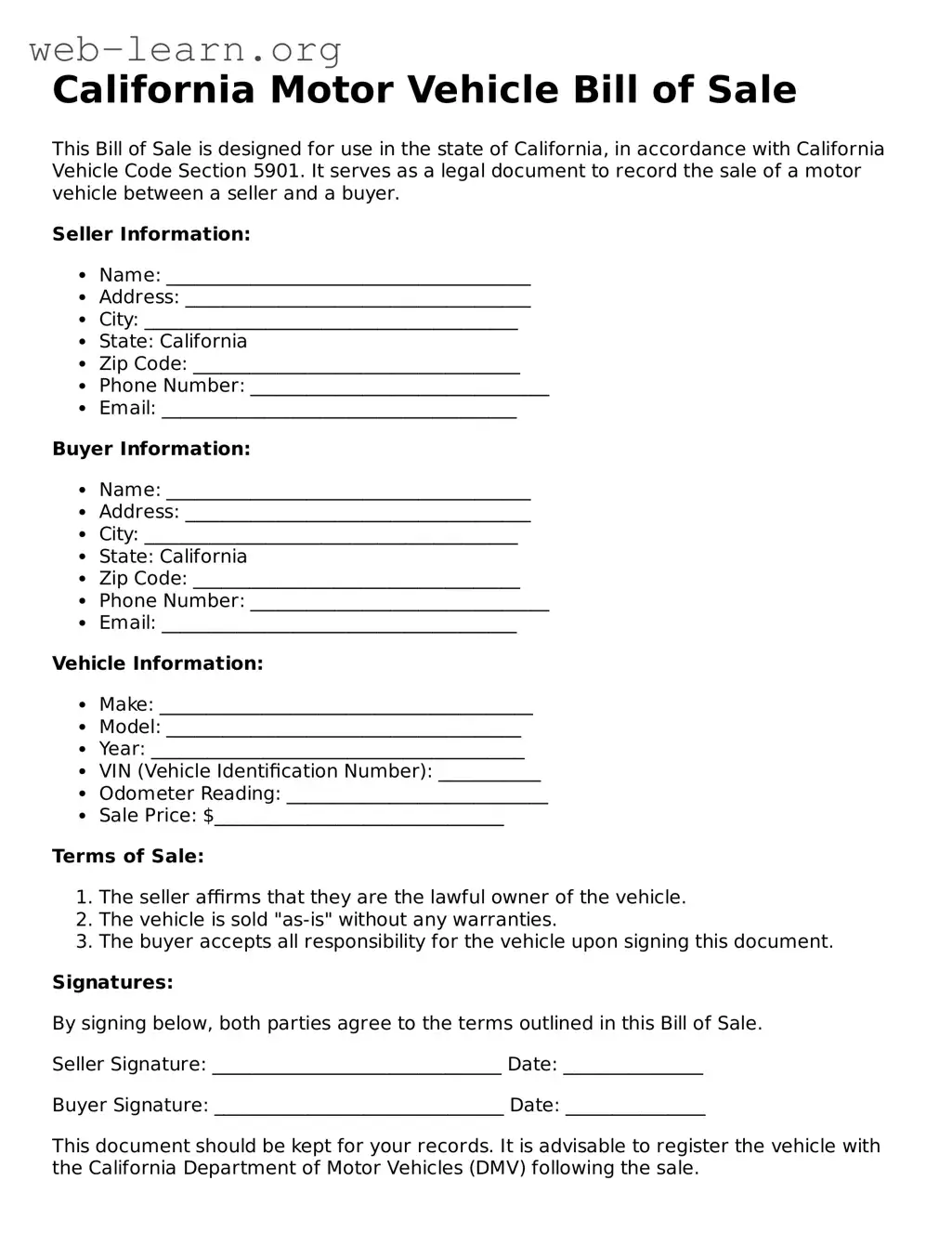
When buying or selling a vehicle in California, a Motor Vehicle Bill of Sale form plays a crucial role in documenting the transaction. This form serves as a legal record that outlines essential details such as the vehicle's make, model, year, and identification number, ensuring both parties have a clear understanding of the item being transferred. It also includes the sale price, which is important for tax purposes, and the date of the sale. Additionally, the form requires the signatures of both the seller and the buyer, solidifying the agreement and providing proof of ownership transfer. Having a properly completed Bill of Sale can protect both parties in the event of disputes and is often required when registering the vehicle with the Department of Motor Vehicles (DMV). Understanding the significance of this document can streamline the process and help avoid potential legal issues down the line.
California Motor Vehicle Bill of Sale
This Bill of Sale is designed for use in the state of California, in accordance with California Vehicle Code Section 5901. It serves as a legal document to record the sale of a motor vehicle between a seller and a buyer.
Seller Information:
Buyer Information:
Vehicle Information:
Terms of Sale:
Signatures:
By signing below, both parties agree to the terms outlined in this Bill of Sale.
Seller Signature: _______________________________ Date: _______________
Buyer Signature: _______________________________ Date: _______________
This document should be kept for your records. It is advisable to register the vehicle with the California Department of Motor Vehicles (DMV) following the sale.
| Fact Name | Description |
|---|---|
| Purpose | The California Motor Vehicle Bill of Sale form is used to document the sale or transfer of a vehicle between a buyer and a seller. |
| Governing Law | This form is governed by California Vehicle Code Section 5901, which outlines the requirements for vehicle sales. |
| Parties Involved | The form requires the names and addresses of both the seller and the buyer to ensure clear identification. |
| Vehicle Information | Details about the vehicle, such as the make, model, year, and Vehicle Identification Number (VIN), must be included. |
| Sale Price | The agreed-upon sale price of the vehicle must be recorded on the form for transparency and legal purposes. |
| Date of Sale | The date when the sale takes place is important and must be noted on the form to establish the timeline of the transaction. |
| Signatures | Both the seller and the buyer must sign the form to validate the transaction and acknowledge their agreement. |
| Record Keeping | It is advisable for both parties to keep a copy of the completed Bill of Sale for their records, in case of future disputes. |
After obtaining the California Motor Vehicle Bill of Sale form, it's essential to complete it accurately. This document serves as proof of the transaction between the buyer and the seller. Once filled out, it can be used for registration and title transfer purposes.
Once you have completed these steps, you will have a properly filled-out Bill of Sale. Make sure to keep a copy for your records and provide a copy to the buyer. This will help ensure a smooth transfer of ownership.
What is a California Motor Vehicle Bill of Sale?
A California Motor Vehicle Bill of Sale is a legal document that serves as proof of the sale of a vehicle. It outlines the details of the transaction, including the buyer and seller's information, vehicle description, sale price, and date of sale. This document is essential for both parties, as it helps protect their rights and interests in the transaction.
Do I need a Bill of Sale to sell my car in California?
While it is not legally required to have a Bill of Sale for every vehicle sale in California, it is highly recommended. This document provides important evidence of the transaction and can help resolve any disputes that may arise later. Additionally, if you are selling a vehicle without a title, a Bill of Sale becomes crucial for transferring ownership.
What information should be included in the Bill of Sale?
A comprehensive Bill of Sale should include the following information:
Including all of this information helps ensure that the document is legally binding and clear.
Is there a specific format for the Bill of Sale?
California does not mandate a specific format for the Bill of Sale. However, using a standard template that includes all necessary information is advisable. Many templates are available online, and they can be customized to fit the specific details of your transaction.
Can I create my own Bill of Sale?
Yes, you can create your own Bill of Sale. As long as it includes all the required information and is signed by both parties, it is valid. However, ensure that the document is clear and unambiguous to avoid any potential misunderstandings.
What if the vehicle has a lien on it?
If there is a lien on the vehicle, it is crucial to address this before completing the sale. The seller should either pay off the lien or ensure that the buyer is aware of it. In such cases, the Bill of Sale should also indicate that the sale is subject to the lien, clarifying the obligations of both parties.
Do I need to have the Bill of Sale notarized?
Notarization is not required for a Bill of Sale in California. However, having the document notarized can provide an extra layer of security and authenticity, especially if the transaction involves a significant amount of money or if either party has concerns about the legitimacy of the sale.
How does the Bill of Sale affect the title transfer?
The Bill of Sale is often used in conjunction with the vehicle title transfer process. When the seller provides the buyer with the signed title, the Bill of Sale acts as additional proof of the transaction. The buyer should keep both documents for their records and to facilitate the title transfer with the Department of Motor Vehicles (DMV).
What should I do with the Bill of Sale after the sale?
After the sale, both the buyer and seller should retain a copy of the Bill of Sale for their records. This document may be needed for future reference, such as when registering the vehicle or if any disputes arise. Keeping a well-organized file of all related documents is wise.
Where can I obtain a Bill of Sale template?
Many resources are available online where you can find free or low-cost Bill of Sale templates. Websites that specialize in legal forms often provide templates specifically designed for California vehicle sales. Ensure that the template you choose complies with California laws and includes all necessary information.
When filling out the California Motor Vehicle Bill of Sale form, individuals often make several common mistakes that can lead to complications. One frequent error is neglecting to provide complete information about the vehicle. Essential details such as the Vehicle Identification Number (VIN), make, model, and year must be accurately included. Omitting any of this information can result in difficulties during the transfer of ownership.
Another common mistake is failing to include the correct odometer reading. California law requires that the seller disclose the vehicle's mileage at the time of sale. An inaccurate odometer reading can lead to legal disputes or issues with the Department of Motor Vehicles (DMV). It is crucial to ensure that this information is both accurate and clearly stated.
Many individuals also overlook the necessity of both the buyer's and seller's signatures. The form must be signed by both parties to validate the sale. If either signature is missing, the document may be considered incomplete, which can hinder the registration process for the new owner.
In addition, people often forget to date the Bill of Sale. Including the date of the transaction is important for establishing the timeline of ownership transfer. Without a date, it may be difficult to prove when the sale occurred, which could lead to issues down the line.
Another mistake is using incorrect payment information. If the transaction involves a specific payment method, such as cash, check, or financing, it should be clearly stated. Ambiguities regarding payment can lead to misunderstandings between the buyer and seller.
Some individuals fail to provide identification information for both parties. It is advisable to include the names and addresses of both the buyer and seller. This information helps to confirm identities and can be useful if any disputes arise later.
Additionally, people sometimes do not retain a copy of the Bill of Sale for their records. Keeping a copy is essential for both the buyer and seller. This document serves as proof of the transaction and can be referenced if any issues occur in the future.
Another oversight is not checking for any liens on the vehicle. Sellers should ensure that the vehicle is free of any liens before completing the sale. If a lien exists, the buyer may face unexpected financial obligations after the purchase.
Many individuals also neglect to review the form for errors before submission. Simple typos or incorrect entries can cause significant delays in the registration process. Taking the time to double-check the form can prevent these issues.
Lastly, some people may not understand the importance of the Bill of Sale in the context of California law. This document not only serves as proof of sale but also protects both parties in the event of future disputes. Understanding its significance can encourage more careful completion of the form.
When completing a vehicle transaction in California, several documents accompany the Motor Vehicle Bill of Sale form. Each of these forms serves a specific purpose, ensuring that both the buyer and seller are protected and that the transaction is legally sound. Below is a list of commonly used documents.
Understanding these documents and their roles can facilitate a smoother transaction process. Ensuring all paperwork is completed accurately is essential for both parties to avoid potential legal issues in the future.
When filling out the California Motor Vehicle Bill of Sale form, it's essential to be thorough and accurate. Here’s a list of things you should and shouldn’t do to ensure the process goes smoothly.
By following these guidelines, you can help ensure that your transaction is documented correctly and that both parties are protected.
Many people have misunderstandings about the California Motor Vehicle Bill of Sale form. Here are ten common misconceptions:
When filling out and using the California Motor Vehicle Bill of Sale form, keep these key takeaways in mind:
Dmv Forms Colorado - Having a Bill of Sale can help protect both the buyer and seller in case of future disputes regarding the vehicle's ownership.
Oahu Dmv - Can be customized to include additional terms specific to the sale.
Bill of Sale Information - In some cases, a Bill of Sale may be required for tax exemptions or deductions.