Homepage Blank California Motion Form
Outline

In the realm of California civil litigation, the California Motion form, specifically MC-051, serves as a crucial tool for attorneys seeking to withdraw from representing a client. This form is not just a simple document; it encapsulates the necessary steps and considerations involved in the process of relieving an attorney of their duties. The form requires essential information such as the names and addresses of both the attorney and the client, the court details, and the case specifics. Additionally, it outlines the legal basis for the motion, referencing the California Code of Civil Procedure and relevant court rules. Importantly, the form includes a notice to the client, emphasizing the implications of the attorney's withdrawal, especially for those who may not be able to represent themselves in court. This notice serves as a vital reminder for clients to seek legal advice promptly if they fall under certain categories, such as guardians or corporations. By understanding the components of this form, individuals involved in civil proceedings can navigate the complexities of legal representation more effectively.

Sample - California Motion Form

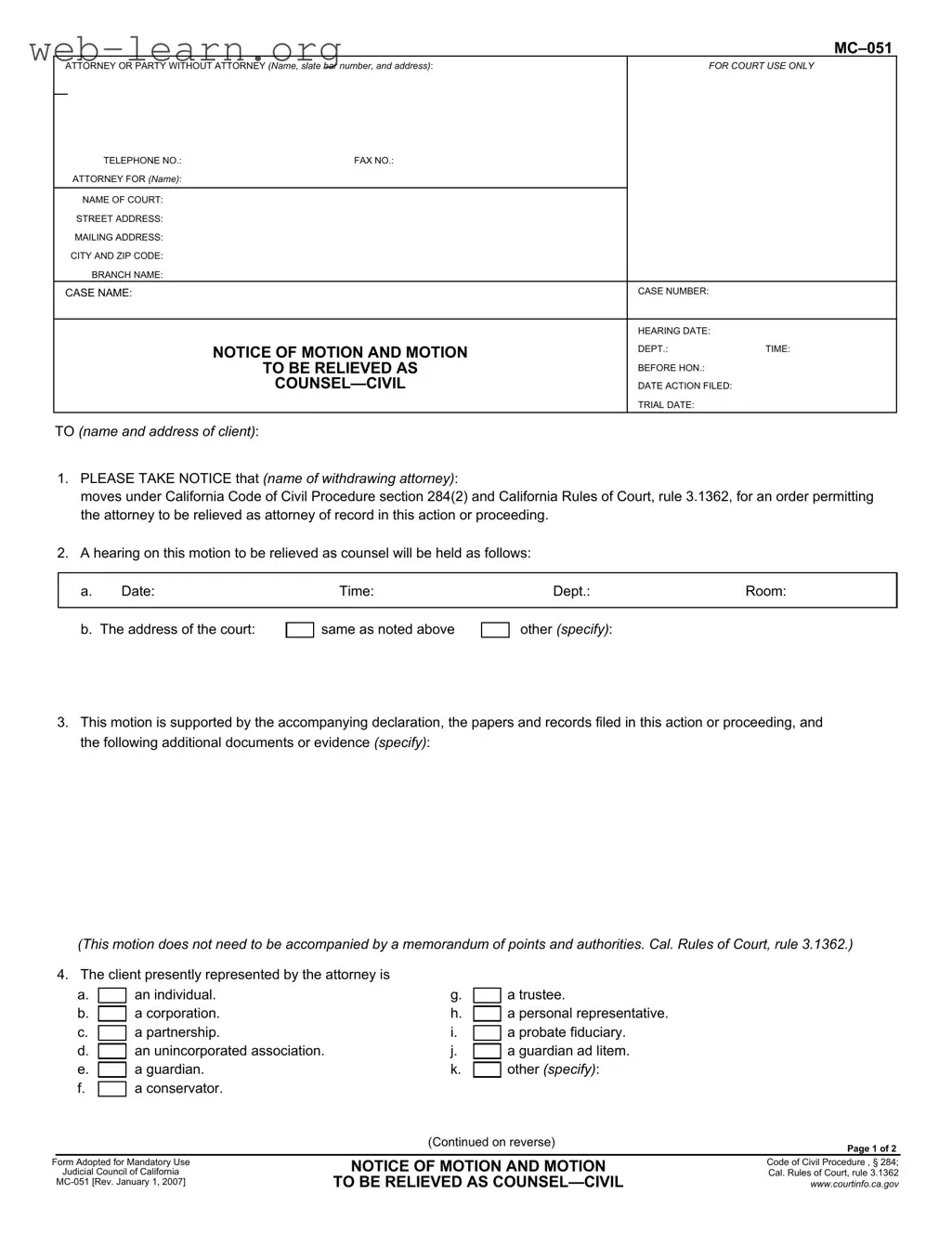
b. The address of the court:
MC–051
ATTORNEY OR PARTY WITHOUT ATTORNEY (Name, slate bar number, and address): FOR COURT USE ONLY
TELEPHONE NO.: FAX NO.:
ATTORNEY FOR (Name):
CASE NAME:
CASE NUMBER:
HEARING DATE:
DEPT.: TIME:
NOTICE OF MOTION AND MOTION
TO BE RELIEVED AS
COUNSEL—CIVIL
BEFORE HON.:
DATE ACTION FILED:
TRIAL DATE:
TO (name and address of client):
1. PLEASE TAKE NOTICE that (name of withdrawing attorney):
moves under California Code of Civil Procedure section 284(2) and California Rules of Court, rule 3.1362, for an order permitting
the attorney to be relieved as attorney of record in this action or proceeding.
2. A hearing on this motion to be relieved as counsel will be held as follows:
Date:a. Time: Dept.: Room:
other (specify):same as noted above
3. This motion is supported by the accompanying declaration, the papers and records filed in this action or proceeding, and
the following additional documents or evidence (specify):
(This motion does not need to be accompanied by a memorandum of points and authorities. Cal. Rules of Court, rule 3.1362.)
4. The client presently represented by the attorney is
a. a trustee.an individual. g.
h.
b. a personal representative.a corporation.
a probate fiduciary.a partnership. i.c.
a guardian ad litem.d. j.an unincorporated association.
k.
e. other (specify):a guardian.
f.
a conservator.
(Continued on reverse)
NOTICE OF MOTION AND MOTION
TO BE RELIEVED AS COUNSEL—CIVIL
Code of Civil Procedure , § 284;
Cal. Rules of Court, rule 3.1362
www.courtinfo.ca.gov
Form Adopted for Mandatory Use
Judicial Council of California
MC-051 [Rev. January 1, 2007]
NAME OF COURT:
STREET ADDRESS:
MAILING ADDRESS:
CITY AND ZIP CODE:
BRANCH NAME:
Page 1 of 2
CASE NAME: CASE NUMBER:
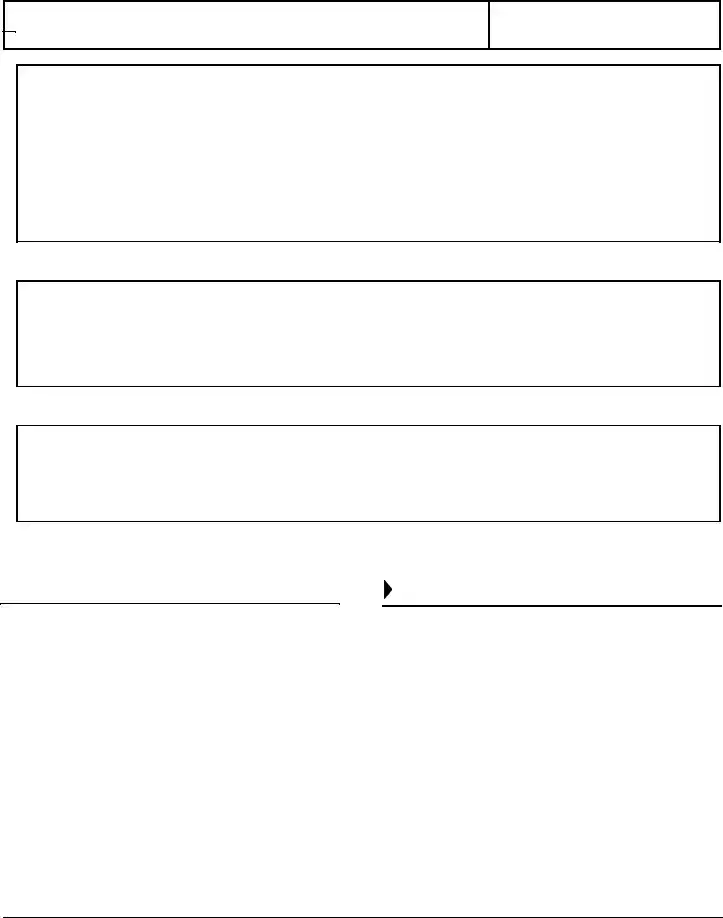
NOTICE TO CLIENT
If this motion to be relieved as counsel is granted, your present attorney will no longer be representing you. You
may not in most cases represent yourself if you are one of the parties on the following list:
• A guardian • A personal representative • A guardian ad litem
• An unincorporated association
• A conservator • A probate fiduciary
• A trustee • A corporation
If you are one of these parties, YOU SHOULD IMMEDIATELY SEEK LEGAL ADVICE REGARDING LEGAL
REPRESENTATION. Failure to retain an attorney may lead to an order striking the pleadings or to the entry of a
default judgment.
5. If this motion is granted and a client is representing himself or herself, the client will be solely responsible for the case.
NOTICE TO CLIENT WHO WILL BE UNREPRESENTED
If this motion to be relieved as counsel is granted, you will not have an attorney representing you. You may wish to
seek legal assistance. If you do not have a new attorney to represent you in this action or proceeding, and you are
legally permitted to do so, you will be representing yourself. It will be your responsibility to comply with all court
rules and applicable laws. If you fail to do so, or fail to appear at hearings, action may be taken against you. You may
lose your case.
6. If this motion is granted, the client must keep the court informed of the client's current address.
NOTICE TO CLIENT WHO WILL BE UNREPRESENTED
If this motion to be relieved as counsel is granted, the court needs to know how to contact you. If you do not keep the
court and other parties informed of your current address and telephone number, they will not be able to send you
notices of actions that may affect you, including actions that may adversely affect your interests or result in your
losing the case.
Date:
(SIGNATURE OF ATTORNEY)
(TYPE OR PRINT NAME)
Attorney for (name):
NOTICE OF MOTION AND MOTION
TO BE RELIEVED AS COUNSEL—CIVIL
MC-051 [Rev. January 1, 2007]
MC–051
Page 2 of 2

Form Information

Fact Name Details
Form Title The form is titled "Notice of Motion and Motion to be Relieved as Counsel—Civil" (MC-051).
Governing Laws This form is governed by California Code of Civil Procedure section 284(2) and California Rules of Court, rule 3.1362.
Purpose of the Form The MC-051 form is used by attorneys to request permission to withdraw from representing a client in a civil case.
Client Notification The form includes a notice to clients explaining the consequences of being unrepresented if the motion is granted.
Hearing Requirement A hearing date and time must be specified in the motion for the court to consider the request.
Client Types The form identifies various types of clients, such as individuals, corporations, and guardians, who may need legal representation.
Supporting Documents The motion must be supported by a declaration and any additional documents or evidence relevant to the case.
Consequences of Non-Representation If granted, clients may face serious risks, including losing their case if they do not comply with court rules.
Address Requirement Clients must keep the court updated with their current address to receive important notifications regarding their case.
Form Revision Date The current version of the MC-051 form was revised on January 1, 2007.

Detailed Guide for Filling Out California Motion

After gathering the necessary information, you can begin filling out the California Motion form. This process involves providing specific details about the case and the parties involved. Follow these steps to complete the form accurately.

  1. At the top of the form, fill in the attorney's name, state bar number, and address.
  2. Provide the attorney's telephone number and fax number, if applicable.
  3. Indicate who the attorney represents by writing the name of the client.
  4. Fill in the name of the court where the case is filed.
  5. Enter the street address and mailing address of the court, along with the city and ZIP code.
  6. Specify the branch name of the court.
  7. Write the case name and case number.
  8. Provide the hearing date and time for the motion.
  9. Indicate the department and room number for the hearing.
  10. State the name of the withdrawing attorney in the appropriate section.
  11. Check the box to confirm the client type, such as individual, corporation, or partnership.
  12. List any additional documents or evidence that support the motion, if applicable.
  13. Sign and date the form at the bottom.

Obtain Answers on California Motion

  1. What is the purpose of the California Motion form MC-051?

    The California Motion form MC-051 is used by an attorney who wishes to withdraw from representing a client in a civil case. This form allows the attorney to formally request permission from the court to be relieved as counsel. The motion is made under specific rules in the California Code of Civil Procedure.

  2. What information must be included in the form?

    The form requires several key pieces of information:

    • The name and address of the attorney or party filing the motion.
    • The name of the court and the case details, including the case name and number.
    • The date and time of the hearing for the motion.
    • Details about the client being represented, such as whether they are an individual, corporation, or other entity.

  3. What happens if the motion is granted?

    If the court grants the motion, the attorney will no longer represent the client. The client must be aware that they may need to find new legal representation, especially if they belong to certain categories, such as a guardian or a corporation. If they do not secure new representation, they might have to represent themselves in court.

  4. What should clients do if they are unrepresented?

    Clients who find themselves without an attorney after the motion is granted should seek legal advice as soon as possible. They must comply with all court rules and laws, as failure to do so could lead to negative consequences, including losing their case.

  5. How can clients ensure they receive important court notices?

    It is crucial for clients to keep the court informed of their current address and contact information. If the court cannot reach them, clients may miss important notices about their case, which could adversely affect their interests. Keeping the court updated helps ensure they stay informed about any actions that may impact their case.

Common mistakes

When filling out the California Motion form, mistakes can lead to delays or complications in your case. One common error is failing to provide complete contact information. Ensure that you include the full name, address, and telephone number of both the attorney and the client. Missing or incorrect details can hinder communication with the court.

Another mistake often made is neglecting to specify the correct court name and address. It is crucial to double-check this information. If the court details are incorrect, your motion may not reach the appropriate judge, causing unnecessary delays.

Some individuals mistakenly leave out the hearing date and time. This information is essential for scheduling and can lead to confusion if not clearly stated. Always confirm that these details are accurate and clearly noted on the form.

Additionally, people sometimes forget to indicate the type of client they are representing. Whether it is an individual, corporation, or another entity, this must be specified. Omitting this detail can complicate the legal process and may require additional clarification later.

Many also overlook the need to attach supporting documents. The motion must be backed by a declaration and any other relevant evidence. Failing to include these documents can result in the motion being denied or delayed.

Another frequent error is not keeping the court informed of the client’s current address. If the motion is granted, the court needs to know how to contact the client. Failure to provide updated information can lead to missed notifications about important court actions.

Some individuals fill out the form but forget to sign it. A missing signature can render the motion invalid. Always ensure that the form is signed before submission.

People sometimes misinterpret the instructions regarding representation. If the client is a guardian or a corporation, they may need legal representation. It is vital to understand these requirements to avoid representing oneself when it is not allowed.

Additionally, many fail to read the notices to clients carefully. These notices provide essential information about the consequences of being unrepresented. Ignoring this guidance can lead to unfavorable outcomes.

Lastly, some individuals rush through the form without reviewing it for errors. Taking the time to proofread can prevent small mistakes that could have significant consequences. Always review the completed form to ensure everything is accurate and complete.

Documents used along the form

The California Motion form is often accompanied by several other important documents that help facilitate the legal process. Understanding these documents can provide clarity on what to expect when filing a motion. Below are five commonly used forms and documents that may be relevant in conjunction with the California Motion form.

  • Declaration in Support of Motion: This document provides detailed information and evidence supporting the motion. It is a sworn statement from the attorney or party that explains why the motion should be granted.
  • Proof of Service: This form confirms that all relevant parties have been notified about the motion. It includes details about how and when the documents were served to ensure compliance with legal requirements.
  • Notice of Hearing: This document informs the parties involved of the date, time, and location of the hearing regarding the motion. It is essential for ensuring that everyone has the opportunity to appear and present their case.
  • Opposition to Motion: If another party disagrees with the motion, they may file this document to present their arguments against it. This allows for a fair hearing where both sides can express their views.
  • Order Granting or Denying Motion: After the hearing, the court will issue this document to formally approve or reject the motion. It outlines the court's decision and may include instructions for the parties involved.

Each of these documents plays a crucial role in the motion process, helping to ensure that all parties are informed and that the court has the necessary information to make a decision. Familiarity with these forms can aid in navigating the legal landscape more effectively.

Similar forms

The California Motion form, specifically MC-051, shares similarities with several other legal documents used in various contexts. Each document serves a unique purpose but often contains similar structural elements and procedural requirements. Below is a list of ten documents that are comparable to the California Motion form, along with a brief explanation of their similarities.

  • Motion to Withdraw as Counsel: This document is used in many jurisdictions and outlines the attorney's request to withdraw from representing a client. Like the California Motion form, it requires a hearing date and notice to the client.
  • Notice of Motion: A standard document in civil litigation that informs parties of an upcoming motion. It parallels the California Motion form in providing details about the hearing and the nature of the motion.
  • Substitution of Attorney: This form allows a client to change their legal representation. Similar to the California Motion form, it requires the consent of both the outgoing and incoming attorneys.
  • Motion for Summary Judgment: This document requests the court to rule in favor of one party without a trial. Both forms require detailed information about the case and a hearing date.
  • Request for Continuance: This form asks the court to postpone a scheduled hearing. It shares the need for a valid reason and a new proposed date, similar to the California Motion form's requirements.
  • Declaration in Support of Motion: Often filed alongside motions, this document provides evidence or testimony to support the motion. It is similar to the California Motion form in that it requires supporting documents.
  • Affidavit of Service: This document confirms that legal papers have been delivered to the relevant parties. Like the California Motion form, it requires details about the parties involved and the method of service.
  • Motion for Reconsideration: This document asks the court to review a prior decision. It requires a clear explanation of why the decision should be reconsidered, akin to the rationale needed in the California Motion form.
  • Petition for Relief: This document requests the court to grant relief from a previous order or judgment. It shares similarities with the California Motion form in terms of structure and required information.
  • Response to Motion: This document allows a party to respond to a motion filed by another party. It mirrors the California Motion form by requiring specific details about the case and the arguments being presented.

Dos and Don'ts

When filling out the California Motion form, consider the following:

  • Do ensure all required fields are completed accurately, including the attorney's name, address, and case details.
  • Do provide a clear and concise reason for the motion to be relieved as counsel.
  • Don't forget to include the date and time of the hearing on the motion.
  • Don't submit the motion without reviewing it for any errors or omissions.

Misconceptions

There are several misconceptions surrounding the California Motion form (MC-051) that can lead to confusion. Understanding these misconceptions can help individuals navigate the legal process more effectively. Below is a list of common misunderstandings:

  • It is only for attorneys. Many believe that this form is exclusively for attorneys, but it is also relevant for clients who need to understand their rights and responsibilities when an attorney withdraws.
  • A memorandum of points and authorities is required. Some people think that they must include a memorandum with this motion. However, the form explicitly states that this is not necessary.
  • All motions are automatically granted. There is a misconception that if a motion to withdraw is filed, it will always be granted. The court must review and approve the motion based on its merits.
  • Clients can represent themselves without restrictions. Some individuals believe they can easily represent themselves after their attorney withdraws. However, certain parties, like corporations and guardians, cannot represent themselves and must seek new legal counsel.
  • The court will always notify clients of hearings. It is a common belief that the court will ensure clients are informed of all hearings. In reality, clients must keep the court updated with their current address to receive important notices.
  • The attorney's withdrawal has no consequences for the client. Many assume that an attorney's withdrawal will not impact their case. In fact, if a client does not secure new representation, they may face serious consequences, including losing their case.
  • Once the motion is filed, the attorney is immediately relieved. Some people think that filing the motion means the attorney is instantly relieved of their duties. The court must first grant the motion before the attorney's responsibilities end.
  • All documents related to the case must be submitted with the motion. There is a belief that all case documents must accompany the motion. However, the motion only needs to be supported by specific documents as outlined in the form.

By clarifying these misconceptions, individuals can better prepare for the process involved with the California Motion form and understand their legal obligations and options.

Key takeaways

  • Understand the Purpose: The California Motion form is used when an attorney wishes to withdraw from representing a client. This process is governed by specific legal rules.
  • Fill Out Correctly: Ensure all sections of the form are completed accurately, including the attorney's details, court information, and case specifics.
  • Notice to Client: Clients must be informed that if the motion is granted, they will no longer have legal representation. This is crucial for their understanding of the implications.
  • Seek Legal Advice: Certain parties, such as guardians and corporations, should seek legal advice immediately if they are affected by the withdrawal. Self-representation may not be an option for them.
  • Maintain Communication: Clients must keep the court updated with their current address and contact information to ensure they receive all necessary notices regarding their case.
  • Be Aware of Responsibilities: If the motion is granted and the client is unrepresented, they will be responsible for complying with all court rules and laws. Failure to do so could jeopardize their case.