Homepage Blank California Motion Set Aside Form
Outline

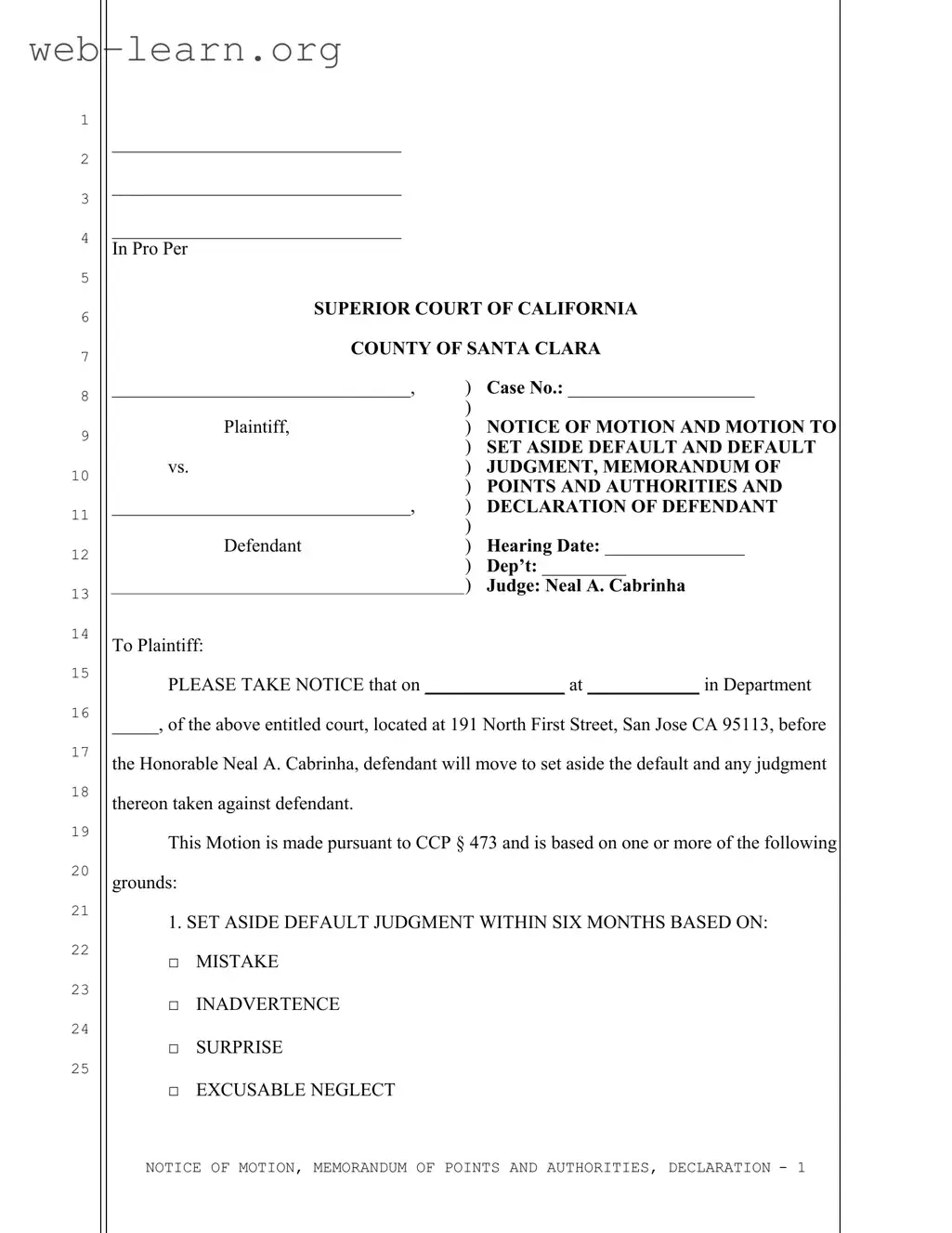
The California Motion Set Aside form is a vital tool for individuals seeking to challenge a default judgment against them in court. This form allows a defendant to request the court to set aside a default judgment that may have been entered due to various reasons such as mistake, inadvertence, surprise, or excusable neglect. Within the context of California law, specifically under Code of Civil Procedure Section 473, the form outlines the necessary steps and requirements for filing this motion. It includes essential components like the notice of motion, a memorandum of points and authorities, and a declaration from the defendant. Each of these elements plays a crucial role in presenting a compelling case to the court. The process must be initiated within six months of the judgment being entered, emphasizing the importance of acting promptly. By utilizing this form, defendants can seek to have their case heard on its merits, reinforcing the legal principle that every individual deserves a fair chance to defend themselves. The court's policy strongly favors allowing such relief, especially when there is a legitimate basis for the request. Understanding how to properly complete and submit this form can significantly impact the outcome of a case, providing a pathway for justice and fairness in the legal system.


Sample - California Motion Set Aside Form

NOTICE OF MOTION, MEMORANDUM OF POINTS AND AUTHORITIES, DECLARATION - 1
1
2
3
4
5
6
7
8
9
10
11
12
13
14
15
16
17
18
19
20
21
22
23
24
25
_______________________________
_______________________________
_______________________________
In Pro Per
SUPERIOR COURT OF CALIFORNIA
COUNTY OF SANTA CLARA
________________________________,
Plaintiff,
vs.
________________________________,
Defendant
)
)
)
)
)
)
)
)
)
)
)
Case No.: ____________________
NOTICE OF MOTION AND MOTION TO
SET ASIDE DEFAULT AND DEFAULT
JUDGMENT, MEMORANDUM OF
POINTS AND AUTHORITIES AND
DECLARATION OF DEFENDANT
Hearing Date: _______________
Dep’t: _________
Judge: Neal A. Cabrinha
To Plaintiff:
PLEASE TAKE NOTICE that on _______________
at ____________ in Department
_____, of the above entitled court, located at 191 North First Street, San Jose CA 95113, before
the Honorable Neal A. Cabrinha, defendant will move to set aside the default and any judgment
thereon taken against defendant.
This Motion is made pursuant to CCP § 473 and is based on one or more of the following
grounds:
1. SET ASIDE DEFAULT JUDGMENT WITHIN SIX MONTHS BASED ON:
MISTAKE
INADVERTENCE
SURPRISE
EXCUSABLE NEGLECT
NOTICE OF MOTION, MEMORANDUM OF POINTS AND AUTHORITIES, DECLARATION - 2
1
2
3
4
5
6
7
8
9
10
11
12
13
14
15
16
17
18
19
20
21
22
23
24
25
This Motion is based on the Memorandum of Points and Authorities and the Declaration of
________________________ which follow, and on all of the pleadings, records, and files in this
action.
Dated:
By:
In Pro Per
MEMORANDUM OF POINTS AND AUTHORITIES
Code of Civil Procedure Section 473 (b) states in relevant part:
The court may, upon any terms as may be just, relieve a party of
his or her legal representative from a judgment, dismissal, order, or
other proceeding taken against him taken against him or her
through his or her mistake, inadvertence, surprise or excusable
neglect. Application for this relief shall be accompanied by a copy
of the answer or other pleading proposed to be filed therein, . . .
and shall be made within a reasonable time, in no case exceeding
six months, after the judgment, order or proceeding was taken.
In the present case, defendant did not file a timely response to the complaint for the
reasons stated in the attached declaration. The policy of the law is to have every case tried on its
merits and that policy views with disfavor a party who, regardless of the merits, attempts to take
advantage of the mistake, inadvertence, or neglect of his adversary. This policy is so strong that
“any doubts in applying section 473 must be resolved in favor of the party seeking relief from
default.” Elston v. City of Turlock (1985) 38 Cal.3d 227, 233; Slusher v. Durrer (1977) 69 Cal.
App. 3d 747, 753.
For the reasons stated in this Memorandum and in the attached Declaration, the
court should set aside the default and any judgment thereon taken against defendant.
NOTICE OF MOTION, MEMORANDUM OF POINTS AND AUTHORITIES, DECLARATION - 3
1
2
3
4
5
6
7
8
9
10
11
12
13
14
15
16
17
18
19
20
21
22
23
24
25
DECLARATION OF DEFENDANT
I, _______________________________, declare:
I am the Defendant in this action. I have personal knowledge of the matters discussed below and,
if called as a witness, I could competently testify to them. I did not file a timely response to
the complaint in this action for the following reason(s):
______________________________________________________________________________
______________________________________________________________________________
______________________________________________________________________________
______________________________________________________________________________
______________________________________________________________________________
______________________________________________________________________________
______________________________________________________________________________
______________________________________________________________________________
______________________________________________________________________________
______________________________________________________________________________
______________________________________________________________________________
______________________________________________________________________________
I declare under penalty of perjury under the laws of the State of California that the foregoing is
true and correct.
Dated:
By:
In Pro Per

Form Information

Fact Name Fact Description
Governing Law The California Motion Set Aside form is governed by California Code of Civil Procedure Section 473.
Time Limit A motion to set aside a default judgment must be filed within six months of the judgment.
Grounds for Motion Common grounds for filing include mistake, inadvertence, surprise, or excusable neglect.
Personal Declaration The defendant must provide a personal declaration explaining the reasons for not responding timely.
Policy of the Law The legal policy favors trying cases on their merits rather than allowing a party to benefit from another's mistake.
Judicial Discretion The court has discretion to grant relief upon terms it finds just.
Filing Requirements The motion must be accompanied by a copy of the proposed answer or pleading.
Location of Hearing The hearing typically occurs at the Superior Court of California, County of Santa Clara.
Judge's Role The motion will be heard by a judge, such as the Honorable Neal A. Cabrinha.

Detailed Guide for Filling Out California Motion Set Aside

Filling out the California Motion Set Aside form requires careful attention to detail. Once completed, the form will be submitted to the court for consideration. Ensure all information is accurate and thorough to support your request.

  1. Obtain the form: Download the California Motion Set Aside form from the California Courts website or visit your local courthouse to get a physical copy.
  2. Fill in your information: In the top section, write your name, address, and contact information. Include the case number and the names of both the plaintiff and defendant.
  3. Specify the hearing details: Indicate the date, time, and department of the hearing where the motion will be presented.
  4. Select the grounds for your motion: Check the appropriate box for the reason you believe the default should be set aside, such as mistake, inadvertence, surprise, or excusable neglect.
  5. Prepare the Memorandum of Points and Authorities: Write a brief explanation of the legal basis for your motion, referencing relevant sections of the California Code of Civil Procedure.
  6. Draft your Declaration: In the declaration section, provide a detailed account of why you did not respond to the complaint in a timely manner. Be honest and clear.
  7. Sign and date the form: At the bottom of the form, sign your name and include the date to certify that all information is true and correct.
  8. Make copies: Create copies of the completed form for your records and for the other party involved in the case.
  9. File the form: Submit the original form to the court clerk, along with any required filing fees or additional documents.

After filing the form, you will need to serve a copy to the other party involved in the case. This ensures they are informed about your motion and can respond if necessary. Keep track of any deadlines related to your motion to ensure everything proceeds smoothly.

Obtain Answers on California Motion Set Aside

  1. What is the purpose of the California Motion Set Aside form?

    The California Motion Set Aside form is used by a defendant to request that the court set aside a default judgment. A default judgment may occur when a defendant fails to respond to a complaint within the required timeframe. This form allows the defendant to explain the reasons for their failure to respond, such as mistake, inadvertence, surprise, or excusable neglect.

  2. Who can file a Motion to Set Aside?

    Any defendant who has received a default judgment against them can file this motion. It is particularly relevant for individuals who believe that their circumstances warrant relief from the judgment due to valid reasons as outlined in the California Code of Civil Procedure.

  3. What are the grounds for setting aside a default judgment?

    According to California law, there are several acceptable grounds for setting aside a default judgment:

    • Mistake
    • Inadvertence
    • Surprise
    • Excusable neglect

    Each of these grounds must be substantiated with a declaration that explains the circumstances leading to the default.

  4. How long do I have to file a Motion to Set Aside?

    Defendants have a maximum of six months from the date the default judgment was entered to file their motion. It is crucial to act promptly, as any delay may jeopardize the chances of having the judgment set aside.

  5. What should be included with the Motion to Set Aside?

    The motion must be accompanied by:

    • A copy of the proposed answer or pleading that the defendant intends to file.
    • A declaration explaining the reasons for the failure to respond in a timely manner.

    These documents help the court understand the context of the request and the defendant's position.

  6. What happens after I file the Motion to Set Aside?

    Once the motion is filed, a hearing will be scheduled. The defendant must attend this hearing, where they will have the opportunity to present their case to the judge. The plaintiff will also be notified and may respond to the motion. The judge will then decide whether to grant or deny the motion based on the arguments presented.

  7. Is it necessary to have an attorney to file this motion?

    No, it is not mandatory to have an attorney to file a Motion to Set Aside. Individuals can represent themselves in court, which is referred to as "In Pro Per." However, legal advice may be beneficial to ensure that all procedures are followed correctly and to enhance the likelihood of a favorable outcome.

Common mistakes

Filling out the California Motion Set Aside form can be a daunting task, and many people make common mistakes that can hinder their chances of success. One frequent error is not providing a clear and specific reason for the request. The form allows for several grounds, such as mistake or excusable neglect, but failing to elaborate on the circumstances surrounding these reasons can leave the court with unanswered questions. It’s crucial to explain the situation thoroughly to help the judge understand why the default should be set aside.

Another common mistake is neglecting to include all required documents. The motion must be accompanied by a copy of the proposed answer or other pleading. Omitting this can lead to delays or even a rejection of the motion. Always double-check that you have all necessary paperwork attached before submitting the form. This small step can make a significant difference in the outcome of your motion.

People also often overlook the importance of filing the motion within the specified time frame. The law requires that the motion be made within six months of the judgment. Waiting too long can result in the court denying the request, regardless of the merits of the case. Keeping track of deadlines is essential, so set reminders and take action promptly to avoid this pitfall.

Additionally, many individuals fail to provide adequate evidence to support their claims. The declaration section of the form is an opportunity to present facts and circumstances that justify the request. Simply stating that you didn’t respond in time is not enough. Providing specific details, such as unexpected personal issues or misunderstandings, can help build a stronger case for the judge’s consideration.

Lastly, some people make the mistake of not being clear and concise in their writing. Legal documents should be straightforward and easy to understand. Avoid overly complex language or convoluted explanations. A well-organized and clearly written motion can significantly enhance the chances of a favorable outcome. Always remember that clarity is key when communicating with the court.

Documents used along the form

When filing a California Motion Set Aside form, several other documents may be necessary to support the motion. Each of these documents plays a specific role in the legal process, helping to clarify the situation and provide necessary information to the court.

  • Notice of Motion: This document informs the other party and the court about the intent to file a motion to set aside the default judgment. It includes the date, time, and location of the hearing.
  • Memorandum of Points and Authorities: This written argument outlines the legal basis for the motion. It references relevant laws and cases that support the request to set aside the judgment.
  • Declaration of Defendant: This is a sworn statement from the defendant explaining why they failed to respond in time. It provides personal insight into the circumstances surrounding the default.
  • Proposed Answer: If the motion is granted, the defendant typically submits a proposed answer to the original complaint. This document outlines the defendant's position in the case.
  • Proof of Service: This document shows that the notice and other filings have been properly served to the other party. It is essential for demonstrating compliance with legal procedures.
  • Ex Parte Application: In some cases, a party may request immediate relief from a default judgment without a hearing. This application must explain why such urgency exists.
  • Request for Judicial Notice: This document asks the court to recognize certain facts or documents as true without requiring formal proof. It can help establish context for the motion.
  • Opposition to Motion: The opposing party may file this document to argue against the motion. It presents their reasons for why the default judgment should remain in place.
  • Reply to Opposition: If an opposition is filed, the moving party can respond to it. This reply addresses the arguments made by the opposing party and reinforces the original motion.
  • Order Granting Motion: If the court agrees to set aside the default, it will issue this order. It formally changes the status of the case and allows the defendant to proceed.

Each of these documents contributes to the overall process of setting aside a default judgment in California. Understanding their purpose can help individuals navigate the legal landscape more effectively.

Similar forms

  • Motion to Vacate Judgment: Similar to the Motion Set Aside, this document requests the court to nullify a judgment due to errors or new evidence that could affect the outcome.
  • Motion for Reconsideration: This form asks the court to review and change its previous ruling based on new facts or legal arguments that were not considered initially.
  • Notice of Appeal: While this document initiates an appeal to a higher court, it similarly seeks to challenge a court's decision, often due to perceived errors in the original ruling.
  • Request for Relief from Default: This document is specifically used to seek relief from a default judgment, citing reasons like mistake or neglect, much like the Motion Set Aside.
  • Answer to Complaint: This is a formal response to a lawsuit, similar in that it aims to address and counter claims made by the plaintiff, often following a default situation.
  • Motion to Dismiss: This form requests the court to dismiss a case for specific reasons, paralleling the Motion Set Aside in that both seek to prevent a judgment from being enforced.
  • Opposition to Motion: This document responds to a motion filed by the opposing party, similar in purpose as it aims to contest the claims made in another motion.
  • Declaration in Support of Motion: This document provides personal testimony or evidence to support a motion, akin to the declaration included in the Motion Set Aside.
  • Motion for Summary Judgment: This requests the court to rule in favor of one party without a trial, sharing similarities in seeking a resolution based on presented facts.
  • Petition for Writ of Mandate: This document requests a higher court to compel a lower court to act, similar in that both seek intervention from the court to correct a perceived injustice.

Dos and Don'ts

When filling out the California Motion Set Aside form, it’s important to follow specific guidelines to ensure your submission is accurate and effective. Here’s a list of things you should and shouldn’t do:

  • Do: Clearly state the reason for your motion. Be specific about whether it’s due to mistake, inadvertence, surprise, or excusable neglect.
  • Do: Include all necessary documentation. Attach a copy of the answer or other pleading you plan to file along with your motion.
  • Do: Submit your motion within the six-month timeframe. Timeliness is crucial for the court to consider your request.
  • Do: Provide a complete declaration. Your declaration should explain why you failed to respond to the complaint in a timely manner.
  • Do: Review your form for errors. Double-check all information for accuracy before submitting.
  • Don’t: Leave any sections blank. Every part of the form should be filled out completely to avoid delays.
  • Don’t: Use legal jargon or overly complex language. Keep your explanations clear and straightforward.
  • Don’t: Submit without proof of service. Ensure that you have properly served the motion to all relevant parties.
  • Don’t: Wait until the last minute. Preparing your motion early can help you avoid unnecessary stress.
  • Don’t: Ignore court rules or procedures. Familiarize yourself with the local rules of the court to ensure compliance.

Misconceptions

Understanding the California Motion Set Aside form can be challenging due to various misconceptions. Below is a list of common misunderstandings regarding this legal process.

  • It can be filed anytime. Many believe there is no deadline for filing a motion to set aside a default judgment. However, the law requires that this motion be filed within six months of the judgment.
  • Only lawyers can file this motion. A common misconception is that only attorneys can submit this form. In fact, individuals can represent themselves, known as filing "in pro per."
  • Filing the motion guarantees a favorable outcome. Some think that submitting the motion will automatically result in the default being set aside. The court has discretion and may deny the motion based on the circumstances.
  • Excusable neglect is the only reason to file. While excusable neglect is one ground for relief, other reasons such as mistake, inadvertence, or surprise can also justify filing the motion.
  • Proof of mistake is not necessary. There is a belief that one can file the motion without providing evidence of why the default occurred. In reality, the court requires a declaration that explains the reasons clearly.
  • The motion can be filed without supporting documents. Some assume that the motion can stand alone. However, it must be accompanied by relevant documents, such as a proposed answer or other pleadings.
  • Once filed, the case will automatically be retried. Many think that filing the motion will lead to a new trial. The court must first grant the motion before any retrial can occur.
  • All defaults can be set aside. Lastly, there is a misconception that all default judgments can be set aside. Certain judgments, especially those based on serious misconduct, may not be eligible for relief.

Clarifying these misconceptions can help individuals better navigate the legal process involved with the California Motion Set Aside form.

Key takeaways

When filling out and using the California Motion Set Aside form, keep these key takeaways in mind:

  • Timeliness is crucial. You must file the motion within six months of the default judgment to be considered.
  • Provide valid reasons. Acceptable grounds for setting aside a default include mistake, inadvertence, surprise, or excusable neglect.
  • Include supporting documents. Attach a copy of the proposed answer or pleading along with your motion to provide context.
  • Be clear and concise. Clearly state the reasons for not responding to the complaint in the declaration section.
  • Understand the court's perspective. Courts generally prefer to resolve cases based on their merits, so presenting a strong case for relief can be beneficial.
  • Follow court procedures. Ensure that you file your motion in the correct department and provide all necessary information, including the hearing date and judge's name.