Homepage Blank California Mh 5671 Form
Outline

The California MH 5671 form plays a crucial role in the management and protection of mental health information. This authorization form is designed to facilitate the release of confidential patient information, ensuring that individuals have control over their mental health records. It is essential for obtaining consent from patients or their guardians before any information can be disclosed to third parties. The form outlines the specific types of information that may be released, including diagnoses, treatment plans, and various assessments. Importantly, it emphasizes that treatment or payment cannot be conditioned upon the signing of this authorization, reinforcing patient rights. The form also provides a clear framework for patients to specify the purpose of the information release, whether for evaluation, treatment planning, or other reasons. Patients retain the right to revoke their consent at any time, underscoring the importance of informed consent in mental health care. By understanding the intricacies of the MH 5671 form, patients and their families can navigate the complexities of mental health information sharing with greater confidence and clarity.


Sample - California Mh 5671 Form

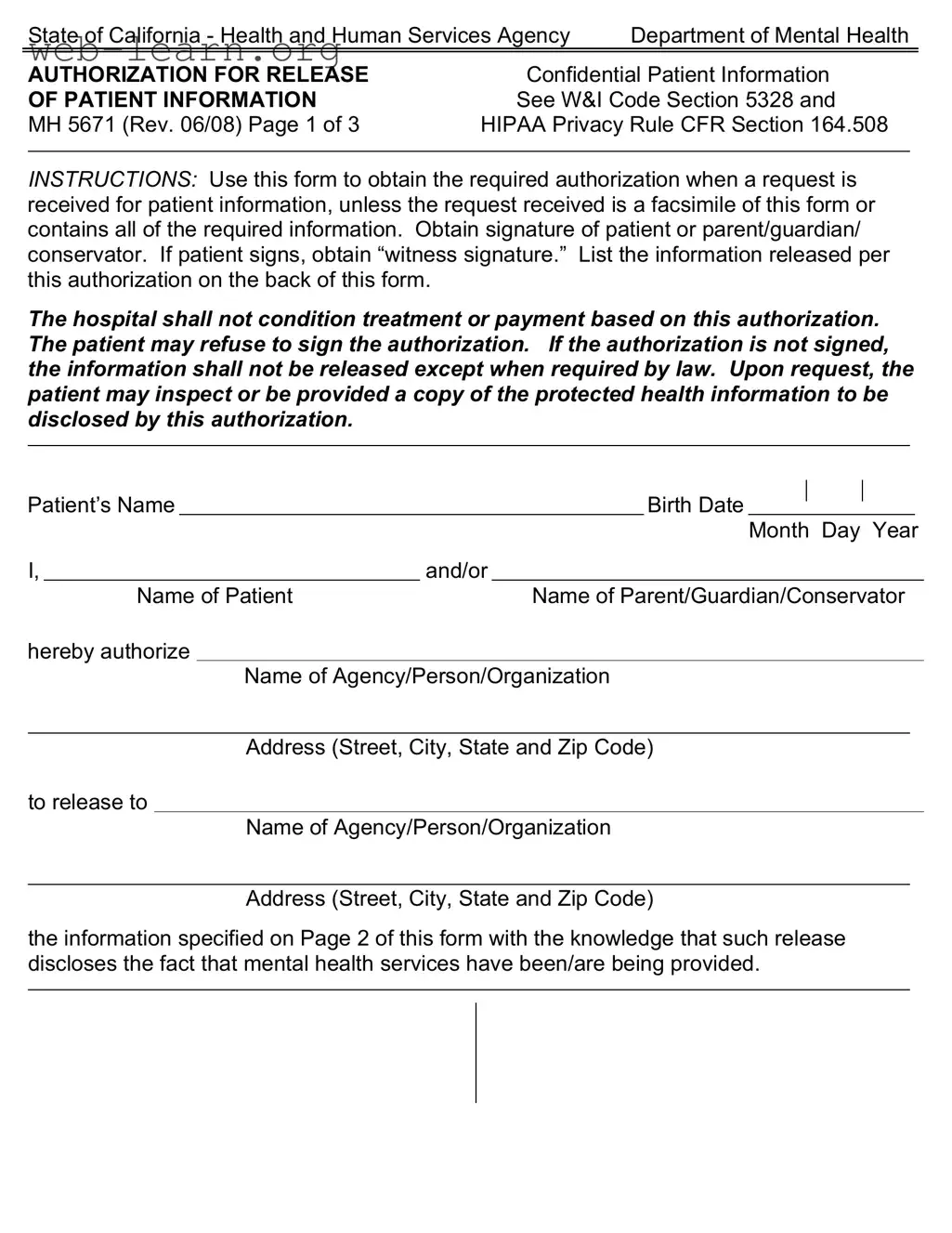
State of California - Health and Human Services Agency Department of Mental Health
AUTHORIZATION FOR RELEASE Confidential Patient Information
OF PATIENT INFORMATION See W&I Code Section 5328 and
MH 5671 (Rev. 06/08) Page 1 of 3 HIPAA Privacy Rule CFR Section 164.508
___ ___
INSTRUCTIONS: Use this form to obtain the required authorization when a request is
received for patient information, unless the request received is a facsimile of this form or
contains all of the required information. Obtain signature of patient or parent/guardian/
conservator. If patient signs, obtain “witness signature.” List the information released per
this authorization on the back of this form.
The hospital shall not condition treatment or payment based on this authorization.
The patient may refuse to sign the authorization. If the authorization is not signed,
the information shall not be released except when required by law. Upon request, the
patient may inspect or be provided a copy of the protected health information to be
disclosed by this authorization.
___ ___
Patient’s Name
Birth Date ______________
Month Day Year
I,
and/or
Name of Patient Name of Parent/Guardian/Conservator
hereby authorize
Name of Agency/Person/Organization
___ ___
Address (Street, City, State and Zip Code)
to release to
Name of Agency/Person/Organization
___ ___
Address (Street, City, State and Zip Code)
the information specified on Page 2 of this form with the knowledge that such release
discloses the fact that mental health services have been/are being provided.
___ ___
State of California - Health and Human Services Agency Department of Mental Health
AUTHORIZATION FOR RELEASE Confidential Patient Information
OF PATIENT INFORMATION See W&I Code Section 5328 and
MH 5671 (Rev. 06/08) Page 2 of 3 HIPAA Privacy Rule C.F.R. Section 164.508
___ ___
This disclosure of information* is required for the following purpose(s): (initial applicable
areas)
Evaluation Treatment Planning/Course Other (Specify) __________
and shall be limited to releasing the following types of information (initial all applicable
areas): from (date required) __________________to (date required) __________________;
or any information/records indicated, regardless of date.
Entire Record
Diagnosis
Psychiatric Evaluation
Discharge Summary
Social History
Individual Treatment
Plan
Legal Information
Medical, Neurological
Assessment, Lab Tests,
e.g., EEG, EKG, etc.
Seclusion and/Restraint
Information
HIV Tests Results
Other Evaluations/
Assessments (specify)
_____________________
_____________________
_____________________
_____________________
_____________________
_____________________
Results of Psychological/
Vocational Testing
Conference(s) Date(s)
____________________
____________________
____________________
Other (specify)
____________________
____________________
____________________
____________________
*The information disclosure under this authorization may be subject to re-disclosure by the
recipient if allowed or required by law. This authorization becomes effective
(Month/Day/Year)
___
. This authorization may be revoked in writing by the
undersigned at anytime except to the extent that action has already been taken. If not
revoked, it shall terminate at the end of (check one):
6 months One year or
Specify Date ____________________.
I understand that I am to receive a copy of this authorization.
Date:
Signature of Patient Month Day Year
Date:
Signature of Parent/Guardian/Conservator, if Applicable Month Day Year
Date:
Witness Signature Month Day Year
Signature of Professional* Date Person Obtaining Authorization Date
*Professional for this authorization refers only to a Physician, Licensed Psychologist or
Social Worker with a Master’s degree in social work, or Marriage and Family Therapist who
approves this patient initiated request for release of patient records.
State of California - Health and Human Services Agency Department of Mental Health
AUTHORIZATION FOR RELEASE Confidential Patient Information
OF PATIENT INFORMATION See W&I Code Section 5328 and
MH 5671 (Rev. 06/08) Page 3 of 3 HIPAA Privacy Rule C.F.R. Section 164.508
___ ___
RECORD OF RELEASE OF INFORMATION
The following information was released to the named party specified on the front of this form.
Identify the specific dates of the reports, records, items released.
Entire Record
Diagnosis
Psychiatric Evaluation
Discharge Summary
Social History
Individual Treatment
Plan
Legal Information
Medical, Neurological
Assessment, Lab
Tests, e.g., EEG,
EKG, etc.
HIV Tests Results
Results of Psychological/
Vocational Testing
Other Evaluations/
Assessments (specify)
____________________
____________________
____________________
____________________
Conference(s) Date(s)
____________________
____________________
____________________
Other:
Released By (Name & Title) Date Released

Form Information

Fact Name Description
Purpose of the Form The MH 5671 form is used to authorize the release of confidential patient information in California's mental health system.
Governing Laws This form is governed by the California Welfare and Institutions Code Section 5328 and the HIPAA Privacy Rule (CFR Section 164.508).
Patient Rights Patients have the right to refuse to sign the authorization. If not signed, information will not be released unless required by law.
Signature Requirements The form requires the signature of the patient or their parent/guardian/conservator, along with a witness signature if the patient signs.
Duration of Authorization The authorization remains effective for a specified period, typically six months or one year, unless revoked in writing.

Detailed Guide for Filling Out California Mh 5671

Filling out the California MH 5671 form involves several key steps to ensure that patient information is released appropriately. This process requires careful attention to detail, as the form must be completed accurately to comply with legal requirements. Below are the steps to guide you through the completion of the form.

  1. Begin by entering the patient’s name and birth date at the top of the form.
  2. Indicate whether the authorization is being signed by the patient or by a parent, guardian, or conservator by writing the appropriate names in the designated spaces.
  3. Fill in the name of the agency, person, or organization that will be releasing the information, along with their address.
  4. Next, enter the name of the agency, person, or organization that will receive the information, along with their address.
  5. On Page 2, specify the purpose of the information disclosure by marking the applicable areas such as evaluation, treatment, or other reasons.
  6. Indicate the types of information to be released by initialing all applicable areas, including the entire record, diagnosis, psychiatric evaluation, and others as needed.
  7. Provide the date range for the information being requested, or check the box for any information/records regardless of date.
  8. State the effective date of the authorization by writing the month, day, and year.
  9. Choose the expiration of the authorization by checking one of the options: 6 months, one year, or specify a date.
  10. Ensure that the patient or their representative signs and dates the form, and include a witness signature if the patient signed.
  11. If applicable, have the parent, guardian, or conservator sign and date the form as well.
  12. Finally, the professional obtaining the authorization must sign and date the form, indicating their title.

Once the form is completed, it can be submitted as needed. Ensure that a copy is provided to the patient or their representative for their records. Proper handling of this form is crucial to maintain confidentiality and comply with privacy regulations.

Obtain Answers on California Mh 5671

  1. What is the purpose of the California MH 5671 form?

    The California MH 5671 form serves as an Authorization for Release of Confidential Patient Information. It is used when a request is made for patient information related to mental health services. This form ensures that the patient or their authorized representative gives consent for the release of sensitive information, in compliance with legal requirements. It helps maintain the confidentiality of mental health records while allowing necessary information to be shared for treatment, evaluation, or other specified purposes.

  2. Who can sign the California MH 5671 form?

    The form can be signed by the patient themselves or by a parent, guardian, or conservator if the patient is a minor or unable to provide consent. If the patient signs the form, a witness signature is also required to validate the authorization. This process ensures that the individual providing consent is aware of what information is being released and to whom.

  3. What types of information can be released using this form?

    The California MH 5671 form allows for the release of various types of mental health information. This may include:

    • Entire Record
    • Diagnosis
    • Psychiatric Evaluation
    • Discharge Summary
    • Social History
    • Individual Treatment Plan
    • Legal Information
    • Medical and Neurological Assessments
    • Results of Psychological or Vocational Testing
    • HIV Test Results

    Patients can specify which information they wish to be released, ensuring that only relevant data is shared.

  4. How long is the authorization valid?

    The authorization granted through the California MH 5671 form is typically valid for a specified period, which can be set for either six months or one year. Alternatively, the patient may choose a specific date for the authorization to terminate. If the authorization is not revoked in writing before the expiration date, it will automatically end, ensuring that the patient's rights are protected over time.

  5. Can a patient revoke their authorization?

    Yes, a patient has the right to revoke their authorization at any time. This revocation must be done in writing. However, it is important to note that any actions taken based on the authorization prior to its revocation remain valid. This provision empowers patients to control their own health information while also recognizing the importance of prior consents.

Common mistakes

Filling out the California MH 5671 form can be straightforward, but many people make critical mistakes that can delay the process or lead to improper handling of sensitive information. One common error is failing to provide complete patient information. It is essential to include the patient's full name and birth date accurately. Missing or incorrect details can result in the form being rejected or the information not being released.

Another mistake involves not specifying the purpose of the information release. The form requires you to indicate the reason for the request. Omitting this detail can create confusion and may lead to unnecessary delays in obtaining the required information. Always ensure that you select at least one purpose from the options provided.

People often neglect to sign the form properly. If the patient is a minor or unable to sign, a parent, guardian, or conservator must do so. Additionally, a witness signature is required if the patient signs the form themselves. Skipping any of these signatures can invalidate the authorization.

Another frequent error is failing to specify the types of information to be released. The form includes various categories, such as medical records and psychiatric evaluations. Be sure to initial all applicable areas to ensure that the correct information is shared. Not doing so can lead to incomplete disclosures and potential legal issues.

Some individuals also overlook the expiration date of the authorization. The form allows you to choose a specific duration for the authorization's validity. If you do not check a box or provide a date, the authorization may not be honored. This could result in delays or complications in accessing necessary information.

Lastly, many people forget to keep a copy of the signed authorization for their records. It is crucial to have a copy for future reference, especially if questions arise about the release of information. Keeping a record can help clarify any misunderstandings and ensure compliance with privacy regulations.

Documents used along the form

The California MH 5671 form is a crucial document for obtaining authorization to release confidential patient information related to mental health services. Alongside this form, several other documents are commonly used to ensure compliance with legal and procedural requirements. Below is a list of these forms, each serving a specific purpose in the process.

  • HIPAA Privacy Notice: This document informs patients about their rights regarding their health information. It outlines how their data may be used and shared, ensuring they are aware of their privacy rights under federal law.
  • Patient Consent Form: This form is used to obtain explicit consent from patients before sharing their health information with third parties. It provides clarity on what information will be shared and with whom.
  • Release of Information Log: A record-keeping document that tracks all requests for patient information. It includes details such as the date of the request, the type of information released, and the recipient's name, ensuring transparency and accountability.
  • Notice of Rights: This document outlines the rights of patients regarding their mental health information. It details their rights to access, amend, and restrict the disclosure of their health records.
  • Authorization Revocation Form: Should a patient decide to revoke their authorization for information release, this form allows them to formally withdraw consent. It is essential for maintaining control over personal health information.

Each of these documents plays a vital role in safeguarding patient rights and ensuring that mental health information is handled with the utmost care and respect. Understanding these forms can help patients navigate the complexities of mental health care and protect their privacy effectively.

Similar forms

The California MH 5671 form is designed to authorize the release of confidential patient information related to mental health services. Several other documents serve similar purposes in different contexts. Here’s a list of eight forms that share similarities with the MH 5671:

  • HIPAA Authorization Form: This form allows healthcare providers to obtain permission from patients to disclose their health information to third parties. Like the MH 5671, it emphasizes patient consent and outlines the information being shared.
  • Patient Consent Form: Used in various healthcare settings, this document secures patient agreement for treatment or procedures. It is similar in that it ensures patients are informed and agree to the release of their information.
  • Release of Information Form: Commonly used in both medical and mental health fields, this form permits the sharing of specific patient records with designated individuals or organizations, much like the MH 5671.
  • Authorization for Release of Medical Records: This document allows patients to authorize their healthcare provider to release medical records to other providers or insurance companies. Similar to the MH 5671, it requires patient signatures and specifies the records being released.
  • Informed Consent for Treatment: This form ensures that patients understand the nature of the treatment they will receive. It parallels the MH 5671 in its focus on patient rights and the importance of informed decision-making.
  • Substance Abuse Treatment Release Form: Used specifically in substance abuse treatment contexts, this form allows for the sharing of treatment information. It shares the same goal of protecting patient confidentiality while facilitating necessary communication.
  • Psychotherapy Notes Authorization: This form is specifically for releasing notes taken during therapy sessions. Like the MH 5671, it focuses on sensitive information and requires explicit patient consent for disclosure.
  • Medical Power of Attorney: This document allows an individual to designate someone to make medical decisions on their behalf. While broader in scope, it shares the principle of patient autonomy and informed consent found in the MH 5671.

Dos and Don'ts

When filling out the California MH 5671 form, it's important to follow specific guidelines to ensure accuracy and compliance. Here are seven things you should and shouldn't do:

  • Do ensure the patient's name and birth date are correctly entered.
  • Don't forget to obtain the necessary signatures. This includes the patient, parent/guardian, and a witness if applicable.
  • Do specify the purpose of the information release. Clearly indicate whether it’s for evaluation, treatment planning, or another reason.
  • Don't leave any sections blank. Fill in all required fields to avoid delays in processing.
  • Do limit the information to what is necessary. Only include the types of information relevant to the stated purpose.
  • Don't use vague language. Be specific about the information and dates to ensure clarity.
  • Do keep a copy of the completed form. This is important for your records and future reference.

Misconceptions

Misconceptions about the California MH 5671 form can lead to confusion regarding patient rights and the process of releasing mental health information. Here are eight common misunderstandings:

  • It is mandatory to sign the form. Many people believe that signing the MH 5671 form is a requirement for treatment. However, patients can refuse to sign this authorization, and treatment cannot be conditioned upon signing.
  • The form can be used for any type of information. Some assume that the MH 5671 allows for the release of all personal information. In reality, it is specifically designed for mental health information and requires clear specification of what is being released.
  • Once signed, the authorization cannot be revoked. A common myth is that signing the form is a permanent agreement. Patients have the right to revoke the authorization in writing at any time, except for actions already taken based on the authorization.
  • Only the patient can authorize the release. Many believe that only the patient can sign the form. In cases where the patient is a minor or unable to provide consent, a parent, guardian, or conservator can authorize the release.
  • The form is only for hospitals. Some think that the MH 5671 is limited to hospital use. This form can be used by various organizations and individuals involved in the patient's mental health care.
  • All information must be released if the form is signed. There is a misconception that signing the MH 5671 means all information must be disclosed. The form allows patients to specify which information they want released, and it can be limited to particular dates or types of records.
  • HIPAA regulations do not apply to this form. Some individuals believe that the MH 5671 is separate from HIPAA regulations. In fact, this form must comply with HIPAA privacy rules, ensuring that patient information is handled appropriately.
  • The witness signature is optional. It is often thought that a witness signature is not necessary. However, if the patient signs the authorization, obtaining a witness signature is required to validate the process.

Understanding these misconceptions can help patients and their families navigate the complexities of mental health information release more effectively.

Key takeaways

When filling out and using the California MH 5671 form, keep these key takeaways in mind:

  • Purpose of the Form: This form is used to authorize the release of confidential patient information related to mental health services.
  • Signature Requirements: Obtain the signature of the patient or their parent/guardian/conservator. If the patient signs, a witness signature is also required.
  • Information to be Released: Clearly list the specific information that will be disclosed on the back of the form.
  • Patient Rights: Patients can refuse to sign the authorization. If they do not sign, the information will not be released unless required by law.
  • Inspection of Records: Patients have the right to inspect or obtain a copy of their protected health information prior to disclosure.
  • Effective Date: The authorization becomes effective on the date specified and can be revoked in writing at any time.
  • Duration of Authorization: The authorization will remain valid for a specified period, which can be six months, one year, or a date you choose.

Always ensure that the form is filled out completely and accurately to avoid any delays in the release of information.