Homepage Blank California Mc 358 Form
Outline

The California MC 358 form plays a crucial role in the legal process for individuals seeking to withdraw funds from a blocked account. This form is typically used in situations where a court has previously placed restrictions on access to certain funds, often for reasons related to legal disputes or the management of estates. The MC 358 outlines the necessary details, including the petitioner's information, the specific funds to be withdrawn, and the depository holding those funds. It also specifies the amounts to be distributed and the payees involved, ensuring transparency and accountability in the transaction. By requiring the petitioner to present a filed endorsed copy of the order to the depository, the form establishes a clear protocol for fund withdrawal. Ultimately, the MC 358 is an essential tool that helps facilitate the release of funds while adhering to the court's directives, making it an important document for both legal professionals and their clients.
Sample - California Mc 358 Form

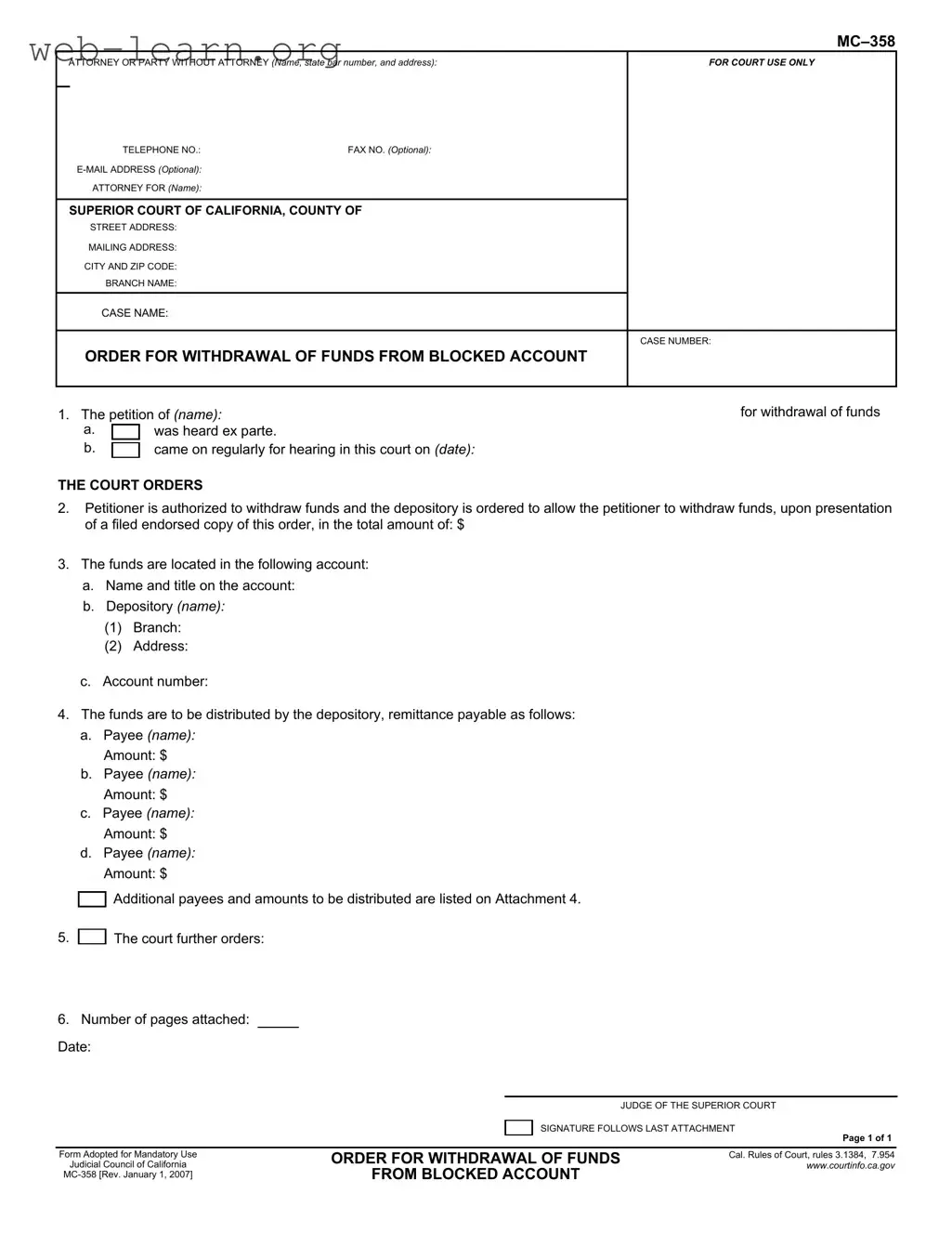
MC–358
FOR COURT USE ONLYATTORNEY OR PARTY WITHOUT ATTORNEY (Name, state bar number, and address):
TELEPHONE NO.: FAX NO. (Optional):
E-MAIL ADDRESS (Optional):
ATTORNEY FOR (Name):
SUPERIOR COURT OF CALIFORNIA, COUNTY OF
STREET ADDRESS:
MAILING ADDRESS:
CITY AND ZIP CODE:
BRANCH NAME:
CASE NAME:
CASE NUMBER:
ORDER FOR WITHDRAWAL OF FUNDS FROM BLOCKED ACCOUNT
1. The petition of (name):
for withdrawal of funds
a.
was heard ex parte.
came on regularly for hearing in this court on (date):
b.
THE COURT ORDERS
3. The funds are located in the following account:
a. Name and title on the account:
b. Depository (name):
(1) Branch:
(2) Address:
c. Account number:
4. The funds are to be distributed by the depository, remittance payable as follows:
a. Payee (name):
Amount: $
b. Payee (name):
Amount: $
c. Payee (name):
Amount: $
d. Payee (name):
Amount: $
Additional payees and amounts to be distributed are listed on Attachment 4.
5.
The court further orders:
6. Number of pages attached:
Date:
JUDGE OF THE SUPERIOR COURT
SIGNATURE FOLLOWS LAST ATTACHMENT
Page 1 of 1
Form Adopted for Mandatory Use
Judicial Council of California
MC-358 [Rev. January 1, 2007]
Cal. Rules of Court, rules 3.1384, 7.954
www.courtinfo.ca.gov
ORDER FOR WITHDRAWAL OF FUNDS
FROM BLOCKED ACCOUNT
2. Petitioner is authorized to withdraw funds and the depository is ordered to allow the petitioner to withdraw funds, upon presentation
of a filed endorsed copy of this order, in the total amount of: $

Form Information

Fact Name Details
Form Title MC–358: Order for Withdrawal of Funds from Blocked Account
Governing Law California Rules of Court, rules 3.1384 and 7.954
Form Purpose This form is used to request the withdrawal of funds from a blocked account.
Filing Requirements The form must be filed with the Superior Court of California.
Hearing Type The petition can be heard ex parte or on a regular hearing date.
Depository Information Details about the account, including the name of the depository and account number, must be provided.
Payee Information The form allows for multiple payees to be listed for fund distribution.
Signature Requirement A judge's signature is required on the form for it to be valid.
Form Revision Date The current version of the form was adopted for mandatory use on January 1, 2007.

Detailed Guide for Filling Out California Mc 358

To complete the California MC 358 form, gather the necessary information about the case and the parties involved. This form is used to request the withdrawal of funds from a blocked account. After filling it out, the completed form must be submitted to the appropriate court for review.

  1. At the top of the form, fill in the name, state bar number, and address of the attorney or party without an attorney.
  2. Provide the telephone number, and if applicable, the fax number and email address.
  3. Indicate the name of the attorney representing the party, if applicable.
  4. Fill in the street address, mailing address, city, and zip code of the court.
  5. Specify the branch name of the court where the case is being filed.
  6. Enter the case name and case number in the designated fields.
  7. In section 1, write the name of the petitioner requesting the withdrawal of funds.
  8. Indicate whether the petition was heard ex parte or came on regularly for hearing, and provide the date of the hearing if applicable.
  9. In section 2, state the total amount of funds the petitioner is authorized to withdraw.
  10. Detail the account from which the funds will be withdrawn, including the name and title on the account, the name of the depository, branch, and address, as well as the account number.
  11. In section 4, list the payees and the corresponding amounts to be distributed from the withdrawn funds.
  12. If there are additional payees, indicate this on Attachment 4.
  13. Complete section 5 if there are further orders from the court.
  14. Indicate the number of pages attached to the form.
  15. Finally, date the form and leave space for the judge's signature at the bottom.

Obtain Answers on California Mc 358

  1. What is the purpose of the California MC 358 form?

    The California MC 358 form is used to request the withdrawal of funds from a blocked account. A blocked account typically holds funds that cannot be accessed without court approval. This form allows a petitioner to formally ask the court for permission to withdraw specific amounts of money from such an account, ensuring that all transactions are conducted legally and transparently.

  2. Who can file the MC 358 form?

    Any individual or party who has a legal interest in the funds held in a blocked account can file the MC 358 form. This may include account holders, guardians, conservators, or attorneys representing the interests of a party. It is important that the person filing the form has the authority to act on behalf of the account holder to ensure compliance with court requirements.

  3. What information is required on the MC 358 form?

    The form requires several key pieces of information:

    • Name and contact details of the attorney or party filing the form.
    • The case name and number associated with the blocked account.
    • Details of the funds being withdrawn, including the total amount and the specific account information.
    • Names and amounts for each payee who will receive funds from the withdrawal.

    Providing accurate and complete information is crucial for the court to process the request efficiently.

  4. What happens after the MC 358 form is submitted?

    After submission, the court will review the petition. If the request is heard ex parte, it means the court may decide without requiring the presence of all parties involved. If the petition is approved, the court will issue an order allowing the petitioner to withdraw the specified funds. The depository holding the account will then be instructed to release the funds upon presentation of the court's order.

Common mistakes

Filling out the California MC 358 form can be straightforward, but many individuals make common mistakes that can lead to delays or complications. One frequent error is failing to include the correct case number. This number is essential for the court to identify the specific case associated with the withdrawal request. Without it, the form may be rejected or lost in the system.

Another mistake involves incomplete information regarding the petitioner. It is crucial to provide the full name of the person requesting the withdrawal. Omitting any part of the name can create confusion and hinder the processing of the request. Additionally, the petitioner must ensure that the name matches the name on the blocked account.

Many people overlook the section for the depository information. This includes the name of the bank or financial institution, the branch, and the address. Incomplete or incorrect details can lead to issues when the court orders the withdrawal. Double-checking this information can save time and effort.

Another common error is not specifying the amount to be withdrawn. The form requires clear amounts for each payee. If the amounts are missing or unclear, the depository may refuse to process the withdrawal. Each payee's name and corresponding amount must be clearly listed to avoid confusion.

People often neglect to attach additional pages when necessary. If there are more payees than can fit in the provided space, an attachment should be included. Failing to mention the number of pages attached can lead to misunderstandings about the distribution of funds.

In some cases, individuals forget to sign the form. A signature is vital for the court to validate the request. Without it, the form is incomplete and cannot be processed. Always ensure that the signature is present before submitting the form.

Another mistake involves not indicating whether the hearing was ex parte or regular. This detail is important for the court's records and affects how the request is processed. Be sure to check the appropriate box to avoid complications.

Inaccurate or missing contact information, such as telephone numbers or email addresses, can also pose problems. If the court needs to reach the petitioner for clarification or additional information, having accurate contact details is essential. This information should be double-checked for accuracy.

Lastly, individuals sometimes fail to keep a copy of the completed form for their records. Having a copy can be invaluable if questions arise later or if further action is needed. Always make sure to retain a copy for personal records.

By being aware of these common mistakes, individuals can fill out the California MC 358 form more accurately and efficiently. Taking the time to review each section carefully can help ensure a smoother process when withdrawing funds from a blocked account.

Documents used along the form

The California MC-358 form is a crucial document for individuals seeking to withdraw funds from a blocked account. However, several other forms and documents are often used in conjunction with it to ensure a smooth process. Below is a list of these forms, each serving a specific purpose in the legal proceedings.

  • MC-359: Order for Deposit of Funds into Blocked Account - This form is used to request that funds be deposited into a blocked account. It outlines the details of the deposit and ensures that the funds are secured until the court authorizes their release.
  • MC-360: Petition for Withdrawal of Funds from Blocked Account - This document serves as the formal request to the court for the withdrawal of funds. It provides the necessary details about the account and the reasons for the withdrawal, allowing the court to make an informed decision.
  • MC-361: Notice of Hearing - This form notifies all relevant parties about the hearing related to the withdrawal request. It includes the date, time, and location of the hearing, ensuring that everyone involved has the opportunity to participate.
  • MC-362: Declaration in Support of Petition - This declaration supports the petition for withdrawal by providing additional information or evidence. It may include statements from witnesses or other relevant documentation to bolster the case for accessing the funds.

Each of these forms plays an essential role in the legal process surrounding blocked accounts in California. Properly completing and submitting these documents can significantly impact the outcome of your request. Always consider consulting with a legal professional to ensure that all forms are filled out correctly and submitted in a timely manner.

Similar forms

The California MC 358 form is specifically designed for the withdrawal of funds from a blocked account. It serves a unique purpose, but there are several other documents that share similarities in function or intent. Here’s a list of ten such documents, along with a brief explanation of how they relate to the MC 358 form:

  • MC-356: Petition to Establish Blocked Account - This form is used to request the court's approval to block funds in an account, similar to how the MC 358 allows for the withdrawal of those funds once they are blocked.
  • MC-357: Order to Deposit Money into Blocked Account - After a court approves a blocked account, this document facilitates the deposit of funds into that account, paralleling the MC 358's role in allowing withdrawals.
  • MC-359: Petition for Withdrawal of Funds from Blocked Account (Minor) - This form specifically addresses withdrawals for minors, similar to the MC 358 but tailored to protect the interests of minor beneficiaries.
  • MC-360: Order for Withdrawal of Funds from Blocked Account (Minor) - Like the MC 358, this document allows for the withdrawal of funds but is specifically designed for cases involving minors.
  • FL-195: Order for Withdrawal of Funds - Used in family law cases, this form allows parties to withdraw funds from a blocked account, functioning similarly to the MC 358 in terms of court authorization.
  • GC-350: Petition for Withdrawal of Funds from Conservatorship Account - This document allows conservators to withdraw funds for the benefit of a conservatee, akin to the MC 358's purpose of enabling fund withdrawals.
  • GC-360: Order for Withdrawal of Funds from Conservatorship Account - Similar to the MC 358, this order permits the withdrawal of funds from accounts under conservatorship, ensuring proper legal oversight.
  • MC-060: Request to Waive Court Fees - While this document does not directly relate to fund withdrawal, it can be used in conjunction with the MC 358 when a petitioner seeks to waive fees associated with court proceedings.
  • MC-030: Declaration - This form can be utilized to provide supporting information or context for a petition, including those involving the MC 358, making it an important companion document.
  • MC-400: Petition for Order to Deposit Money into Court - This form is used to request the court's permission to deposit money into court, similar to the MC 358's function of facilitating fund management through court orders.

Understanding these related documents can help clarify the broader context of financial transactions and court orders in California. Each serves a specific purpose while sharing common themes of court oversight and financial management.

Dos and Don'ts

When filling out the California MC-358 form, there are important dos and don’ts to keep in mind. This form is used for requesting the withdrawal of funds from a blocked account. Ensuring accuracy and compliance with the requirements can make the process smoother.

  • Do provide complete and accurate information.
  • Do ensure that all required signatures are included.
  • Do attach any necessary documentation to support your request.
  • Do double-check the case number and names for accuracy.
  • Don't leave any sections blank unless instructed.
  • Don't forget to include the total amount you wish to withdraw.
  • Don't submit the form without reviewing it for errors.
  • Don't ignore the court's specific instructions regarding attachments and additional information.

Misconceptions

Misconceptions about the California MC 358 form can lead to confusion regarding its purpose and use. Below are ten common misconceptions, along with clarifications for each.

  1. Only attorneys can file the MC 358 form. Many believe that only licensed attorneys can submit this form. However, individuals can also file it if they represent themselves in court.
  2. The MC 358 form is only for minors. While it is often used in cases involving minors, the form can also apply to other situations where funds are held in a blocked account.
  3. Funds can be withdrawn without a court order. Some think that a court order is not necessary for withdrawing funds. In reality, the MC 358 form is specifically designed to obtain such an order.
  4. The form guarantees fund withdrawal. The submission of the MC 358 form does not automatically guarantee that funds will be released. The court must review and approve the petition.
  5. All types of accounts can be accessed with this form. There is a misconception that any account can be accessed. The MC 358 form is only applicable to accounts that have been officially blocked by a court order.
  6. There is no need for supporting documents. Some believe that the MC 358 form can be filed without any additional documentation. In fact, supporting documents may be required to substantiate the request.
  7. The form is only for specific counties in California. Many assume that the MC 358 form is limited to certain counties. However, it is a state-wide form used in all California counties.
  8. Once filed, the process is quick and straightforward. Individuals may think that the process is simple and fast. The timeline can vary depending on the court's schedule and requirements.
  9. The MC 358 form does not require a judge's signature. Some may believe that the form can be processed without a judge's approval. A judge must sign the order for it to be valid.
  10. There are no fees associated with filing the form. It is often thought that filing the MC 358 form is free. However, there may be filing fees or costs associated with the process.

Understanding these misconceptions can help individuals navigate the complexities of the MC 358 form more effectively.

Key takeaways

When filling out and using the California MC-358 form, it is essential to keep several key points in mind. Below are important takeaways that can help ensure the process runs smoothly.

  • Understand the Purpose: The MC-358 form is used to request the withdrawal of funds from a blocked account, often in cases involving minors or individuals unable to manage their finances.
  • Petitioner's Information: Ensure that the petitioner's name, contact information, and attorney details (if applicable) are accurately filled out at the top of the form.
  • Hearing Details: Specify whether the petition was heard ex parte or during a regular court session. Include the date of the hearing if applicable.
  • Withdrawal Amount: Clearly state the total amount of funds the petitioner is authorized to withdraw. This should match the amount specified in the court order.
  • Account Information: Provide detailed information about the account from which funds are being withdrawn, including the account name, depository name, branch, address, and account number.
  • Distribution of Funds: List all payees and the amounts they are to receive. Ensure that this information is clear and complete to avoid confusion during the distribution process.
  • Attachments: If additional payees or amounts are included, reference them in Attachment 4. Make sure to indicate the number of pages attached to the form.
  • Signature Requirement: The form must be signed by the judge of the superior court. Ensure that this signature is obtained before attempting to withdraw funds.
  • Review Before Submission: Carefully review the entire form for accuracy and completeness. Any errors could lead to delays in processing the withdrawal.

By following these key takeaways, you can navigate the process of using the California MC-358 form with greater confidence and clarity.