Homepage Blank California Mc 012 Form
Outline

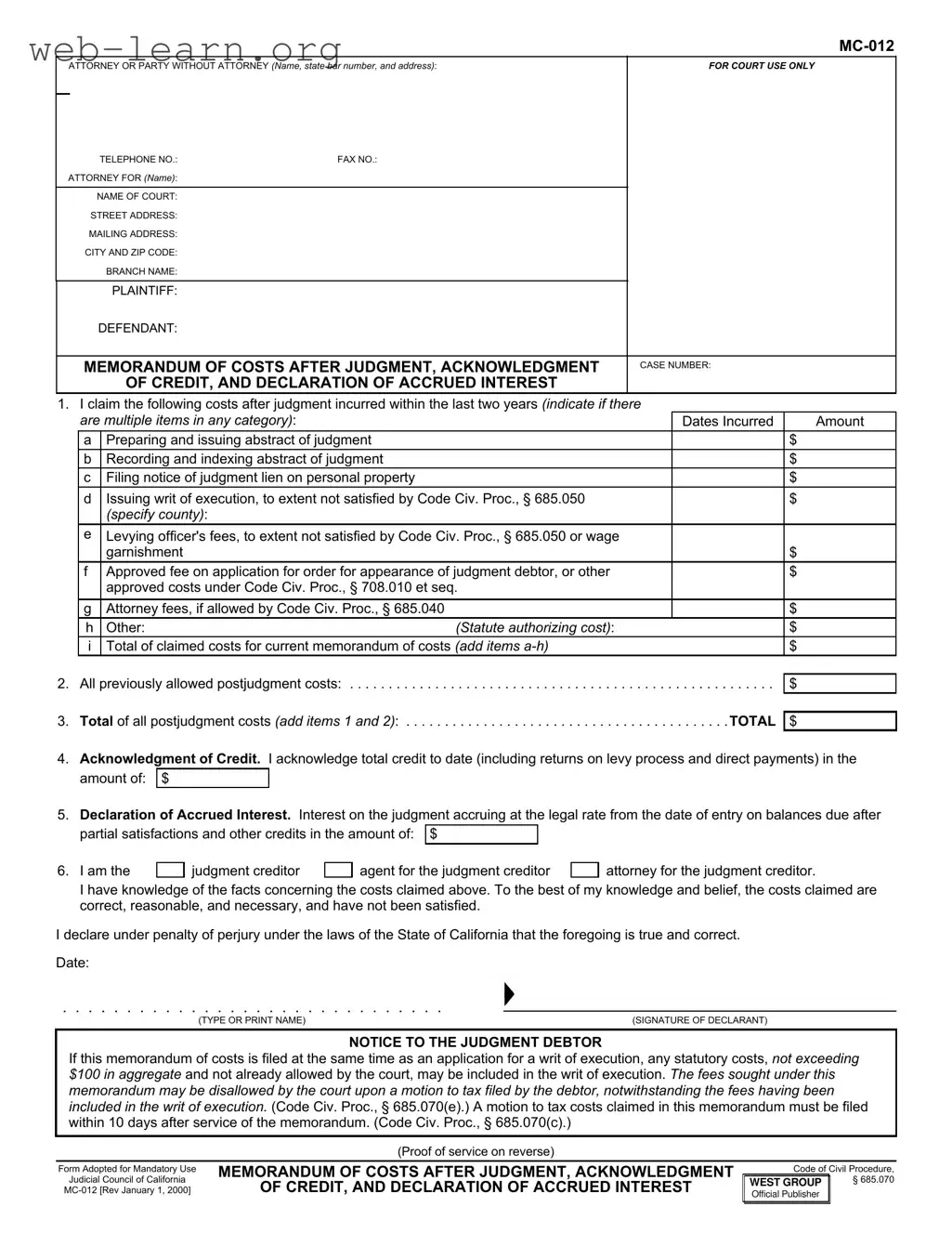
The California MC-012 form plays a crucial role in the post-judgment process, serving as a memorandum of costs incurred after a judgment has been rendered. This form is essential for creditors seeking to recover costs associated with enforcing a judgment. It allows them to itemize various expenses, such as fees for preparing and issuing an abstract of judgment, recording liens, and attorney fees, all of which can add up significantly. Additionally, the MC-012 requires the creditor to acknowledge any credits received and declare accrued interest on the judgment amount. By completing this form, the creditor asserts that the claimed costs are accurate and necessary, and they do so under penalty of perjury. This document is not just a formality; it can impact the enforcement of a judgment and the debtor's obligations. Moreover, it includes important notices for the debtor, informing them of their rights and the process for contesting the costs claimed. Understanding the nuances of the MC-012 is vital for both creditors and debtors navigating the complexities of post-judgment collections in California.
Sample - California Mc 012 Form

Acknowledgment of Credit. I acknowledge total credit to date (including returns on levy process and direct payments) in the
amount of: $
FOR COURT USE ONLY
ATTORNEY FOR (Name):
NAME OF COURT:
STREET ADDRESS:
MAILING ADDRESS:
CITY AND ZIP CODE:
BRANCH NAME:
PLAINTIFF:
DEFENDANT:
CASE NUMBER:
MEMORANDUM OF COSTS AFTER JUDGMENT, ACKNOWLEDGMENT
OF CREDIT, AND DECLARATION OF ACCRUED INTEREST
TELEPHONE NO.:
ATTORNEY OR PARTY WITHOUT ATTORNEY (Name, state bar number, and address):
FAX NO.:
I claim the following costs after judgment incurred within the last two years (indicate if there
are multiple items in any category):
1.
Declaration of Accrued Interest. Interest on the judgment accruing at the legal rate from the date of entry on balances due after
partial satisfactions and other credits in the amount of: $
4.
5.
judgment creditor
attorney for the judgment creditor. agent for the judgment creditor
I am the
6.
I have knowledge of the facts concerning the costs claimed above. To the best of my knowledge and belief, the costs claimed are
correct, reasonable, and necessary, and have not been satisfied.
I declare under penalty of perjury under the laws of the State of California that the foregoing is true and correct.
Date:
(SIGNATURE OF DECLARANT)(TYPE OR PRINT NAME)
. . . . . . . . . . . . . . . . . . . . . . . . . . . . . .
MEMORANDUM OF COSTS AFTER JUDGMENT, ACKNOWLEDGMENT
OF CREDIT, AND DECLARATION OF ACCRUED INTEREST
Form Adopted for Mandatory Use
Judicial Council of California
MC-012 [Rev January 1, 2000]
(Proof of service on reverse)
If this memorandum of costs is filed at the same time as an application for a writ of execution, any statutory costs, not exceeding
$100 in aggregate and not already allowed by the court, may be included in the writ of execution. The fees sought under this
memorandum may be disallowed by the court upon a motion to tax filed by the debtor, notwithstanding the fees having been
included in the writ of execution. (Code Civ. Proc., § 685.070(e).) A motion to tax costs claimed in this memorandum must be filed
within 10 days after service of the memorandum. (Code Civ. Proc., § 685.070(c).)
NOTICE TO THE JUDGMENT DEBTOR
Code of Civil Procedure,
§ 685.070
MC-012
a Preparing and issuing abstract of judgment
b Recording and indexing abstract of judgment
c Filing notice of judgment lien on personal property
d Issuing writ of execution, to extent not satisfied by Code Civ. Proc., § 685.050
(specify county):
e
Levying officer's fees, to extent not satisfied by Code Civ. Proc., § 685.050 or wage
garnishment
f Approved fee on application for order for appearance of judgment debtor, or other
approved costs under Code Civ. Proc., § 708.010 et seq.
g Attorney fees, if allowed by Code Civ. Proc., § 685.040
$
$
$
$
$
$
$
Dates Incurred Amount
Total of all postjudgment costs (add items 1 and 2): $
Other: (Statute authorizing cost):h
$
Total of claimed costs for current memorandum of costs (add items a-h)i $
All previously allowed postjudgment costs:
$
2.
. . . . . . . . . . . . . . . . . . . . . . . . . . . . . . . . . . . . . . . . . . . . . . . . . . . . . . .
3. TOTAL
. . . . . . . . . . . . . . . . . . . . . . . . . . . . . . . . . . . . . . . . . .
WEST GROUP
Official Publisher
CASE NUMBER:
SHORT TITLE:
MEMORANDUM OF COSTS AFTER JUDGMENT, ACKNOWLEDGMENT
OF CREDIT, AND DECLARATION OF ACCRUED INTEREST
MC-012 [Rev January 1, 2000] Page two
PROOF OF SERVICE
Mail Personal Service
At the time of service I was at least 18 years of age and not a party to this legal action.
(SIGNATURE OF DECLARANT)
My residence or business address is (specify):
I mailed or personally delivered a copy of the Memorandum of Costs After Judgment, Acknowledgment of Credit, and Declaration
of Accrued Interest as follows (complete either a or b):
Mail. I am a resident of or employed in the county where the mailing occurred.
(1) I enclosed a copy in an envelope AND
a.
deposited the sealed envelope with the United States Postal Service with the postage fully prepaid.
placed the envelope for collection and mailing on the date and at the place shown in items below following
our ordinary business practices. I am readily familiar with this business's practice for collecting and processing
correspondence for mailing. On the same day that correspondence is placed for collection and mailing, it is
deposited in the ordinary course of business with the United States Postal Service in a sealed envelope with
postage fully prepaid.
(a)
(b)
The envelope was addressed and mailed as follows:
(a) Name of person served:
(b) Address on envelope:
(c) Date of mailing:
(d) Place of mailing (city and state):
Personal delivery. I personally delivered a copy as follows:
(1) Name of person served:
(2) Address where delivered:
b.
(3) Date delivered:
(4) Time delivered:
I declare under penalty of perjury under the laws of the State of California that the foregoing is true and correct.
Date:
. . . . . . . . . . . . . . . . . . . . . . . . . . . . . .
(TYPE OR PRINT NAME)
2.
3.
(2)
1.
WEST GROUP
Official Publisher

Form Information

Fact Name Description
Purpose The MC-012 form is used to claim costs incurred after a judgment in a civil case in California.
Governing Law This form is governed by the California Code of Civil Procedure, specifically sections 685.040 and 685.070.
Filing Requirements The form must be filed within two years of incurring the costs, and can be submitted alongside an application for a writ of execution.
Judgment Debtor Notice Judgment debtors have the right to challenge the costs listed in the MC-012 by filing a motion to tax within 10 days of service.

Detailed Guide for Filling Out California Mc 012

Completing the California MC-012 form involves gathering necessary information regarding costs incurred after a judgment and acknowledging any credits. This process ensures that all relevant financial details are accurately reported to the court.

  1. Fill in your contact information: Enter your name, state bar number (if applicable), address, telephone number, and fax number in the designated section at the top of the form.
  2. Identify the court: Specify the name of the court where the case is filed, along with the street address, mailing address, city, and ZIP code.
  3. Provide case details: Include the case number, names of the plaintiff and defendant, and the branch name of the court.
  4. List costs incurred: In section 1, detail the costs incurred after judgment within the last two years. For each cost, provide the date incurred and the amount. Include costs for items such as preparing and issuing an abstract of judgment, recording, and attorney fees.
  5. Summarize previously allowed costs: In section 2, list any previously allowed post-judgment costs.
  6. Calculate total costs: In section 3, add the total of claimed costs from section 1 and the total from section 2 to provide the total of all post-judgment costs.
  7. Acknowledge credit: In section 4, indicate the total credit amount to date, including any returns on levy process and direct payments.
  8. Declare accrued interest: In section 5, specify the amount of interest on the judgment that has accrued at the legal rate.
  9. Sign and date the form: In section 6, indicate your role (judgment creditor, agent, or attorney) and provide your signature and the date.
  10. Complete proof of service: Fill out the proof of service section, confirming the method of service (mail or personal delivery), and provide the required details.

Obtain Answers on California Mc 012

  1. What is the purpose of the California MC-012 form?

    The California MC-012 form, officially known as the "Memorandum of Costs After Judgment, Acknowledgment of Credit, and Declaration of Accrued Interest," is used by judgment creditors to claim costs incurred after a judgment has been made. This form allows creditors to outline specific costs associated with enforcing the judgment, such as fees for filing and recording documents, as well as any accrued interest on the judgment amount.

  2. Who needs to fill out the MC-012 form?

    The MC-012 form is primarily filled out by the judgment creditor, their attorney, or an agent acting on behalf of the creditor. This individual must have knowledge of the facts concerning the costs being claimed. If you are seeking to recover costs after a judgment has been rendered, this form is necessary for properly documenting those expenses.

  3. What types of costs can be claimed on the MC-012 form?

    Several categories of costs can be claimed on the MC-012 form. These include:

    • Preparing and issuing an abstract of judgment
    • Recording and indexing the abstract of judgment
    • Filing a notice of judgment lien on personal property
    • Issuing a writ of execution
    • Levying officer's fees
    • Attorney fees, if permitted
    • Any other costs authorized by statute

    It’s important to ensure that all claimed costs are reasonable and necessary for enforcing the judgment.

  4. How does one acknowledge credit on the MC-012 form?

    The MC-012 form includes a section for acknowledging total credit to date. This credit may include returns from the levy process and direct payments made by the judgment debtor. Accurately reporting this credit is crucial, as it affects the total amount being claimed. The form requires you to enter the total amount of credit received, which helps provide a clear picture of the outstanding balance.

  5. What happens after the MC-012 form is filed?

    Once the MC-012 form is filed, it may be used in conjunction with an application for a writ of execution. If filed together, certain statutory costs may be included in the writ. However, it’s important to note that the judgment debtor has the right to challenge the claimed costs. They can file a motion to tax costs within ten days of being served with the memorandum. This process allows for a review of the claimed expenses and ensures that only valid costs are enforced.

Common mistakes

Filling out the California MC-012 form can seem straightforward, but many individuals make common mistakes that can lead to complications in their legal proceedings. Understanding these pitfalls can help ensure that your submission is accurate and complete.

One frequent error is failing to provide complete information. Each section of the form requires specific details, such as the names of the parties involved and the case number. Omitting any of this information can delay processing and may even lead to rejection of the form. Always double-check that all fields are filled out clearly and accurately.

Another common mistake is inaccurate calculations. When adding up costs, it’s essential to ensure that the total reflects the correct sum of all claimed expenses. Miscalculating the total can create discrepancies that complicate matters later. Taking the time to verify each figure before submitting can save significant headaches.

Many people also neglect to include supporting documentation for the costs claimed. The court may require evidence to substantiate the expenses listed on the form. Without appropriate documentation, the court may question the validity of your claims, leading to potential disallowance of costs.

Another issue arises when individuals forget to sign the declaration. The MC-012 form includes a declaration that must be signed to affirm the accuracy of the information provided. Failing to sign this declaration can render the form invalid, causing unnecessary delays in your case.

Additionally, some individuals do not acknowledge previous costs accurately. If there have been costs allowed in prior proceedings, these must be clearly stated. Failing to do so can lead to confusion and may result in the court rejecting your claims for additional costs.

Lastly, not adhering to deadlines can be detrimental. The form may need to be filed within specific timeframes, especially if it is associated with a motion for a writ of execution. Missing these deadlines can result in lost opportunities to recover costs or enforce judgments.

By being aware of these common mistakes and taking steps to avoid them, individuals can navigate the complexities of the MC-012 form with greater confidence and clarity. Each detail matters, and a careful approach can lead to a smoother legal process.

Documents used along the form

The California MC-012 form is essential for documenting costs incurred after a judgment has been made. Several other forms and documents often accompany this form to ensure that all necessary information is communicated effectively and in compliance with court requirements. Below is a list of some commonly used forms related to the MC-012.

  • MC-013: Writ of Execution - This form is used to request the court to issue a writ that allows the creditor to enforce a judgment through the seizure of the debtor's property. It provides the legal authority for the collection of the judgment amount.
  • MC-014: Notice of Judgment Lien - This document serves to notify relevant parties that a judgment lien has been placed on the debtor's property. It is important for establishing the creditor's claim against the debtor's assets.
  • MC-015: Application for Order for Appearance of Judgment Debtor - This form is used to request a court order that requires the judgment debtor to appear in court to answer questions regarding their financial situation. It is a way for creditors to gather information about the debtor's ability to pay.
  • MC-020: Motion to Tax Costs - This motion allows a debtor to challenge the costs claimed by the creditor in the MC-012. It provides a formal process for disputing any costs that the debtor believes are unreasonable or incorrect.
  • MC-021: Acknowledgment of Credit - This form is used to formally acknowledge any payments made by the debtor towards the judgment. It helps keep an accurate record of the amounts credited against the total judgment amount.

These forms work together with the MC-012 to facilitate the post-judgment collection process. Utilizing the correct forms ensures that both creditors and debtors adhere to legal requirements while maintaining clarity in their financial dealings.

Similar forms

The California MC-012 form, which serves as a memorandum of costs after judgment, acknowledgment of credit, and declaration of accrued interest, shares similarities with several other legal documents. Below is a list of ten documents that are comparable in purpose or function:

  • MC-013: Memorandum of Costs - Like the MC-012, this form is used to claim costs incurred after a judgment, but it may be applied in different contexts or for different types of claims.
  • MC-001: Request for Entry of Default - This document initiates the process of obtaining a default judgment, similar to how the MC-012 addresses post-judgment costs.
  • MC-030: Notice of Motion and Motion - This form is used to request a court order, just as the MC-012 requests acknowledgment of costs and interest related to a judgment.
  • MC-020: Application for Writ of Execution - This document seeks to enforce a judgment, paralleling the MC-012’s role in detailing costs related to enforcing that judgment.
  • FL-150: Income and Expense Declaration - While primarily used in family law, this form similarly outlines financial obligations and could relate to costs incurred post-judgment.
  • CV-01: Complaint - This is the initial document to start a legal case, while the MC-012 serves to finalize costs after a judgment has been made.
  • SC-100: Plaintiff's Claim and Order to Go to Small Claims Court - This form initiates small claims actions, akin to how the MC-012 addresses costs after a small claims judgment.
  • UD-100: Complaint - Unlawful Detainer - This document is used in eviction cases, similar in that it addresses costs and claims associated with a legal judgment.
  • MC-040: Stipulation and Order - This form is used to agree on certain terms in a case, just as the MC-012 outlines agreed-upon costs after a judgment.
  • JUD-100: Judgment - This is the final decision in a case, while the MC-012 details the financial implications of that judgment.

Dos and Don'ts

When filling out the California MC-012 form, there are several important dos and don'ts to keep in mind. Here’s a list to guide you:

  • Do read the instructions carefully before starting.
  • Do provide accurate information in all fields.
  • Do include all relevant costs incurred after judgment.
  • Do sign and date the form before submission.
  • Do keep a copy of the completed form for your records.
  • Don't leave any required fields blank.
  • Don't exaggerate or misrepresent costs.
  • Don't forget to serve the form to the judgment debtor properly.
  • Don't submit the form without checking for errors.

Misconceptions

Misconceptions about the California MC-012 form can lead to confusion regarding its purpose and use. Below are four common misconceptions clarified.

  • The MC-012 form is only for attorneys. This form can be used by both attorneys and parties representing themselves in court. It is designed for any judgment creditor to claim costs after a judgment has been made.
  • All costs can be claimed on the MC-012 form. Not all costs are eligible for inclusion. Only specific post-judgment costs incurred within the last two years can be claimed, as outlined in the form.
  • The court automatically approves all claimed costs. Claims made on the MC-012 form are subject to review. The court has the authority to disallow any fees if a motion to tax is filed by the judgment debtor.
  • The MC-012 form is only relevant after a writ of execution is filed. While it can be filed alongside a writ of execution, the MC-012 form serves as a separate document to claim costs after judgment, regardless of any other actions taken.

Key takeaways

When filling out the California MC-012 form, there are several important aspects to keep in mind. This form is essential for claiming costs after a judgment has been made. Here are key takeaways to ensure proper completion and use:

  • Understand the Purpose: The MC-012 form is used to detail costs incurred after a judgment, acknowledge any credits, and declare accrued interest.
  • Accurate Information: Provide precise information regarding the court, parties involved, and case number. Errors can lead to delays or disallowance of claims.
  • Cost Breakdown: List all costs incurred within the last two years. Be specific about each item and its associated amount.
  • Include Supporting Documentation: Attach any necessary documents that support your claims for costs. This may include receipts or invoices.
  • Acknowledgment of Credit: Clearly state any credits received to date, which may affect the total amount claimed.
  • Declaration of Interest: Calculate and declare any interest that has accrued on the judgment amount since its entry.
  • Sign and Date: Ensure that the form is signed and dated by the appropriate party, confirming the truthfulness of the information provided.
  • Know the Deadlines: Be aware of the time limits for filing the memorandum and responding to any motions to tax costs that may be filed by the judgment debtor.

By following these guidelines, you can effectively navigate the process of using the California MC-012 form. Proper completion helps ensure that your claims are recognized and processed by the court.