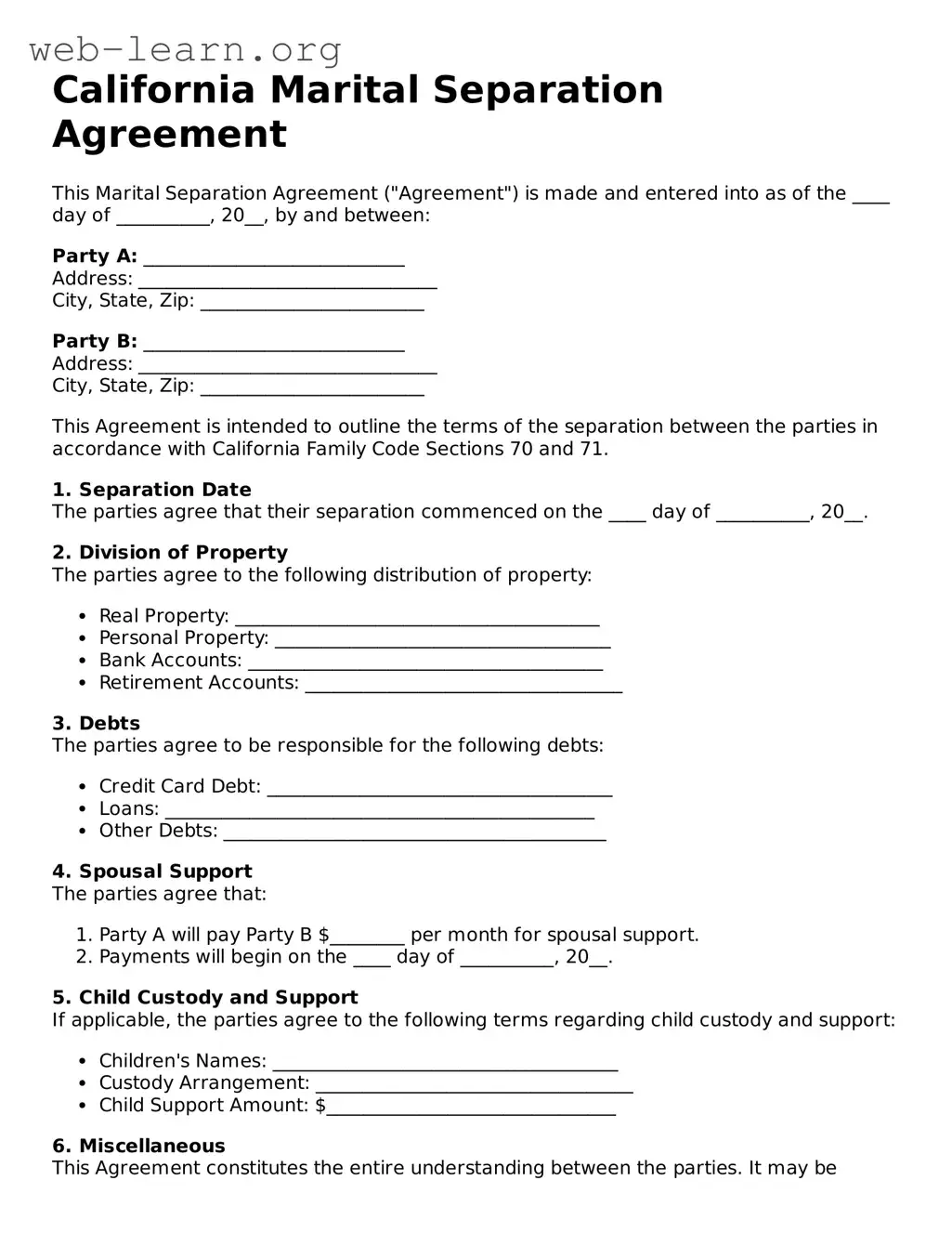
In California, couples contemplating a separation often turn to the Marital Separation Agreement form as a crucial tool to navigate their new circumstances. This form serves as a written contract that outlines the terms of the separation, addressing various aspects such as property division, spousal support, child custody, and visitation rights. By clearly defining the responsibilities and rights of each party, the agreement aims to minimize conflicts and provide a clear framework for both individuals moving forward. Importantly, it can also serve as a foundation for future legal proceedings, should the couple decide to pursue divorce. Understanding the nuances of this agreement is vital, as it can significantly impact both parties’ lives during and after the separation process. With careful consideration and thorough documentation, the Marital Separation Agreement can facilitate a smoother transition, allowing each individual to focus on their personal growth and future stability.
California Marital Separation Agreement
This Marital Separation Agreement ("Agreement") is made and entered into as of the ____ day of __________, 20__, by and between:
Party A: ____________________________
Address: ________________________________
City, State, Zip: ________________________
Party B: ____________________________
Address: ________________________________
City, State, Zip: ________________________
This Agreement is intended to outline the terms of the separation between the parties in accordance with California Family Code Sections 70 and 71.
1. Separation Date
The parties agree that their separation commenced on the ____ day of __________, 20__.
2. Division of Property
The parties agree to the following distribution of property:
3. Debts
The parties agree to be responsible for the following debts:
4. Spousal Support
The parties agree that:
5. Child Custody and Support
If applicable, the parties agree to the following terms regarding child custody and support:
6. Miscellaneous
This Agreement constitutes the entire understanding between the parties. It may be modified only by a written agreement signed by both parties.
IN WITNESS WHEREOF, the parties hereto have executed this Agreement as of the date first above written.
______________________________
Party A Signature
______________________________
Party B Signature
______________________________
Date
| Fact Name | Details |
|---|---|
| Purpose | The California Marital Separation Agreement form outlines the terms of separation between spouses, addressing issues such as property division, child custody, and support obligations. |
| Governing Law | This agreement is governed by the California Family Code, which provides the legal framework for marital separation and divorce in the state. |
| Voluntary Nature | Both parties must voluntarily agree to the terms outlined in the separation agreement. It is essential that both spouses fully understand and accept the conditions. |
| Enforceability | Once signed, the agreement may be enforceable in court, provided it meets legal requirements and both parties have disclosed their financial information. |
| Modification | The terms of the separation agreement can be modified by mutual consent of both parties, but any changes should be documented in writing to ensure clarity and legality. |
After you have gathered the necessary information, it's time to fill out the California Marital Separation Agreement form. Completing this form accurately is essential for your next steps in the separation process.
Once the form is filled out, it will need to be filed with the appropriate court. Be sure to check local requirements for submission and any additional documents that may be needed.
What is a California Marital Separation Agreement?
A California Marital Separation Agreement is a legal document that outlines the terms of a couple's separation. It covers various aspects such as property division, debt responsibilities, child custody, and support obligations. This agreement serves as a roadmap for both parties during the separation period, helping to clarify expectations and responsibilities.
Why should I consider a Marital Separation Agreement?
Opting for a Marital Separation Agreement can provide clarity and structure during a challenging time. It helps to minimize conflict by clearly defining each party's rights and obligations. Additionally, having a written agreement can be beneficial if the couple decides to reconcile or if the separation leads to divorce. It can also assist in resolving disputes that may arise later.
What should be included in the agreement?
When drafting a Marital Separation Agreement, it’s important to include:
Each section should be as detailed as possible to avoid misunderstandings in the future.
Is a Marital Separation Agreement legally binding?
Yes, a Marital Separation Agreement is legally binding once both parties sign it. However, it’s crucial that both individuals fully understand the terms before signing. If either party does not adhere to the agreement, it can be enforced in court. It’s often advisable to consult with a legal professional to ensure that the agreement complies with California law and meets both parties’ needs.
Can the agreement be modified later?
Yes, a Marital Separation Agreement can be modified if both parties agree to the changes. It’s essential to document any modifications in writing and have both parties sign the updated agreement. This helps maintain clarity and ensures that all changes are legally recognized.
Do I need a lawyer to create a Marital Separation Agreement?
While it’s not legally required to have a lawyer to create a Marital Separation Agreement, it is highly recommended. A legal professional can provide valuable guidance, ensuring that the agreement is fair and comprehensive. They can also help navigate any complex issues that may arise, particularly regarding child custody or significant assets.
Filling out the California Marital Separation Agreement form can be a daunting task for many. One common mistake is failing to provide complete and accurate information. When individuals do not include all relevant details, it can lead to misunderstandings later on. For example, omitting a spouse's income or assets can affect the division of property and financial obligations.
Another frequent error is not understanding the implications of the agreement. People may sign the form without fully grasping how it affects their rights and responsibilities. This lack of awareness can lead to unintended consequences, such as losing certain rights to property or spousal support. It is crucial to read the entire document and consider consulting a legal professional if there are any uncertainties.
Additionally, some individuals overlook the importance of having the agreement notarized. In California, notarization can lend credibility to the document and may be necessary for it to be enforceable in court. Failing to have the agreement properly notarized can result in complications if either party later disputes the terms.
Another mistake involves not addressing all relevant issues in the agreement. This can include matters like child custody, visitation rights, and financial support. If these topics are not clearly outlined, it can lead to conflicts and confusion down the line. It is essential to cover all bases to avoid future disputes.
Finally, many people neglect to keep a copy of the signed agreement. After the form is filled out and notarized, it is vital to retain a copy for personal records. Without a copy, individuals may find it challenging to enforce the terms or prove what was agreed upon. Keeping thorough documentation is a simple yet crucial step in the process.
A California Marital Separation Agreement is an important document for couples who wish to outline the terms of their separation. Several other forms and documents often accompany this agreement to ensure that all legal matters are addressed properly. Here’s a list of some commonly used documents:
Having these documents prepared can help streamline the separation process and ensure that all important issues are addressed. It’s always a good idea to consult with a legal professional to ensure everything is completed correctly.
The Marital Separation Agreement is a crucial document in the process of separating from a spouse. It outlines the terms of the separation and addresses various aspects of the couple's lives. Here are nine documents that are similar to the Marital Separation Agreement, along with a brief explanation of how they compare:
Filling out the California Marital Separation Agreement form can be a daunting task, but knowing what to do and what to avoid can make the process smoother. Here’s a helpful list to guide you through it.
By following these guidelines, you can navigate the Marital Separation Agreement form with confidence and clarity. Good luck!
Many people hold misconceptions about the California Marital Separation Agreement form. Understanding the truth behind these misconceptions is essential for anyone considering separation. Here are ten common misunderstandings:
Understanding these misconceptions can help individuals navigate the complexities of marital separation more effectively. Take the time to educate yourself and seek professional guidance when needed.
When filling out and using the California Marital Separation Agreement form, it is important to keep the following key takeaways in mind:
Taking these steps can help facilitate a smoother separation process and protect the interests of both parties involved.
Legal Separation in New York - This form can assist in setting expectations for future relationships.
Is Hawaii a 50/50 Divorce State - A Marital Separation Agreement can be legally binding if properly executed.