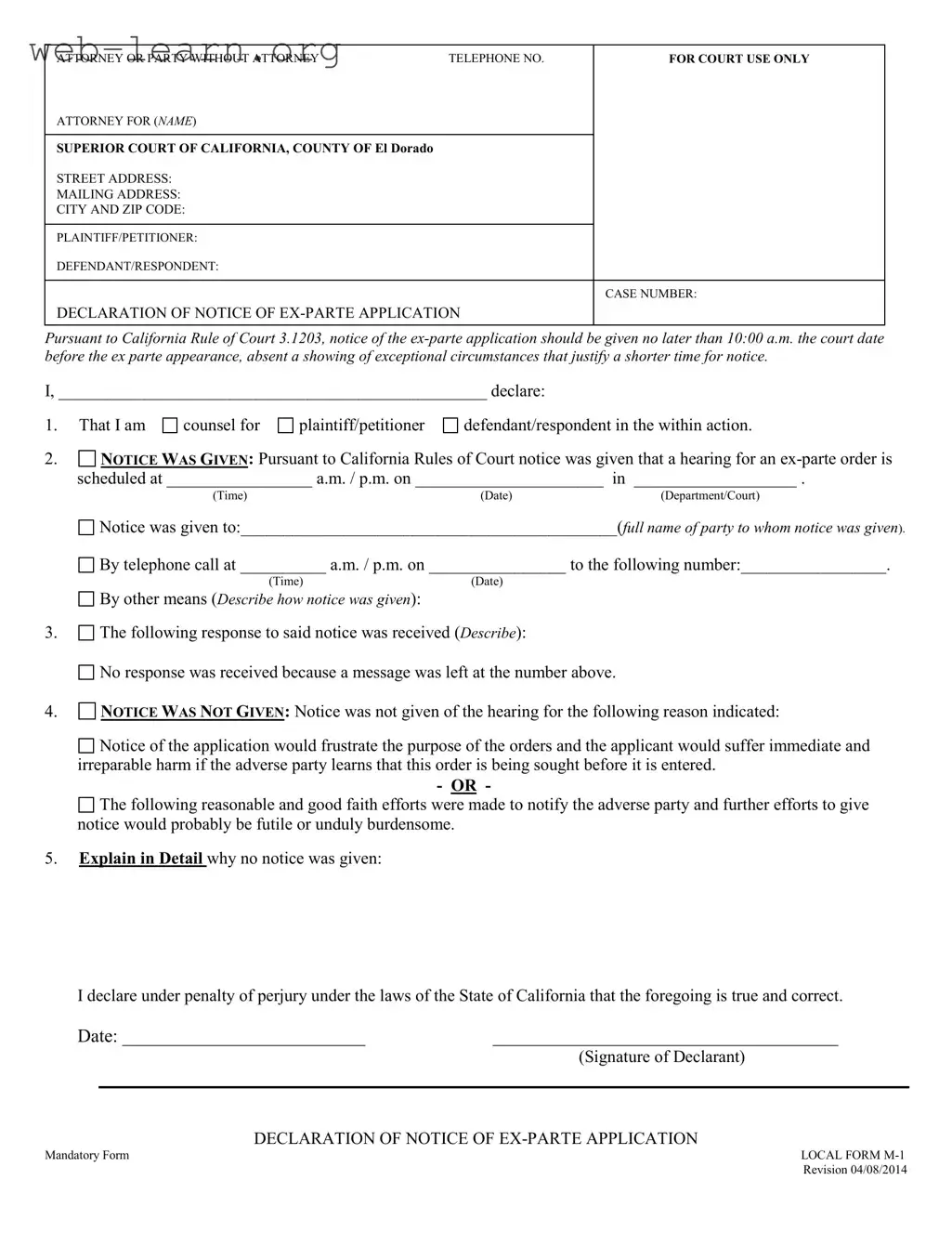
The California Local M 1 form is an essential document used in the Superior Court of California, particularly for ex-parte applications. This form serves multiple purposes, primarily to declare that notice of an ex-parte application has been given or, in some cases, explain why notice could not be provided. It requires the attorney or party to fill in specific details, including their contact information, the names of the involved parties, and the case number. The form also outlines the requirements for giving notice, which is crucial to ensure that all parties are informed about the proceedings. If notice was given, the form must specify how and when it was communicated, as well as any responses received. Alternatively, if notice was not given, the form allows for an explanation of the circumstances that justify this decision. This declaration is made under penalty of perjury, emphasizing the importance of accuracy and honesty in the legal process. Completing the Local M 1 form accurately helps maintain transparency and fairness in legal proceedings, ensuring that all parties have an opportunity to respond appropriately.
| Fact Name | Details |
|---|---|
| Governing Law | California Rule of Court 3.1203 governs the notice requirements for ex-parte applications. |
| Form Title | The form is officially titled "Declaration of Notice of Ex-Parte Application." |
| Mandatory Status | This is a mandatory form that must be used in specific circumstances. |
| Notice Deadline | Notice of the ex-parte application must be given no later than 10:00 a.m. on the court date. |
| Exceptional Circumstances | Shorter notice may be allowed if exceptional circumstances are demonstrated. |
| Notification Methods | Notice can be given by telephone or other means as specified in the form. |
| Response to Notice | The form requires a section to describe any responses received regarding the notice. |
| Declaration Under Penalty | The declarant must affirm the truth of the information under penalty of perjury. |
Filling out the California Local M 1 form requires careful attention to detail. This form is essential for notifying the court and the involved parties about an ex-parte application. Follow these steps to ensure you complete the form correctly.
Once you have completed the form, review it for accuracy. It’s important to ensure all required sections are filled out correctly before submitting it to the court. This will help facilitate a smooth process for your ex-parte application.
What is the California Local M 1 form?
The California Local M 1 form is a mandatory document used in the Superior Court of California, specifically in El Dorado County. It serves to declare that notice has been given for an ex-parte application, which is a request made to the court for immediate relief without the presence of the other party. This form ensures that the court is aware of the notification process and any responses received.
Who needs to fill out the Local M 1 form?
This form must be completed by the attorney or party representing either the plaintiff/petitioner or the defendant/respondent in a legal action. It is essential for anyone seeking an ex-parte order to demonstrate that they have followed proper notification procedures.
When should notice be given according to the California Rules of Court?
Notice of the ex-parte application must be provided no later than 10:00 a.m. on the court date preceding the ex-parte appearance. However, if there are exceptional circumstances, a shorter notice period may be justified. This rule ensures that all parties have a fair opportunity to respond.
What information must be included in the Local M 1 form?
The form requires several key pieces of information:
What should I do if I was unable to give notice?
If notice was not given, the form allows you to explain the reason. Common justifications include situations where notifying the adverse party could cause immediate harm or where further efforts to notify would be futile or overly burdensome.
What happens if I do not provide proper notice?
Failure to provide proper notice can lead to the denial of your ex-parte application. The court may view this as a lack of good faith or an attempt to circumvent the other party's right to be heard. It is crucial to adhere to the notification requirements to avoid complications.
Is there a penalty for providing false information on the Local M 1 form?
Yes, the form includes a declaration under penalty of perjury. Providing false information can lead to serious legal consequences, including potential sanctions from the court. Always ensure that the information you provide is accurate and truthful.
How can I obtain a Local M 1 form?
The Local M 1 form is typically available at the Superior Court of California, County of El Dorado, or it can often be downloaded from the court's official website. Ensure you are using the most recent version of the form to comply with current requirements.
Can I submit the Local M 1 form electronically?
Many courts now offer electronic filing options. Check with the El Dorado County Superior Court to determine if electronic submission of the Local M 1 form is allowed. If not, you will need to file it in person or by mail.
Filling out the California Local M 1 form can be straightforward, but many people make common mistakes that can lead to delays or complications. Understanding these pitfalls can help ensure a smoother process.
One frequent error is failing to provide complete contact information. The form requires the attorney or party without attorney to include their telephone number and address. Omitting this information can lead to communication issues, which may hinder the progress of the case.
Another mistake involves incorrect or incomplete details regarding the parties involved. It's essential to accurately fill in the plaintiff/petitioner and defendant/respondent sections. Misnaming a party or leaving out critical information can result in confusion or legal complications.
People often overlook the requirement for timely notice. According to California Rules of Court, notice of the ex-parte application must be given by 10:00 a.m. on the court date. Failing to adhere to this timeline can jeopardize the application.
When indicating how notice was given, some individuals neglect to provide sufficient detail. Whether notice was given by phone or other means, it’s crucial to specify the method clearly. Incomplete descriptions can lead to misunderstandings about whether proper notice was served.
Additionally, a lack of clarity in explaining why notice was not given can be problematic. The form requires a detailed explanation if notice is not provided. Vague responses can raise doubts about the legitimacy of the application.
Some applicants forget to sign and date the form. The declaration under penalty of perjury is a critical component, and without a signature, the form may be considered invalid.
Another common oversight is not following the correct format for dates and times. It is important to be consistent and clear in how this information is presented to avoid confusion.
People may also confuse the sections regarding responses to the notice. Clearly stating whether a response was received or not is vital. Misrepresenting this information can lead to complications in court.
Lastly, applicants sometimes fail to review the entire form before submission. Taking a moment to double-check all entries can prevent many of these errors and help ensure that the application is processed smoothly.
The California Local M 1 form is commonly used in legal proceedings to provide notice of an ex-parte application. However, several other forms and documents may accompany it to ensure compliance with court procedures and enhance the clarity of the case. Below is a list of these documents, each described briefly.
Understanding these documents is crucial for anyone involved in legal proceedings that require an ex-parte application. Each form plays a specific role in the process, ensuring that all parties are informed and that the court can make informed decisions based on the presented information.
California Local M 2 Form: Similar to the M 1 form, the M 2 form is used for ex-parte applications but focuses on different types of requests, such as temporary restraining orders.
California Local M 3 Form: This form also pertains to ex-parte applications, specifically for family law matters, detailing the notice requirements for custody or support issues.
California Local M 4 Form: Like the M 1 form, the M 4 is used for ex-parte applications but is tailored for civil litigation cases, emphasizing the need for immediate relief.
California Local M 5 Form: This document serves a similar purpose in family law cases, focusing on modifications to existing orders and the notice process involved.
California Local M 6 Form: The M 6 form is another ex-parte application document, specifically for probate matters, outlining the required notice and declaration procedures.
California Local M 7 Form: This form is used for ex-parte applications in juvenile dependency cases, highlighting the unique notice requirements relevant to minors.
California Local M 8 Form: Similar to the M 1, the M 8 is focused on requests for emergency orders in civil harassment cases, detailing notice obligations.
California Local M 9 Form: This form applies to ex-parte applications in small claims court, where specific notice requirements must be met for expedited hearings.
California Local M 10 Form: The M 10 is used for ex-parte applications related to landlord-tenant disputes, addressing the notice process for eviction matters.
California Local M 11 Form: This form is similar in function but is tailored for applications in the context of civil rights cases, focusing on urgent requests and notice protocols.
When filling out the California Local M 1 form, attention to detail is crucial. Here are five important guidelines to follow, as well as some common pitfalls to avoid.
While the form is often filled out by attorneys, it can also be used by self-represented individuals. Anyone involved in a legal case who needs to request an ex-parte order can utilize this form to ensure proper notice is given.
This is not true. California Rule of Court 3.1203 mandates that notice must be given by 10:00 a.m. on the court date, unless there are exceptional circumstances. This requirement ensures that all parties have a fair opportunity to respond.
The use of the Local M 1 form is actually mandatory when filing for an ex-parte application in El Dorado County. Failing to use the correct form can lead to delays or dismissal of the application.
Submitting the form requires adherence to specific timelines. Notice must be given by the set deadline, and if this is not followed, it could jeopardize the application. Timeliness is crucial in ex-parte matters.
Filling out the California Local M 1 form can be a crucial step in the legal process, especially when seeking an ex-parte application. Here are some key takeaways to keep in mind:
By keeping these points in mind, individuals can navigate the complexities of the California Local M 1 form more effectively, ensuring compliance with the necessary legal requirements.