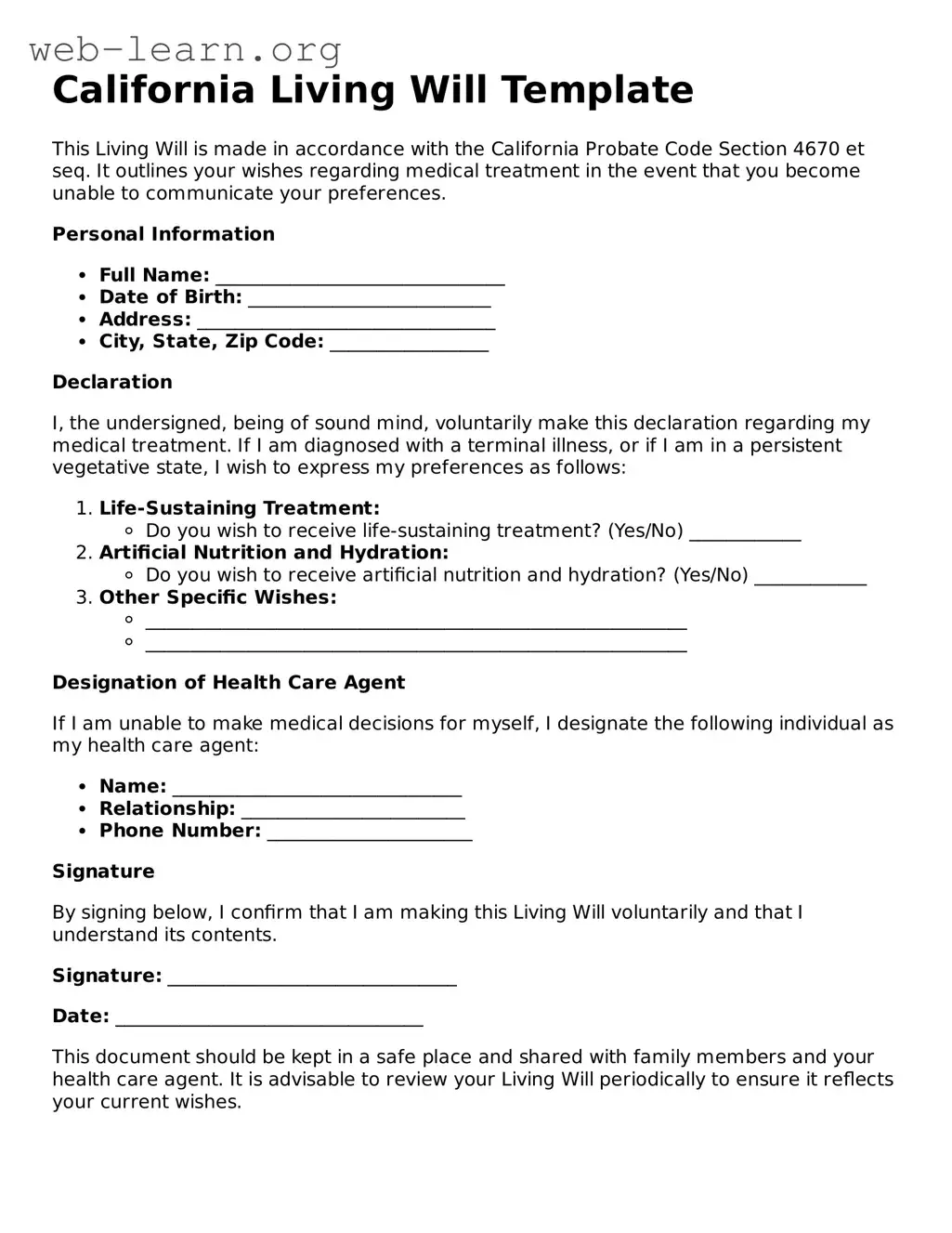
In the state of California, individuals have the opportunity to express their healthcare preferences through a Living Will, formally known as an Advance Health Care Directive. This essential document allows individuals to outline their wishes regarding medical treatment in the event they become unable to communicate their decisions due to illness or incapacity. The Living Will encompasses critical elements such as the designation of a healthcare agent, who is authorized to make medical decisions on behalf of the individual, as well as specific instructions regarding life-sustaining treatments, resuscitation efforts, and palliative care options. Importantly, the form ensures that personal values and beliefs are respected in medical situations that may arise in the future. By completing a Living Will, individuals can alleviate the burden on family members and healthcare providers, providing clarity during emotionally challenging times. Understanding the nuances of this form is vital for anyone considering their long-term healthcare preferences.
California Living Will Template
This Living Will is made in accordance with the California Probate Code Section 4670 et seq. It outlines your wishes regarding medical treatment in the event that you become unable to communicate your preferences.
Personal Information
Declaration
I, the undersigned, being of sound mind, voluntarily make this declaration regarding my medical treatment. If I am diagnosed with a terminal illness, or if I am in a persistent vegetative state, I wish to express my preferences as follows:
Designation of Health Care Agent
If I am unable to make medical decisions for myself, I designate the following individual as my health care agent:
Signature
By signing below, I confirm that I am making this Living Will voluntarily and that I understand its contents.
Signature: _______________________________
Date: _________________________________
This document should be kept in a safe place and shared with family members and your health care agent. It is advisable to review your Living Will periodically to ensure it reflects your current wishes.
| Fact Name | Description |
|---|---|
| Definition | A California Living Will is a legal document that outlines an individual's wishes regarding medical treatment in the event they become unable to communicate those wishes themselves. |
| Governing Law | The California Living Will is governed by the California Probate Code, specifically sections 4600 to 4806. |
| Purpose | This document serves to guide healthcare providers and family members in making decisions about life-sustaining treatment. |
| Requirements | To be valid, the form must be signed by the individual and witnessed by two people or notarized. |
| Revocation | A Living Will can be revoked at any time by the individual, as long as they are mentally competent. |
| Durable Power of Attorney | While a Living Will specifies treatment preferences, a Durable Power of Attorney for Health Care appoints someone to make decisions on behalf of the individual. |
| Age Requirement | Individuals must be at least 18 years old to create a Living Will in California. |
| Accessibility | The form is available online and can be downloaded for free from various legal resources. |
| Limitations | A Living Will does not cover all possible medical situations, so it is important to discuss specific wishes with healthcare providers. |
| Storage | It is advisable to keep the Living Will in a safe place and provide copies to family members and healthcare providers. |
Completing a California Living Will form is an important step in expressing your healthcare preferences. Once you have filled out the form, it is advisable to share it with your healthcare provider and loved ones to ensure they are aware of your wishes.
What is a Living Will in California?
A Living Will, also known as an advance healthcare directive, is a legal document that allows individuals to outline their preferences for medical treatment in the event they become unable to communicate their wishes. In California, this document helps ensure that your healthcare choices are respected, particularly concerning life-sustaining treatment and end-of-life care.
Who should have a Living Will?
Every adult should consider having a Living Will, regardless of age or health status. Unexpected medical emergencies can happen to anyone, and having this document in place provides peace of mind. It ensures that your healthcare providers and loved ones understand your wishes, reducing the burden on them during difficult times.
How do I create a Living Will in California?
Creating a Living Will in California is a straightforward process. You can either use a standard form provided by the state or draft your own document. It is essential to include specific instructions about your medical preferences. Once completed, you must sign the document in the presence of two witnesses or a notary public to ensure its validity.
What should I include in my Living Will?
Your Living Will should clearly outline your wishes regarding various medical treatments, such as:
Additionally, consider addressing any specific conditions under which you would or would not want certain treatments. Being as detailed as possible can help guide your healthcare providers in making decisions that align with your values.
Can I change or revoke my Living Will?
Yes, you can change or revoke your Living Will at any time as long as you are mentally competent. To make changes, simply create a new document that clearly states your revised wishes. Make sure to inform your healthcare providers and loved ones about any changes to ensure they are aware of your current preferences.
Is a Living Will the same as a Durable Power of Attorney for Healthcare?
No, a Living Will and a Durable Power of Attorney for Healthcare are distinct documents. While a Living Will specifies your medical treatment preferences, a Durable Power of Attorney designates an individual to make healthcare decisions on your behalf if you are unable to do so. It is advisable to have both documents to ensure comprehensive planning for your healthcare needs.
Where should I keep my Living Will?
Store your Living Will in a safe but accessible location. Inform your family members, healthcare proxy, and primary care physician about its location. Additionally, consider carrying a card in your wallet that indicates you have a Living Will and where it can be found. This can help ensure that your wishes are honored in a medical emergency.
Filling out a California Living Will form is a crucial step in ensuring that your healthcare preferences are respected when you can no longer communicate them. However, many individuals make mistakes that can lead to confusion or unintended consequences. Understanding these common errors can help ensure that your wishes are clearly articulated.
One frequent mistake is failing to specify your preferences clearly. Vague language can lead to misinterpretation by healthcare providers or family members. It is essential to articulate your desires regarding life-sustaining treatments, resuscitation efforts, and other medical interventions in precise terms.
Another common error is neglecting to date the document. A Living Will should always be dated to establish its validity. Without a date, there may be questions about whether the document is current or if it has been superseded by a more recent directive.
Many people also forget to sign the form in the presence of witnesses or a notary, which is a requirement in California. Not adhering to these formalities can render the Living Will invalid. It is crucial to follow the legal requirements to ensure that your document is enforceable.
Additionally, individuals often overlook the importance of discussing their wishes with family members. Failing to communicate your preferences can lead to disputes or uncertainty among loved ones during critical moments. Open discussions can help ensure that everyone understands your wishes and can advocate for them if necessary.
Some may mistakenly assume that a Living Will is the same as a Durable Power of Attorney for Health Care. While both documents serve important roles in healthcare decision-making, they are distinct. A Living Will outlines your treatment preferences, while a Durable Power of Attorney designates someone to make decisions on your behalf if you are unable to do so.
Another mistake involves not reviewing or updating the document regularly. Life circumstances, medical advancements, and personal beliefs can change over time. It is vital to revisit your Living Will periodically to ensure that it still reflects your current wishes.
Lastly, individuals sometimes fail to provide copies of the completed Living Will to relevant parties, such as family members, healthcare providers, or legal representatives. Sharing the document ensures that those who may need to act on your behalf have access to your wishes, reducing the likelihood of confusion or conflict in the future.
A California Living Will is an essential document for individuals wishing to outline their healthcare preferences in the event they become unable to communicate their wishes. However, there are several other important forms and documents that often accompany a Living Will, each serving a unique purpose in the realm of healthcare decisions. Understanding these documents can help ensure that your wishes are honored and your healthcare is managed according to your preferences.
In summary, having a California Living Will is an important step in planning for your healthcare. However, it is equally important to consider these additional documents to create a comprehensive healthcare plan. Each form plays a critical role in ensuring that your medical preferences are respected and followed, providing peace of mind for you and your loved ones.
When filling out the California Living Will form, it is essential to approach the process thoughtfully. Here is a list of things to do and avoid:
Taking these steps will help ensure that your wishes are respected and understood. It is vital to be proactive in this important matter.
Many people hold misconceptions about the California Living Will form, which can lead to confusion about its purpose and effectiveness. Here are five common misunderstandings:
This is not true. A Living Will specifically outlines an individual's wishes regarding medical treatment in the event they become unable to communicate. In contrast, a Durable Power of Attorney for Healthcare designates someone to make medical decisions on your behalf.
This misconception is incorrect. Individuals can update or revoke their Living Will at any time, as long as they are mentally competent. It is important to review and adjust the document as life circumstances change.
This belief is misleading. Anyone over the age of 18 can create a Living Will. Accidents and sudden illnesses can happen to anyone, making it wise for all adults to consider their medical preferences.
While a Living Will provides guidance to healthcare providers, it does not guarantee that every wish will be honored. Some situations may arise where medical professionals must act in ways that prioritize saving a life, even if it contradicts the Living Will.
This is a common misconception. A Living Will is a proactive measure that allows individuals to express their wishes regarding medical treatment regardless of their current health status. It ensures that personal preferences are known and respected.
Filling out and using the California Living Will form is an important step in ensuring that your healthcare preferences are respected. Here are ten key takeaways to consider:
Living Will Indiana - By completing a Living Will, you take control of your healthcare decisions, even when you are unable to voice them.
Alabama Living Will - This form can guide your healthcare team in making decisions that align with your wishes.
Free Living Will Georgia - A Living Will is legally binding in many states once properly executed.