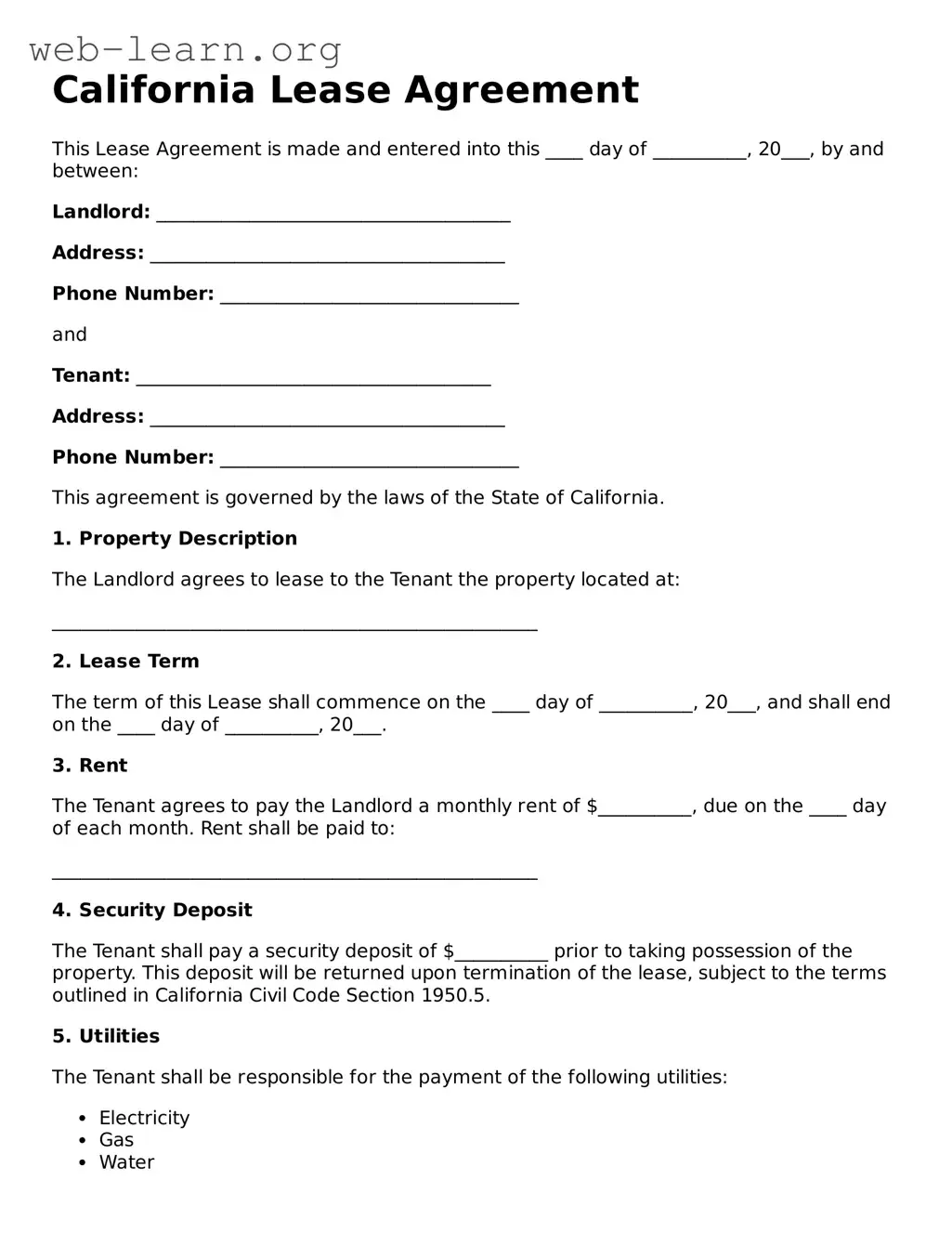
The California Lease Agreement form serves as a critical document for both landlords and tenants, outlining the terms and conditions of rental arrangements across the state. This form typically includes essential elements such as the duration of the lease, rental payment details, security deposit requirements, and maintenance responsibilities. Additionally, it addresses the rights and obligations of both parties, ensuring clarity in the event of disputes. Provisions regarding pets, subletting, and property use are often included, providing a comprehensive framework for the rental relationship. By establishing a mutual understanding, the California Lease Agreement not only protects the interests of landlords but also safeguards the rights of tenants, fostering a balanced and fair leasing environment.
California Lease Agreement
This Lease Agreement is made and entered into this ____ day of __________, 20___, by and between:
Landlord: ______________________________________
Address: ______________________________________
Phone Number: ________________________________
and
Tenant: ______________________________________
Address: ______________________________________
Phone Number: ________________________________
This agreement is governed by the laws of the State of California.
1. Property Description
The Landlord agrees to lease to the Tenant the property located at:
____________________________________________________
2. Lease Term
The term of this Lease shall commence on the ____ day of __________, 20___, and shall end on the ____ day of __________, 20___.
3. Rent
The Tenant agrees to pay the Landlord a monthly rent of $__________, due on the ____ day of each month. Rent shall be paid to:
____________________________________________________
4. Security Deposit
The Tenant shall pay a security deposit of $__________ prior to taking possession of the property. This deposit will be returned upon termination of the lease, subject to the terms outlined in California Civil Code Section 1950.5.
5. Utilities
The Tenant shall be responsible for the payment of the following utilities:
6. Maintenance and Repairs
The Tenant agrees to maintain the property in good condition. Any repairs needed due to Tenant's negligence will be the responsibility of the Tenant.
7. Pets
Pets are (allowed/not allowed). If allowed, a pet deposit of $__________ is required.
8. Termination
Either party may terminate this agreement by providing written notice at least ____ days prior to the intended termination date.
9. Governing Law
This Lease Agreement shall be governed by and construed in accordance with the laws of the State of California.
IN WITNESS WHEREOF, the parties hereto have executed this Lease Agreement as of the date first above written.
Landlord Signature: ________________________________
Date: ___________________________________________
Tenant Signature: ________________________________
Date: ___________________________________________
| Fact Name | Description |
|---|---|
| Governing Law | The California Lease Agreement is governed by California Civil Code Sections 1940-1954. |
| Parties Involved | The agreement typically includes a landlord and a tenant, both of whom must be clearly identified. |
| Lease Duration | Lease agreements can be for a fixed term or a month-to-month basis, depending on the arrangement. |
| Security Deposit | California law limits the security deposit to two months' rent for unfurnished properties and three months' rent for furnished ones. |
| Rent Payment Terms | The lease must specify the amount of rent, payment due dates, and acceptable payment methods. |
| Maintenance Responsibilities | The agreement outlines the responsibilities for maintenance and repairs, typically assigning these duties to the landlord. |
| Termination Notice | California law requires specific notice periods for lease termination, which vary based on the duration of the tenancy. |
| Use of Property | The lease should specify permitted uses of the property, such as residential or commercial purposes. |
| Disclosures Required | Landlords must provide certain disclosures, including information about lead-based paint and mold, as required by state law. |
Filling out the California Lease Agreement form is an important step in establishing a rental relationship. Completing this form accurately ensures that both the landlord and tenant understand their rights and responsibilities. Follow the steps below to fill out the form correctly.
A California Lease Agreement is a legally binding contract between a landlord and a tenant. It outlines the terms and conditions under which a tenant can occupy a rental property. The agreement typically includes details such as the rental amount, duration of the lease, security deposit, and responsibilities of both parties.
Key terms to include in a California Lease Agreement are:
Lease terms in California can vary widely. Common terms include:
Generally, landlords cannot increase rent during a fixed-term lease unless specified in the agreement. For month-to-month leases, landlords must provide at least 30 days’ notice for rent increases. However, local rent control laws may impose additional restrictions.
A security deposit is a sum of money collected by the landlord to cover potential damages or unpaid rent. In California, the maximum security deposit is typically equivalent to:
Landlords must return the deposit within 21 days after the tenant moves out, minus any deductions for repairs or unpaid rent.
Tenants in California have several important rights, including:
If a tenant needs to break the lease, they should first review the lease terms to understand the penalties involved. It is advisable to communicate with the landlord as soon as possible. In some cases, a tenant may be able to negotiate an early termination agreement. California law also allows for lease termination under certain circumstances, such as domestic violence or uninhabitable conditions.
When filling out a California Lease Agreement form, many individuals overlook crucial details that can lead to misunderstandings or legal issues down the line. One common mistake is failing to include the full names of all tenants. This omission can create confusion about who is responsible for the lease terms and can complicate matters if disputes arise.
Another frequent error involves not specifying the rental amount clearly. It’s essential to state the exact monthly rent and any additional fees. Leaving this information vague can lead to disagreements between landlords and tenants regarding payment expectations.
Some people forget to include the security deposit amount. This detail is vital, as it outlines the financial commitment of the tenant and protects the landlord's interests. Not addressing this can lead to disputes over what the tenant owes before moving in.
Additionally, many individuals neglect to define the lease term clearly. Whether it’s a month-to-month agreement or a fixed-term lease, clarity is key. Vague language can lead to misunderstandings about when the lease begins and ends, potentially resulting in unexpected consequences.
Another mistake is failing to outline the rules regarding pets. Many landlords have specific pet policies, and not including these can lead to conflicts. Tenants should be aware of any restrictions or additional fees associated with having pets on the property.
People often overlook the importance of specifying maintenance responsibilities. Who is responsible for repairs? This should be clearly stated in the agreement to avoid confusion later. If maintenance responsibilities are not defined, both parties may have different expectations, leading to frustration.
Not including the process for terminating the lease is another common error. Clear guidelines on how to end the lease, including notice periods, can prevent misunderstandings and potential legal disputes. Both landlords and tenants should be aware of their rights and obligations in this regard.
Some individuals also forget to include provisions for late payments. Establishing clear penalties for late rent can deter delays and provide a structured approach to handling such situations. Without this information, tenants may not understand the consequences of late payments.
Another mistake is neglecting to address subletting policies. If tenants wish to sublet their unit, the lease should clearly outline whether this is allowed and under what conditions. Failing to address this can lead to unauthorized subletting and potential eviction.
Lastly, many people do not take the time to read the lease agreement thoroughly before signing. This oversight can lead to agreeing to terms that are not fully understood. It’s crucial for both landlords and tenants to review the document carefully to ensure that all terms are clear and acceptable.
When entering into a rental agreement in California, several additional forms and documents may be necessary to ensure clarity and protect the rights of both landlords and tenants. These documents help outline responsibilities, provide essential information, and establish terms that govern the rental relationship.
Utilizing these forms alongside the California Lease Agreement helps create a transparent and organized rental process. Each document plays a vital role in fostering a positive landlord-tenant relationship and safeguarding the interests of both parties.
Rental Agreement: Similar to a lease agreement, a rental agreement outlines the terms of renting a property. However, it is typically for a shorter duration, often month-to-month, while a lease is usually for a longer term, such as a year.
Sublease Agreement: This document allows a tenant to lease their rented space to another individual. It includes similar terms as a lease agreement, such as rent amount and duration, but is specific to the arrangement between the original tenant and the subtenant.
Commercial Lease Agreement: This type of lease is specifically designed for commercial properties. It includes terms related to business use, maintenance responsibilities, and often different payment structures compared to residential leases.
Month-to-Month Lease: This agreement provides flexibility for both landlords and tenants. Like a lease agreement, it outlines rent and property rules, but it allows either party to terminate the agreement with short notice, typically 30 days.
Property Management Agreement: This document establishes the relationship between a property owner and a property management company. It includes terms about rent collection, maintenance responsibilities, and property management fees, similar to a lease in its detail-oriented nature.
When filling out the California Lease Agreement form, it’s important to be careful and thorough. Here’s a list of things you should and shouldn’t do:
Misconception 1: The California Lease Agreement is the same for all types of rental properties.
This is not true. Different types of properties, such as residential, commercial, or industrial, may require specific terms and conditions in their lease agreements. A one-size-fits-all approach does not apply.
Misconception 2: A verbal agreement is as binding as a written lease.
While verbal agreements can be enforceable, they are much harder to prove in court. A written lease provides clear terms and protects both parties.
Misconception 3: The lease agreement can include any terms the landlord wants.
Landlords must adhere to California's laws when drafting lease agreements. Certain terms, such as discriminatory clauses or illegal fees, are not allowed.
Misconception 4: Tenants have no rights once they sign the lease.
This is incorrect. Tenants retain rights under California law, including the right to a habitable living environment and protection against unlawful eviction.
Misconception 5: A lease automatically renews without notice.
Many leases contain specific terms regarding renewal. If a tenant wishes to avoid automatic renewal, they should check the lease terms and provide proper notice.
Misconception 6: Security deposits can be kept by the landlord for any reason.
Landlords can only retain security deposits for specific reasons, such as unpaid rent or damage beyond normal wear and tear. They must provide an itemized statement of deductions.
When filling out and using the California Lease Agreement form, it is essential to understand several key aspects to ensure a smooth rental experience. Here are five important takeaways:
By paying attention to these key elements, both landlords and tenants can foster a positive rental relationship and mitigate potential conflicts.
Free Rental Agreement Template - The agreement can clarify the landlord's policy on lease transfers or assignments.
Free Lease Agreement Florida - Clarifies the rules for common areas, if applicable.
House Rental Agreement Template - The agreement may outline the landlord's right to enter the property for inspections.