In California, creating a Last Will and Testament is a crucial step in ensuring that your wishes are honored after your passing. This legal document serves as a roadmap for distributing your assets, appointing guardians for minor children, and designating an executor to manage your estate. The form typically includes vital information such as the testator's name, a declaration that the document is indeed a will, and a detailed list of beneficiaries along with their respective shares of the estate. Additionally, it addresses the appointment of an executor, who will be responsible for carrying out the terms of the will and ensuring that all debts and taxes are settled. California law also allows for the inclusion of specific bequests, which can outline particular items or amounts of money to be given to named individuals. Importantly, the will must be signed and witnessed according to state requirements to ensure its validity. Understanding these key elements can help individuals navigate the process of drafting a will that reflects their personal wishes and provides peace of mind for their loved ones.
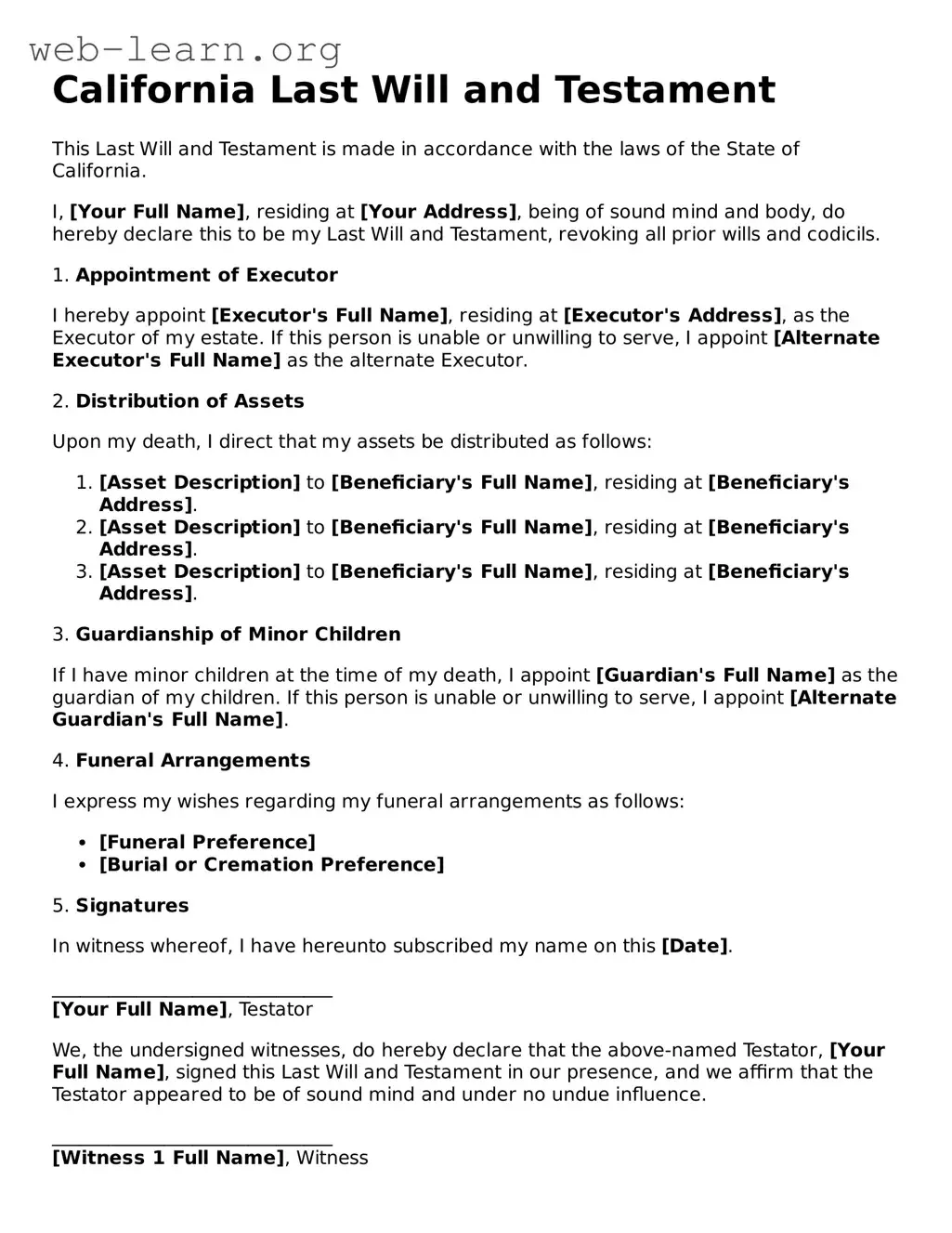
California Last Will and Testament
This Last Will and Testament is made in accordance with the laws of the State of California.
I, [Your Full Name], residing at [Your Address], being of sound mind and body, do hereby declare this to be my Last Will and Testament, revoking all prior wills and codicils.
1. Appointment of Executor
I hereby appoint [Executor's Full Name], residing at [Executor's Address], as the Executor of my estate. If this person is unable or unwilling to serve, I appoint [Alternate Executor's Full Name] as the alternate Executor.
2. Distribution of Assets
Upon my death, I direct that my assets be distributed as follows:
3. Guardianship of Minor Children
If I have minor children at the time of my death, I appoint [Guardian's Full Name] as the guardian of my children. If this person is unable or unwilling to serve, I appoint [Alternate Guardian's Full Name].
4. Funeral Arrangements
I express my wishes regarding my funeral arrangements as follows:
5. Signatures
In witness whereof, I have hereunto subscribed my name on this [Date].
______________________________
[Your Full Name], Testator
We, the undersigned witnesses, do hereby declare that the above-named Testator, [Your Full Name], signed this Last Will and Testament in our presence, and we affirm that the Testator appeared to be of sound mind and under no undue influence.
______________________________
[Witness 1 Full Name], Witness
______________________________
[Witness 2 Full Name], Witness
| Fact Name | Details |
|---|---|
| Governing Law | The California Probate Code governs the Last Will and Testament. |
| Age Requirement | Individuals must be at least 18 years old to create a valid will in California. |
| Signature Requirement | The will must be signed by the testator (the person making the will). |
| Witness Requirement | At least two witnesses are required to sign the will, affirming they witnessed the testator's signature. |
| Holographic Wills | California recognizes holographic wills, which are handwritten and do not require witnesses if the signature and material provisions are in the testator's handwriting. |
| Revocation | A will can be revoked by the testator at any time, either by creating a new will or by physically destroying the old one. |
| Self-Proving Wills | California allows for self-proving wills, which streamline the probate process by including a notarized affidavit from witnesses. |
| Distribution of Assets | The will specifies how the testator's assets will be distributed after their death, including who receives what. |
| Executor Appointment | The testator can appoint an executor in the will to manage the estate and ensure the will's terms are carried out. |
| Legal Capacity | The testator must have the legal capacity to understand the nature of making a will and the consequences of their decisions. |
Creating a Last Will and Testament is an essential step in ensuring your wishes are honored after your passing. Once you have gathered the necessary information and materials, you can begin filling out the form. The process is straightforward and can be completed in a few simple steps.
What is a California Last Will and Testament?
A California Last Will and Testament is a legal document that outlines how an individual wishes their assets and property to be distributed after their death. It can also designate guardians for minor children and specify any final wishes regarding funeral arrangements. This document serves as a critical tool for ensuring that a person's wishes are honored and can help to avoid potential disputes among heirs.
Who can create a Last Will and Testament in California?
In California, any individual who is at least 18 years old and of sound mind can create a Last Will and Testament. Sound mind generally means that the person understands the nature of the document, the extent of their property, and the intended beneficiaries. It is important for the individual to be free from undue influence or coercion when drafting the will.
What are the requirements for a valid Last Will and Testament in California?
To be considered valid, a Last Will and Testament in California must meet specific requirements:
If these requirements are not met, the will may be deemed invalid, which could lead to complications in the distribution of the estate.
Can I change or revoke my Last Will and Testament?
Yes, individuals can change or revoke their Last Will and Testament at any time while they are still of sound mind. To make changes, a new will can be drafted, or an existing will can be amended with a codicil. A codicil is a separate document that makes specific changes to the original will. To revoke a will, the testator can either create a new will that explicitly states the previous will is revoked or destroy the original document. It is advisable to follow proper legal procedures to ensure that the revocation is effective.
Filling out a California Last Will and Testament form can be straightforward, but many people make common mistakes that can lead to complications. One frequent error is not clearly identifying the testator. The testator is the person making the will. If the name is misspelled or incomplete, it could create confusion about the document's validity.
Another common mistake is failing to properly sign the will. In California, a will must be signed by the testator and witnessed by at least two individuals. If the will lacks the necessary signatures, it may not be considered valid. It's crucial to ensure that all required signatures are present before finalizing the document.
Some individuals neglect to update their wills after significant life events. Changes such as marriage, divorce, or the birth of a child should prompt a review of the will. Failing to make these updates can result in unintended beneficiaries or outdated instructions regarding asset distribution.
Additionally, people often overlook the importance of being specific about asset distribution. Vague language can lead to misunderstandings among beneficiaries. Clearly stating who receives what can help prevent disputes and ensure that the testator's wishes are honored.
Lastly, many individuals forget to store their will in a safe and accessible location. A will that cannot be found after the testator's passing can lead to delays in the probate process. It's advisable to inform trusted family members or an attorney about where the will is kept to avoid unnecessary complications.
When creating a California Last Will and Testament, several other documents may also be necessary to ensure that your estate is managed according to your wishes. Each of these documents serves a specific purpose in the estate planning process.
Each of these documents plays a crucial role in comprehensive estate planning. By addressing various aspects of your estate, you can provide clarity and direction for your loved ones during a difficult time.
When filling out the California Last Will and Testament form, it’s important to follow certain guidelines to ensure your document is valid and reflects your wishes. Here’s a list of things to do and avoid.
When it comes to creating a Last Will and Testament in California, several misconceptions often arise. Understanding the truth behind these myths can help individuals make informed decisions about their estate planning. Here are four common misconceptions:
Many believe that only formally typed wills are legally binding. However, California recognizes handwritten wills, known as holographic wills, as valid provided they meet certain criteria. The testator must write and sign the will in their own handwriting, and it must clearly express their wishes regarding the distribution of their assets.
While having a trust can streamline the distribution of assets, it does not replace the need for a will. A will can address any assets not included in the trust and designate guardians for minor children. It acts as a supplementary document to ensure all wishes are clearly articulated.
Some individuals think they can simply write a new will or make changes without following legal procedures. In California, to ensure that a will is valid, any modifications must be made in writing and signed by the testator. This prevents disputes and confusion regarding the testator's intentions.
This belief is misleading. Everyone, regardless of their financial status, can benefit from having a will. A will provides clarity about how personal belongings, assets, and responsibilities will be managed after death. It can also simplify the process for loved ones during a difficult time.
Filling out and using a California Last Will and Testament form is an important step in ensuring that your wishes are honored after your passing. Here are some key takeaways to consider:
By keeping these points in mind, you can create a Last Will and Testament that accurately reflects your wishes and provides peace of mind for you and your loved ones.
Free Illinois Will Template - Can include charitable donations or bequests to organizations.
Free Will Forms to Print - Is often recommended to be reviewed regularly, especially after major life changes.
Will Template Alabama - Can serve as a guide for family discussions about inheritance and values.
Kansas Will - Include provisions for your business interests if applicable.