Homepage Blank California Laciv 198 Form
Outline

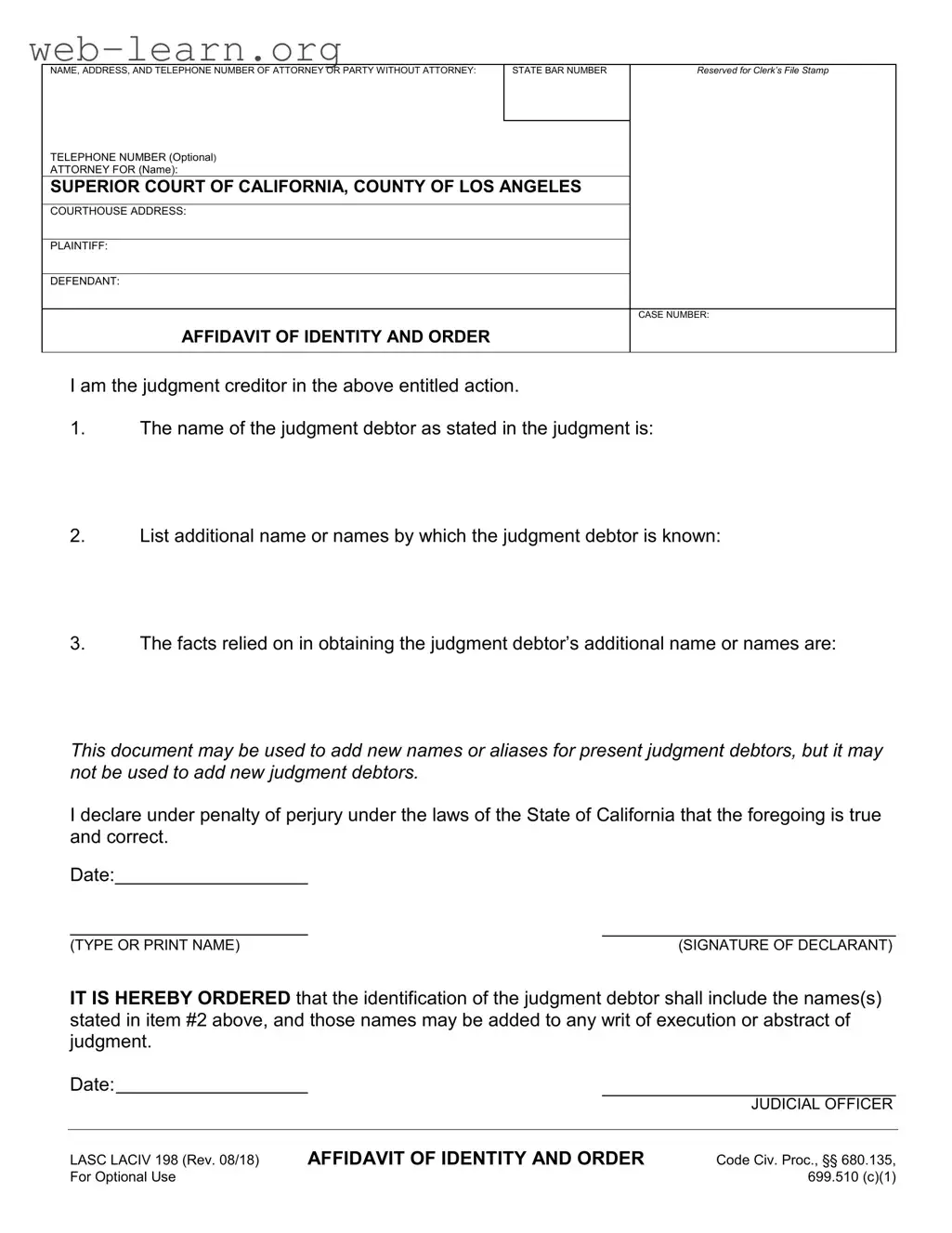
The California Laciv 198 form serves a crucial role in the enforcement of judgments within the state’s legal framework. This form, formally titled "Affidavit of Identity and Order," is utilized primarily by judgment creditors who need to clarify or expand the identity of a judgment debtor. It allows creditors to list additional names or aliases associated with the debtor, ensuring that all relevant identities are recognized in the enforcement process. By including the judgment debtor's name as stated in the original judgment, along with any other known names, the form helps streamline the collection process. Importantly, it does not permit the addition of new judgment debtors, maintaining focus on those already identified in the case. The form requires the creditor to declare the truthfulness of the information provided under penalty of perjury, emphasizing the seriousness of the declaration. Once completed, this document is submitted to the Superior Court of California, where it can facilitate the inclusion of the debtor's additional names on any writ of execution or abstract of judgment. The judicial officer's order at the bottom of the form finalizes the process, ensuring that all necessary details are officially recognized and actionable.

Sample - California Laciv 198 Form

LASC LACIV 198 (Rev. 08/18) AFFIDAVIT OF IDENTITY AND ORDER Code Civ. Proc., §§ 680.135,
For Optional Use 699.510 (c)(1)
NAME, ADDRESS, AND TELEPHONE NUMBER OF ATTORNEY OR PARTY WITHOUT ATTORNEY:
TELEPHONE NUMBER (Optional)
ATTORNEY FOR (Name):
STATE BAR NUMBER
Reserved for Clerk’s File Stamp
SUPERIOR COURT OF CALIFORNIA, COUNTY OF LOS ANGELES
COURTHOUSE ADDRESS:
PLAINTIFF:
DEFENDANT:
AFFIDAVIT OF IDENTITY AND ORDER
CASE NUMBER:
I am the judgment creditor in the above entitled action.
1. The name of the judgment debtor as stated in the judgment is:
2. List additional name or names by which the judgment debtor is known:
3. The facts relied on in obtaining the judgment debtor’s additional name or names are:
This document may be used to add new names or aliases for present judgment debtors, but it may
not be used to add new judgment debtors.
I declare under penalty of perjury under the laws of the State of California that the foregoing is true
and correct.
Date:
(TYPE OR PRINT NAME) (SIGNATURE OF DECLARANT)
IT IS HEREBY ORDERED that the identification of the judgment debtor shall include the names(s)
stated in item #2 above, and those names may be added to any writ of execution or abstract of
judgment.
Date:
JUDICIAL OFFICER

Form Information

Fact Name Details
Form Title LACIV 198 - Affidavit of Identity and Order
Purpose This form is used to add new names or aliases for existing judgment debtors.
Limitations The form cannot be used to add new judgment debtors; it is strictly for existing ones.
Judgment Creditor The individual or entity that holds the judgment and is seeking to identify the debtor.
Judgment Debtor The person or entity against whom the judgment has been entered.
Governing Laws California Code of Civil Procedure, Sections 680.135 and 699.510 (c)(1).
Signature Requirement The declarant must sign the form, declaring the information is true under penalty of perjury.
Clerk's File Stamp A reserved space for the clerk to stamp the form, indicating it has been filed.
Judicial Officer's Role The judicial officer reviews and orders the inclusion of the additional names in the judgment records.

Detailed Guide for Filling Out California Laciv 198

Completing the California Laciv 198 form is an important step in updating the identification of a judgment debtor. After filling out the form, you will submit it to the appropriate court, which will review the information and issue an order based on your affidavit. Follow these steps to ensure you fill out the form correctly.

  1. Begin by entering your name, address, and telephone number in the designated section at the top of the form.
  2. Provide your State Bar number if you are an attorney. If you are not, leave this section blank.
  3. Fill in the name of the attorney representing you or write "Party Without Attorney" if applicable.
  4. Write the name of the plaintiff and the defendant in the corresponding fields.
  5. Enter the case number associated with the judgment in the specified area.
  6. In item #1, state the name of the judgment debtor as it appears in the judgment.
  7. For item #2, list any additional names or aliases by which the judgment debtor is known.
  8. In item #3, describe the facts that support the use of the additional names provided in item #2.
  9. Sign and date the form where indicated. Make sure to print your name clearly under your signature.
  10. Leave the section for the judicial officer blank, as this will be filled out by the court.

Obtain Answers on California Laciv 198

  1. What is the California Laciv 198 form?

    The California Laciv 198 form is an official document used in the Superior Court of California. It serves as an Affidavit of Identity and Order. This form allows a judgment creditor to add additional names or aliases of a judgment debtor to the court records. However, it does not permit the addition of new judgment debtors.

  2. Who needs to fill out the Laciv 198 form?

    This form is intended for use by judgment creditors. If you are a creditor who has obtained a judgment against a debtor and you need to identify them by other names or aliases, you should complete this form.

  3. What information is required on the form?

    You will need to provide the following details:

    • Your name, address, and telephone number.
    • The name of the judgment debtor as stated in the judgment.
    • Any additional names or aliases by which the judgment debtor is known.
    • The facts that support the use of these additional names.
  4. Can I use this form to add a new judgment debtor?

    No, the Laciv 198 form cannot be used to add new judgment debtors. It is strictly for adding additional names or aliases of an existing judgment debtor.

  5. What happens after I submit the Laciv 198 form?

    Once you submit the form, a judicial officer will review it. If approved, the names you provided in item #2 will be officially recognized. These names can then be added to any writ of execution or abstract of judgment related to your case.

  6. Is there a penalty for providing false information on this form?

    Yes, there is a penalty for providing false information. You must declare under penalty of perjury that the information you provided is true and correct. Providing false information can lead to legal consequences.

  7. What should I do if I need assistance with the form?

    If you need help completing the Laciv 198 form, consider reaching out to a legal professional. They can guide you through the process and ensure that all information is filled out correctly.

  8. Where do I submit the completed Laciv 198 form?

    You should submit the completed form to the Superior Court of California, County of Los Angeles, at the courthouse address specified in the form. Make sure to keep a copy for your records.

Common mistakes

Filling out the California Laciv 198 form can be straightforward, but many people make common mistakes that can lead to delays or complications. One frequent error is failing to provide complete and accurate information. When listing the name of the judgment debtor, it’s crucial to ensure that the name matches exactly as it appears in the judgment. Inaccuracies, even small typos, can cause confusion and may result in the form being rejected.

Another mistake often seen is neglecting to include additional names or aliases that the judgment debtor might be known by. This section is important because it helps to clarify the identity of the debtor. If this information is omitted, it could hinder the enforcement of the judgment. Always take the time to think through any other names that might be relevant.

Some individuals also overlook the necessity of providing the facts that support the additional names listed. This section requires a clear explanation of how you know the judgment debtor by these other names. Without this context, the court may find it difficult to accept the additional names, which could complicate the process.

Additionally, many people forget to sign the form. A signature is essential, as it verifies the authenticity of the information provided. Not only does a missing signature delay proceedings, but it can also raise questions about the validity of the submission. Always double-check that your signature is included before submitting the form.

Another common oversight is not including the date on the form. The date serves as a reference point for when the affidavit was completed. Omitting this detail can lead to confusion and may even result in the form being considered incomplete. Make it a habit to include the date every time you fill out a legal document.

Lastly, people sometimes fail to review the entire form before submission. It’s easy to overlook small details when filling out a form, but a thorough review can catch mistakes before they become issues. Taking a moment to read through the completed form can save time and prevent unnecessary complications down the road.

Documents used along the form

When dealing with legal matters in California, especially in relation to judgments, several forms and documents often accompany the California Laciv 198 form. Understanding these documents can help clarify the process and ensure that all necessary information is provided. Below is a list of commonly used forms that may be relevant.

  • Writ of Execution: This document is issued by the court and authorizes the sheriff or another enforcement officer to seize the debtor's property to satisfy a judgment.
  • Abstract of Judgment: A summary of the judgment that can be recorded with the county recorder's office. This creates a lien on the debtor's real property.
  • Notice of Judgment Lien: This notice informs the debtor and other interested parties that a judgment lien has been placed against the debtor’s property.
  • Application for Renewal of Judgment: If a judgment is nearing expiration, this application can be filed to extend its enforceability for another ten years.
  • Request for Entry of Default: If a defendant fails to respond to a lawsuit, this request can be filed to obtain a default judgment against them.
  • Request for Court Order: This document is used to ask the court for specific orders related to the enforcement of a judgment.
  • Declaration of Service: This form confirms that legal documents have been properly served to the relevant parties involved in the case.
  • Financial Disclosure Form: This form requires the debtor to disclose their financial situation, which can be important for determining the ability to pay the judgment.

Each of these documents plays a critical role in the legal process surrounding judgments. It’s essential to ensure that they are completed accurately and submitted on time to avoid delays or complications in enforcement. Familiarity with these forms can help navigate the complexities of the legal system more effectively.

Similar forms

The California Laciv 198 form is used in legal proceedings to identify judgment debtors accurately. Here are ten other documents that serve similar purposes in various contexts:

  • Affidavit of Identity: This document confirms the identity of an individual, often used in various legal processes to ensure the correct person is involved.
  • Judgment Creditor's Claim: This form allows a creditor to assert their claim against a debtor, similar to how the Laciv 198 identifies the debtor.
  • Writ of Execution: This legal order allows creditors to enforce a judgment, requiring identification of the debtor, akin to the Laciv 198.
  • Abstract of Judgment: This document summarizes the judgment and includes the debtor's identity, paralleling the purpose of the Laciv 198 form.
  • Notice of Judgment Lien: This form establishes a lien against a debtor's property, relying on accurate identification similar to the Laciv 198.
  • Request for Order: This document is used to request the court to take action, often requiring identification of parties involved, much like the Laciv 198.
  • Substitution of Attorney: This form identifies a change in legal representation, requiring accurate names and contact information, similar to the Laciv 198.
  • Declaration of Service: This document verifies that legal papers were served to the correct individual, emphasizing the need for proper identification.
  • Identity Theft Affidavit: This form helps victims report identity theft and verify their identity, which aligns with the identification purpose of the Laciv 198.
  • Change of Name Petition: This document requests a legal name change and requires the individual's current and new names, paralleling the identification function of the Laciv 198.

Dos and Don'ts

When filling out the California Laciv 198 form, follow these guidelines to ensure accuracy and compliance.

  • Do provide your complete name, address, and phone number at the top of the form.
  • Do clearly state the name of the judgment debtor as it appears in the judgment.
  • Do list any additional names or aliases of the judgment debtor in item #2.
  • Do include specific facts that support the additional names in item #3.
  • Don't use this form to add new judgment debtors; it is strictly for existing ones.
  • Don't forget to sign and date the form before submission.
  • Don't leave any sections blank; incomplete forms may be rejected.

By adhering to these dos and don'ts, you can avoid common pitfalls and streamline the process of submitting the Laciv 198 form.

Misconceptions

Misconceptions about the California Laciv 198 form can lead to confusion. Here are seven common misunderstandings clarified:

  • This form can be used to add new judgment debtors. This is incorrect. The Laciv 198 form is specifically for adding names or aliases of existing judgment debtors, not for introducing new ones.
  • The form requires extensive legal knowledge to complete. In reality, the form is straightforward. Basic information about the judgment debtor is all that is needed.
  • Filing this form guarantees a successful judgment collection. While the form helps clarify the identity of the judgment debtor, it does not ensure that the debt will be collected.
  • You must have an attorney to file the Laciv 198 form. Individuals can file this form without legal representation, although consulting an attorney can be beneficial.
  • Only the original judgment creditor can file this form. Any party with an interest in the judgment may be able to file, provided they can establish their connection to the case.
  • The information on the form is confidential. This is misleading. While certain details may be protected, the information can be accessed by involved parties in the case.
  • The form must be filed in person at the courthouse. Many jurisdictions allow for electronic filing, making the process more convenient.

Understanding these misconceptions can help ensure that you use the Laciv 198 form effectively and appropriately.

Key takeaways

When filling out and using the California Laciv 198 form, it is important to keep several key points in mind. Here are ten essential takeaways:

  • Identify Yourself: Clearly state your name, address, and telephone number at the top of the form.
  • Judgment Creditor: Confirm that you are the judgment creditor in the case.
  • Judgment Debtor's Name: Provide the name of the judgment debtor as it appears in the judgment.
  • Additional Names: List any additional names or aliases the judgment debtor may use.
  • Supporting Facts: Include facts that support the use of these additional names.
  • Limitations: Remember that this form cannot be used to add new judgment debtors.
  • Declaration: Sign the form, declaring under penalty of perjury that the information is accurate.
  • Judicial Officer's Order: The form must be signed by a judicial officer to be effective.
  • Use of Names: The names added can be included in any writ of execution or abstract of judgment.
  • Keep Copies: Always keep copies of the completed form for your records.

Understanding these points will help ensure that you fill out the Laciv 198 form correctly and use it effectively in your legal proceedings.