Homepage Blank California L 206 Form
Outline

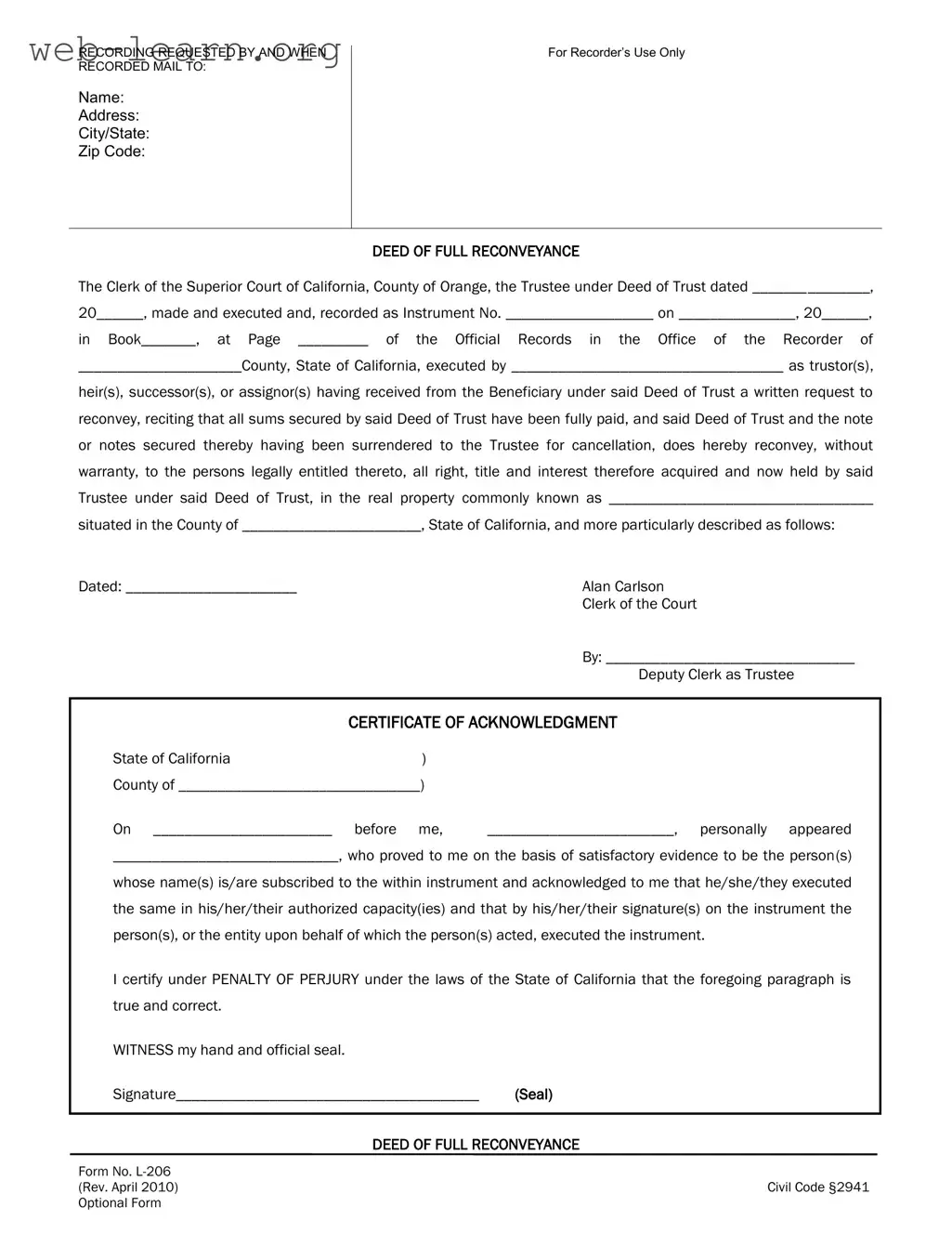
The California L 206 form, known as the Deed of Full Reconveyance, plays a vital role in real estate transactions within the state. This document is primarily used to indicate that a borrower has fully repaid their mortgage, allowing the lender to officially release their claim on the property. The form includes essential details such as the names of the parties involved, the date of the original deed of trust, and the specific property being reconveyed. It also requires the signature of the Clerk of the Court, who acts as the Trustee, and may include a certificate of acknowledgment to verify the identities of those signing the document. By completing the L 206 form, all rights and interests in the property are returned to the borrower, ensuring a clear title moving forward. This process is crucial for homeowners looking to confirm their ownership free from any liens or encumbrances, making the L 206 an important tool in the realm of real estate law in California.

Sample - California L 206 Form

Form No. L-206
(Rev. April 2010) Civil Code §2941
Optional Form
DEED OF FULL RECONVEYANCE
The Clerk of the Superior Court of California, County of Orange, the Trustee under Deed of Trust dated _______________,
20______, made and executed and, recorded as Instrument No. ___________________ on _______________, 20______,
in Book_______, at Page _________ of the Official Records in the Office of the Recorder of
_____________________County, State of California, executed by ___________________________________ as trustor(s),
heir(s), successor(s), or assignor(s) having received from the Beneficiary under said Deed of Trust a written request to
reconvey, reciting that all sums secured by said Deed of Trust have been fully paid, and said Deed of Trust and the note
or notes secured thereby having been surrendered to the Trustee for cancellation, does hereby reconvey, without
warranty, to the persons legally entitled thereto, all right, title and interest therefore acquired and now held by said
Trustee under said Deed of Trust, in the real property commonly known as __________________________________
situated in the County of _______________________, State of California, and more particularly described as follows:
Dated: ______________________ Alan Carlson
Clerk of the Court
By: ________________________________
Deputy Clerk as Trustee
DEED OF FULL RECONVEYANCE
RECORDING REQUESTED BY AND WHEN
RECORDED MAIL TO:
Name:
Address:
City/State:
Zip Code:
For Recorder’s Use Only
CERTIFICATE OF ACKNOWLEDGMENT
State of California )
County of _______________________________)
On _______________________ before me, ________________________, personally appeared
_____________________________, who proved to me on the basis of satisfactory evidence to be the person(s)
whose name(s) is/are subscribed to the within instrument and acknowledged to me that he/she/they executed
the same in his/her/their authorized capacity(ies) and that by his/her/their signature(s) on the instrument the
person(s), or the entity upon behalf of which the person(s) acted, executed the instrument.
I certify under PENALTY OF PERJURY under the laws of the State of California that the foregoing paragraph is
true and correct.
WITNESS my hand and official seal.
Signature_______________________________________
(Seal)

Form Information

Fact Name Details
Form Purpose The California L 206 form is used for a Deed of Full Reconveyance, which indicates that a loan secured by a deed of trust has been fully paid off.
Governing Law This form is governed by California Civil Code §2941, which outlines the requirements for reconveyance of a deed of trust.
Form Revision Date The L 206 form was last revised in April 2010, ensuring it meets current legal standards.
Signature Requirement A certificate of acknowledgment is required, confirming that the signatory is authorized and has executed the document willingly.
Recorder's Use The form must be recorded with the county recorder's office, where it serves as public notice that the associated debt has been satisfied.

Detailed Guide for Filling Out California L 206

Filling out the California L 206 form requires careful attention to detail. This form is used to document the reconveyance of a deed of trust, which means that the trustee is returning the property to the rightful owner after the debt has been fully paid. Follow these steps to ensure the form is completed correctly.

  1. Gather Required Information: Collect all necessary details, including the names of the parties involved, property address, and dates related to the deed of trust.
  2. Fill in the Recording Information: In the top section, write the name and address of the person or entity requesting the recording. Include the city, state, and zip code.
  3. Enter Deed of Trust Details: Below the recording information, input the date of the deed of trust, the recording instrument number, and the date it was recorded. Also, provide the book and page numbers from the official records.
  4. List the Trustor(s): Write the name(s) of the trustor(s), heir(s), successor(s), or assignor(s) who executed the deed of trust.
  5. State the Beneficiary's Request: Include a statement that the beneficiary has requested the reconveyance and that all sums secured by the deed of trust have been fully paid.
  6. Property Description: Clearly describe the property being reconveyed. Include its common name and any additional details needed for identification.
  7. Sign and Date: The form must be signed by the trustee. Include the date of signing and the name of the trustee, which should be printed below the signature.
  8. Complete the Acknowledgment Section: This section requires the notary public to verify the identities of the signers. Leave space for the notary's signature, seal, and date.

Once the form is filled out, review it for accuracy. Ensure that all required fields are completed and that the signatures are in place. After verification, the form can be submitted for recording with the appropriate county recorder's office.

Obtain Answers on California L 206

  1. What is the California L 206 form?

    The California L 206 form, also known as the Deed of Full Reconveyance, is a legal document used to indicate that a borrower has fully repaid a loan secured by a deed of trust. This form is essential for the borrower to clear the title of the property and confirm that the lender no longer has any claim to the property.

  2. When is the L 206 form used?

    This form is utilized when a borrower has paid off the debt associated with a deed of trust. It serves to officially document the reconveyance of the property back to the borrower, confirming that all obligations under the deed of trust have been satisfied.

  3. Who fills out the L 206 form?

    The trustee named in the deed of trust is responsible for completing the L 206 form. This trustee acts on behalf of the lender and will execute the reconveyance once they have received the necessary documentation indicating that the loan has been paid in full.

  4. What information is required on the L 206 form?

    The form requires various pieces of information, including:

    • The date of the original deed of trust
    • The recording details of the deed of trust
    • The names of the trustor(s)
    • A description of the property being reconveyed
    • The date of reconveyance
  5. Do I need to notarize the L 206 form?

    Yes, the L 206 form must be notarized. A notary public will verify the identity of the individuals signing the document and ensure that it is executed correctly. This step adds a layer of authenticity and legal validity to the reconveyance.

  6. Where do I file the L 206 form?

    The completed L 206 form must be filed with the county recorder's office in the county where the property is located. This filing is crucial as it updates public records to reflect that the deed of trust has been fully reconveyed.

  7. What happens if the L 206 form is not filed?

    If the L 206 form is not filed, the deed of trust may still appear to be in effect, which can create complications for the borrower. The borrower may face difficulties in selling or refinancing the property, as the lender's claim may still be recorded in public records.

  8. Can I use the L 206 form for any type of property?

    The L 206 form can be used for residential and commercial properties, as long as they are secured by a deed of trust. It is important to ensure that all obligations under the deed of trust have been fulfilled before using this form.

  9. Is there a fee associated with filing the L 206 form?

    Yes, there is typically a fee for filing the L 206 form with the county recorder's office. The amount may vary by county, so it is advisable to check with the local recorder's office for the exact fee structure.

  10. What if I have more questions about the L 206 form?

    If you have additional questions about the L 206 form, it is recommended to consult with a real estate attorney or a professional familiar with California real estate law. They can provide guidance tailored to your specific situation.

Common mistakes

When completing the California L 206 form, individuals often make several common mistakes that can lead to delays or complications. One frequent error is failing to provide complete and accurate information in the "Recording Requested By" section. Missing details such as the name, address, or city/state can result in the form being rejected.

Another mistake involves neglecting to fill in the date of the Deed of Trust. This date is essential for establishing the timeline of the transaction. Omitting it may create confusion about the validity of the reconveyance.

People sometimes forget to include the correct Instrument Number and recording dates. These details are crucial for identifying the original Deed of Trust in the public records. Inaccuracies can lead to difficulties in tracking the document later.

Many individuals also overlook the necessity of signing the form. Both the Trustee and the person requesting the reconveyance must provide their signatures. Without these, the document cannot be processed.

Additionally, there can be errors in the description of the property. It is important to ensure that the property is accurately identified, including its common name and legal description. Incomplete or incorrect descriptions can lead to disputes about property ownership.

Some people fail to provide a proper acknowledgment of the signatures. The Certificate of Acknowledgment must be filled out correctly, including the name of the notary and the date of acknowledgment. Missing or incorrect information in this section can invalidate the form.

Another common issue is not including the official seal of the notary public. The absence of this seal may render the document unenforceable, as it is a requirement for legal acknowledgment.

Finally, individuals sometimes do not keep a copy of the completed form for their records. Retaining a copy is important for future reference and can help resolve any disputes that may arise later regarding the reconveyance.

Documents used along the form

The California L 206 form, known as the Deed of Full Reconveyance, is an essential document in real estate transactions, particularly when a mortgage has been fully paid off. Alongside this form, several other documents are often utilized to ensure a smooth and legally sound process. Below is a list of these related forms and documents.

  • Grant Deed: This document transfers ownership of real property from one party to another. It guarantees that the seller has the right to sell the property and that there are no undisclosed encumbrances.
  • Trustee's Deed: Used when a property is sold at a foreclosure auction, this deed transfers the property from the trustee to the winning bidder, ensuring the new owner has legal title.
  • Notice of Default: This document is filed when a borrower fails to meet mortgage payments. It serves as a formal notice that the borrower is in default, initiating the foreclosure process.
  • Notice of Sale: Issued after a Notice of Default, this document announces the date and time of the foreclosure auction, providing public notice of the impending sale.
  • Affidavit of Death: In cases where a property owner passes away, this affidavit helps clarify the transfer of ownership to heirs, simplifying the probate process.
  • Title Insurance Policy: This policy protects the buyer and lender against any claims or disputes regarding the property’s title, ensuring that the ownership is free from legal issues.

These documents play a vital role in the real estate process in California. Understanding their purpose can help individuals navigate property transactions more effectively and with greater confidence.

Similar forms

  • Deed of Trust: Similar to the California L 206 form, a Deed of Trust establishes a loan agreement where a borrower conveys property to a trustee for the benefit of a lender. Both documents involve the transfer of interest in real property and outline the responsibilities of each party.
  • Grant Deed: A Grant Deed transfers ownership of real property from one party to another. Like the L 206, it provides a clear statement of the property being conveyed and serves to confirm that the transfer has occurred, although it does not address the underlying debt.
  • Quitclaim Deed: This document allows one party to transfer any interest they have in a property to another party. While the L 206 focuses on reconveyance after debt satisfaction, a Quitclaim Deed does not guarantee that the grantor has any ownership interest to transfer.
  • Warranty Deed: A Warranty Deed provides a guarantee from the seller that they hold clear title to a property and have the right to sell it. Similar to the L 206, it involves the transfer of title, but it includes additional assurances regarding the state of the property’s title.
  • Release of Lien: This document formally removes a lien from a property once a debt has been satisfied. Like the L 206, it confirms that a financial obligation has been met, allowing the property to be free of encumbrances.
  • Bill of Sale: A Bill of Sale transfers ownership of personal property from one person to another. While it pertains to personal rather than real property, both documents serve as proof of ownership transfer and satisfaction of obligations.
  • Power of Attorney: This document grants one person the authority to act on behalf of another in legal matters. It is similar in that it can facilitate transactions related to property, although it does not itself transfer property rights.
  • Affidavit of Title: This document is used to affirm the ownership of property and the absence of liens or claims against it. Like the L 206, it provides assurance regarding the status of property ownership but is typically used in different contexts.
  • Notice of Default: This document informs a borrower that they are in default on their mortgage. While it serves a different purpose, both documents are part of the process of managing property and financial obligations.

Dos and Don'ts

When filling out the California L 206 form, it is crucial to follow certain guidelines to ensure accuracy and compliance. Below is a list of things you should and shouldn't do.

  • Do provide complete and accurate information in all fields.
  • Do double-check the dates entered to avoid discrepancies.
  • Do ensure that the names of all parties involved are spelled correctly.
  • Do include the correct instrument number and recording details.
  • Do sign the form in the appropriate section as required.
  • Don't leave any fields blank; fill in all required information.
  • Don't use white-out or any correction fluid on the form.
  • Don't submit the form without confirming that all necessary signatures are present.
  • Don't forget to include your contact information for any follow-up.
  • Don't rush through the process; take your time to ensure accuracy.

Following these guidelines will help facilitate a smooth processing of your form. Take the time to review each detail carefully before submission.

Misconceptions

Misconceptions about the California L 206 form can lead to confusion for those involved in real estate transactions. Here are five common misunderstandings:

  • It is only for homeowners. Many believe the L 206 form is exclusive to homeowners. In reality, it can be used by any trustor, heir, successor, or assignor involved in a Deed of Trust.
  • It guarantees a clear title. Some think that using the L 206 form automatically provides a clear title to the property. However, this form only serves as a reconveyance of the deed; it does not guarantee that there are no other claims or liens on the property.
  • It must be filed immediately after paying off a mortgage. There is a misconception that the L 206 form must be recorded right after the mortgage is paid off. While it is advisable to do so promptly, there is no strict timeline mandated by law.
  • It is a complex legal document. Many individuals assume that the L 206 form is difficult to understand. In fact, it is a straightforward document designed to facilitate the reconveyance process.
  • All lenders require this form. Some people believe that all lenders require the L 206 form for reconveyance. This is not always the case, as requirements can vary depending on the lender and specific circumstances.

Key takeaways

Understanding the California L 206 form is crucial for those involved in real estate transactions. Here are some key takeaways to consider:

  • Purpose of the Form: The California L 206 form is primarily used to document the full reconveyance of a deed of trust.
  • Parties Involved: The form requires information about the trustor(s), beneficiary, and trustee, ensuring all parties are clearly identified.
  • Recording Requirements: After completion, the form must be recorded with the county recorder’s office where the property is located.
  • Payment Confirmation: The form indicates that all sums secured by the deed of trust have been fully paid, which is essential for the reconveyance process.
  • Signature Requirement: The trustee must sign the form, confirming their authority to reconvey the property.
  • Acknowledgment: A notary public must acknowledge the signatures on the form, verifying the identities of the individuals involved.
  • Legal Description: A detailed legal description of the property must be included to avoid any ambiguity regarding the property being reconveyed.
  • Use of the Form: The L 206 form is optional but recommended to ensure clarity and legality in the reconveyance process.
  • Retention of Records: Parties should retain copies of the completed form for their records, as it serves as proof of the reconveyance.

By understanding these key points, individuals can navigate the process of filling out and using the California L 206 form more effectively.