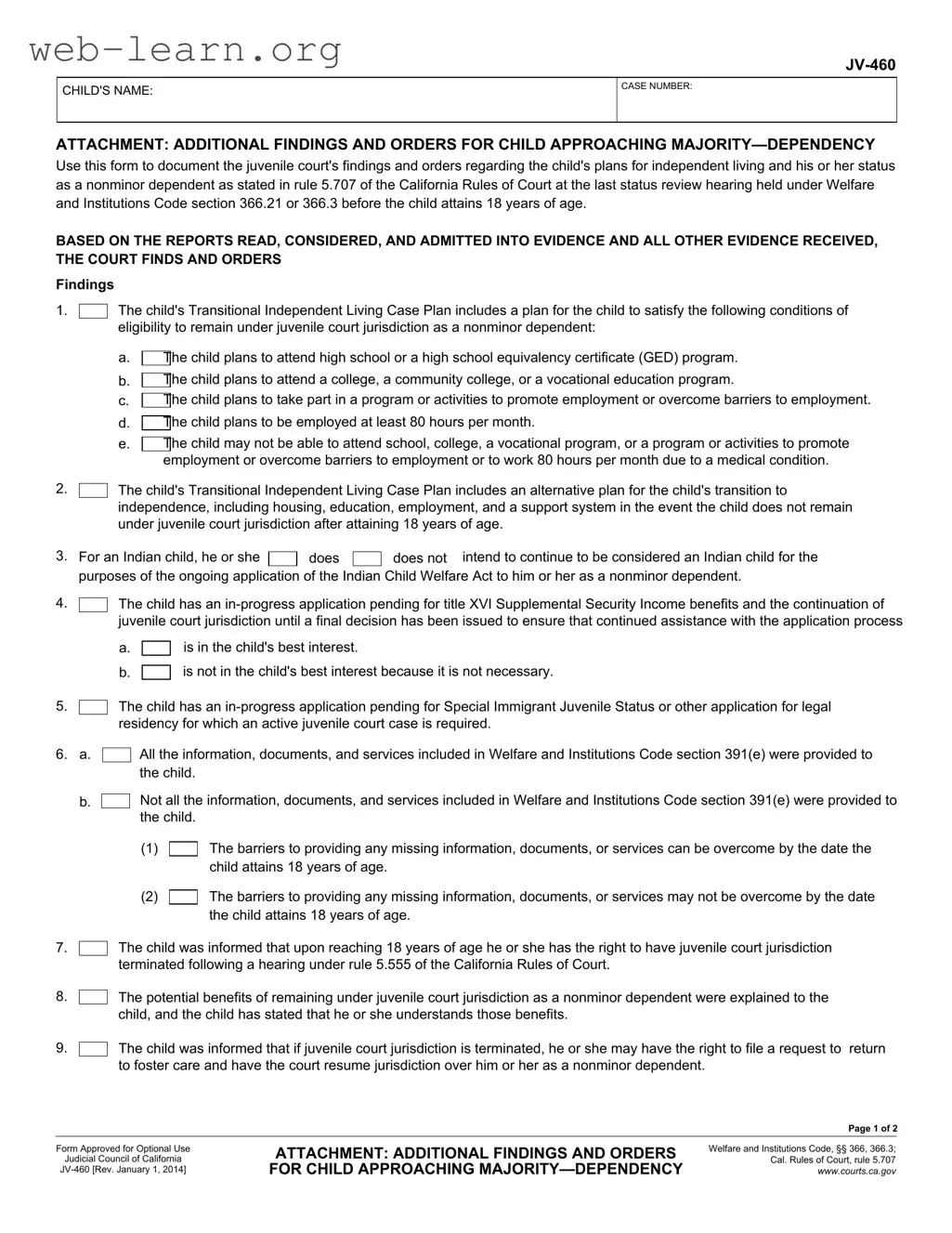
The California JV-460 form plays a crucial role in the juvenile court system, specifically designed for children nearing adulthood who are under dependency. This form captures essential findings and orders from the court regarding a child's plans for independent living as they approach the age of 18. It reflects the court's review of the child's Transitional Independent Living Case Plan, which outlines their eligibility to remain under juvenile court jurisdiction as a nonminor dependent. Key components include the child's educational and employment aspirations, any medical conditions that may affect their plans, and provisions for their transition to independence. The form also addresses specific legal considerations, such as applications for Supplemental Security Income benefits or Special Immigrant Juvenile Status. Additionally, it ensures that the child is informed about their rights and options as they approach adulthood, including the potential benefits of remaining under court jurisdiction. Through this comprehensive documentation, the JV-460 form facilitates the court's decision-making process and supports the child's journey toward self-sufficiency.

| Fact Name | Details |
|---|---|
| Form Purpose | The JV-460 form documents the juvenile court's findings and orders for a child approaching adulthood in dependency cases. |
| Governing Laws | This form is governed by the California Welfare and Institutions Code sections 366, 366.3, and California Rules of Court rule 5.707. |
| Eligibility Criteria | The form outlines conditions for a child to remain under juvenile court jurisdiction as a nonminor dependent. |
| Educational Plans | It includes the child's plans for education, such as attending high school, college, or vocational programs. |
| Employment Goals | The child must plan to work at least 80 hours per month as part of their transition to independence. |
| Alternative Plans | The form requires documentation of alternative plans for housing, education, and employment if the child does not remain under court jurisdiction. |
| Indian Child Welfare Act | It addresses whether an Indian child intends to continue being recognized as such under the Indian Child Welfare Act. |
| Supplemental Security Income | The child may have an application pending for Supplemental Security Income benefits, affecting court jurisdiction. |
| Rights Upon Turning 18 | The child is informed about their rights to terminate juvenile court jurisdiction upon turning 18. |
| Future Hearings | The form sets timelines for future hearings based on the child's intentions regarding court jurisdiction after reaching adulthood. |
Completing the California JV-460 form is an important step in the process of documenting the findings and orders related to a child's transition to independent living. This form must be filled out carefully to ensure that all necessary information is included and accurately reflects the child's situation. The following steps outline how to fill out the form correctly.
What is the purpose of the JV-460 form?
The JV-460 form is used by the juvenile court to document findings and orders regarding a child's plans for independent living as they approach adulthood. This form is particularly important for nonminor dependents, as it outlines the child's eligibility to remain under juvenile court jurisdiction until they turn 18. It ensures that the court considers the child's needs and plans during the last status review hearing before they reach this milestone.
Who needs to fill out the JV-460 form?
The form is typically filled out by the juvenile court or the child’s legal representative. It reflects the findings from the court regarding the child’s Transitional Independent Living Case Plan. The child, along with their social worker and attorney, may also be involved in discussions that inform the contents of the form.
What information is included in the JV-460 form?
The JV-460 form includes several key findings and orders related to the child's transition to independence. This encompasses:
What happens if the child does not wish to remain under juvenile court jurisdiction?
If the child decides they do not want to remain under juvenile court jurisdiction after turning 18, a hearing will be scheduled to discuss this decision. The court will ensure the child understands the implications of this choice and may provide options for re-entering the system if needed.
How does the court determine the child’s eligibility to remain under jurisdiction?
The court assesses the child's Transitional Independent Living Case Plan, which outlines their educational and employment goals, as well as any barriers they might face. The court considers whether the child is actively pursuing these goals and if they have a support system in place. The findings from the hearing help determine the child's eligibility to remain under juvenile court jurisdiction.
Can a child appeal the court's decision regarding their status?
Yes, a child has the right to appeal the court's decision regarding their status as a nonminor dependent. If they believe the court did not adequately consider their situation or rights, they can seek legal counsel to explore their options for an appeal. It’s important for them to understand their rights and the process involved.
Filling out the California JV-460 form can be a daunting task, and mistakes can lead to delays or complications in the legal process. One common error is failing to provide the child's full name and case number accurately. This information is crucial for the court to identify the case and ensure that all documents are properly associated with the correct child.
Another frequent mistake is neglecting to include all relevant findings and orders. Each section of the form serves a specific purpose, and omitting details can create gaps in the child's case plan. It is important to ensure that all findings related to the child's eligibility and plans for independent living are thoroughly documented.
People often misinterpret the requirements for the child's Transitional Independent Living Case Plan. This plan should clearly outline the child's intentions regarding education, employment, and housing. Failing to specify these intentions can hinder the court's ability to assess the child's readiness for independence.
In addition, individuals sometimes overlook the significance of the child's medical condition. If a child cannot meet certain eligibility criteria due to health issues, this must be explicitly noted on the form. Not addressing this aspect can lead to misunderstandings about the child's situation and needs.
Another common oversight is not addressing the child's status as an Indian child, if applicable. The form requires specific information regarding the child's intent to continue being recognized under the Indian Child Welfare Act. Missing this detail can affect the legal protections available to the child.
Furthermore, people may fail to indicate whether the child has pending applications for benefits or legal residency. This information is vital for the court to understand the child's current situation and future needs. Neglecting to mention these applications can result in unnecessary delays in receiving support.
Another mistake involves misunderstanding the process for terminating juvenile court jurisdiction. It is essential to inform the child of their rights and the implications of their choices regarding court jurisdiction. Failing to communicate this can leave the child unprepared for their transition to adulthood.
Additionally, individuals sometimes do not provide a complete account of the information and services received by the child. It is important to document what has been provided and any barriers that may exist. This transparency helps the court evaluate the child's readiness for independence accurately.
Lastly, people may neglect to schedule the necessary hearings as required by the form. Each order must have a corresponding hearing date to ensure that the child's needs are addressed promptly. Failing to set these dates can lead to further complications in the child's case.
By being mindful of these common mistakes, individuals can better navigate the complexities of the California JV-460 form. Attention to detail and thoroughness can significantly impact the child's transition to independence and overall well-being.
The California JV-460 form plays a crucial role in documenting the findings and orders of the juvenile court concerning a child's transition to independent living. However, it is often used alongside several other forms and documents that help facilitate a comprehensive understanding of the child's situation and needs. Below is a list of related documents that are commonly utilized in conjunction with the JV-460 form.
Each of these documents serves a specific purpose in supporting the juvenile court process and ensuring that the child's best interests are prioritized. Collectively, they provide a framework for evaluating the child's readiness for independence and the necessary support systems in place to facilitate a successful transition.
The California JV-460 form serves a specific purpose in documenting the findings and orders of the juvenile court regarding a child's transition to independent living. Several other documents share similarities with the JV-460 form, each addressing different aspects of juvenile dependency and transition. Below is a list of six documents that are similar to the JV-460 form:
When filling out the California JV-460 form, it is crucial to adhere to specific guidelines to ensure accuracy and compliance. Here are some essential dos and don'ts to consider:
Completing the JV-460 form accurately is vital for the child's future. Take the time to ensure that every detail is correct and complete.
The California JV-460 form is an important document used in juvenile court proceedings, particularly for children approaching adulthood. However, there are several misconceptions about this form that can lead to confusion. Here are eight common misunderstandings:
Understanding these misconceptions can help clarify the purpose and importance of the JV-460 form in the transition to adulthood for youth in the juvenile system.