Homepage Blank California Jv 250 Form
Outline

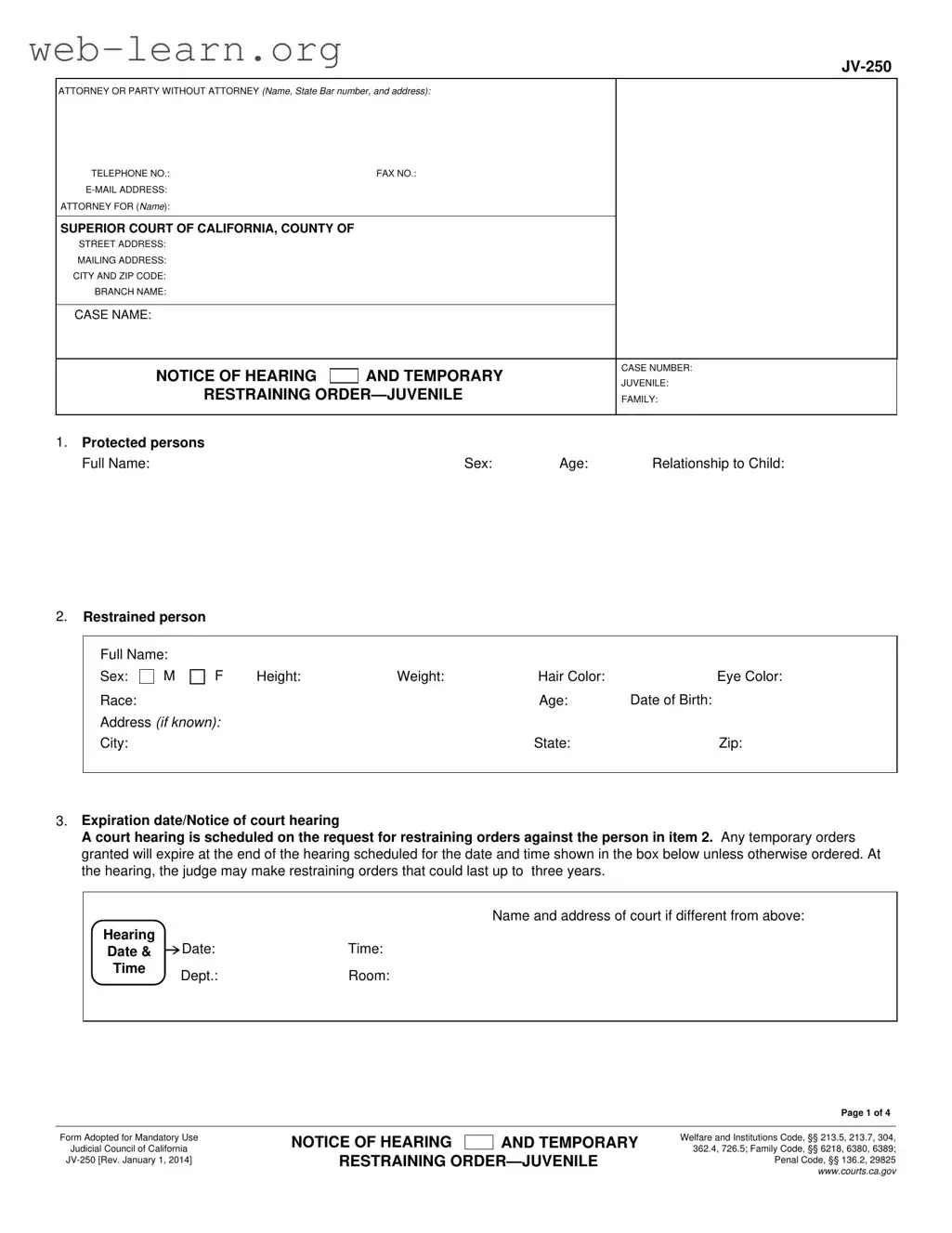
The California JV-250 form serves a crucial role in the juvenile justice system, particularly in cases involving restraining orders. This document outlines the necessary information for both the protected and restrained individuals, ensuring that the court can make informed decisions. Key elements of the form include details about the protected persons, such as their full names, ages, and relationships to the child, alongside information about the restrained person, including their physical characteristics and any known addresses. The JV-250 also specifies the conditions under which the restrained individual must operate, detailing restrictions on contact and the requirement to stay a certain distance away from the protected persons. Furthermore, it establishes a timeline for the court hearing, indicating when temporary orders may expire and how long any granted restraining orders could potentially last. The form emphasizes the importance of compliance, outlining the consequences of violations, which can include criminal charges and penalties. By providing a structured approach to these sensitive matters, the JV-250 form aims to protect the welfare of minors while navigating the complexities of the legal system.
Sample - California Jv 250 Form

Page 1 of 4
Form Adopted for Mandatory Use
Judicial Council of California
JV-250 [Rev. January 1, 2014]
Welfare and Institutions Code, §§ 213.5, 213.7, 304,
362.4, 726.5; Family Code, §§ 6218, 6380, 6389;
Penal Code, §§ 136.2, 29825
www.courts.ca.gov
2.
Protected persons
1.
Restrained person
Full Name:
Sex:
Address (if known):
Race:
Date of Birth:
City:
Age:
Weight: Hair Color: Eye Color:
State: Zip:
3.
Expiration date/Notice of court hearing
A court hearing is scheduled on the request for restraining orders against the person in item 2. Any temporary orders
granted will expire at the end of the hearing scheduled for the date and time shown in the box below unless otherwise ordered. At
the hearing, the judge may make restraining orders that could last up to three years.
Name and address of court if different from above:
Date: Time:
Room:Dept.:
ATTORNEY OR PARTY WITHOUT ATTORNEY (Name, State Bar number, and address):
TELEPHONE NO.: FAX NO.:
E-MAIL ADDRESS:
ATTORNEY FOR (Name):
SUPERIOR COURT OF CALIFORNIA, COUNTY OF
BRANCH NAME:
CITY AND ZIP CODE:
STREET ADDRESS:
MAILING ADDRESS:
CASE NAME:
JUVENILE:
CASE NUMBER:
FAMILY:
NOTICE OF HEARING
RESTRAINING ORDER—JUVENILE
AND TEMPORARY
JV-250
F
M
Height:
Hearing
Date &
Time
NOTICE OF HEARING
RESTRAINING ORDER—JUVENILE
AND TEMPORARY
Full Name: Sex: Age: Relationship to Child:
JV-250 [Rev. January 1, 2014]
Page 2 of 4
NOTICE OF HEARING
RESTRAINING ORDER—JUVENILE
AND TEMPORARY
a.
must not do the following things to the person or persons in item 1:
7.
JV-250
6.
THE COURT FINDS AND ORDERS
Judicial officer (name):
Persons and attorneys present (names):
b.
c.
b.
at least (specify):
yards from
(3)
(4)
(7)
(1)
(2)
(2)
(1)
(5)
(6)
Time: Room:Dept.:Date hearing held:
4.
a.
a.
issued on (date):
, as an exception to the "no-contact" provision in item 6a of this order.
b.
and take only personal clothing and belongings.
e.
d.
c.
(1)
(2)
b.
5.
a.
c.
CASE NUMBER:
CASE NAME:
Hearing on this temporary restraining order
Temporary orders (select one):
Granted. The court has granted the temporary orders that are checked below.
Not granted. No temporary orders are granted pending the scheduled hearing in item 3.
Restrained person (child in delinquency proceedings) (Complete either 6 or 7, not both.)
Restrained person (other than child in delinquency proceeding) (Complete either 6 or 7, not both.)
is a ward of the court or the subject of a petition under Welfare and Institutions Code section 601 or 602 and must
not contact, threaten, stalk, or disturb the peace of the person or persons in item 1.
may have peaceful contact with the protected persons in item 1 only for the safe exchange of children for court-
ordered visitation as stated in the attached Family, Juvenile, or Probate court order in Case No.
may have peaceful contact with the protected persons in item 1 only for the safe exchange of children for visitation
as stated in a Family, Juvenile, or Probate court order issued after the date this order is signed, as an exception to
the "no-contact" provision in item 6a on this order.
Molest, attack, strike, stalk, threaten, sexually assault, batter, harass, destroy the personal property of, or
disturb the peace.
Contact, either directly or indirectly in any way, including but not limited to, in person, by telephone, in
writing, by public or private mail, by interoffice mail, by e-mail, by text message, by fax, or by other electronic
means.
except for visitation as indicated in c below.
must stay away
has the right to visit the minor children named in item 1 as follows:
must move immediately from (address):
must NOT take any action to get the address or location of any person named in item 1 or the addresses or
locations of the family members, caregivers, or guardians of any persons named in item 1. If this box is not
checked, the court has found good cause not to make this order.
protected person or persons in item 1, except for visitation as indicated in c below.
home of person or persons in item 1.
job or workplace of person or persons in item 1.
vehicle of person or persons in item 1.
school of person or persons in item 1.
the children’s school or child care.
None
Visitation according to the attached schedule (Form JV-205 must be attached if any visitation is ordered.)
except for visitation as indicated in c below.
(specify):
Other
10.
12.
Transmittal order. The data in this order must be transmitted within one business day to law enforcement personnel.
a.
b.
If designee, insert name:
This order must be entered into the California Restraining and Protective Order System (CARPOS) through the California Law
Enforcement Telecommunications System (CLETS).
The restrained person must
sell to a licensed gun dealer or turn in to a law enforcement agency any guns or other firearms within his or her immediate
possession or control. This must be done within 24 hours of being served with this order.
file a receipt with the court within 48 hours of receiving this order that proves guns have been turned in or sold. (Proof of
Firearms Turned In or Sold (form DV-800/JV-252) may be used for the receipt.)
bring a copy of the receipt or Proof of Firearms Turned In or Sold (form DV-800/JV-252) to the hearing listed in item 3.
c.
9.
8.
No guns or other firearms or ammunition (Applies only if box 5a is checked on this form.)
The restrained person cannot own, possess, have, buy or try to buy, receive or try to receive, or in any other way get guns,
other firearms, or ammunition.
a.
13.
a.
b.
days before the hearing.
Case number:
(expiration date):
County (if known):
11.
JV-250
CASE NUMBER:
CASE NAME:
b.
The court has received information that the restrained person owns or possesses a firearm.
The protected persons have the right to record communications made by the restrained person that violate the judge's orders.
A criminal protective order on form CR-160 is in effect as follows:
The court will enter the order into CARPOS through CLETS directly.
The court or its designee will transmit a copy of the order to a local law enforcement agency authorized by the
Department of Justice to enter orders into CARPOS through CLETS.
Service of temporary order
Restrained person was present at the time the order was made. No further service is needed.
Restrained person was not present at the time the order was made. This order must be served.
Service of this notice of hearing must be at least five or
(specify):
Date:
JUDICIAL OFFICER
14.
JV-250 [Rev. January 1, 2014]
Page 3 of 4
NOTICE OF HEARING
RESTRAINING ORDER—JUVENILE
AND TEMPORARY
Other orders (specify):
Certificate of Compliance With VAWA for Temporary Orders
This temporary protective order meets all full faith and credit requirements of the Violence Against Women Act (18 U.S.C. § 2265)
(VAWA) upon notice of the restrained person. This court has jurisdiction over the parties and the subject matter; the restrained
person has been or will be afforded notice and a timely opportunity to be heard as provided by the laws of this jurisdiction. This
order is valid and entitled to enforcement in all jurisdictions throughout the 50 United States, the District of Columbia, all
tribal lands, and all U.S. territories, commonwealths, and possessions and shall be enforced as if it were an order of
those jurisdictions.
CLERK’S CERTIFICATE
I certify that the foregoing Temporary Restraining Order—Juvenile is a true and correct copy of
the original on file in the court.
[SEAL]
Date:
Clerk, by
, Deputy
Instruction for Law Enforcement
Applicable only if box 5a is checked.
Enforcing the restraining order. This order is effective when made. It is enforceable in all 50 states, the District of Columbia, all
tribal lands, and all U.S. territories and shall be enforced as if it were an order of that jurisdiction by any law enforcement agency
that has received the order, is shown a copy of the order, or has verified its existence on the California Law Enforcement
Telecommunications System (CLETS). If proof of service on the restrained person has not been received and the restrained
person was not present at the court hearing, the law enforcement agency shall advise the restrained person of the terms of the
order and then shall enforce it.
Conflicting orders. If a criminal protective order (form CR-160) conflicts with a juvenile restraining order (form JV-250), a law
enforcement agency must enforce the criminal order. Even if the criminal order is older, the officer must still enforce it over the
juvenile order. (Pen. Code, § 136.2.) Any nonconflicting terms of the juvenile custody or visitation order remain in full force. An
emergency protective order (form EPO-001) that is in effect between the same parties and that is more restrictive than other
restraining orders takes precedence over all other restraining orders. (Pen. Code, § 136.2.)
If you do not obey these orders, you can be arrested and charged with a crime. And you may have to go to jail or prison, pay a
fine of up to $1,000, or both. Taking or hiding a child in violation of this order is subject to state and federal criminal penalties.
You cannot have guns, firearms, or ammunition. If box 5a is checked, the court issued a temporary restraining order, which
means you cannot own, have, possess, buy or try to buy, receive or try to receive, or otherwise get guns, other firearms, or
ammunition while the order is in effect. If you do, you can go to jail and pay a $1,000 fine. You must sell to a licensed gun dealer or
turn in to a law enforcement agency any guns or other firearms that you have or control. The judge will ask you for proof that you did
so. If you do not obey this order, you can be charged with a crime. Federal law says you cannot have guns or ammunition while the
order is in effect.
Service of order by mail. If the judge makes a restraining order at the hearing, which has the same orders as in this form, you will
get a copy of that order by mail at your last known address, which is written in item 2. If this address is not correct, or to find out if the
orders were made permanent, contact the court.
Warnings to the Restrained Person
JV-250
CASE NUMBER:
CASE NAME:
JV-250 [Rev. January 1, 2014]
Page 4 of 4
NOTICE OF HEARING
RESTRAINING ORDER—JUVENILE
AND TEMPORARY
For your protection and privacy, please press the Clear
This Form button after you have printed the form.
Print this form
Save this form
Clear this form

Form Information

Fact Name Details
Form Purpose The JV-250 form is used to request a temporary restraining order for juveniles.
Governing Laws The form is governed by the Welfare and Institutions Code, Family Code, and Penal Code.
Protected Persons The form allows for the identification of protected persons, including their full name, age, and relationship to the child.
Restrained Persons Details about the restrained person, such as name, sex, and physical characteristics, must be provided.
Court Hearing A court hearing is scheduled for the request of restraining orders, and temporary orders may expire at the end of this hearing.
Temporary Orders The court can grant temporary orders that may last up to three years, depending on the case.
Firearm Restrictions If applicable, the restrained person is prohibited from owning or possessing firearms while the order is in effect.
Enforcement The order is enforceable in all 50 states and must be entered into the California Restraining and Protective Order System (CARPOS).
Service of Order If the restrained person is not present at the hearing, the order must be served at least five days before the hearing.
Compliance Certificate The order complies with the Violence Against Women Act, ensuring it is enforceable across jurisdictions.

Detailed Guide for Filling Out California Jv 250

Filling out the California JV-250 form is an important step in initiating a request for a temporary restraining order in juvenile cases. After completing this form, you will need to submit it to the court and ensure that all parties involved are notified about the upcoming hearing. This process helps ensure the safety and well-being of those affected.

  1. Identify Yourself: At the top of the form, provide your name, State Bar number (if applicable), and address. Include your telephone number, fax number, and email address.
  2. Attorney Information: If you are an attorney, indicate who you are representing by filling in the name of the party you are representing.
  3. Court Information: Fill in the name of the Superior Court of California, the county, and the addresses for both street and mailing. Include the city and zip code.
  4. Case Details: Write the case name and temporary case number, if applicable. Specify whether the case is juvenile or juvenile family.
  5. Protected Persons: In section 1, provide the full name, sex, age, and relationship to the child of the protected persons.
  6. Restrained Person: In section 2, fill out the full name, sex, height, weight, hair color, eye color, race, age, date of birth, and address (if known) of the restrained person.
  7. Expiration Date: In section 3, indicate the expiration date and the details of the court hearing, including the date, time, department, and room number.
  8. Hearing Details: Complete section 5 with the hearing date, time, department, room, and the name of the judicial officer. List the names of persons and attorneys present.
  9. Temporary Orders: In section 6, select whether temporary orders were granted or not and specify any conditions related to the restrained person.
  10. Firearms Restrictions: If applicable, complete section 8 regarding firearms restrictions for the restrained person.
  11. Other Orders: In section 10, specify any other orders that the court is making, if necessary.
  12. Service of Order: In section 14, indicate whether the restrained person was present at the time the order was made and if further service is needed.
  13. Signature: Ensure that the judicial officer signs the form at the bottom, certifying its accuracy and legitimacy.

After completing the form, review it for accuracy before submitting it to the court. Make sure to keep a copy for your records and follow up on the next steps as required by the court's instructions.

Obtain Answers on California Jv 250

  1. What is the California JV-250 form?

    The California JV-250 form is a legal document used to request a temporary restraining order in juvenile cases. It is designed to protect minors from harm by prohibiting certain individuals from contacting or coming near them. The form outlines the details of the case, including the protected and restrained persons, and the terms of the restraining order.

  2. Who can file a JV-250 form?

    Any party involved in a juvenile case, including parents or guardians, can file the JV-250 form. This form is often used when there is a concern for the safety of a child due to threats or harmful behavior from another individual.

  3. What information is required on the form?

    The JV-250 form requires detailed information, including:

    • Names and details of the protected persons.
    • Information about the restrained person, including physical characteristics.
    • The nature of the relationship between the parties.
    • Details about the court hearing, including date and time.
  4. What happens at the court hearing?

    During the court hearing, a judge will review the request for a restraining order. The judge may grant temporary orders that can last up to three years. If the restrained person is not present, the order must be served to them. The judge will consider the evidence and arguments presented by both parties.

  5. What are the consequences of violating a restraining order?

    If the restrained person violates the order, they can face serious legal consequences. This may include arrest, criminal charges, fines, or even jail time. The law takes violations of restraining orders very seriously to ensure the safety of protected individuals.

  6. Can the restrained person have contact with the protected person?

    In certain circumstances, the restrained person may be allowed to have peaceful contact with the protected person, usually for specific purposes like child visitation. However, this is strictly outlined in the order and must be followed carefully.

  7. How is the order enforced?

    The JV-250 order is enforceable in all 50 states and U.S. territories. Law enforcement agencies can enforce the order upon receiving it. If the restrained person has not been served but is found, law enforcement must inform them of the order's terms and enforce it accordingly.

  8. What should I do if I need to modify or extend the order?

    If you wish to modify or extend the restraining order, you must file a request with the court. This usually involves submitting a new form and attending another hearing where you can present your reasons for the changes.

Common mistakes

Filling out the California JV-250 form can be a daunting task, and mistakes can have serious consequences. One common error is failing to provide complete information about the protected persons. It is crucial to include the full name, age, and relationship to the child for each protected person. Incomplete details may lead to delays in processing the request or even denial of the order.

Another frequent mistake involves the information about the restrained person. When listing the restrained individual, ensure that all relevant details, such as sex, height, weight, and date of birth, are accurately filled in. Omitting or incorrectly entering this information can hinder law enforcement's ability to enforce the order effectively.

Many individuals overlook the importance of specifying the expiration date for the temporary restraining order. This date should be clearly indicated to avoid confusion during the court hearing. If the expiration date is not provided, the order may not be enforceable, which could compromise the safety of those involved.

Additionally, failing to attend the scheduled court hearing can be detrimental. If the person seeking the restraining order does not appear, the judge may dismiss the request. It is vital to mark the date and time of the hearing clearly and ensure that all parties are aware of their obligations to attend.

Another error often made is neglecting to check the appropriate boxes for temporary orders. When filling out the form, it is essential to indicate whether the court has granted or denied temporary orders. This information is critical for both the court and the parties involved, as it dictates the immediate protections in place.

Some individuals may also forget to attach necessary documents, such as the Family, Juvenile, or Probate court order when visitation is involved. Not including these attachments can lead to complications and may prevent the court from issuing the order as requested.

Finally, individuals sometimes fail to keep copies of the completed form and any supporting documents. Having a personal record of what was submitted can be invaluable if questions arise later or if further actions are required. Keeping thorough documentation ensures that all parties are on the same page and can help facilitate a smoother process.

Documents used along the form

The California JV-250 form is a critical document used in juvenile restraining order cases. However, several other forms and documents are often required in conjunction with it to ensure a comprehensive legal process. Below is a list of related forms and documents that may be utilized alongside the JV-250.

  • JV-205: This form is used to outline the visitation schedule for children involved in a restraining order case. It provides clear guidelines for how and when visitation should occur, ensuring that both parties understand their rights and responsibilities.
  • CR-160: The Criminal Protective Order form is used when there are allegations of criminal behavior. It establishes restrictions on the restrained person, similar to those in the JV-250, but is specific to criminal cases.
  • EPO-001: The Emergency Protective Order form is utilized in urgent situations where immediate protection is necessary. This order can be issued quickly and provides temporary relief until a more formal hearing can take place.
  • DV-800/JV-252: This document serves as proof that firearms have been surrendered or sold by the restrained person. It is essential for compliance with the firearm restrictions outlined in the JV-250.
  • Form FL-300: This form is often used for requesting temporary orders in family law cases, including child custody and support. It can be relevant in cases where family law intersects with juvenile restraining orders.
  • Form FL-320: This form is a declaration of disclosure that provides the court with necessary financial information. It may be used in cases where financial support or obligations are being discussed alongside restraining orders.
  • Form JV-210: This form is used to request a hearing regarding a restraining order. It allows parties to formally ask the court to consider modifications or extensions of the existing orders.
  • Form JV-280: This document is a request for the court to terminate or modify a juvenile restraining order. It is essential for those seeking changes to existing orders based on new circumstances.

Understanding these forms and their purposes can greatly assist individuals navigating the juvenile legal system. Each document plays a vital role in protecting the rights and well-being of all parties involved, ensuring that the legal process is both thorough and fair.

Similar forms

The California JV-250 form serves as a vital document in juvenile restraining order cases. It shares similarities with several other legal documents. Here are four forms that are comparable to the JV-250, along with an explanation of how they relate:

  • Form CR-160 (Criminal Protective Order): This form is used to issue a protective order in criminal cases. Like the JV-250, it aims to protect individuals from harassment or harm by a restrained person. Both documents outline the restrictions placed on the restrained individual, including no-contact provisions and the need for law enforcement to enforce these orders.
  • Form DV-100 (Domestic Violence Restraining Order): Similar to the JV-250, the DV-100 is utilized in cases involving domestic violence. Both forms provide a means to protect individuals from abuse, detailing the specific restrictions imposed on the restrained person. They also establish court dates for hearings and outline the consequences of violating the orders.
  • Form EPO-001 (Emergency Protective Order): This form is designed for immediate protection in urgent situations. Like the JV-250, it provides swift legal relief to individuals facing imminent danger. Both forms include provisions for law enforcement to enforce the orders and emphasize the importance of timely hearings to ensure ongoing safety.
  • Form JV-205 (Visitation Order): This form is often attached to the JV-250 when visitation rights are involved. It details the conditions under which a restrained person may have contact with the protected individual, especially regarding child visitation. Similar to the JV-250, it focuses on the welfare of minors and establishes clear guidelines for safe interactions.

Dos and Don'ts

When filling out the California JV-250 form, it is essential to follow specific guidelines to ensure accuracy and compliance. Below is a list of things to do and avoid during this process.

  • Do provide accurate and complete information for all required fields, including names, addresses, and case numbers.
  • Do double-check the spelling of names and details to prevent any errors that could delay the process.
  • Do ensure that the court date and time are clearly indicated, as this is crucial for the hearing.
  • Do include contact information for all parties involved, including phone numbers and email addresses when applicable.
  • Don't leave any mandatory fields blank; incomplete forms may be rejected by the court.
  • Don't use abbreviations or shorthand when filling out the form, as clarity is vital.
  • Don't forget to sign and date the form; an unsigned form is considered invalid.
  • Don't submit the form without making copies for your records and for the other parties involved.

Misconceptions

Understanding the California JV-250 form is crucial for anyone navigating the juvenile justice system. However, several misconceptions can cloud its purpose and use. Here are six common misunderstandings:

  • The JV-250 form is only for serious criminal cases. Many believe this form is reserved for severe offenses. In reality, it is used for various situations involving minors, including family disputes and protective orders.
  • Filing the JV-250 guarantees a restraining order will be issued. While the form initiates the process, it does not automatically lead to a restraining order. A judge must review the case and determine whether to grant the order based on the evidence presented.
  • Only the victim can file the JV-250 form. This form can be filed by a parent, guardian, or even the minor themselves in certain circumstances. It’s not limited to just the individual seeking protection.
  • Temporary orders last indefinitely. Temporary restraining orders issued through the JV-250 are only effective until the scheduled court hearing. They can last up to three years if the judge makes them permanent during that hearing.
  • Once filed, the JV-250 form requires no further action. After submitting the form, it is essential to attend the court hearing. Failure to appear may result in the dismissal of the request for a restraining order.
  • The JV-250 form is only relevant in California. While it is specific to California, the principles of protective orders apply in many states. However, the forms and procedures may differ, so it’s important to understand the local laws.

Clearing up these misconceptions can empower individuals to navigate the juvenile justice system more effectively. Understanding the nuances of the JV-250 form is essential for ensuring that the rights and safety of minors are upheld.

Key takeaways

When filling out and using the California JV-250 form, keep these key takeaways in mind:

  • Accurate Information is Crucial: Ensure that all personal details, including names, addresses, and case numbers, are filled out accurately. Errors can delay the process or lead to complications in court.
  • Understanding Hearing Dates: Be aware that temporary orders expire at the end of the scheduled hearing unless the judge specifies otherwise. Mark the date and time clearly.
  • Compliance with Orders: The restrained person must follow all conditions set forth in the order. Noncompliance can lead to serious legal consequences, including arrest.
  • Firearm Restrictions: If the order includes firearm restrictions, the restrained person must surrender any firearms within 24 hours and provide proof to the court. This is a critical requirement that must not be overlooked.