Homepage Blank California Jv 195 Form
Outline

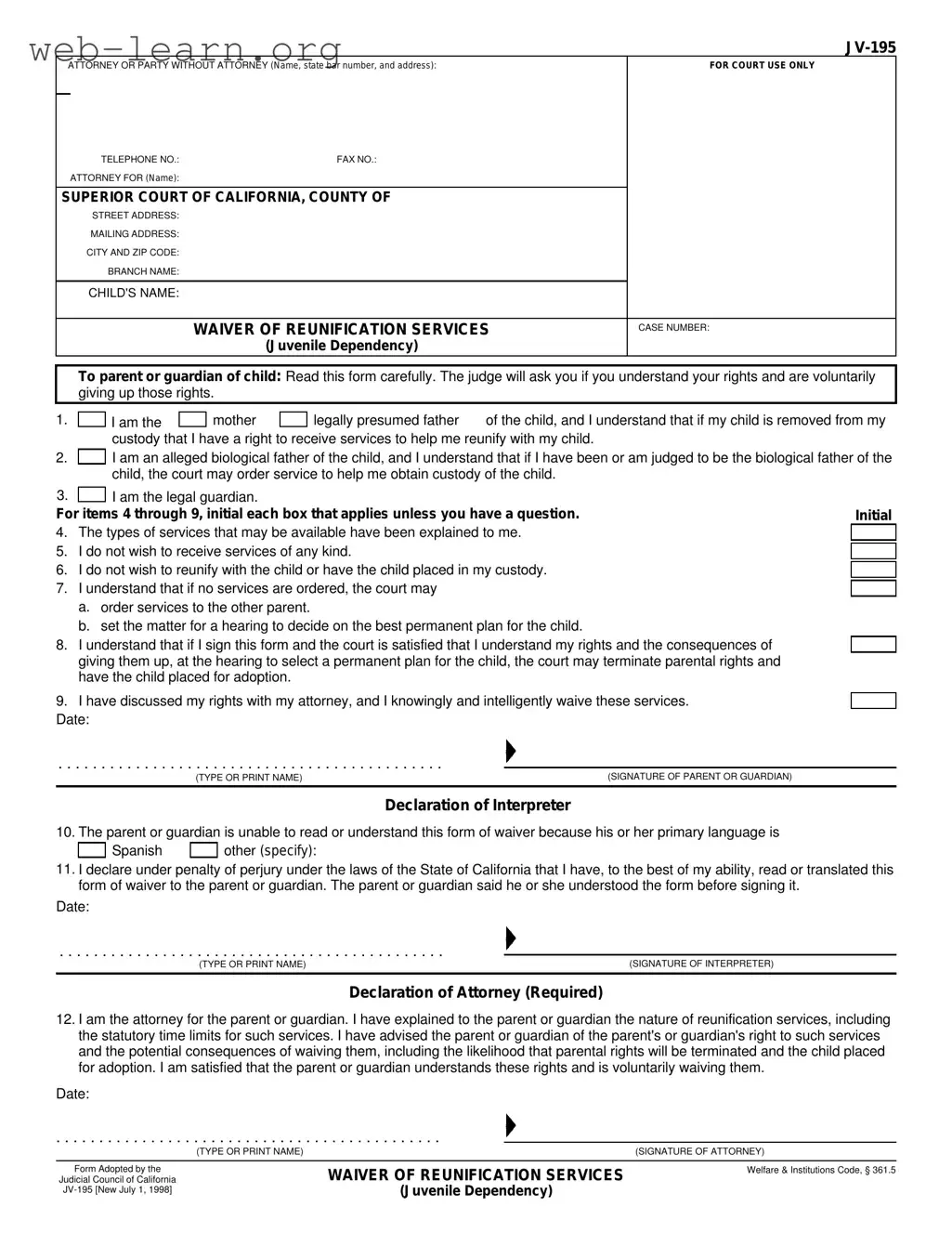
The California JV-195 form is a crucial document in the juvenile dependency process, specifically designed for parents or guardians facing the possibility of losing custody of their child. This form allows individuals to voluntarily waive their right to reunification services, which are typically offered to assist in regaining custody. It outlines the rights of the parent or guardian, detailing the implications of signing the form. For instance, it clarifies that if a child is removed from custody, the parent or guardian has a right to services aimed at reunification, unless they choose to decline. The form also addresses the rights of alleged biological fathers and legal guardians, ensuring that they understand the potential consequences of their decisions. By signing the JV-195, individuals acknowledge that they have been informed about available services and the possibility that parental rights may be terminated, leading to adoption. The document requires the signatures of both the parent or guardian and their attorney, ensuring that the decision is made with full understanding of the legal ramifications. Furthermore, provisions for language interpretation are included, emphasizing the importance of comprehension in this sensitive process.
Sample - California Jv 195 Form

Declaration of Interpreter
WAIVER OF REUNIFICATION SERVICES
(Juvenile Dependency)
(SIGNATURE OF INTERPRETER)
(SIGNATURE OF PARENT OR GUARDIAN)
Declaration of Attorney (Required)
1.
2.
4.
a.
b.
WAIVER OF REUNIFICATION SERVICES
(Juvenile Dependency)
Form Adopted by the
Judicial Council of California
JV-195 [New July 1, 1998]
Welfare & Institutions Code, § 361.5
JV-195
To parent or guardian of child: Read this form carefully. The judge will ask you if you understand your rights and are voluntarily
giving up those rights.
I am the
mother legally presumed father of the child, and I understand that if my child is removed from my
custody that I have a right to receive services to help me reunify with my child.
I am an alleged biological father of the child, and I understand that if I have been or am judged to be the biological father of the
child, the court may order service to help me obtain custody of the child.
The types of services that may be available have been explained to me.
I do not wish to receive services of any kind.
I do not wish to reunify with the child or have the child placed in my custody.
I understand that if no services are ordered, the court may
order services to the other parent.
set the matter for a hearing to decide on the best permanent plan for the child.
I understand that if I sign this form and the court is satisfied that I understand my rights and the consequences of
giving them up, at the hearing to select a permanent plan for the child, the court may terminate parental rights and
have the child placed for adoption.
5.
6.
7.
8.
9. I have discussed my rights with my attorney, and I knowingly and intelligently waive these services.
The parent or guardian is unable to read or understand this form of waiver because his or her primary language is
Spanish other (specify):
Date:
(TYPE OR PRINT NAME)
. . . . . . . . . . . . . . . . . . . . . . . . . . . . . . . . . . . . . . . . . . . . .
Date:
(TYPE OR PRINT NAME)
. . . . . . . . . . . . . . . . . . . . . . . . . . . . . . . . . . . . . . . . . . . . .
10.
I am the attorney for the parent or guardian. I have explained to the parent or guardian the nature of reunification services, including
the statutory time limits for such services. I have advised the parent or guardian of the parent's or guardian's right to such services
and the potential consequences of waiving them, including the likelihood that parental rights will be terminated and the child placed
for adoption. I am satisfied that the parent or guardian understands these rights and is voluntarily waiving them.
12.
Date:
(TYPE OR PRINT NAME) (SIGNATURE OF ATTORNEY)
. . . . . . . . . . . . . . . . . . . . . . . . . . . . . . . . . . . . . . . . . . . . .
FOR COURT USE ONLY
ATTORNEY FOR (Name):
CHILD'S NAME:
CASE NUMBER:
TELEPHONE NO.:
ATTORNEY OR PARTY WITHOUT ATTORNEY (Name, state bar number, and address):
FAX NO.:
SUPERIOR COURT OF CALIFORNIA, COUNTY OF
CITY AND ZIP CODE:
BRANCH NAME:
STREET ADDRESS:
MAILING ADDRESS:
For items 4 through 9, initial each box that applies unless you have a question.
Initial
3.
I am the legal guardian.
I declare under penalty of perjury under the laws of the State of California that I have, to the best of my ability, read or translated this
form of waiver to the parent or guardian. The parent or guardian said he or she understood the form before signing it.
11.
Laura Lynn Morgan 31/03
Morgan I Love You

Form Information

Fact Name Fact Description
Form Title The form is officially titled "JV-195 Waiver of Reunification Services." It is used in juvenile dependency cases.
Governing Law This form is governed by the Welfare & Institutions Code, § 361.5 in California.
Purpose The JV-195 form allows a parent or guardian to voluntarily waive their right to reunification services.
Eligibility It is intended for parents or guardians of children involved in juvenile dependency proceedings.
Understanding Rights Before signing, the parent or guardian must understand their rights and the implications of waiving them.
Interpreter Declaration If the parent or guardian cannot read or understand the form, an interpreter must declare their assistance.
Legal Representation It is required that the parent or guardian has discussed their rights with an attorney before waiving services.
Consequences Waiving services may lead to the termination of parental rights and the possibility of adoption for the child.
Initials Required The form requires the parent or guardian to initial several statements to confirm their understanding.
Form Adoption Date The JV-195 form was adopted by the Judicial Council of California on July 1, 1998.

Detailed Guide for Filling Out California Jv 195

Completing the California JV-195 form is an important step in the juvenile dependency process. It is essential to fill it out accurately to ensure that your rights and the rights of the child are properly addressed. Below are the steps to guide you through filling out the form.

  1. Begin by filling in the section for Attorney or Party Without Attorney. Include your name, state bar number, and address. Make sure to provide a telephone number and fax number if applicable.
  2. In the next line, write the name of the attorney representing the parent or guardian.
  3. Complete the Superior Court of California section by entering the county, street address, mailing address, city, and ZIP code.
  4. Write the child’s name in the designated space.
  5. Enter the case number in the appropriate field.
  6. Read the instructions carefully, as they pertain to your rights. Initial each applicable box from items 1 to 9. This indicates your understanding of each statement.
  7. For item 10, if you or the parent/guardian requires an interpreter, indicate the primary language and provide the necessary information.
  8. In item 11, the interpreter must sign and date the declaration, confirming that they have translated the form accurately.
  9. Item 12 requires the attorney to sign and date the declaration, confirming that they have explained the nature of reunification services and the consequences of waiving them.
  10. Finally, ensure that all signatures are in place and that the form is dated correctly before submission.

Once you have completed the JV-195 form, it will be submitted to the court. The judge will review the form and may ask questions to confirm that you understand your rights and the implications of waiving them. This is a crucial moment in the process, so be prepared to discuss your decisions openly.

Obtain Answers on California Jv 195

  1. What is the purpose of the California JV-195 form?

    The California JV-195 form, also known as the Waiver of Reunification Services, is used in juvenile dependency cases. It allows a parent or guardian to voluntarily waive their right to receive services aimed at helping them reunify with their child if the child has been removed from their custody. This form is crucial as it ensures that parents or guardians are fully informed of their rights and the potential consequences of waiving these rights.

  2. Who should complete the JV-195 form?

    The JV-195 form should be completed by a parent or guardian of the child involved in a juvenile dependency case. This includes:

    • The mother or legally presumed father of the child.
    • The alleged biological father, if recognized by the court.
    • The legal guardian of the child.

    Each individual must carefully read the form and understand its implications before signing.

  3. What rights does the JV-195 form address?

    The form addresses several key rights of the parent or guardian, including:

    • The right to receive services aimed at reunification with the child.
    • The right to have a hearing regarding the best permanent plan for the child if no services are ordered.
    • The understanding that signing the form may lead to the termination of parental rights and the potential adoption of the child.

    Understanding these rights is essential for making an informed decision about waiving them.

  4. What happens after the JV-195 form is signed?

    Once the JV-195 form is signed, the court will review it during a hearing. If the court is satisfied that the parent or guardian understands their rights and the consequences of waiving them, it may proceed to consider the child’s permanent plan. This could involve terminating parental rights and placing the child for adoption, depending on the circumstances of the case.

  5. Is legal counsel required when completing the JV-195 form?

    While it is not legally mandated to have an attorney when completing the JV-195 form, it is highly advisable. An attorney can provide essential guidance regarding the implications of waiving reunification services and help ensure that the parent or guardian understands all aspects of the process. The form itself requires a declaration from an attorney, confirming that they have explained the nature of reunification services and the potential consequences of waiving them.

Common mistakes

Filling out the California JV-195 form can be a complex process, and several common mistakes may lead to complications. One frequent error occurs when individuals fail to read the form carefully. This document outlines important rights and responsibilities regarding parental rights and reunification services. Not understanding the implications of the waiver can lead to unintended consequences.

Another mistake is not providing accurate information in the personal details section. Individuals often overlook the importance of filling in their name, address, and contact information correctly. Inaccurate details can delay the processing of the form and may even lead to issues in court.

Some people neglect to initial each applicable box in items 4 through 9. This step is crucial, as it indicates which statements the individual agrees with. Failing to initial can create confusion about the person’s intentions and may result in the court questioning their understanding of the form.

Additionally, individuals sometimes misunderstand their rights regarding reunification services. For example, a parent might mistakenly believe that waiving these services will guarantee a favorable outcome in custody decisions. This misconception can lead to significant legal repercussions, including the termination of parental rights.

Another common error is not discussing the form with an attorney. It is essential for parents or guardians to consult with legal counsel before signing. Some individuals may sign the form without fully grasping the consequences of waiving their rights, which can lead to regrets later on.

Miscommunication with interpreters can also pose a problem. If a parent or guardian does not fully understand the form due to language barriers, it is vital to ensure that the interpreter accurately conveys the information. A lack of clarity can result in the individual signing without a complete understanding of what they are agreeing to.

Finally, some people forget to date the form or provide the necessary signatures. This oversight can render the document invalid, creating further complications in the legal process. It is essential to ensure that all required fields are completed before submitting the form.

Documents used along the form

The California JV-195 form is an essential document in juvenile dependency cases, specifically concerning the waiver of reunification services. Several other forms and documents often accompany this form, each serving a unique purpose in the legal process. Below is a list of these documents, along with a brief description of their significance.

  • JV-100: Petition to Establish Dependency - This form initiates the dependency process by requesting the court to take jurisdiction over a child due to concerns about their safety or welfare.
  • JV-110: Notice of Hearing - This document informs all parties involved about the upcoming court hearing, ensuring that parents and guardians are aware of the proceedings regarding their child.
  • JV-130: Jurisdictional Hearing Report - This report provides the court with details about the child’s situation, including any allegations of abuse or neglect, and is used during the jurisdictional hearing.
  • JV-140: Dispositional Hearing Report - After the court establishes jurisdiction, this report outlines recommendations for the child’s placement and services needed for the family.
  • JV-150: Case Plan - This document outlines the goals and services that will be provided to the family, detailing steps to achieve reunification or other permanency plans.
  • JV-160: Status Review Report - This report is submitted to the court during status review hearings, providing updates on the child’s progress and the effectiveness of the services provided.
  • JV-170: Permanent Plan Hearing Report - This form is used to inform the court about the proposed permanent plan for the child, whether it be reunification, adoption, or guardianship.
  • JV-180: Notice of Intent to Terminate Parental Rights - This document notifies parents of the intention to terminate their parental rights, which is a critical step in the adoption process.

Understanding these accompanying documents can help parents and guardians navigate the complexities of the juvenile dependency system. Each form plays a vital role in ensuring that the rights of all parties are respected and that the best interests of the child remain the central focus throughout the legal proceedings.

Similar forms

The California JV-195 form is a critical document in juvenile dependency cases, specifically concerning the waiver of reunification services. Several other forms share similarities with the JV-195, primarily in their purpose and structure. Here’s a list of ten documents that are comparable:

  • JV-100: Petition to Establish Dependency - This form initiates a dependency case, outlining the reasons a child may need protection. Like the JV-195, it emphasizes the rights of parents and guardians regarding their children.
  • JV-200: Notice of Hearing - This document informs parents or guardians about upcoming hearings in dependency cases. It mirrors the JV-195 in its focus on parental rights and responsibilities.
  • JV-220: Request for Court Appointed Counsel - Parents can use this form to request legal representation. Similar to the JV-195, it addresses the legal rights of parents in dependency proceedings.
  • JV-300: Report of the Child's Social Worker - This report provides the court with updates on a child's welfare. It parallels the JV-195 by discussing the implications of parental decisions on a child's future.
  • JV-310: Application for Reunification Services - This form allows parents to apply for services aimed at reuniting with their children. It connects with the JV-195 through its focus on the importance of reunification.
  • JV-320: Waiver of Right to Counsel - This document allows a parent to waive their right to legal representation. It shares the theme of waiving rights found in the JV-195.
  • JV-330: Consent to Adoption - This form is used when a parent consents to the adoption of their child. It relates to the JV-195 by addressing the termination of parental rights.
  • JV-340: Petition for Termination of Parental Rights - This document requests the court to terminate parental rights. It is similar to the JV-195 in its focus on the consequences of parental decisions.
  • JV-350: Application for Visitation - This form allows a parent to request visitation rights. It connects with the JV-195 by emphasizing the ongoing relationship between parent and child.
  • JV-360: Report of the Court Appointed Special Advocate (CASA) - This report provides insights into the child's best interests, similar to how the JV-195 considers the implications of parental waivers on a child’s future.

Each of these documents plays a role in the juvenile dependency process, highlighting the rights and responsibilities of parents while also addressing the welfare of children involved in such cases.

Dos and Don'ts

When filling out the California JV-195 form, it’s important to follow certain guidelines to ensure accuracy and compliance. Here are eight things to consider:

  • Do read the entire form carefully before signing.
  • Do ensure that all information is complete and accurate.
  • Do consult with an attorney if you have any questions about your rights.
  • Do initial each applicable box to confirm your understanding of the services discussed.
  • Don't leave any sections blank; incomplete forms may be rejected.
  • Don't rush through the process; take your time to understand each part.
  • Don't sign the form if you do not fully understand your rights.
  • Don't forget to have your interpreter sign the declaration if needed.

Misconceptions

Understanding the California JV-195 form is essential for parents and guardians involved in juvenile dependency cases. Here are ten common misconceptions about this form:

  • Misconception 1: Signing the JV-195 means I am giving up my parental rights permanently.
  • This is not true. The JV-195 allows you to waive reunification services, but it does not automatically terminate your parental rights. A court hearing will determine the next steps.

  • Misconception 2: I cannot change my mind after signing the JV-195.
  • You can express your desire to receive services at any time before the court makes a decision regarding your parental rights.

  • Misconception 3: The JV-195 is only for biological parents.
  • Any legal guardian or presumed parent can use this form. It is not limited to biological relationships.

  • Misconception 4: I don’t need an attorney to sign the JV-195.
  • While it is not mandatory, having an attorney is highly recommended. They can help you understand the implications of waiving your rights.

  • Misconception 5: The court will automatically provide services if I do not sign the JV-195.
  • Not signing does not guarantee that services will be provided. The court will assess the situation and make decisions based on the best interest of the child.

  • Misconception 6: The JV-195 is a simple form that requires no explanation.
  • This form is complex and carries significant consequences. It is crucial to understand every part before signing.

  • Misconception 7: I can fill out the JV-195 without any assistance.
  • It is advisable to seek help, especially if you have language barriers or difficulty understanding legal terms.

  • Misconception 8: The JV-195 is only relevant if my child has already been removed from my custody.
  • The form is relevant in situations where the court is considering removal or has already removed the child. It addresses future services and rights.

  • Misconception 9: If I sign the JV-195, I will never see my child again.
  • Signing does not mean you will lose all contact with your child. The court will determine custody and visitation arrangements.

  • Misconception 10: The JV-195 is a quick process and will be resolved immediately.
  • The process can take time. The court must review the case and make decisions based on the best interests of the child, which may involve hearings and additional steps.

Being informed about the JV-195 form can help you make the best decisions for you and your child. Always consider seeking legal advice to navigate this process effectively.

Key takeaways

Here are some key takeaways regarding the California JV-195 form, which is used for waiving reunification services in juvenile dependency cases:

  • Understand Your Rights: Before signing the JV-195 form, it's crucial to comprehend your rights as a parent or guardian. You have the right to receive services aimed at helping you reunify with your child if they have been removed from your custody.
  • Voluntary Waiver: Signing the form indicates that you are voluntarily giving up your rights to these services. The court will confirm that you understand the implications of this decision during the hearing.
  • Consequences of Waiving Services: If you choose not to receive services, be aware that the court may proceed to decide on a permanent plan for your child, which could include terminating parental rights and placing the child for adoption.
  • Legal Guidance is Essential: It is recommended to discuss your situation with an attorney before signing the form. They can explain the nature of reunification services, the time limits involved, and the potential outcomes of waiving these rights.