Homepage Blank California Jv 100 Form
Outline

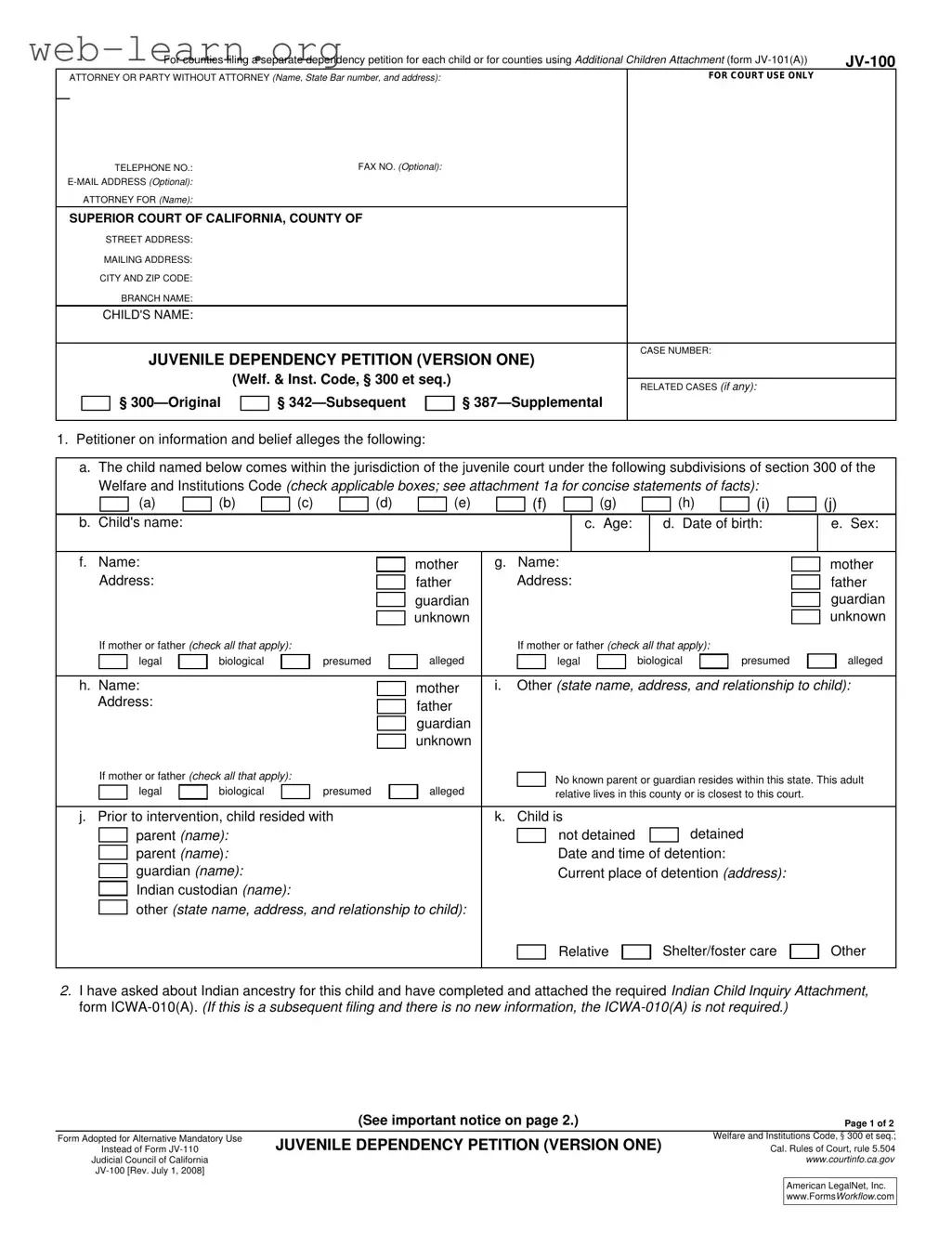
The California JV-100 form is a critical document used in juvenile dependency cases, specifically when a petition is filed for a child under the jurisdiction of the juvenile court. This form is essential for counties that either file separate dependency petitions for each child or utilize the Additional Children Attachment (form JV-101(A)). It requires detailed information about the child, including their name, age, date of birth, and sex, as well as information about their parents or guardians. The petitioner must allege specific facts that bring the child under the jurisdiction of the court, checking applicable boxes that correspond to the relevant sections of the Welfare and Institutions Code. Additionally, the form includes sections to address the child's current living situation, any prior detentions, and inquiries into the child's Indian ancestry, if applicable. It is crucial for petitioners to understand that by signing this document, they declare under penalty of perjury that all information provided is accurate. Furthermore, the form includes important notices for parents regarding their rights and responsibilities, emphasizing the potential consequences of the court proceedings on parental rights and financial obligations. Completing the JV-100 accurately is vital to ensure the child's welfare is prioritized and that legal proceedings can move forward effectively.
Sample - California Jv 100 Form

American LegalNet, Inc.
www.FormsWorkflow.com
JV-100
For counties filing a separate dependency petition for each child or for counties using Additional Children Attachment (form JV-101(A))
ATTORNEY OR PARTY WITHOUT ATTORNEY (Name, State Bar number, and address):
FOR COURT USE ONLY
TELEPHONE NO.:
FAX NO. (Optional):
ATTORNEY FOR (Name):
SUPERIOR COURT OF CALIFORNIA, COUNTY OF
STREET ADDRESS:
MAILING ADDRESS:
CITY AND ZIP CODE:
BRANCH NAME:
CHILD'S NAME:
CASE NUMBER:
RELATED CASES (if any):
1. Petitioner on information and belief alleges the following:
a. The child named below comes within the jurisdiction of the juvenile court under the following subdivisions of section 300 of the
Welfare and Institutions Code (check applicable boxes; see attachment 1a for concise statements of facts):
(j)(f) (i)
(a) (b) (c) (d) (e) (h)
(g)
b. Child's name:
d. Date of birth: e. Sex:c. Age:
f. Name: g. Name:
Address: Address:
h. Name: i. Other (state name, address, and relationship to child):
No known parent or guardian resides within this state. This adult
relative lives in this county or is closest to this court.
k. Child isj. Prior to intervention, child resided with
not detained
detained
Date and time of detention:
Relative
Shelter/foster care Other
JUVENILE DEPENDENCY PETITION (VERSION ONE)
Cal. Rules of Court, rule 5.504
Welfare and Institutions Code, § 300 et seq.;
Form Adopted for Alternative Mandatory Use
Instead of Form JV-110
Judicial Council of California
JV-100 [Rev. July 1, 2008]
Current place of detention (address):
unknown
mother
father
guardian
unknown
mother
father
guardian
Address:
unknown
mother
father
guardian
parent (name):
parent (name):
guardian (name):
other (state name, address, and relationship to child):
www.courtinfo.ca.gov
Page 1 of 2
E-MAIL ADDRESS (Optional):
If mother or father (check all that apply):
legal
biological
presumed
alleged
If mother or father (check all that apply):
legal
biological
presumed
alleged
If mother or father (check all that apply):
legal
biological
presumed
alleged
JUVENILE DEPENDENCY PETITION (VERSION ONE)
(Welf. & Inst. Code, § 300 et seq.)
§ 342—Subsequent § 387—Supplemental § 300—Original
2. I have asked about Indian ancestry for this child and have completed and attached the required Indian Child Inquiry Attachment,
form ICWA-010(A). (If this is a subsequent filing and there is no new information, the ICWA-010(A) is not required.)
(See important notice on page 2.)
Indian custodian (name):
— NOTICE —
TO PARENT
Your parental rights may be permanently terminated. To protect your rights, you must appear
in court and answer this petition.
You and the estate of your child may be jointly and severally liable for the cost of the care,
support, and maintenance of your child in any placement or detention facility, the cost of legal
services for you or your child by a public defender or other attorney, and the cost of supervision of
your child by order of the juvenile court.
TO PARENTS OR OTHERS LEGALLY RESPONSIBLE
FOR THE SUPPORT OF THE CHILD
JV-100
JV-100 [Rev. July 1, 2008]
Page 2 of 2
JUVENILE DEPENDENCY PETITION (VERSION ONE)
Address and telephone number (if different person signing than listed in caption above):
Number of pages attached: Other children are listed on Additional Children Attachment (form JV-101(A))
CHILD'S NAME:
CASE NUMBER:
3. Petitioner requests that the court find these allegations to be true.
I declare under penalty of perjury under the laws of the State of California that the foregoing and all attachments are true and correct.
Date:
(SIGNATURE OF PETITIONER)(TYPE OR PRINT NAME)
ʼ

Form Information

Fact Name Fact Description
Purpose of Form The JV-100 form is used to initiate a juvenile dependency petition in California, addressing issues related to the welfare of a child.
Governing Law This form is governed by the Welfare and Institutions Code, specifically sections 300 et seq., which outline the circumstances under which a child may be deemed a dependent of the court.
Filing Requirements Counties may file a separate dependency petition for each child involved, or they can use the Additional Children Attachment (form JV-101(A)) for multiple children in a single petition.
Parental Rights Notice The form includes a critical notice to parents, informing them that their parental rights may be permanently terminated if they do not respond to the petition.
Liability for Costs Parents or guardians may be held jointly and severally liable for the costs associated with the care, support, and legal services for the child while in a placement or detention facility.

Detailed Guide for Filling Out California Jv 100

Completing the California JV-100 form is an important step in the juvenile dependency process. This form gathers essential information about the child and the circumstances surrounding their situation. It is crucial to provide accurate and complete details to ensure that the court can make informed decisions regarding the child's welfare.

  1. Obtain the Form: Download the JV-100 form from the California Judicial Council website or obtain a physical copy from the local courthouse.
  2. Fill in Your Information: At the top of the form, provide your name, State Bar number (if applicable), address, and contact information. If you are representing yourself, indicate that you are a party without an attorney.
  3. Specify the Court Information: Enter the name of the Superior Court of California, the county, and the court's street address and mailing address.
  4. Child's Information: Write the child's full name, case number, age, date of birth, and sex in the designated fields.
  5. Parent and Guardian Details: Provide the names and addresses of the child's mother, father, and any guardians. Indicate their legal status by checking the appropriate boxes (e.g., legal, biological, presumed, alleged).
  6. Prior Residency: Indicate where the child resided prior to any intervention.
  7. Detention Status: Specify if the child is currently detained or not, along with the name and address of the current place of detention.
  8. Indian Ancestry Inquiry: Confirm that you have inquired about the child's Indian ancestry and that you have attached the required Indian Child Inquiry Attachment, if applicable.
  9. Request to the Court: State your request for the court to find the allegations true. This section also requires your signature and the date.
  10. Attachments: Note the number of pages attached and mention if additional children are listed on the Additional Children Attachment (form JV-101(A)).

After completing the form, review all entries for accuracy. It is important to ensure that all necessary attachments are included before submitting the form to the court. This will help facilitate the court's review process and support the child's best interests.

Obtain Answers on California Jv 100

  1. What is the purpose of the California JV-100 form?

    The California JV-100 form is used to initiate a juvenile dependency petition. This form allows the petitioner to present allegations regarding a child's welfare and request the court's intervention. It is essential for cases where a child may need protection due to abuse, neglect, or other circumstances that threaten their well-being.

  2. Who can file the JV-100 form?

    Any individual or attorney who has a legitimate concern for a child's safety and welfare can file the JV-100 form. This often includes social workers, family members, or legal guardians. The petitioner must provide accurate information about the child and their circumstances to ensure the court can make an informed decision.

  3. What information is required on the JV-100 form?

    The form requires detailed information about the child, including:

    • Child's name, age, and date of birth
    • Names and addresses of parents or guardians
    • Allegations that justify the need for intervention
    • Current living situation of the child

    Providing complete and accurate information is crucial for the court's review.

  4. What is the significance of the Indian Child Inquiry Attachment (form ICWA-010(A))?

    This attachment is necessary if the child may have Indian ancestry. It ensures compliance with the Indian Child Welfare Act (ICWA), which aims to protect the interests of Native American children. If there is no new information in a subsequent filing, this attachment may not be required.

  5. What happens after the JV-100 form is filed?

    Once the JV-100 form is filed, the court will schedule a hearing. The petitioner must appear in court to present their case. Failure to appear can result in the dismissal of the petition. During the hearing, the court will review the allegations and determine whether the child's safety is at risk.

  6. What are the potential consequences of filing a JV-100 form?

    Filing this form can lead to significant legal proceedings. If the court finds the allegations to be true, it may intervene in the family's situation, which could include removing the child from their home. Additionally, parents may face the possibility of having their parental rights terminated if the court deems it necessary for the child's safety.

  7. Can additional children be included in the JV-100 filing?

    Yes, if there are multiple children involved, the petitioner can use the Additional Children Attachment (form JV-101(A)). This allows for the inclusion of information about other children in the same family, ensuring that all relevant details are presented to the court.

  8. What should I do if I receive a notice related to the JV-100 form?

    If you receive a notice regarding the JV-100 form, it is crucial to take it seriously. This notice informs you that your parental rights may be at risk. You should appear in court and respond to the petition to protect your rights and address any concerns raised.

  9. Where can I obtain the JV-100 form?

    The JV-100 form can be obtained from the Superior Court of California's website or at the courthouse. Many legal aid organizations also provide access to this form and can assist you in filling it out correctly.

Common mistakes

Filling out the California JV-100 form can be a complex process, and mistakes can lead to delays or complications in your case. Here are seven common errors people make when completing this form.

One frequent mistake is failing to provide complete contact information for the attorney or party without an attorney. This section requires not just a name but also a state bar number, address, and phone number. Omitting any of these details can hinder communication with the court.

Another common error is neglecting to check the appropriate boxes regarding the child's situation under section 300 of the Welfare and Institutions Code. It is essential to accurately indicate the specific allegations that apply to the child. Misrepresenting or leaving out information can lead to misunderstandings about the case.

People often forget to include the child's full name, age, and date of birth. These details are critical for identifying the child in the court system. Incomplete information can cause confusion and may result in additional hearings or requests for clarification.

Some individuals mistakenly check the wrong parental status boxes. It is important to accurately identify whether the parents are legal, biological, presumed, or alleged. Incorrectly categorizing a parent can affect the outcome of the case and the rights of the individuals involved.

Another mistake is not attaching the required Indian Child Inquiry Attachment, form ICWA-010(A), when necessary. If there is Indian ancestry, this form must be completed and submitted. Failing to do so can delay proceedings and impact the court's ability to make informed decisions.

People sometimes neglect to sign the form or provide the date of signing. A signature is necessary to validate the petition. Without it, the court may not accept the filing, leading to further complications.

Lastly, failing to list other children on the Additional Children Attachment (form JV-101(A)) can create issues. If there are additional children involved in the case, they must be documented correctly. Not doing so can lead to incomplete records and potential legal challenges.

Documents used along the form

The California JV-100 form is a crucial document used in juvenile dependency cases. It initiates the process of petitioning the court regarding a child's welfare. However, several other forms often accompany the JV-100 to provide a comprehensive view of the child's situation and the legal context surrounding the case. Here are seven important forms that may be used alongside the JV-100:

  • JV-101(A) - Additional Children Attachment: This form is used when there are multiple children involved in a single dependency case. It provides additional information about each child, ensuring that the court has a complete understanding of the family dynamics.
  • ICWA-010(A) - Indian Child Inquiry Attachment: This form is essential for determining whether a child is a member of, or eligible for membership in, a Native American tribe. It ensures compliance with the Indian Child Welfare Act (ICWA) and protects the rights of Indian children and families.
  • JV-110 - Notice of Hearing: This document informs all parties involved about the upcoming court hearing related to the juvenile dependency case. It includes details such as the date, time, and location of the hearing, ensuring that everyone is adequately notified.
  • JV-500 - Petition to Terminate Parental Rights: In cases where the court considers the termination of parental rights, this form is used to formally request that the court sever the legal relationship between a parent and child.
  • JV-294 - Caregiver Information Statement: This form collects information about the child’s current caregiver, including their relationship to the child and details about the child's living situation. It helps the court assess the child's environment and well-being.
  • JV-220 - Application for Reunification Services: This form is used by parents seeking to reunite with their child after a dependency case has been initiated. It outlines the services they are requesting to help facilitate this process.
  • JV-212 - Report of the Child's Social Worker: This report provides the court with insights from the child's social worker, detailing the child's circumstances, progress, and any recommendations for future actions regarding the child's care.

Understanding these forms can significantly enhance the ability to navigate the juvenile dependency process. Each document plays a unique role in presenting information to the court, ensuring that the best interests of the child are prioritized throughout the legal proceedings.

Similar forms

  • JV-110: Notice of Hearing - This form notifies parties involved in a juvenile dependency case about upcoming court hearings. Like the JV-100, it aims to ensure that all relevant parties are informed and can participate in the proceedings.
  • JV-101: Additional Children Attachment - This document is used when filing for multiple children. It complements the JV-100 by providing additional space to detail the circumstances of other children involved in the case.
  • ICWA-010(A): Indian Child Inquiry Attachment - This form is necessary for cases involving potential Indian ancestry. Similar to the JV-100, it seeks to gather essential information that may affect the child's legal status and placement.
  • JV-130: Petition for Modification - This form allows parties to request changes to existing court orders. Like the JV-100, it serves as a formal request to the court regarding the child's welfare and legal situation.
  • JV-140: Request for Visitation - This document is used to request visitation rights for family members. It shares the same goal as the JV-100, focusing on maintaining family connections while ensuring the child's best interests.
  • JV-150: Report of Child's Attorney - This form provides the court with updates and recommendations from the child's legal representative. It is similar to the JV-100 in that it emphasizes the child's needs and circumstances within the legal framework.

Dos and Don'ts

When filling out the California JV-100 form, it's important to follow certain guidelines to ensure accuracy and compliance. Here’s a list of things you should and shouldn't do:

  • Do double-check all information for accuracy before submitting.
  • Do provide complete names and addresses for all parties involved.
  • Do ensure you check all applicable boxes regarding the child's status.
  • Do attach any required documents, such as the Indian Child Inquiry Attachment.
  • Do sign and date the form where indicated.
  • Don't leave any sections blank unless instructed to do so.
  • Don't use abbreviations or shorthand that may confuse the reader.
  • Don't forget to include your contact information if it differs from the one listed.
  • Don't submit the form without making a copy for your records.
  • Don't ignore any notices or instructions provided with the form.

Following these tips will help ensure that your submission is complete and correct, which can help avoid delays in the process.

Misconceptions

  • Misconception 1: The JV-100 form is only for cases involving serious abuse.

    Many people believe that the JV-100 form is only necessary for extreme cases of child abuse or neglect. In reality, this form is used for a variety of situations where a child may be at risk, including less severe cases that still require intervention from the juvenile court.

  • Misconception 2: Completing the JV-100 guarantees that the child will be removed from the home.

    Some individuals think that submitting the JV-100 form automatically leads to the child being taken away from their parents. However, the purpose of the form is to initiate a legal process. The court will review the information and determine the appropriate course of action based on the specific circumstances of each case.

  • Misconception 3: The JV-100 form is only for attorneys.

    There is a common belief that only legal professionals can fill out the JV-100 form. In fact, the form can be completed by any party involved in the case, including parents or guardians, who have the necessary information to provide.

  • Misconception 4: Once filed, the JV-100 cannot be changed.

    Some may think that the information submitted on the JV-100 form is set in stone. In reality, if new information arises or corrections are needed, parties can often submit amendments or additional documents to the court to ensure that the case reflects the most accurate and current details.

Key takeaways

Filling out the California JV-100 form is an important step in the juvenile dependency process. Here are some key takeaways to keep in mind:

  • Understand the Purpose: The JV-100 form is used to file a juvenile dependency petition, which seeks court intervention for a child who may be at risk.
  • Gather Necessary Information: Before starting, collect all required details about the child, parents, and any guardians. This includes names, addresses, and relationships.
  • Check Applicable Jurisdiction: Identify which sections of the Welfare and Institutions Code apply to your case by checking the appropriate boxes on the form.
  • Attach Additional Documents: If there are other children involved, use the Additional Children Attachment (form JV-101(A)) to include their information.
  • Complete the Indian Child Inquiry: If applicable, ensure you complete and attach the Indian Child Inquiry Attachment (form ICWA-010(A)). This is crucial for cases involving Native American children.
  • Be Aware of Legal Consequences: Parents should understand that failing to respond to the petition can lead to permanent termination of parental rights.
  • Review Before Submission: Double-check all information for accuracy and completeness. Errors can delay the process or affect the outcome of the petition.

By following these guidelines, you can navigate the filing process more effectively and ensure that the necessary steps are taken to protect the child's well-being.