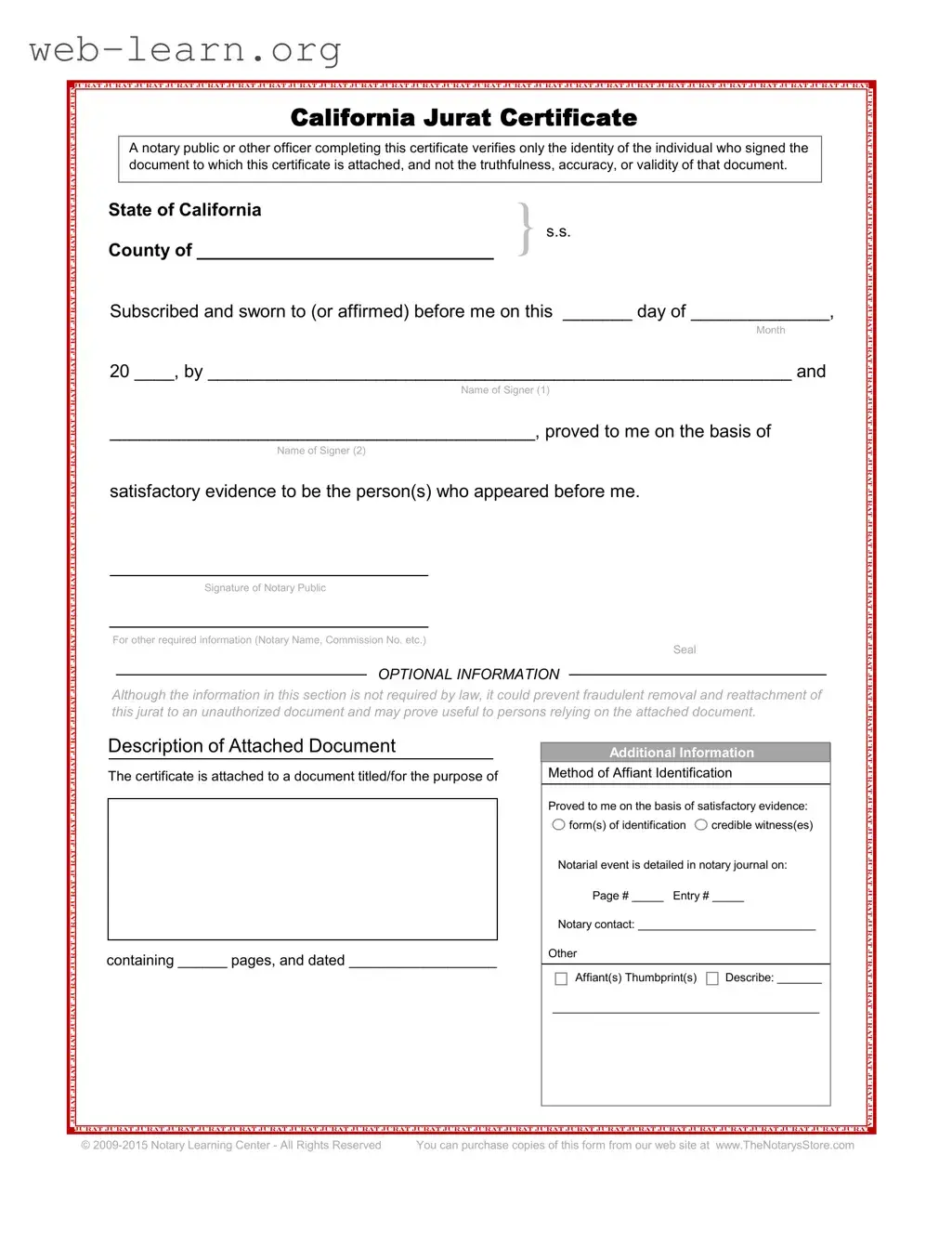
Homepage Blank California Jurat Form
Outline

The California Jurat form plays a crucial role in the notarization process, ensuring that individuals affirm the truthfulness of their statements under oath. This form requires the presence of a notary public who witnesses the signing and provides a certification that the signer has taken an oath. Key components of the Jurat include the signer's name, the date of the oath, and the notary's signature and seal. It is essential for legal documents where the accuracy of the information is paramount. The form is commonly used in various situations, such as affidavits and declarations, where a sworn statement is necessary. Understanding how to properly complete and utilize the California Jurat form can help individuals navigate legal requirements more effectively.
Sample - California Jurat Form

  ! !"#"""$%&$!
                         
                         
                                 
                                 

 !""
#$!"!%
' '!
% !( 
 )*%!#)*'#+,,,,,,,
,,,,,,,,,,,,,,,,,,,,,,,,,,,,,,,,,,,,,,,,,,
& -#
&
,,,,,,.,,,,,,,,,,,,,,,,,,
/  0 
-!#  +
1+
+,,,,,,,,,,,,,,,,,,,,,,,,,,,,
2

-3,,,,,43,,,,,
!)*  #")*
56 !)!.!!$$*


$$
&##") !*# !,,,,,,, ,,,,,,,,,,,,,,.
,,,,.#,,,,,,,,,,,,,,,,,,,,,,,,,,,,,,,,,,,,,,,,,,,,,,,,,,,,,,,,,,,
,,,,,,,,,,,,,,,,,,,,,,,,,,,,,,,,,,,,,,,,,,,.!#
 #)*"# !$
/
! &)*
! &)*
# !   "
!" . .. !$

Form Information

Fact Name Description
Definition A jurat is a part of a notarial certificate where the signer swears or affirms that the contents of a document are true.
Governing Law The California Jurat form is governed by California Civil Code Section 1189.
Signature Requirement The signer must personally appear before the notary and sign the document in their presence.
Oath or Affirmation The notary must administer an oath or affirmation to the signer, confirming the truth of the document's contents.
Format The jurat must include specific wording, such as “Subscribed and sworn to (or affirmed) before me…”
Use Cases Commonly used for affidavits, depositions, and other legal documents requiring a sworn statement.

Detailed Guide for Filling Out California Jurat

After obtaining the California Jurat form, you'll need to fill it out carefully. This form is often used in legal situations where a person must declare the truthfulness of their statements. Follow these steps to complete the form accurately.

  1. Begin by writing your name at the top of the form, where it asks for the "Name of Signer."
  2. Next, indicate the date on which you are signing the document.
  3. In the section that asks for the "Title," write the title or position you hold, if applicable.
  4. Provide the name of the individual or organization that you are representing, if any.
  5. In the body of the jurat, state the facts or statements you are affirming. Be clear and concise.
  6. Leave space for the notary's signature and seal, which will be added later.
  7. Finally, sign the form where indicated. Ensure your signature matches the name you provided at the top.

Once you have filled out the form, it will be ready for a notary public to review and notarize. Make sure to bring a valid form of identification when you go to the notary.

Obtain Answers on California Jurat

  1. What is a California Jurat form?

    A California Jurat form is a legal document used to verify that a person has sworn an oath or affirmation before a notary public. This form includes a statement confirming that the signer has personally appeared before the notary and has acknowledged that the information provided is true.

  2. When is a Jurat needed?

    A Jurat is typically required when a document needs to be sworn to or affirmed. This is common in legal proceedings, affidavits, and other official documents where the truthfulness of the content is crucial.

  3. What information is included in a Jurat?

    A Jurat generally includes the following details:

    • The name of the person signing the document.
    • The date the oath was administered.
    • The notary's signature and seal.
    • A statement that the signer appeared before the notary and swore to the truth of the contents.
  4. Who can administer a Jurat?

    Only a notary public can administer a Jurat. Notaries are authorized by the state to witness signatures and verify identities, ensuring that the signer is acting voluntarily and is aware of the document's contents.

  5. How does one complete a Jurat?

    To complete a Jurat, follow these steps:

    • The signer must appear in person before the notary.
    • The notary will ask the signer to provide identification.
    • The notary will read the Jurat aloud and ask the signer to affirm the truth of the document.
    • After the affirmation, the notary will complete the Jurat by signing and sealing the document.
  6. Can a Jurat be used for any type of document?

    While a Jurat can be used for many types of documents, it is not suitable for all. It is primarily used for documents that require an oath or affirmation. Always check the specific requirements for the document in question.

  7. What happens if the signer refuses to swear or affirm?

    If the signer refuses to swear or affirm, the notary cannot complete the Jurat. The document cannot be notarized, and the signer may need to reconsider their position or consult legal advice.

  8. Is there a fee for notarizing a Jurat?

    Yes, notaries in California may charge a fee for their services, including administering a Jurat. The maximum fee is set by state law, so it is advisable to ask the notary about their charges beforehand.

  9. How long is a Jurat valid?

    A Jurat does not have a specific expiration date. Its validity depends on the context in which it is used. However, it is essential to ensure that the document is used within the timeframe relevant to its purpose, especially in legal matters.

Common mistakes

When filling out the California Jurat form, individuals often make several common mistakes that can lead to complications or delays. One frequent error is failing to include the correct date. The date is crucial as it indicates when the affidavit was sworn. Without this information, the document may be considered incomplete. Always double-check the date before submitting the form.

Another common mistake is neglecting to sign the form in the appropriate place. The signature must be provided where indicated, and it should match the name printed on the form. If the signature is missing or does not correspond with the printed name, the document may not be valid. It is essential to ensure that the signature is clear and legible.

People also sometimes forget to include their printed name beneath their signature. This detail is important because it helps to clarify who has signed the document. Without a printed name, there could be confusion regarding the identity of the signer, which can lead to further issues. Always remember to print your name clearly beneath your signature.

Another mistake often made is using the wrong notarial wording. The California Jurat has specific language that must be included to ensure its validity. If the wording is altered or incomplete, the notary may refuse to acknowledge the document. Familiarizing yourself with the exact wording required can prevent this issue from arising.

Lastly, individuals sometimes fail to provide proper identification when presenting the form to a notary. Notaries are required to verify the identity of the signer, and without appropriate identification, they cannot proceed. Always bring a valid form of ID to ensure a smooth notarization process. Taking these steps can help avoid unnecessary complications and ensure that your California Jurat form is filled out correctly.

Documents used along the form

The California Jurat form is a crucial document used in the notarization process, ensuring that a signer has sworn to the truthfulness of the contents of a document. In addition to the Jurat, several other forms and documents often accompany it, each serving a specific purpose in legal and administrative procedures. Below is a list of these commonly used documents.

  • Acknowledgment Form: This form verifies that a signer personally appeared before a notary and acknowledged signing the document. It is often used for deeds, contracts, and other legal instruments.
  • Affidavit: An affidavit is a written statement confirmed by oath or affirmation, used as evidence in court. It often accompanies the Jurat to provide sworn testimony regarding facts pertinent to a case.
  • Power of Attorney: This document grants one person the authority to act on behalf of another in legal or financial matters. A Jurat may be required when the power of attorney is executed.
  • Certificate of Authentication: This document certifies that a signature, seal, or public record is genuine. It is often used for documents that need to be recognized in foreign jurisdictions.
  • Will: A will is a legal document that outlines how a person's assets will be distributed after their death. Notarization may be required to validate the will, often accompanied by a Jurat.
  • Trust Document: This document establishes a trust, detailing how assets are to be managed and distributed. A Jurat may be necessary to confirm the trust's validity.
  • Real Estate Deed: This document transfers ownership of real property from one party to another. A Jurat is often included to affirm that the signing party is acting voluntarily and with full understanding.
  • Loan Agreement: A loan agreement outlines the terms of a loan between a lender and a borrower. Notarization, including a Jurat, may be required to ensure the agreement is legally binding.

Each of these documents plays a vital role in the legal landscape, often working in tandem with the California Jurat form to ensure that transactions and agreements are conducted fairly and transparently. Understanding their purposes can help individuals navigate legal processes with greater confidence.

Similar forms

The California Jurat form is a specific type of notarial certificate that verifies the identity of the signer and their oath or affirmation regarding the contents of a document. Several other documents serve similar purposes in various contexts. Below is a list of ten documents that share similarities with the California Jurat form:

  • Acknowledgment: This document confirms that a signer appeared before a notary public and acknowledged signing a document voluntarily. Unlike a Jurat, it does not require the signer to take an oath.
  • Affidavit: An affidavit is a written statement confirmed by oath or affirmation, often used as evidence in court. It requires the affiant to swear to the truth of the contents, similar to a Jurat.
  • Verification: This document is used to affirm the truth of statements made in a written document. It typically requires a signer to declare the truthfulness under penalty of perjury, much like a Jurat.
  • Power of Attorney: A power of attorney document allows one person to act on behalf of another. While it doesn't always require a Jurat, it often includes a notarial acknowledgment that can resemble a Jurat.
  • Declaration under Penalty of Perjury: This document allows individuals to make statements that are legally binding. It requires the declarant to affirm the truth of their statements, similar to the oath in a Jurat.
  • Notarized Will: A notarized will often includes a Jurat or acknowledgment to verify the identity of the testator and the signing process, ensuring its validity.
  • Contract with Notarization: Some contracts require notarization to confirm the identities of the parties involved. This process can include a Jurat, affirming that the parties signed the contract under oath.
  • Loan Documents: Many loan agreements require notarization. The notary may use a Jurat to confirm that the signer swore to the accuracy of the information provided in the documents.
  • Real Estate Deeds: When transferring property, deeds often require notarization. A Jurat may be included to ensure that the grantor swears to the truthfulness of the deed's contents.
  • Application for a Marriage License: Some jurisdictions require the applicant to swear to the truth of the information provided. This process can resemble a Jurat, affirming the applicant's statements.

Each of these documents plays a vital role in legal processes, ensuring that information is verified and that individuals are held accountable for their statements.

Dos and Don'ts

When filling out the California Jurat form, there are important dos and don'ts to keep in mind. Here’s a straightforward list to guide you.

  • Do read the instructions carefully before starting.
  • Do ensure that all information is accurate and complete.
  • Do sign the form in the presence of a notary public.
  • Do use black or blue ink to fill out the form.
  • Do check for any required identification before your appointment.
  • Don't leave any sections blank; fill in all required fields.
  • Don't sign the form before meeting with the notary.
  • Don't use correction fluid or tape on the form.
  • Don't provide false information; it could lead to legal consequences.
  • Don't forget to bring any necessary documents that support your claim.

Misconceptions

Many people have misunderstandings about the California Jurat form. Here are seven common misconceptions and clarifications for each:

  • A Jurat is the same as an Acknowledgment. A Jurat is different from an acknowledgment. A Jurat confirms that the signer personally appeared before the notary and swore or affirmed the truth of the document.
  • Notaries can fill out the Jurat form for the signer. Notaries cannot fill out the form on behalf of the signer. The signer must complete the document before the notary can perform the Jurat.
  • All documents require a Jurat. Not all documents need a Jurat. A Jurat is specifically for documents that require an oath or affirmation regarding the truthfulness of the content.
  • The Jurat can be completed without the signer present. This is incorrect. The signer must be present in front of the notary when the Jurat is executed.
  • There is a specific format for the Jurat. While there are guidelines, the Jurat can be adapted to fit the needs of the document, as long as it meets the legal requirements.
  • Anyone can act as a notary for a Jurat. Only individuals who are officially commissioned as notaries public in California can perform a Jurat.
  • The signer must sign the Jurat form in front of the notary. This is true. The signer must sign the document in the presence of the notary, who will then complete the Jurat.

Key takeaways

The California Jurat form is an important document used in legal proceedings. Understanding how to fill it out correctly is essential for its proper use. Here are key takeaways regarding the form:

  • The Jurat serves as a declaration that the signer has taken an oath or affirmation before a notary public.
  • Always ensure that the form is filled out completely before presenting it to the notary.
  • Include the date and location where the oath is administered to provide context.
  • The signer must personally appear before the notary to take the oath; this cannot be done remotely.
  • Clear identification is required; the notary must verify the identity of the signer using valid identification.
  • Be mindful of the wording; the Jurat must clearly state that the signer is swearing or affirming the truth of the contents of the document.
  • After the notary completes the form, it should be kept with the original document for legal validity.
  • Failure to follow the proper procedure can result in the document being deemed invalid in court.