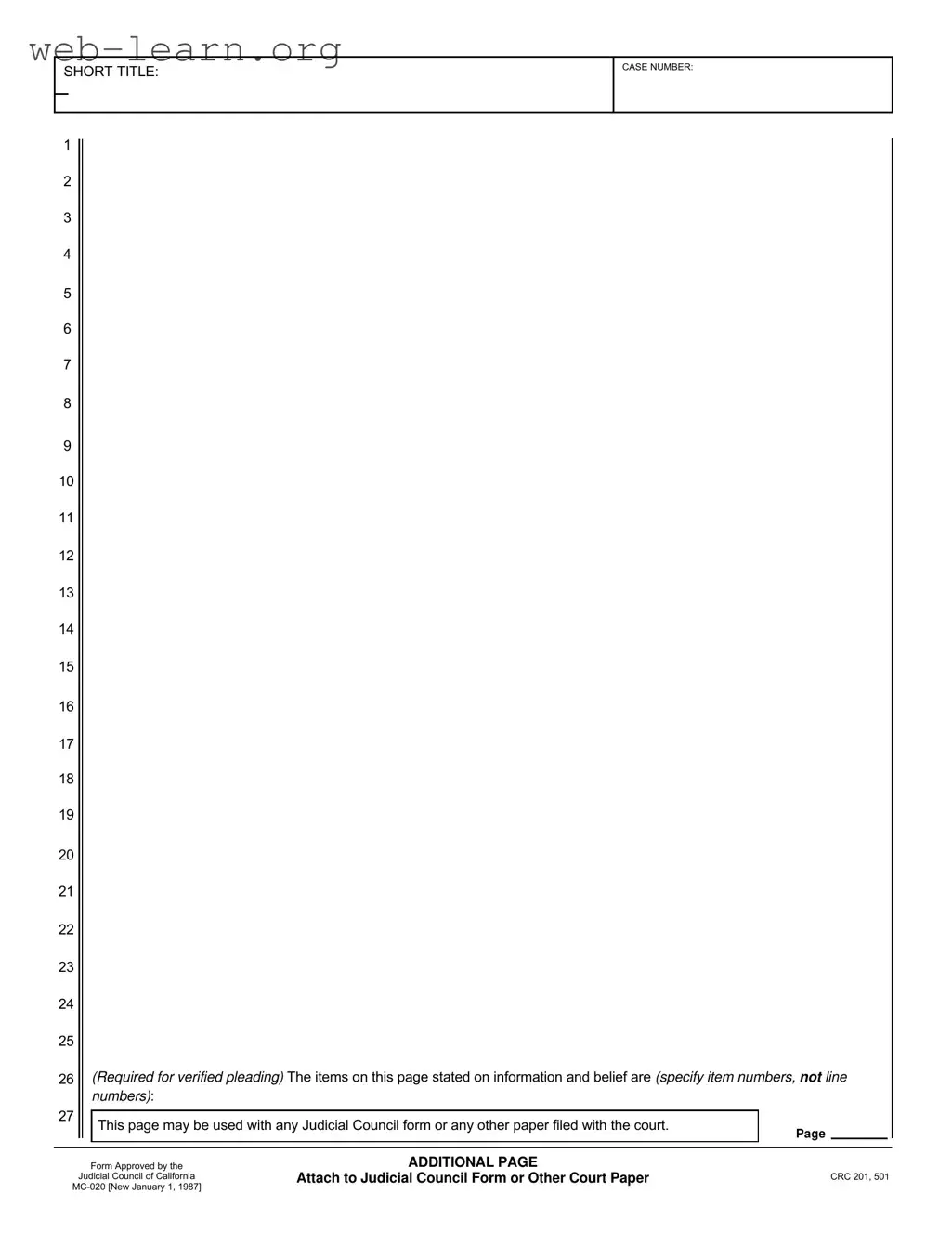
The California Judicial Council form serves as a vital tool for individuals navigating the state’s legal system. This form is structured to streamline the filing process, ensuring that necessary information is presented clearly and concisely. It includes essential elements such as a short title and case number, which help identify the specific case at hand. The form allows users to specify items based on their information and belief, with a designated section for item numbers, enhancing clarity and precision. Furthermore, this form can be utilized alongside any Judicial Council form or other court documents, making it versatile for various legal proceedings. Approved by the Judicial Council of California, this form has been in use since January 1, 1987, and adheres to the guidelines set forth in the California Rules of Court. This adaptability is crucial for individuals and legal professionals alike, as it aids in maintaining organized records and facilitates communication with the court.

| Fact Name | Description |
|---|---|
| Short Title Requirement | The form requires a short title to identify the case clearly. |
| Case Number | A designated case number is necessary for tracking and referencing the case. |
| Verified Pleading | This form is required for verified pleadings, ensuring that the information is accurate and truthful. |
| Information and Belief | Users must specify item numbers based on information and belief, not line numbers, for clarity. |
| Compatibility | This page can be used with any Judicial Council form or other court papers, providing flexibility. |
| Form Approval | The form is approved by the Judicial Council of California, indicating it meets legal standards. |
| Form Code | The specific form code for this document is MC-020, established in January 1987. |
| California Rules of Court | This form adheres to the California Rules of Court, specifically CRC 201 and 501. |
After gathering the necessary information, you can begin filling out the California Judicial Council form. This form is designed to provide additional details for your case. Follow the steps below to complete the form accurately.
Once you have completed these steps, review the form for any errors or missing information. Ensure that everything is clear and accurate before submitting it to the court.
What is the purpose of the California Judicial Council form?
The California Judicial Council form serves to standardize court documents, making it easier for individuals to file papers with the court. It ensures that all necessary information is collected in a consistent manner.
What information is required on the form?
Each form requires a short title and case number. Additionally, if you are providing information based on belief, you must specify the item numbers. This helps clarify which details you are addressing.
Can I use this form with other court documents?
Yes, this form can be attached to any Judicial Council form or any other paper filed with the court. This flexibility allows for comprehensive documentation of your case.
What is the significance of stating information on belief?
Stating information on belief indicates that you are providing information based on your understanding or knowledge rather than personal experience. This is important for transparency in legal proceedings.
Is there a specific format for filling out the form?
While the form has designated sections, it is essential to fill it out clearly and accurately. Use item numbers rather than line numbers when specifying details, as this aligns with court requirements.
When was this form approved?
This form was approved by the Judicial Council of California on January 1, 1987. It has been in use for several decades, reflecting its importance in the legal process.
What does "CRC 201, 501" refer to?
CRC stands for California Rules of Court. Rules 201 and 501 pertain to the requirements and guidelines for filing documents in California courts, ensuring that all submissions meet legal standards.
How do I obtain this form?
You can obtain the California Judicial Council form from the official California courts website or at your local courthouse. Many forms are also available online for easy access.
What should I do if I need additional pages?
If you need more space, you can attach additional pages to the Judicial Council form or other court papers. Ensure that these pages are clearly labeled and follow the same format as the main form.
Are there any fees associated with filing this form?
Filing fees may vary depending on the type of case and the court. It is advisable to check with your local court for specific fee information related to your filing.
Filling out the California Judicial Council form can be a straightforward process, but many people encounter common pitfalls that can lead to delays or complications in their cases. One frequent mistake is leaving the short title and case number sections blank. These details are crucial for identifying your case in the court system. Without them, your form may not be processed correctly.
Another common error is failing to specify the item numbers in the designated section. When asked to provide information on items, it's important to list the correct item numbers, not line numbers. This distinction can be confusing, but ensuring accuracy here is essential for clarity and proper handling of your submission.
Many individuals overlook the importance of completing every required field. Each section of the form is designed to gather specific information. Omitting even a single piece of required information can result in the form being rejected or returned for corrections, which can prolong the process.
Additionally, some people forget to sign the form. A signature is often necessary to validate the document. Without it, the court may consider the form incomplete. Always double-check that you have signed where required before submitting your paperwork.
Another mistake is using incorrect or outdated versions of the form. The California Judicial Council periodically updates its forms, and using an old version can lead to complications. Always ensure that you are using the most current form available.
Inaccurate or inconsistent information can also be a significant issue. For example, if the names or addresses listed on the form do not match those in other court documents, it can create confusion. Consistency is key to ensuring that your case is processed smoothly.
Some individuals may not attach additional pages when necessary. If your responses exceed the space provided on the form, you must attach additional pages properly. Failing to do so can leave important information unaddressed.
Another mistake occurs when individuals do not keep copies of their submitted forms. It’s essential to retain a copy for your records. This way, you can reference it later if any questions arise or if you need to follow up on your case.
Lastly, some people neglect to review their forms before submission. Taking the time to proofread can help catch any errors or omissions that could lead to complications. A thorough review can save time and prevent unnecessary delays in your case.
By being aware of these common mistakes, you can enhance your chances of successfully completing the California Judicial Council form and moving forward with your case without unnecessary setbacks.
When navigating the legal system in California, several forms and documents often accompany the California Judicial Council form. Each serves a specific purpose in the legal process, ensuring that all necessary information is accurately presented to the court. Below is a list of common forms that may be used alongside the Judicial Council form.
Understanding these forms can significantly impact the outcome of a legal matter. Each document plays a vital role in ensuring that the court has the necessary information to make informed decisions. Properly completing and submitting these forms can help facilitate a smoother legal process.
The California Judicial Council form has similarities with various other legal documents. Each of these documents serves specific purposes within the judicial process, yet they share common elements. Below is a list of ten documents that are comparable to the California Judicial Council form, along with a brief explanation of their similarities:
Understanding these similarities can help clarify the roles each document plays in the legal process, ensuring that parties are well-prepared when navigating the court system.
When filling out the California Judicial Council form, it’s important to follow specific guidelines to ensure your submission is accurate and complete. Here are nine things you should and shouldn't do:
Misconceptions about the California Judicial Council form can lead to confusion and potential errors in legal proceedings. Here are eight common misconceptions along with clarifications:
Understanding these misconceptions can help individuals navigate the legal process more effectively and ensure compliance with court requirements.
When using the California Judicial Council form, it is essential to keep several key points in mind to ensure accuracy and compliance. Here are some important takeaways:
By following these guidelines, you can navigate the process of filling out and using the California Judicial Council form more effectively.