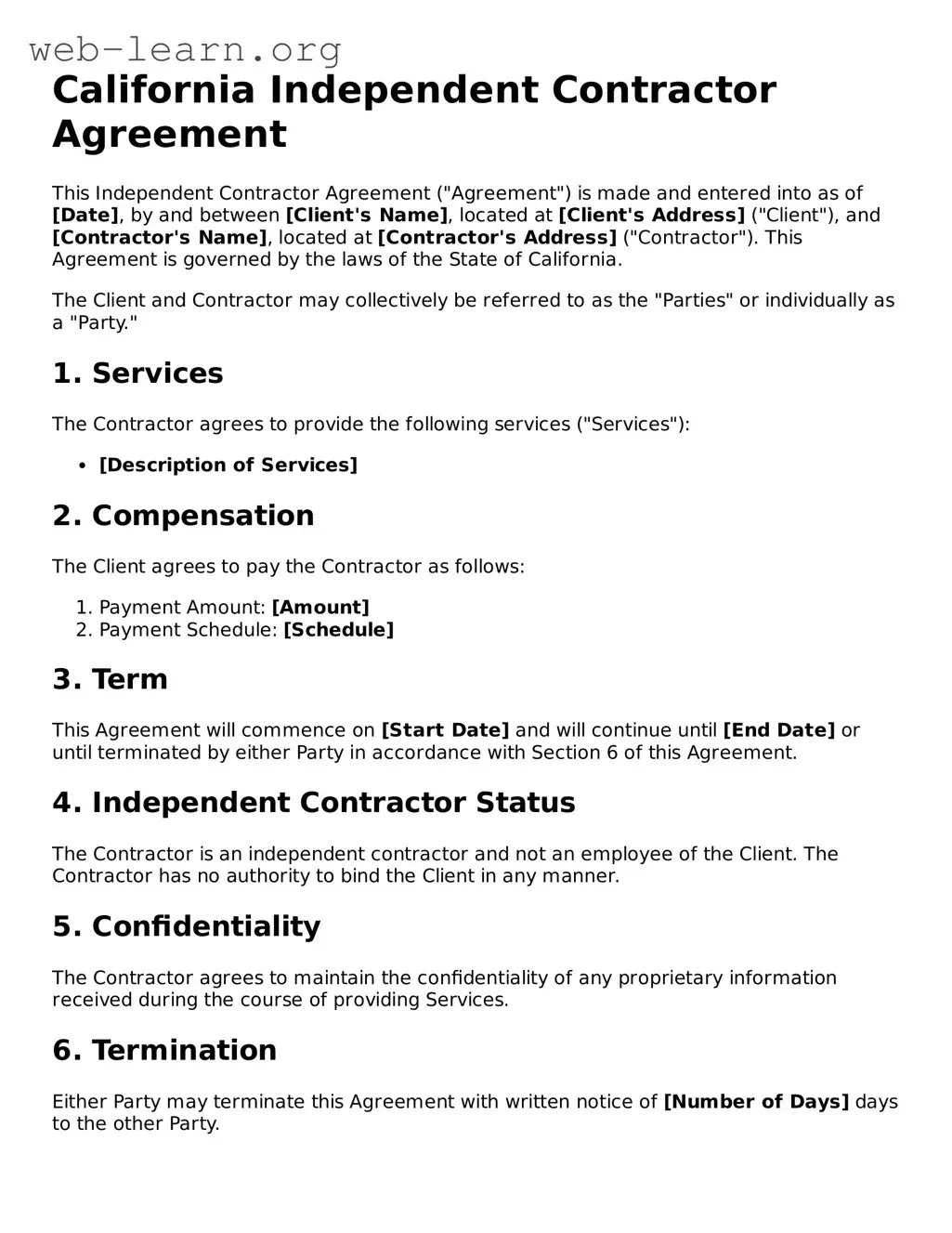
In California, the Independent Contractor Agreement form plays a crucial role in defining the working relationship between businesses and independent contractors. This document outlines the expectations, responsibilities, and rights of both parties involved. It typically includes essential elements such as the scope of work, payment terms, and deadlines, ensuring clarity from the outset. Additionally, it addresses issues like confidentiality and ownership of work products, which are vital for protecting both the contractor's and the business's interests. By having a well-drafted agreement in place, both parties can avoid misunderstandings and potential disputes down the line. This form not only promotes professionalism but also helps to establish a clear framework for collaboration, which is especially important in today’s fast-paced work environment.
California Independent Contractor Agreement
This Independent Contractor Agreement ("Agreement") is made and entered into as of [Date], by and between [Client's Name], located at [Client's Address] ("Client"), and [Contractor's Name], located at [Contractor's Address] ("Contractor"). This Agreement is governed by the laws of the State of California.
The Client and Contractor may collectively be referred to as the "Parties" or individually as a "Party."
1. Services
The Contractor agrees to provide the following services ("Services"):
2. Compensation
The Client agrees to pay the Contractor as follows:
3. Term
This Agreement will commence on [Start Date] and will continue until [End Date] or until terminated by either Party in accordance with Section 6 of this Agreement.
4. Independent Contractor Status
The Contractor is an independent contractor and not an employee of the Client. The Contractor has no authority to bind the Client in any manner.
5. Confidentiality
The Contractor agrees to maintain the confidentiality of any proprietary information received during the course of providing Services.
6. Termination
Either Party may terminate this Agreement with written notice of [Number of Days] days to the other Party.
7. Governing Law
This Agreement shall be governed by and construed in accordance with the laws of the State of California.
8. Entire Agreement
This Agreement constitutes the entire understanding between the Parties and supersedes all prior agreements, whether written or oral, relating to the subject matter herein.
IN WITNESS WHEREOF, the Parties hereto have executed this Independent Contractor Agreement as of the date first above written.
Client Signature: ________________________ Date: _______________
Contractor Signature: _____________________ Date: _______________
| Fact Name | Details |
|---|---|
| Definition | The California Independent Contractor Agreement outlines the terms of engagement between a contractor and a client. |
| Governing Law | This agreement is governed by California state law, specifically the California Labor Code. |
| Classification | It distinguishes between independent contractors and employees, which affects tax and liability issues. |
| Essential Elements | Key components include scope of work, payment terms, and duration of the contract. |
| Termination Clause | A clear termination clause outlines the conditions under which either party can end the agreement. |
| Confidentiality | Many agreements include confidentiality provisions to protect sensitive information. |
| Dispute Resolution | Provisions for dispute resolution, such as mediation or arbitration, are often included. |
| Compliance | It is crucial for both parties to comply with California’s AB 5 law, which defines independent contractor criteria. |
Filling out the California Independent Contractor Agreement form is straightforward. Once completed, you'll have a clear understanding of the terms between you and the contractor. This can help prevent misunderstandings and ensure that everyone is on the same page regarding the work to be done.
After completing these steps, review the form to ensure all information is accurate. Each party should keep a copy for their records. This will help maintain clarity and accountability throughout the working relationship.
What is a California Independent Contractor Agreement?
A California Independent Contractor Agreement is a legal document that outlines the terms and conditions of a working relationship between a business and an independent contractor. This agreement specifies the scope of work, payment terms, and other important details to ensure both parties understand their rights and responsibilities.
Why is it important to have an Independent Contractor Agreement?
Having an Independent Contractor Agreement is crucial for several reasons:
What should be included in the agreement?
An effective Independent Contractor Agreement should include:
How does the agreement affect taxes?
Independent contractors are responsible for their own taxes, unlike employees whose taxes are withheld by the employer. The agreement should clarify that the contractor is responsible for reporting their income and paying any applicable taxes. It’s advisable for contractors to consult with a tax professional to understand their obligations.
Can the agreement be modified?
Yes, the Independent Contractor Agreement can be modified if both parties agree to the changes. It is best to document any modifications in writing and have both parties sign the updated agreement to avoid any future disputes.
What happens if there is a dispute?
If a dispute arises, the agreement should outline the process for resolving it. This may include mediation or arbitration before pursuing legal action. Having a clear dispute resolution process can save time and resources for both parties.
Filling out the California Independent Contractor Agreement form can be straightforward, but many people make common mistakes that can lead to issues later on. One frequent error is failing to clearly define the scope of work. Without a detailed description of the services to be provided, both parties may have different expectations, which can lead to disputes.
Another mistake is neglecting to specify the payment terms. It's important to outline how much the contractor will be paid, when payments will be made, and the method of payment. Vague terms can create confusion and potentially result in delays or disagreements over compensation.
Many individuals also overlook the importance of including a termination clause. This clause should detail how either party can end the agreement. Without this information, one party may feel trapped in a contract that no longer meets their needs.
Additionally, people often forget to include necessary legal provisions. For example, clauses regarding confidentiality, intellectual property rights, and dispute resolution can protect both parties. Omitting these provisions can leave one or both parties vulnerable.
Finally, some individuals fail to sign the agreement properly. A signature is crucial for the contract to be legally binding. Not only should both parties sign, but they should also date the agreement. An unsigned or undated contract may not hold up in court if a dispute arises.
When engaging independent contractors in California, it's essential to have the right forms and documents in place. These documents help clarify the relationship between the contractor and the hiring party, ensuring compliance with legal standards and protecting both parties' interests. Here’s a list of other forms and documents that are often used alongside the California Independent Contractor Agreement:
Having these documents in place can help create a smoother working relationship and minimize misunderstandings. They provide clarity and structure, making it easier for both parties to navigate the terms of their engagement.
The Independent Contractor Agreement form shares similarities with several other legal documents. Here’s a list of nine documents that serve related purposes:
When filling out the California Independent Contractor Agreement form, it's important to follow certain guidelines to ensure clarity and compliance. Here are four things you should and shouldn't do:
Understanding the California Independent Contractor Agreement form is essential for both workers and employers. However, several misconceptions can lead to confusion and potential legal issues. Here are nine common misconceptions:
This is not true. Independent contractors have rights under California law, including the right to be paid for their work and to work in a safe environment.
Not every worker qualifies as an independent contractor. The classification depends on various factors, including the level of control the employer has over the worker.
This misconception overlooks the fact that independent contractors can and should negotiate terms to ensure they are fair and beneficial.
While verbal agreements can be valid, having a written contract provides clarity and legal protection for both parties.
Independent contractors are responsible for paying their own taxes, including self-employment taxes. They must report their income to the IRS.
Every agreement can vary significantly based on the nature of the work, the parties involved, and specific legal requirements. Customization is often necessary.
Agreements can be amended if both parties consent to the changes. Flexibility is often necessary as circumstances evolve.
In fact, independent contractors often work for multiple clients simultaneously, which is one of the benefits of this type of arrangement.
When properly drafted and signed, these agreements are legally binding contracts that can be enforced in court.
Addressing these misconceptions is crucial for ensuring that both independent contractors and employers understand their rights and responsibilities under California law.
When utilizing the California Independent Contractor Agreement form, there are several important points to consider. Below are key takeaways to keep in mind:
Contractor Contract - This document can help in tax compliance by clearly defining the contractor's status.
Contract Template for Independent Contractor - It can specify the payment schedule, whether it's hourly, per project, or milestone-based.