Homepage Blank California Id 1060 Form
Outline

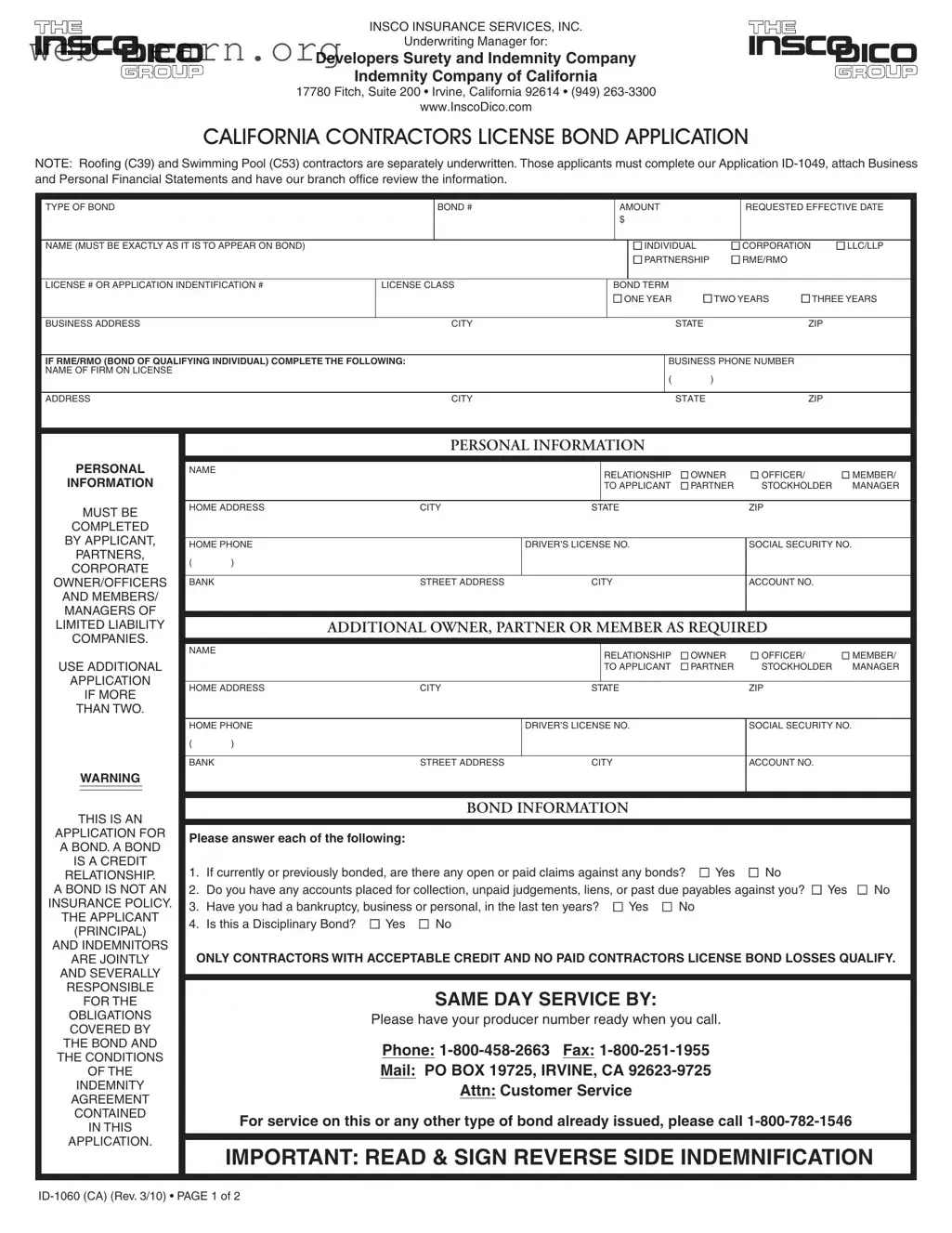
In the landscape of California's contracting industry, the California ID 1060 form plays a pivotal role in the bonding process for contractors. This application is essential for those seeking a contractor's license bond, which is a requirement for many trades, ensuring that contractors adhere to state regulations and protect consumers. The form requires detailed information about the applicant, including business structure—whether an individual, corporation, LLC, or partnership—as well as the specific type of bond requested and its effective date. Additionally, personal information from key individuals associated with the business must be provided, highlighting the collective responsibility of all parties involved. Importantly, the ID 1060 form emphasizes that a bond is not an insurance policy but rather a credit relationship, which holds applicants and indemnitors accountable for any obligations covered by the bond. Furthermore, the form outlines the indemnity agreement, detailing the responsibilities and potential liabilities of the applicants, thereby underscoring the urgency of providing accurate and complete information. Understanding the nuances of this form is critical for contractors aiming to navigate the complexities of compliance and financial responsibility in California.

Sample - California Id 1060 Form

CALIFORNIA CONTRACTORS LICENSE BOND APPLICATION
ID-1060 (CA) (Rev. 3/10)  PAGE 1 of 2
TYPE OF BOND BOND # AMOUNT REQUESTED EFFECTIVE DATE
$
NAME (MUST BE EXACTLY AS IT IS TO APPEAR ON BOND)
n INDIVIDUAL n CORPORATION n LLC/LLP
n PARTNERSHIP n RME/RMO
LICENSE # OR APPLICATION INDENTIFICATION # LICENSE CLASS BOND TERM
n ONE YEAR n TWO YEARS n THREE YEARS
BUSINESS ADDRESS CITY STATE ZIP
IF RME/RMO (BOND OF QUALIFYING INDIVIDUAL) COMPLETE THE FOLLOWING: BUSINESS PHONE NUMBER
NAME OF FIRM ON LICENSE
( )
ADDRESS CITY STATE ZIP
Please answer each of the following:
1. If currently or previously bonded, are there any open or paid claims against any bonds?
n Yes n No
2. Do you have any accounts placed for collection, unpaid judgements, liens, or past due payables against you? n Yes n No
3. Have you had a bankruptcy, business or personal, in the last ten years? n Yes n No
4. Is this a Disciplinary Bond? n Yes n No
ONLY CONTRACTORS WITH ACCEPTABLE CREDIT AND NO PAID CONTRACTORS LICENSE BOND LOSSES QUALIFY.
INSCO INSURANCE SERVICES, INC.
Underwriting Manager for:
Developers Surety and Indemnity Company
Indemnity Company of California
17780 Fitch, Suite 200
 Irvine, California 92614  (949) 263-3300
www.InscoDico.com
IMPORTANT: READ & SIGN REVERSE SIDE INDEMNIFICATION
MUST BE
COMPLETED
BY APPLICANT,
PARTNERS,
CORPORATE
OWNER/OFFICERS
AND MEMBERS/
MANAGERS OF
LIMITED LIABILITY
COMPANIES.
USE ADDITIONAL
APPLICATION
IF MORE
THAN TWO.
PERSONAL
INFORMATION
THIS IS AN
APPLICATION FOR
A BOND. A BOND
IS A CREDIT
RELATIONSHIP.
A BOND IS NOT AN
INSURANCE POLICY.
THE APPLICANT
(PRINCIPAL)
AND INDEMNITORS
ARE JOINTLY
AND SEVERALLY
RESPONSIBLE
FOR THE
OBLIGATIONS
COVERED BY
THE BOND AND
THE CONDITIONS
OF THE
INDEMNITY
AGREEMENT
CONTAINED
IN THIS
APPLICATION.
WARNING
RELATIONSHIP
n OWNER n OFFICER/ n MEMBER/
TO APPLICANT
n PARTNER STOCKHOLDER MANAGER
NOTE: Roofing (C39) and Swimming Pool (C53) contractors are separately underwritten. Those applicants must complete our Application ID-1049, attach Business
and Personal Financial Statements and have our branch office review the information.
PERSONAL INFORMATION
NAME
HOME ADDRESS CITY STATE ZIP
HOME PHONE DRIVERS LICENSE NO. SOCIAL SECURITY NO.
( )
BANK STREET ADDRESS CITY ACCOUNT NO.
ADDITIONAL OWNER, PARTNER OR MEMBER AS REQUIRED
RELATIONSHIP n OWNER n OFFICER/ n MEMBER/
TO APPLICANT
n PARTNER STOCKHOLDER MANAGER
NAME
HOME ADDRESS CITY STATE ZIP
HOME PHONE DRIVERS LICENSE NO. SOCIAL SECURITY NO.
( )
BANK STREET ADDRESS CITY ACCOUNT NO.
BOND INFORMATION
SAME DAY SERVICE BY:
Please have your producer number ready when you call.
Phone: 1-800-458-2663 Fax: 1-800-251-1955
Mail: PO BOX 19725, IRVINE, CA 92623-9725
Attn: Customer Service
For service on this or any other type of bond already issued, please call 1-800-782-1546
Principal and each of the other undersigned (collectively Indemnitors) affirm that the statements in the foregoing application are true and are
made to induce Developers Surety and Indemnity Company and/or Indemnity Company of California (hereinafter Surety) to issue the bond or
bonds described therein (collectively Bond), including any extensions, renewals, modifications or substitutions of or additions to the Bond. Each
Indemnitor further affirms that he, she or it understands that a Bond is a credit relationship, and authorizes Surety or its authorized agent, Insco
Insurance Services, Inc., to gather the information it considers necessary and appropriate to evaluate creditworthiness.
AS CONSIDERATION for issuing the Bond, Indemnitors hereby jointly and severally agree, for themselves, their personal representatives,
successors and assigns:
1. To fully reimburse Surety and indemnify it against all liability, loss, claims, demands, attorneys fees, costs and expenses of every kind and
nature which Surety incurs or for which it may become liable as a consequence of issuing the Bond (collectively Loss), regardless of whether the
Surety has actually received a claim or paid any amount.
2. To pay Surety the initial, fully earned, premium and all subsequent renewals, extensions, or modifications until there is no further liability
under the Bond.
3. Surety may, at its sole discretion, deny, pay, compromise, defend or appeal any claim or suit against the Bond. An itemized statement of or
sworn voucher from the Surety attesting to the Loss shall be prima facie evidence of the Loss.
4. If Surety establishes a reserve account, the Indemnitors shall immediately upon demand provide Surety with acceptable collateral equal to the
reserve set and any future reserve increases, whether or not Surety has yet made a payment or incurred a Loss. Surety may retain the collateral
until all actual and potential claims against the bond are exonerated and all loss is fully reimbursed.
5. All money and other proceeds of the obligations covered by the Bond (Obligation) are received by Principal in trust for the benefit of Surety
for the sole purpose of performing the Obligation until the Suretys liability is completely exonerated.
6. To secure Indemnitors duties and obligations to Surety, Indemnitors, upon Suretys declaration of principals default, assign to Surety all
rights and title to and interest in all amounts due under the Obligation and under all other bonded and unbonded contracts; all agreements, notes,
accounts or accounts receivable in which Indemnitors have any interest; and all subcontracts under the Obligation.
7. Each Indemnitor irrevocably appoints Surety or its designee as his, her or its attorney-in-fact with the right and power, but not the obligation,
to exercise all of the rights assigned to Surety under this Agreement and to make, execute and deliver any and all additional contracts, instruments,
assignments, documents or papers (including, but not limited to, the endorsement of checks or other instruments payable to Principal or any
Indemnitor representing payment of Obligation monies) deemed necessary and proper by Surety in order to give full effect to the intent and
meaning of the assignments or rights contained herein. It is expressly agreed that this power-of-attorney is coupled with the interest of Surety in
receiving the indemnification from Indemnitors. Indemnitors hereby ratify all acts by Surety or its designee as attorney-in-fact.
8. Until full satisfactory performance of the Obligation and exoneration of the Bond, Surety may freely access, examine and copy Indemnitors
books, records, credit reports and accounts (Records). Indemnitors authorize third parties in possession of these Records to furnish to Surety any
information requested in connection with any transaction.
9. Indemnitors agree that the place of performance of the obligations created by this Agreement or issuance of the Bond is Orange County,
California.
10. Each Indemnitor agrees he, she or it is bound to every obligation in this Agreement regardless of (a) whether the principal fails to sign a
Bond; (b) the existence, release, return, exchange or viability of or failure to obtain collateral or security securing Indemnitors duties and obligations
under this Agreement; (c) the identity of any other Indemnitor; (d) whether or not any other Indemnitor is bound; or (e) the failure of any other
person or entity to sign this Agreement.
11. Indemnitors expressly waive notice of any claim or demand against the Bond or information provided to the Surety. Surety shall have the
right to decline issuance of any or all bonds and may cancel, withdraw or procure its release from the Bond or any bond at any time, without
incurring liability to Indemnitors.
12. As used in this Agreement, the plural and singular shall include each other as circumstances require. If any portion of this Agreement is
unenforceable that portion shall be considered deleted with the remainder continuing in full force and effect.
13. A facsimile, photocopy, electronic or optical reproduction shall be admissible in a court of law with the same force and effect as the original.
14. This Agreement is a continuing obligation of the Principal and Indemnitors and may not be terminated.
15. As consideration for Suretys execution of the Bond applied for, each Indemnitor jointly and severally agrees to be bound by all of the terms of
this Agreement as though each were the sole applicant and each admits to being financially interested in the performance of the Obligation.
INDEMNITY AGREEMENT  READ CAREFULLY
Signed this day of , .
(Company Name)
ID-1060 (CA) (Rev. 3/10)  PAGE 2 of 2
By:
(Name/Title)
(Signature)
By:
(Name/Title)
(Signature)
(Indemnitor)
(Signature)
(Spouses Signature)
(Indemnitor)
(Signature)
(Spouses Signature)
AGENCY CONTACT PERSON PHONE PRODUCER CODE
r AGENCY BILL
r DIRECT BILL
IMPORTANT
If a Sole Proprietorship, applicant must sign. Applicant and spouse must sign personal indemnity below.
If a Partnership, two authorized p
artners must sign on behalf of the firm. The two authorized partners and their spouses must sign personal indemnity below.
If a Corporation, two corporate officers must sign below on behalf of firm. Owners of the corporation and their spouses must sign personal indemnity below.
If a Limited Liability Company, two managers/members must sign on behalf of the company. The two authorized managers/members and their spouses
must sign personal indemnity below.

Form Information

Fact Name Description
Form Purpose The California ID 1060 form is used to apply for a contractor's license bond. This bond is a credit relationship, not an insurance policy.
Governing Law This form is governed by California Business and Professions Code Section 7071.6, which outlines the requirements for contractor bonds.
Eligibility Requirements Only contractors with acceptable credit and no paid contractor license bond losses qualify for the bond. Additional information may be required for certain types of contractors.
Important Notice Applicants must read and sign the indemnity agreement on the reverse side of the form. The agreement outlines responsibilities and liabilities associated with the bond.

Detailed Guide for Filling Out California Id 1060

Filling out the California ID 1060 form is an important step in applying for a contractor's license bond. After completing the form, you will need to submit it to the appropriate insurance company along with any required documentation. Make sure to review your answers carefully before sending it off.

  1. Begin by entering the type of bond you are applying for.
  2. Fill in the bond number and the amount requested.
  3. Specify the effective date for the bond.
  4. Write your name exactly as you want it to appear on the bond.
  5. Select your business structure: Individual, Corporation, LLC/LLP, Partnership, or RME/RMO.
  6. Provide your license number or application identification number.
  7. Choose the license class and the bond term (one, two, or three years).
  8. Fill out your business address, including city, state, and zip code.
  9. For RME/RMO applicants, complete the additional information section with your business phone number and name of the firm.
  10. Provide personal information for yourself and any partners or corporate owners. Include their names, relationships, addresses, phone numbers, driver’s license numbers, and social security numbers.
  11. Answer the bond information questions regarding any claims, unpaid judgments, bankruptcies, or if this is a disciplinary bond.
  12. Read the indemnity agreement carefully and ensure all required signatures are obtained.
  13. Finally, include any additional owners, partners, or members as needed, and make sure all signatures are in place.

Obtain Answers on California Id 1060

  1. What is the California ID 1060 form?

    The California ID 1060 form is an application for a contractor's license bond. It is used by contractors in California to apply for a bond that guarantees their compliance with state regulations and protects clients from potential financial loss. This form is essential for contractors looking to operate legally within the state.

  2. Who needs to fill out the ID 1060 form?

    Any contractor seeking a license bond in California must complete the ID 1060 form. This includes individuals, corporations, LLCs, partnerships, and qualifying individuals (RME/RMO). However, roofing and swimming pool contractors must use a different application, the ID-1049, and submit additional documentation.

  3. What information is required on the form?

    The form requires detailed information about the applicant, including:

    • Name and business address
    • Type of bond and requested amount
    • Personal information for all partners or corporate officers
    • Financial history, including any open or paid claims against previous bonds

    It is crucial to provide accurate and complete information to avoid delays in processing.

  4. What happens if I have a poor credit history?

    Contractors with unacceptable credit or a history of paid bond losses may not qualify for the bond. The application includes questions about unpaid judgments, liens, and bankruptcies. If you have concerns about your credit history, it is advisable to address these issues before applying.

  5. Is the bond the same as insurance?

    No, a bond is not the same as an insurance policy. A bond represents a credit relationship. The applicant and any indemnitors are jointly responsible for any claims or obligations covered by the bond. It is essential to understand this distinction when applying for a bond.

  6. What should I do if I need assistance with the application?

    If you need help, you can contact customer service at 1-800-458-2663. Make sure to have your producer number ready. They can guide you through the application process and answer any questions you may have.

Common mistakes

Completing the California ID 1060 form can be a straightforward process, but many applicants make common mistakes that can lead to delays or complications. One frequent error occurs when individuals fail to provide their name exactly as it should appear on the bond. This detail is crucial, as any discrepancies can result in the bond being invalidated. It is essential to double-check the spelling and ensure that all components, including middle names or initials, are accurately represented.

Another common mistake involves the omission of required personal information. The form explicitly states that personal details must be filled out by the applicant, partners, and corporate owners or officers. When applicants neglect to include all necessary individuals, it can lead to incomplete applications. This oversight can cause unnecessary delays in processing, as the bond issuer will require additional information before moving forward.

Additionally, applicants often misinterpret the questions regarding their financial history. For instance, the form asks if there are any open or paid claims against previous bonds. Some individuals mistakenly answer "no" when they should disclose relevant information. Failing to provide accurate financial details not only jeopardizes the bond approval process but may also raise concerns about transparency and trustworthiness.

Another area where mistakes frequently occur is in the selection of the bond term. Applicants may select a term that does not align with their business needs or financial situation. It is important to carefully consider whether a one, two, or three-year term is most appropriate. Making an ill-informed choice can lead to financial strain or the need to reapply sooner than expected.

Lastly, many individuals overlook the importance of signatures on the application. Depending on the business structure, specific individuals must sign the form, including spouses in certain cases. Failing to secure all necessary signatures can render the application incomplete, resulting in delays. Ensuring that all required parties review and sign the document is vital for a smooth submission process.

Documents used along the form

The California ID 1060 form is a critical document used in the bonding process for contractors. In addition to this form, there are several other documents that are often required to ensure a comprehensive application. Each of these documents plays a vital role in establishing the qualifications and financial stability of the applicant.

  • California Application ID-1049: This form is specifically designed for roofing and swimming pool contractors. It requires applicants to provide detailed business and personal financial statements, which are essential for underwriting these specialized trades.
  • Business Financial Statement: This document outlines the financial health of the business. It includes assets, liabilities, income, and expenses, allowing the surety company to assess the applicant’s creditworthiness and ability to fulfill contractual obligations.
  • Personal Financial Statement: Similar to the business financial statement, this document focuses on the personal finances of the owners or partners. It provides a snapshot of personal assets and liabilities, which helps in evaluating the overall financial stability of the individuals involved in the business.
  • Indemnity Agreement: This document is crucial for establishing the responsibilities of the indemnitors. It outlines the obligations and liabilities of the parties involved, ensuring that they understand their roles in the bond agreement.

Collectively, these documents support the application process for obtaining a contractor's bond in California. They provide the surety company with a comprehensive view of both the business and personal financial situations of the applicants, ensuring that the bond is issued to qualified individuals or entities.

Similar forms

  • California Contractors License Application: Similar to the ID 1060 form, this application is required for contractors to obtain a license. It collects personal and business information and verifies the applicant’s qualifications to work in the state.
  • Surety Bond Application: This document is used to apply for a surety bond. Like the ID 1060 form, it requires detailed personal and financial information, ensuring the applicant can meet the obligations of the bond.
  • Indemnity Agreement: This document outlines the responsibilities of the indemnitors in relation to the bond. It shares similarities with the ID 1060 form by emphasizing the financial obligations and liabilities of the parties involved.
  • Business License Application: This application is necessary for businesses to legally operate in California. It collects similar information regarding the business structure and ownership, paralleling the data required on the ID 1060 form.
  • Personal Financial Statement: This document provides a snapshot of an individual’s financial situation. Like the ID 1060 form, it includes detailed personal information and is often required to assess creditworthiness for bond applications.

Dos and Don'ts

When filling out the California ID 1060 form, there are important practices to follow to ensure accuracy and compliance. Here’s a list of dos and don'ts to guide you through the process.

  • Do read the entire form carefully before starting to fill it out.
  • Do use black or blue ink to complete the form, ensuring that your entries are clear and legible.
  • Do provide your name exactly as it should appear on the bond.
  • Do double-check all numbers, especially your Social Security number and license number, for accuracy.
  • Do complete all sections of the form, even if some questions seem irrelevant to you.
  • Don't leave any required fields blank; incomplete forms can delay processing.
  • Don't use abbreviations or nicknames; stick to formal names and titles.
  • Don't forget to sign and date the form where indicated.
  • Don't rush through the application; take your time to ensure all information is accurate.
  • Don't submit the form without making a copy for your records.

Misconceptions

Misconception 1: The California ID 1060 form is an insurance policy.

This form is actually an application for a bond, not an insurance policy. A bond establishes a credit relationship, meaning that the applicant and indemnitors are responsible for obligations covered by the bond.

Misconception 2: All contractors can use the ID 1060 form without additional documentation.

Roofing (C39) and Swimming Pool (C53) contractors must complete a different application, the ID-1049, and provide additional financial statements for review.

Misconception 3: Submitting the ID 1060 form guarantees bond approval.

Approval is not guaranteed. Only contractors with acceptable credit and no paid bond losses qualify for a bond. The surety has the discretion to deny or approve applications based on their assessment.

Misconception 4: Once the bond is issued, the applicant has no further obligations.

The applicant and indemnitors are jointly responsible for any liabilities that may arise from the bond. They must also pay the initial premium and any subsequent renewals until the bond's obligations are fully satisfied.

Misconception 5: Personal information provided on the form is not significant.

Personal information is crucial. It must be completed accurately by all relevant parties, as it helps evaluate the creditworthiness of the applicant and indemnitors. Any inaccuracies could lead to issues with bond approval.

Key takeaways

  • Understanding the California ID 1060 form is crucial for contractors seeking a license bond. This form serves as an application for a bond, which is different from an insurance policy.

  • Applicants must provide accurate information, including their legal name, business address, and license classification. Any discrepancies can lead to delays or denials.

  • Personal information is required not just from the applicant but also from partners, corporate owners, and managers of limited liability companies. This ensures a thorough assessment of creditworthiness.

  • It is essential to disclose any past or current claims against previous bonds. Failure to do so can result in serious consequences, including rejection of the application.

  • The bond amount requested must be clearly stated, and applicants should be aware of the bond term options available: one, two, or three years.

  • Read the indemnity agreement carefully. This section outlines the responsibilities of the applicant and indemnitors, including financial obligations in case of a claim.

  • Before submitting the form, ensure that all required signatures are obtained. This includes signatures from spouses in certain business structures, such as sole proprietorships and partnerships.

  • Keep copies of the completed form and any supporting documents for your records. This can be invaluable for future reference or if any issues arise.