Homepage Blank California Hs 402 Form
Outline

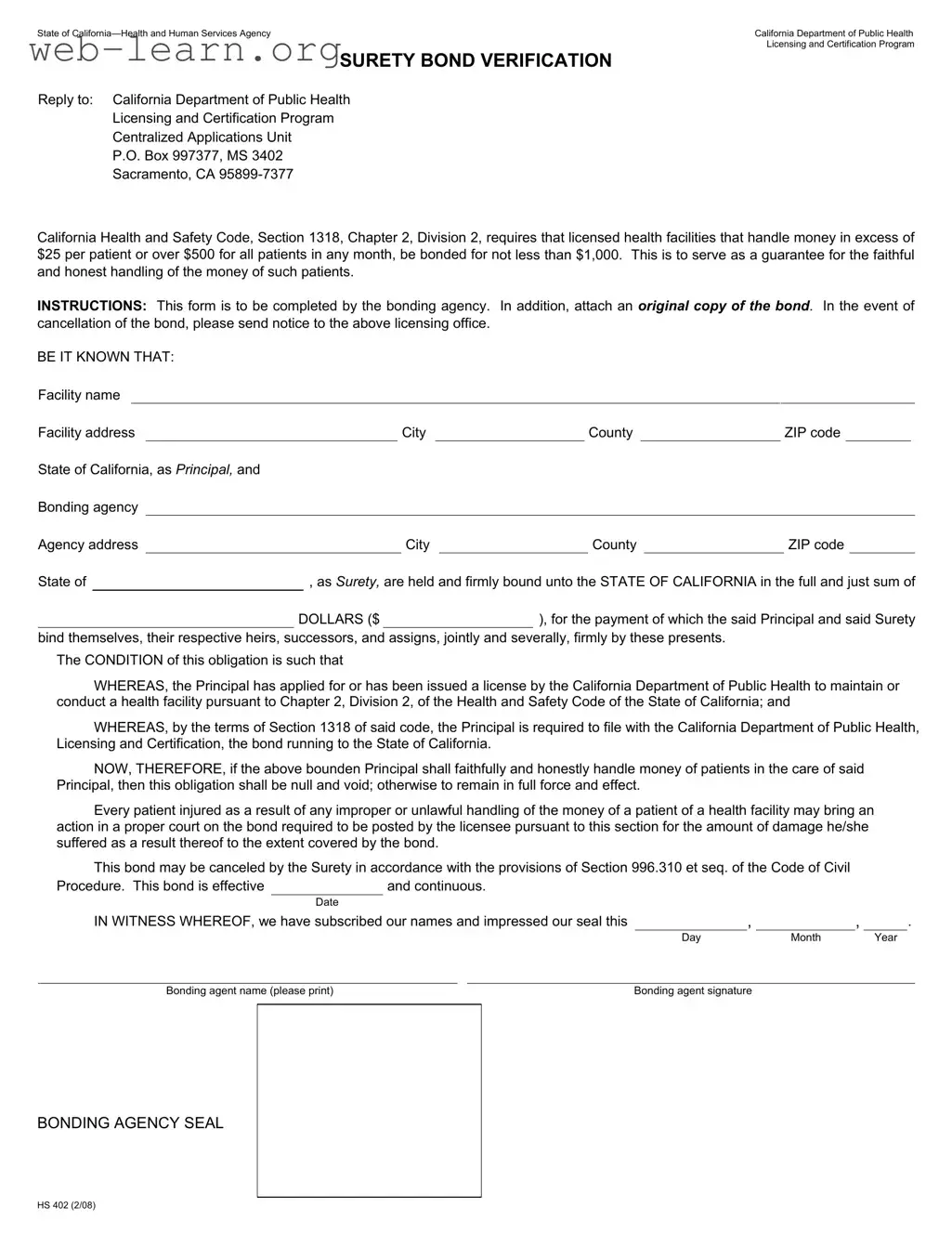
The California HS 402 form plays a vital role in ensuring the financial integrity of licensed health facilities within the state. Designed to comply with the California Health and Safety Code, this form is specifically required for facilities that manage patient funds exceeding certain thresholds—namely, more than $25 per patient or over $500 in total for all patients in any given month. The purpose of the HS 402 form is to establish a surety bond, which acts as a safeguard for the honest handling of patient money. This bond must be for a minimum amount of $1,000 and serves as a guarantee that the facility will manage funds responsibly. When completing the form, the bonding agency must provide specific details, including the facility name and address, as well as the agency's information. It’s important to note that should the bond be canceled, the bonding agency is required to notify the California Department of Public Health. This proactive measure ensures that patients are protected, allowing them to seek legal recourse should they suffer any financial harm due to improper handling of their funds. By understanding the significance and requirements of the HS 402 form, health facilities can uphold their responsibilities and maintain trust with their patients.

Sample - California Hs 402 Form

State of California—Health and Human Services Agency California Department of Public Health
Licensing and Certification Program
SURETY BOND VERIFICATION
Reply to: California Department of Public Health
Licensing and Certification Program
Centralized Applications Unit
P.O. Box 997377, MS 3402
Sacramento, CA 95899-7377
California Health and Safety Code, Section 1318, Chapter 2, Division 2, requires that licensed health facilities that handle money in excess of
$25 per patient or over $500 for all patients in any month, be bo
nded for n
ot less than $1,000. This is to serve as a guarantee for the faithful
and honest handling of the money of such patients.
INSTRUCTIONS: This form is to be completed by the bonding agency. In addition, attach an original copy of the bond. In the event of
cancellation of the bond, pleas
e send notice to the abov
e licensing office.
BE IT KNOWN THAT:
Facility name
Facility address City County ZIP code
State of California, as Principal, and
Bonding agency
Agency address City County ZIP code
State of , as Surety, are held and firmly bound unto the STATE OF CA
LIFORNIA in the full and just
sum of
DOLLARS ($ ), for the payment of which the said Principal and said Surety
bind themselves, their respective heirs, s
uccessors, and assigns, jointly and severally, firmly by these presents.
The CONDITION of this obligation is such that
WHEREAS, the Principal has applied for or has been issued a license by the California Department of Public Health to maintain or
conduct a health facility pursuant to Chapter 2, Division 2, of the Health and Safety Code of the State of California; and
WHEREAS, by the terms of Section 1318 of said code, the Principal is required to file with the California Department of Public Health,
Licensing and Certification, the bond running to the State of California.
NOW, THEREFORE, if the above bounden Principal shall faithfully and honestly handle money of patients in the care of said
Principal, then this obligation shall be null and void; otherwis
e to remain in full force and effect.
Every patie
nt injured as a result of any improper or unlawful handling of the money of a patient of a health facility may bring an
action in a proper court on the bond required to be posted by the licensee pursuant to this section for the amount of damage he/she
suffered as a result thereof to the extent covered by the bond.
This bond may be canceled by the Surety in accordance with the provisions of Section 996.310 et se
q. of the Code of Civil
Procedure. This bond is effective and continuous.
Date
IN WITNESS WHEREOF, we have subscribed our names and impressed our seal this
, ,
.
Day Month Year
Bonding agent name (please print) Bonding agent signature
BONDING AGENCY SEAL
HS 402 (2/08)

Form Information

Fact Name Details
Governing Law The California Health and Safety Code, Section 1318, Chapter 2, Division 2 governs the HS 402 form.
Purpose This form is used for surety bond verification for licensed health facilities in California.
Bond Requirement Facilities handling more than $25 per patient or over $500 in a month must be bonded for at least $1,000.
Principal The Principal is the health facility applying for or holding a license from the California Department of Public Health.
Surety The Surety is the bonding agency that guarantees the bond amount to the State of California.
Bond Cancellation The Surety may cancel the bond according to Section 996.310 et seq. of the Code of Civil Procedure.
Liability Both the Principal and Surety are jointly and severally liable for the bond amount.
Patient Rights Patients can bring legal action against the bond for damages due to improper handling of their money.
Continuous Effectiveness The bond remains effective and continuous until canceled by the Surety.
Submission Instructions The bonding agency must complete the form and attach an original copy of the bond for submission.

Detailed Guide for Filling Out California Hs 402

After gathering the necessary information, you are ready to fill out the California Hs 402 form. This form must be completed by the bonding agency and requires specific details about the facility and the bond. Make sure to attach an original copy of the bond when submitting the form.

  1. Obtain the form: Download or print the California Hs 402 form from the California Department of Public Health website.
  2. Fill in the facility details: Enter the facility name, address, city, county, and ZIP code in the designated sections.
  3. Provide bonding agency information: Fill in the bonding agency's name, address, city, county, and ZIP code.
  4. Specify the bond amount: Write the total dollar amount of the bond in the space provided.
  5. Complete the principal and surety statement: Confirm that the facility and bonding agency are bound to the State of California as outlined in the form.
  6. Sign and date the form: The bonding agent must print their name, sign, and date the form where indicated.
  7. Attach the bond: Include an original copy of the bond with the completed form.
  8. Submit the form: Send the completed form and the bond to the California Department of Public Health Licensing and Certification Program at the address provided on the form.

Obtain Answers on California Hs 402

  1. What is the purpose of the California HS 402 form?

    The California HS 402 form is designed to verify the surety bond for licensed health facilities that handle patient funds. According to the California Health and Safety Code, any facility managing over $25 per patient or exceeding $500 in total monthly patient funds must secure a bond of at least $1,000. This bond acts as a guarantee that the facility will manage patient funds responsibly and honestly.

  2. Who is responsible for completing the HS 402 form?

    The bonding agency is responsible for completing the HS 402 form. It is crucial that the agency accurately fills out the necessary information and attaches an original copy of the bond. This ensures compliance with state regulations and protects the interests of the patients being served.

  3. What happens if the bond is canceled?

    If the bond is canceled, the bonding agency must notify the California Department of Public Health's Licensing and Certification Program. This notification is essential to maintain transparency and compliance with the law. Failure to notify may lead to legal consequences for the facility.

  4. What are the potential consequences of improper handling of patient funds?

    In the event of improper or unlawful handling of patient funds, any affected patient has the right to take legal action against the bond. This means they can seek compensation for damages suffered as a result of the facility's actions. The bond serves as a financial safety net for patients, ensuring they have recourse if their funds are mishandled.

  5. How long is the bond effective?

    The bond is effective and continuous, meaning it remains in force as long as the health facility is licensed and handling patient funds. It is crucial for facilities to maintain their bond to ensure ongoing compliance with state regulations and to protect the financial interests of their patients.

Common mistakes

Filling out the California HS 402 form can be a straightforward process, but several common mistakes can lead to delays or complications. Understanding these pitfalls can help ensure that the form is completed correctly and efficiently.

One frequent error is failing to provide the correct facility name. The name must match the one used in the licensing application. Any discrepancies can result in the bond being deemed invalid. It is essential to double-check this information to avoid unnecessary issues.

Another mistake involves inaccurate financial amounts. The form requires the bond amount to be specified clearly. If this figure does not meet the minimum requirement of $1,000, the application will be rejected. It is crucial to review the financial details carefully before submission.

Some individuals neglect to attach the original copy of the bond to the form. This attachment is mandatory for processing. Without it, the application cannot proceed, leading to delays in obtaining the necessary licensing.

Providing incomplete addresses for both the facility and the bonding agency is another common issue. All address fields must be filled out completely, including city, county, and ZIP code. Incomplete information can hinder communication and processing.

Additionally, people often forget to include the date of signing the form. The date is crucial as it marks the validity of the bond. Without it, the bond may be considered ineffective, complicating the licensing process.

Another mistake is the use of incorrect signatures. The bonding agent must sign the form, and it should be clear and legible. Failure to do so can lead to questions about the authenticity of the bond.

Some applicants overlook the requirements for the bonding agency seal. This seal is a vital part of the form and must be affixed properly. A missing seal can render the bond invalid, so it is important to ensure it is included.

Lastly, individuals sometimes submit the form without reviewing the instructions thoroughly. Each section of the form has specific requirements that must be followed. Ignoring these instructions can lead to incomplete submissions and further complications.

By being aware of these common mistakes and taking the time to review the form carefully, applicants can enhance their chances of a smooth and successful application process.

Documents used along the form

The California HS 402 form is a crucial document for licensed health facilities, ensuring they are bonded to protect patient funds. However, several other forms and documents are often used in conjunction with the HS 402 to ensure compliance with state regulations and to facilitate the licensing process. Here’s a brief overview of these essential documents:

  • California Health and Safety Code, Section 1318: This statute outlines the legal requirements for health facilities regarding the handling of patient funds. It establishes the necessity of obtaining a surety bond and the obligations of the facilities to manage these funds responsibly.
  • Surety Bond Agreement: This document is a formal contract between the health facility and the bonding agency. It details the terms of the bond, including the amount and conditions under which the bond can be claimed. This agreement is essential for clarifying the responsibilities of all parties involved.
  • Application for Health Facility License: Before submitting the HS 402 form, health facilities must complete this application. It provides necessary information about the facility, including its location, services offered, and ownership details. Approval of this application is required for the issuance of a license.
  • Financial Disclosure Statement: This document requires health facilities to disclose their financial status, including income and expenses. It helps the California Department of Public Health assess the facility's financial stability and ability to manage patient funds appropriately.
  • Notice of Bond Cancellation: If a bonding agency decides to cancel the surety bond, this notice must be sent to the California Department of Public Health. It serves to inform the department about the change in bonding status, ensuring that the facility remains compliant with state regulations.

Understanding these documents is vital for health facilities operating in California. Properly managing these forms not only helps in maintaining compliance but also protects the interests of patients and ensures the integrity of financial transactions within the facility.

Similar forms

The California HS 402 form serves as a surety bond verification for licensed health facilities. Several other documents share similar functions or purposes in ensuring compliance and protecting the interests of patients and the state. Below is a list of documents that are comparable to the HS 402 form:

  • California Surety Bond Form: This document is used to guarantee the performance of a contract or obligation, similar to the HS 402. It ensures that the principal will fulfill their responsibilities.
  • California Health Facility License Application: This application is required for health facilities seeking licensure. Like the HS 402, it involves financial accountability and compliance with state regulations.
  • Surety Bond Indemnity Agreement: This agreement outlines the obligations of the parties involved in a surety bond. It parallels the HS 402 by establishing financial responsibility for the actions of the principal.
  • Certificate of Insurance: This document provides proof of insurance coverage for health facilities. It serves a protective role, akin to the HS 402, ensuring financial security for patient funds.
  • Financial Disclosure Statement: This statement requires health facilities to disclose their financial status. It is similar to the HS 402 in that it aims to protect patient interests through transparency.
  • Patient Trust Fund Agreement: This agreement governs the handling of patient funds in care facilities. Like the HS 402, it ensures that patient money is managed responsibly.
  • Compliance Audit Report: This report assesses whether a health facility adheres to legal and regulatory requirements. It shares the HS 402's goal of ensuring accountability in financial practices.
  • Bond Cancellation Notice: This notice is required if a surety bond is canceled. It is related to the HS 402 as it ensures that the licensing authority is informed of changes affecting financial guarantees.

Dos and Don'ts

When filling out the California HS 402 form, it is important to follow specific guidelines to ensure accuracy and compliance. Here are some dos and don’ts to keep in mind:

  • Do ensure that all information is accurate and complete.
  • Do use clear and legible handwriting or type the information.
  • Do attach an original copy of the bond as required.
  • Do check that the bonding agency's details are correct.
  • Don’t leave any fields blank; fill in all required sections.
  • Don’t forget to sign and date the form.
  • Don’t submit the form without verifying the information with the bonding agency.
  • Don’t ignore the instructions regarding bond cancellation notifications.

Misconceptions

Misconceptions about the California HS 402 form can lead to confusion among health facility operators and bonding agencies. Here are ten common misunderstandings:

  • 1. The HS 402 form is optional. Some believe that completing the HS 402 form is not mandatory. In reality, it is required for licensed health facilities that handle certain amounts of money.
  • 2. Only large facilities need a bond. Many think that only large health facilities need to be bonded. However, any facility that handles more than $25 per patient or over $500 in a month must comply.
  • 3. The bond amount is fixed. There is a misconception that the bond amount is always $1,000. While this is the minimum, some facilities may need a higher bond based on their financial activities.
  • 4. The bonding agency does not need to be licensed. Some assume that any bonding agency can issue the bond. In truth, the bonding agency must be properly licensed to operate in California.
  • 5. The bond protects the facility, not the patients. Many believe that the bond primarily protects the facility. However, it is designed to protect patients from improper handling of their money.
  • 6. Cancellation of the bond is not a concern. Some think that once a bond is in place, it does not need to be monitored. In fact, if the bond is canceled, the licensing office must be notified immediately.
  • 7. The form does not require a signature. There is a belief that the HS 402 form can be submitted without signatures. However, it must be signed by both the bonding agent and the facility's representative.
  • 8. The bond is effective for a limited time. Some people think that the bond is only effective for a short period. In reality, it is continuous until canceled or replaced.
  • 9. Patients cannot take legal action. Many believe that patients cannot sue for damages related to the bond. In fact, patients can bring legal action for any improper handling of their money.
  • 10. The HS 402 form is the only requirement. Some assume that completing the HS 402 form is the only requirement for compliance. However, facilities must also adhere to other regulations set forth by the California Department of Public Health.

Understanding these misconceptions can help ensure compliance and protect both facilities and patients. It is essential to stay informed about all requirements related to the HS 402 form.

Key takeaways

When dealing with the California HS 402 form, it’s essential to understand its purpose and the requirements involved. This form is crucial for licensed health facilities that manage patient funds. Here are some key takeaways:

  • Bond Requirement: Health facilities handling over $25 per patient or $500 total in a month must secure a bond of at least $1,000. This bond ensures the responsible management of patient funds.
  • Completion by Bonding Agency: The HS 402 form must be filled out by the bonding agency. It’s important to attach an original copy of the bond when submitting the form.
  • Notification of Cancellation: If the bond is canceled, the bonding agency must notify the California Department of Public Health Licensing and Certification promptly.
  • Legal Implications: Patients harmed by improper handling of their funds can take legal action against the bond. This means the bond serves as a financial safety net for patients.

Understanding these points can help ensure compliance with California regulations and protect both facilities and patients alike.