Homepage Attorney-Approved Letter of Intent Template Attorney-Approved Homeschool Letter of Intent Template Attorney-Approved Homeschool Letter of Intent Document for the State of California
Outline

In California, parents who choose to homeschool their children must navigate a few essential steps to ensure they are compliant with state regulations. One of the most important requirements is the submission of a Homeschool Letter of Intent. This form serves as a formal notification to the local school district that you are opting to educate your child at home. It typically includes key details such as the names and ages of the children being homeschooled, the educational program you plan to follow, and your contact information. While the form itself is relatively straightforward, understanding its implications can help parents feel more confident in their decision. By submitting the letter, you not only fulfill a legal obligation but also take a proactive step in establishing a structured learning environment for your children. It’s essential to be aware of deadlines and any additional documentation that may be required, as these factors can vary by district. As you embark on your homeschooling journey, knowing how to properly complete and submit this form can set a solid foundation for your educational adventure.

Sample - California Homeschool Letter of Intent Form

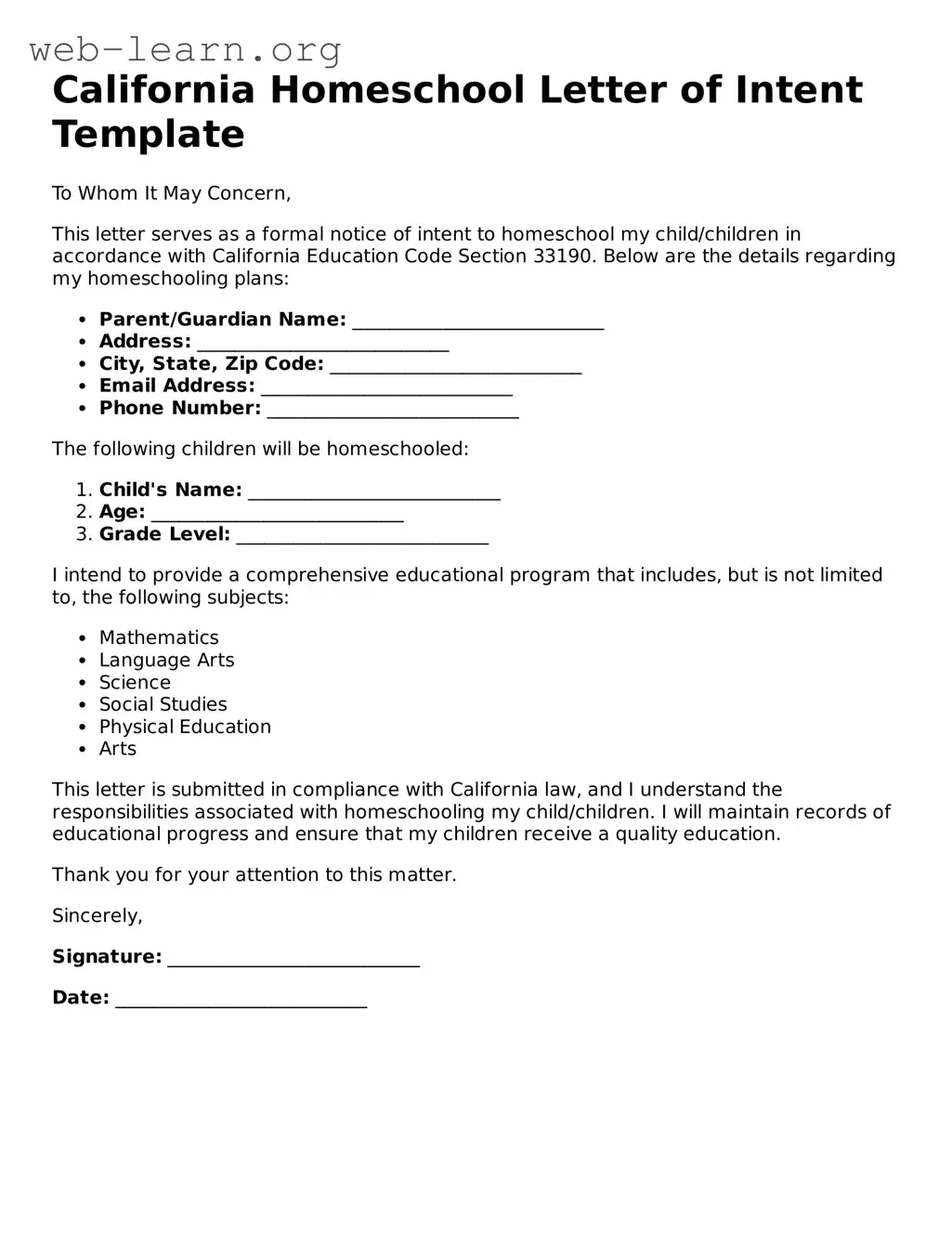
California Homeschool Letter of Intent Template

To Whom It May Concern,

This letter serves as a formal notice of intent to homeschool my child/children in accordance with California Education Code Section 33190. Below are the details regarding my homeschooling plans:

  • Parent/Guardian Name: ___________________________
  • Address: ___________________________
  • City, State, Zip Code: ___________________________
  • Email Address: ___________________________
  • Phone Number: ___________________________

The following children will be homeschooled:

  1. Child's Name: ___________________________
  2. Age: ___________________________
  3. Grade Level: ___________________________

I intend to provide a comprehensive educational program that includes, but is not limited to, the following subjects:

  • Mathematics
  • Language Arts
  • Science
  • Social Studies
  • Physical Education
  • Arts

This letter is submitted in compliance with California law, and I understand the responsibilities associated with homeschooling my child/children. I will maintain records of educational progress and ensure that my children receive a quality education.

Thank you for your attention to this matter.

Sincerely,

Signature: ___________________________

Date: ___________________________

File Characteristics

Fact Name Description
Definition The California Homeschool Letter of Intent is a document submitted to inform the state of a family's decision to homeschool their child.
Governing Law This form is governed by California Education Code Section 33190.
Submission Deadline The Letter of Intent must be submitted within 10 days of the start of the homeschooling program.
Required Information The form requires the child's name, birthdate, and the name of the homeschooling parent or guardian.
Annual Renewal Families must submit a new Letter of Intent each school year to continue homeschooling.
Record Keeping Parents should keep a copy of the submitted Letter of Intent for their records.

Detailed Guide for Filling Out California Homeschool Letter of Intent

Completing the California Homeschool Letter of Intent form is an essential step for families choosing to homeschool their children. This process ensures that you officially notify the state of your intention to educate your child at home. Follow the steps below to fill out the form accurately.

  1. Obtain the California Homeschool Letter of Intent form. This can typically be found on the California Department of Education website or through local school district offices.
  2. Fill in your personal information. Include your name, address, and contact information. Ensure that this information is current and accurate.
  3. Provide your child’s information. Include their full name, date of birth, and any other required identifying details.
  4. Indicate the grade level of your child. This should reflect the grade they would be in if attending a traditional school.
  5. Specify the start date for your homeschooling program. This date should align with your planned educational schedule.
  6. Sign and date the form. Your signature confirms that the information provided is correct and that you intend to homeschool your child.
  7. Submit the completed form. This can usually be done by mailing it to your local school district or submitting it in person, depending on district requirements.

Once you submit the form, keep a copy for your records. You may receive a confirmation from your local school district, but follow up if you do not hear back within a reasonable timeframe.

Obtain Answers on California Homeschool Letter of Intent

  1. What is the California Homeschool Letter of Intent?

    The California Homeschool Letter of Intent is a document that parents or guardians submit to inform their local school district of their decision to homeschool their child. This letter serves as a formal notification and is a key step in the homeschooling process in California.

  2. Who needs to submit the Letter of Intent?

    Any parent or guardian who decides to homeschool their child must submit the Letter of Intent. This applies to children who are of compulsory school age, typically between 6 and 18 years old.

  3. When should the Letter of Intent be submitted?

    The Letter of Intent should be submitted to the local school district at the beginning of the homeschooling process. It is recommended to do this before the school year starts or as soon as you decide to homeschool.

  4. What information is required in the Letter of Intent?

    The Letter of Intent generally requires the following information:

    • Your name and address
    • Your child's name and date of birth
    • The date you intend to begin homeschooling

    Some districts may have additional requirements, so it is important to check with your local school district for specific guidelines.

  5. Is there a specific format for the Letter of Intent?

    While there is no official state form, the Letter of Intent should be clear and concise. You can write it in a simple letter format, ensuring all required information is included.

  6. Do I need to provide any additional documentation?

    Typically, the Letter of Intent is sufficient for notifying the school district. However, some districts may request additional documentation, such as proof of residency or educational plans. Always check with your local district for their specific requirements.

  7. What happens after I submit the Letter of Intent?

    Once you submit the Letter of Intent, the school district will acknowledge receipt. They may follow up with any questions or additional requests. After this, you are free to begin your homeschooling journey.

  8. Can I withdraw my child from homeschooling later?

    Yes, you can withdraw your child from homeschooling at any time. If you decide to enroll your child back into a public or private school, you should notify the school district and follow their enrollment procedures.

  9. What if I move to a different school district?

    If you move to a different school district, you will need to submit a new Letter of Intent to the new district. It’s important to inform them of your homeschooling status as soon as possible.

  10. Where can I find more information about homeschooling in California?

    For more information, you can visit the California Department of Education's website or reach out to local homeschooling groups. They can provide valuable resources and support for your homeschooling journey.

Common mistakes

Filling out the California Homeschool Letter of Intent form can be a straightforward process, but many people make common mistakes that can lead to delays or complications. One frequent error is forgetting to include all required information. The form asks for specific details about the student and the educational program. Omitting any of this information can result in the form being deemed incomplete, causing unnecessary setbacks.

Another mistake often made is not signing the form. It may seem obvious, but some individuals overlook this crucial step. Without a signature, the school district will not recognize the letter, which means your intent to homeschool won't be officially acknowledged. Always double-check that you have signed and dated the document before submitting it.

Many people also fail to keep a copy of the submitted letter for their records. This can be problematic if questions arise later about your homeschooling status. Having a copy allows you to reference what was submitted and can be helpful if any discrepancies occur. It's always wise to maintain your own records for peace of mind.

Lastly, some individuals misunderstand the deadlines for submitting the form. California law requires that the letter be submitted within a certain timeframe, typically at the beginning of the school year or when starting homeschooling. Missing this deadline can lead to complications with the school district. It's essential to be aware of these timelines to ensure compliance and a smooth homeschooling experience.

Documents used along the form

When families decide to homeschool in California, they often need to complete several forms and documents in addition to the Homeschool Letter of Intent. These documents help ensure that the homeschooling process is organized and compliant with state regulations. Below is a list of common forms and documents that may be used alongside the Homeschool Letter of Intent.

  • Curriculum Plan: This document outlines the subjects and materials that will be used for instruction. It helps parents stay organized and ensures that they cover all necessary educational content.
  • Attendance Records: Keeping track of daily attendance is essential. This record shows that students are engaged in learning and helps maintain accountability.
  • Progress Reports: These reports summarize a student's progress in various subjects over a specific period. They can be helpful for both parents and students to assess learning outcomes.
  • Assessment Records: Some families choose to conduct assessments or standardized tests. Keeping records of these assessments can demonstrate academic progress and compliance with educational standards.
  • Withdrawal Form: If a child is transferring from a public or private school to homeschooling, a withdrawal form may be needed. This document formally removes the child from the previous school’s rolls.
  • Educational Philosophy Statement: This statement outlines the parent’s beliefs and methods regarding education. It can serve as a guide for teaching and help clarify the family's educational goals.
  • Field Trip Permission Slips: If a homeschool group organizes field trips, these slips allow parents to give consent for their children to participate. They ensure safety and communication among families.
  • Extracurricular Activity Forms: Many homeschoolers participate in community sports or arts programs. These forms help register students for activities outside of their standard curriculum.
  • Resource Lists: A list of educational resources, such as books, websites, and local co-ops, can be invaluable for parents seeking materials and support for their homeschooling journey.

Using these documents alongside the Homeschool Letter of Intent can help families navigate the homeschooling process more smoothly. Each form serves a specific purpose and contributes to a structured and effective educational experience for students.

Similar forms

The Homeschool Letter of Intent form shares similarities with several other documents used in educational settings. Each document serves a specific purpose related to educational intent or status. Below is a list of eight documents that are comparable to the Homeschool Letter of Intent form:

  • Enrollment Application: This document indicates a parent's intention to enroll a child in a specific school or educational program, similar to how the Letter of Intent expresses the intent to homeschool.
  • Withdrawal Form: A parent submits this form to officially withdraw a child from a school, paralleling the intent to transition to homeschooling.
  • Educational Plan: This document outlines the curriculum and educational goals for a child being homeschooled, much like the intent letter communicates the decision to homeschool.
  • Affidavit of Homeschooling: This legal document is often required to affirm a family's commitment to homeschooling, akin to the Letter of Intent in its purpose of declaring educational intent.
  • Notification of Intent to Homeschool: Similar in name and function, this document formally notifies the relevant educational authority of a family's choice to homeschool.
  • Curriculum Choice Form: This document details the educational materials and methods a family plans to use, reflecting the educational direction implied in the Letter of Intent.
  • Annual Assessment Report: This report evaluates a child's educational progress, which can be linked to the initial intent expressed in the Letter of Intent.
  • Statement of Educational Philosophy: This document articulates a family's educational beliefs and approaches, paralleling the intent to provide a specific type of education through homeschooling.

Dos and Don'ts

When filling out the California Homeschool Letter of Intent form, attention to detail is crucial. Here are ten things you should and shouldn't do to ensure a smooth process.

  • Do provide accurate information about your child, including their full name and date of birth.
  • Do include your address and contact information to facilitate communication.
  • Do specify the educational program you plan to use for homeschooling.
  • Do submit the form in a timely manner, ideally at least 30 days before you start homeschooling.
  • Do keep a copy of the submitted form for your records.
  • Don't leave any required fields blank; incomplete forms may delay processing.
  • Don't use vague language; be specific about your educational plans.
  • Don't forget to sign and date the form before submission.
  • Don't submit the form via an untraceable method; use certified mail or another reliable delivery service.
  • Don't ignore any follow-up communications from the school district.

Misconceptions

Many people have misconceptions about the California Homeschool Letter of Intent form. Here are ten common misunderstandings:

  1. Homeschooling is illegal in California. This is not true. Homeschooling is legal in California, provided families follow the state's requirements.
  2. Only certain families can homeschool. Any family can choose to homeschool their children, regardless of their background or educational experience.
  3. The Letter of Intent is a complicated document. The form is straightforward and requires only basic information about the student and the homeschooling parent.
  4. Submitting the Letter of Intent guarantees approval. While the form must be submitted, there is no formal approval process. Families simply need to file it.
  5. Homeschooling requires a specific curriculum. Families have the freedom to choose any curriculum that fits their educational philosophy and their child’s needs.
  6. Parents must have teaching credentials to homeschool. California does not require parents to hold teaching credentials to educate their children at home.
  7. Homeschooling means no socialization for children. Many homeschooling families actively seek out social opportunities through co-ops, classes, and community activities.
  8. All subjects must be taught in a specific order. Parents can design their own educational plan and determine the order in which subjects are taught.
  9. Once you file the Letter of Intent, you cannot change your mind. Families can choose to stop homeschooling at any time and return their children to a traditional school.
  10. Homeschooling is only for children with special needs. Homeschooling is a valid choice for any child, regardless of their learning abilities or challenges.

Key takeaways

When considering homeschooling in California, filling out the Homeschool Letter of Intent form is a crucial step. Here are some key takeaways to keep in mind:

  • Understand the Purpose: The Homeschool Letter of Intent serves as a formal notification to the school district that you intend to homeschool your child.
  • Know the Deadline: You must submit the letter within 10 days of beginning your homeschooling program.
  • Include Required Information: Ensure that you provide your child's name, age, and address, along with your contact information.
  • Keep a Copy: Always retain a copy of the submitted letter for your records. This can be helpful for future reference or if any questions arise.
  • Be Aware of Local Requirements: Some school districts may have additional requirements or forms. Check with your local district for any specific guidelines.
  • Stay Informed: Familiarize yourself with California homeschooling laws to ensure compliance and to understand your rights and responsibilities.
  • Communicate with Your District: If you have any questions or concerns about the process, reach out to your school district for assistance.

By following these guidelines, you can navigate the process of submitting the Homeschool Letter of Intent with confidence. Remember, this is the first step in providing a tailored educational experience for your child.