The California Hold Harmless Agreement form serves as a crucial tool for individuals and businesses seeking to protect themselves from liability in various situations. This document outlines the responsibilities and liabilities of parties involved in an agreement, ensuring that one party agrees to indemnify the other against potential claims or damages. It is commonly used in rental agreements, construction contracts, and event planning, among other scenarios. By clearly defining the terms of liability, this form helps to mitigate risks associated with accidents or unforeseen events. Parties must carefully consider the language and provisions included in the agreement, as these can significantly impact their legal standing. Understanding the nuances of this form is essential for anyone looking to navigate the complexities of liability and risk management in California.
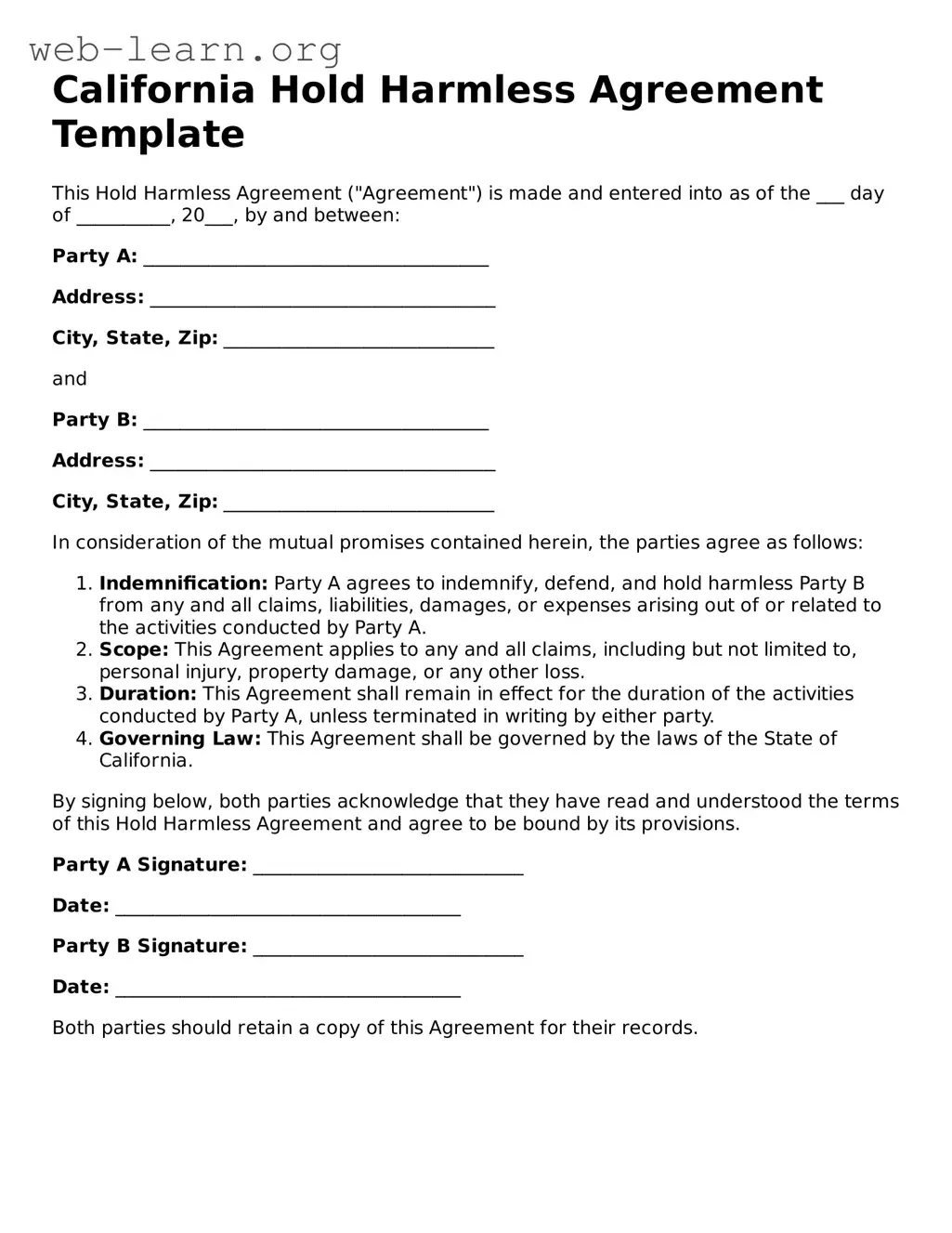
California Hold Harmless Agreement Template
This Hold Harmless Agreement ("Agreement") is made and entered into as of the ___ day of __________, 20___, by and between:
Party A: _____________________________________
Address: _____________________________________
City, State, Zip: _____________________________
and
Party B: _____________________________________
Address: _____________________________________
City, State, Zip: _____________________________
In consideration of the mutual promises contained herein, the parties agree as follows:
By signing below, both parties acknowledge that they have read and understood the terms of this Hold Harmless Agreement and agree to be bound by its provisions.
Party A Signature: _____________________________
Date: _____________________________________
Party B Signature: _____________________________
Date: _____________________________________
Both parties should retain a copy of this Agreement for their records.
| Fact Name | Description |
|---|---|
| Definition | A Hold Harmless Agreement is a legal document where one party agrees to not hold the other party liable for any damages or losses. |
| Purpose | This agreement is often used to protect one party from legal claims resulting from the actions of another party. |
| Common Uses | It is commonly used in rental agreements, construction contracts, and event planning. |
| Governing Law | In California, the agreement is governed by state contract law, primarily under the California Civil Code. |
| Key Components | Typically includes the names of the parties, the scope of indemnification, and any limitations on liability. |
| Enforceability | For the agreement to be enforceable, it must be clear, specific, and voluntarily agreed upon by both parties. |
| Limitations | California law may not allow hold harmless clauses to waive liability for gross negligence or willful misconduct. |
| Written vs. Oral | While written agreements are preferred, oral agreements can also be valid, though harder to enforce. |
| Consultation Recommended | It's advisable to consult with a legal professional before signing any Hold Harmless Agreement to ensure it meets your needs. |
Filling out the California Hold Harmless Agreement form is a straightforward process that requires attention to detail. After completing this form, you will have a legally binding document that outlines the responsibilities and liabilities of the parties involved.
What is a California Hold Harmless Agreement?
A California Hold Harmless Agreement is a legal document designed to protect one party from liability for any damages or injuries that may occur during a specific activity or event. This agreement is commonly used in various situations, such as rental agreements, construction contracts, or events where one party may be exposed to risks. By signing this agreement, one party agrees to assume responsibility for any potential claims or legal actions that may arise from the activities covered in the document.
Who typically uses a Hold Harmless Agreement?
Various individuals and organizations utilize Hold Harmless Agreements. Common users include property owners, contractors, event organizers, and businesses that provide services. For instance, a property owner may require a contractor to sign this agreement before beginning work on their property, ensuring that the owner is not held liable for any accidents that occur during the project. Event organizers often use it to protect themselves from claims related to injuries that may happen during the event.
What are the key components of a Hold Harmless Agreement?
A Hold Harmless Agreement typically includes several important elements:
Including these components helps ensure that the agreement is comprehensive and legally binding.
Is a Hold Harmless Agreement legally enforceable in California?
Yes, a Hold Harmless Agreement can be legally enforceable in California, provided it meets certain requirements. The agreement must be clear and specific about the liabilities being waived and the risks being assumed. Additionally, both parties should have a mutual understanding of the terms and voluntarily agree to them. It is advisable to consult with a legal professional to ensure that the agreement complies with California laws and adequately protects your interests.
Can a Hold Harmless Agreement be modified after it has been signed?
Yes, a Hold Harmless Agreement can be modified after it has been signed, but both parties must agree to the changes. Any modifications should be documented in writing and signed by both parties to ensure clarity and enforceability. It is important to maintain open communication and ensure that all parties are on the same page regarding any updates to the agreement.
Filling out a California Hold Harmless Agreement can seem straightforward, but many individuals make common mistakes that can lead to complications later on. One frequent error is not reading the entire document thoroughly before signing. This oversight can result in misunderstandings about the obligations and rights outlined in the agreement.
Another mistake is failing to include all necessary parties. It is crucial to ensure that everyone involved in the agreement is listed. Omitting a party can lead to disputes or liability issues down the line. Additionally, people often forget to specify the scope of the agreement clearly. Vague language can create confusion regarding what is covered and what is not.
Many individuals also neglect to date the agreement properly. A missing date can create uncertainty about when the agreement takes effect, which could complicate matters if a dispute arises. Furthermore, some people do not seek legal advice before signing. Consulting with a legal professional can provide clarity and help identify potential pitfalls.
Another common error is using incorrect terminology or failing to define key terms. This can lead to misinterpretations and weaken the enforceability of the agreement. Additionally, individuals sometimes overlook the importance of understanding the implications of the agreement. It is essential to grasp what it means to hold someone harmless and the potential liabilities involved.
People may also fail to keep a copy of the signed agreement for their records. Having a copy is vital for reference in case any issues arise in the future. Lastly, some individuals do not follow up to ensure that all parties have signed the agreement. An unsigned document may not hold up in court, leaving one party vulnerable.
By being aware of these common mistakes, individuals can take steps to fill out the California Hold Harmless Agreement correctly. This awareness can lead to a smoother process and provide peace of mind for all parties involved.
When engaging in agreements that involve risk, such as a California Hold Harmless Agreement, it's essential to consider other related documents that can provide additional protection and clarity. Each of these forms serves a unique purpose and helps ensure that all parties understand their rights and responsibilities.
Understanding these documents can help you navigate agreements more confidently. They work together to create a framework of protection, ensuring that all parties are on the same page and minimizing the potential for disputes down the line.
When filling out the California Hold Harmless Agreement form, it’s important to follow certain guidelines to ensure clarity and legality. Here are some things you should and shouldn't do:
By following these guidelines, you can help ensure that the Hold Harmless Agreement serves its intended purpose effectively.
Many people have misunderstandings about the California Hold Harmless Agreement form. Here are six common misconceptions:
Some believe that signing this agreement means they are completely shielded from any liability. However, it typically only covers specific risks outlined in the agreement.
Many think that only companies use Hold Harmless Agreements. In reality, individuals can also use them to protect themselves in various situations, like renting property.
People often assume that these agreements are enforceable in every case. However, courts may not uphold them if they are deemed unfair or if they violate public policy.
Some believe that signing this agreement means they no longer need insurance. In fact, it is usually recommended to have insurance coverage, as the agreement does not cover every potential risk.
Many think they can sign a Hold Harmless Agreement after an accident to avoid liability. However, these agreements should be signed before any potential risk arises to be effective.
Some assume that all agreements are identical. In truth, the terms can vary widely based on the situation and the parties involved.
When filling out and using the California Hold Harmless Agreement form, it is essential to understand its purpose and implications. Here are some key takeaways:
Hold Harmless Agreement - Using a Hold Harmless Agreement can be a responsible choice for anyone organizing an event.
What Is Hold Harmless Agreement - It serves as a legal safeguard, allowing parties to focus on the task at hand without fear of liability.
What Is a Hold Harmless Agreement - A Hold Harmless Agreement can be a simple yet effective legal tool.