Homepage Blank California Heirship Form
Outline

The California Heirship form plays a crucial role in the process of claiming property after a loved one has passed away. Designed to establish the rightful heirs of a deceased property owner, this form requires detailed information about the deceased and their family members. It includes sections for listing the names, dates of birth, and dates of death of the deceased's spouse, children, grandchildren, parents, and siblings. Each section must be filled out meticulously, ensuring that all known relatives are accounted for, even if some are no longer living. The form also provides space for additional relatives if necessary, making it flexible for various family structures. Importantly, it emphasizes the need for accurate information, as any discrepancies could lead to complications in the claims process. By gathering and presenting this information clearly, the California Heirship form helps facilitate the distribution of assets in a fair and organized manner, providing peace of mind during a challenging time.

Sample - California Heirship Form

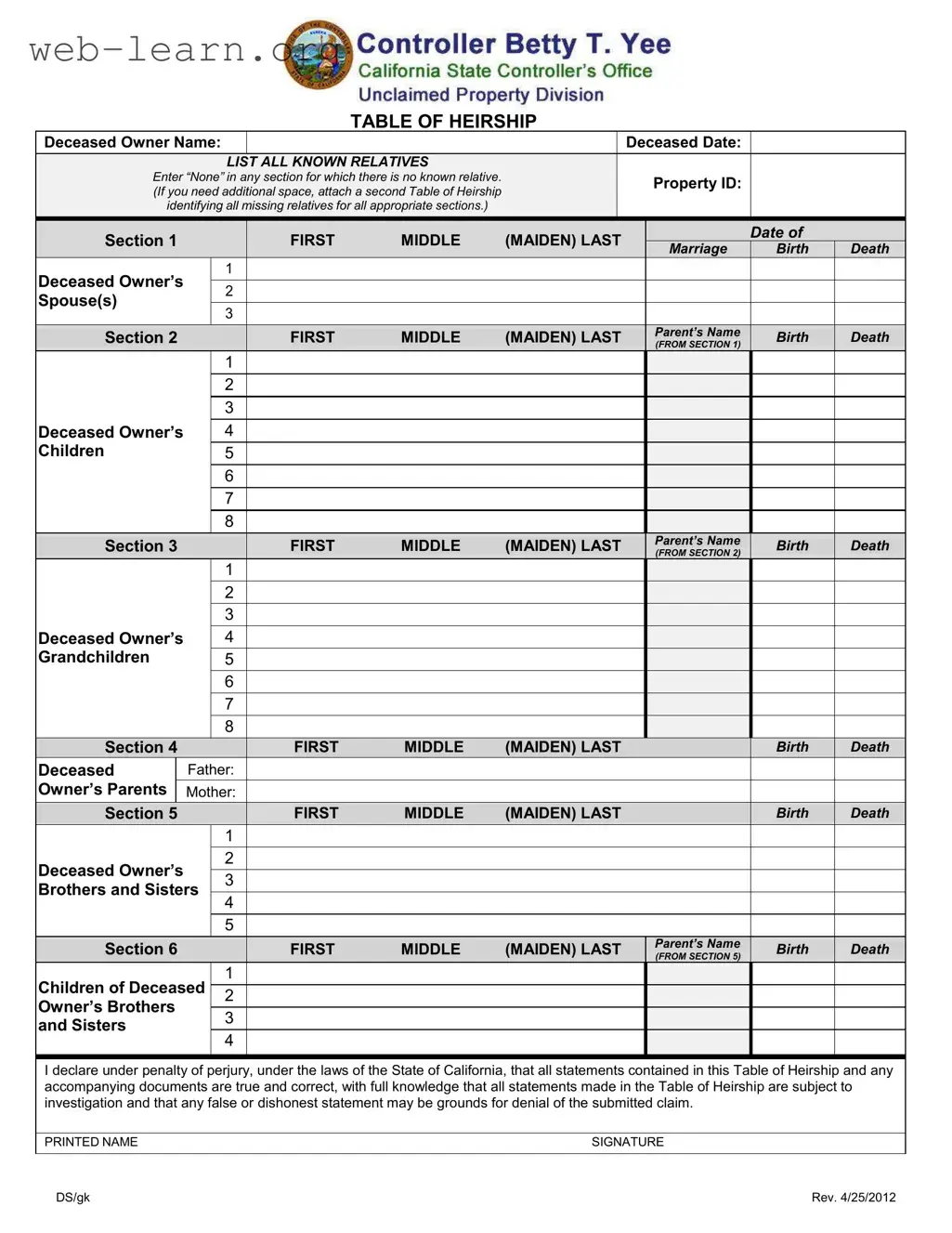
TABLE OF HEIRSHIP
DS/gk
Rev. 4/25/2012
Deceased Owner Name:
Deceased Date:
LIST ALL KNOWN RELATIVES
Enter None in any section for which there is no known
relative.
(If you need additional space, attach a second Table of
Heirship
identifying all missing relatives for all appropriate
sections.)
Property ID:
Section 1
FIRST MIDDLE (MAIDEN) LAST
Date of
Marriage
Birth
Death
Deceased Owner’s
Spouse(s)
1
2
3
Section 2
FIRST MIDDLE (MAIDEN) LAST
Parent’s Name
(FROM SECTION 1)
Birth
Death
Deceased Owner’s
Children
1
2
3
4
5
6
7
8
Section 3
FIRST MIDDLE (MAIDEN) LAST
Parent’s Name
(FROM SECTION 2)
Birth
Death
Deceased Owner’s
Grandchildren
1
2
3
4
5
6
7
8
Section 4
FIRST MIDDLE (MAIDEN) LAST
Birth
Death
Deceased
Owner’s Parents
Father:
Mother:
Section 5
FIRST MIDDLE (MAIDEN) LAST
Birth
Death
Deceased Owner’s
Brothers and Sisters
1
2
3
4
5
Section 6
FIRST MIDDLE (MAIDEN) LAST
Parent’s Name
(FROM SECTION 5)
Birth
Death
Children of Deceased
Owner’s Brothers
and Sisters
1
2
3
4
I declare under penalty of perjury, under the laws of the State of California, that all statements contained in this Table of Heirship and any
accompanying documents are true and correct, with full knowledge that all statements made in the Table of Heirship are subject to
investigation and that any false or dishonest statement may be grounds for denial of the submitted claim.
PRINTED NAME SIGNATURE
TABLE OF HEIRSHIP
DS/gk
Rev. 4/25/2012
INSTRUCTIONS
Deceased Owner Name
Enter the name of the deceased person whose property you are claiming.
Deceased Date
Enter the date the deceased property owner died.
Property ID
Enter the Property ID found on the claim details page printed with your claim form.
To ensure you receive the funds to which you are entitled, enter the requested information for yourself and all of the
deceased property owners known relatives, both living and dead. In addition, provide a copy of all pages of the certified
death certificate for all deceased relatives listed in all Sections above your name to whom you are directly related (such as,
your grandmother/grandfather, mother/father, and/or son/daughter).
Section 1
Include in this section all of the deceased property owner’s current or former spouses. Enter
one spouse per line (living or dead). If the deceased owner never married, enter “None.”
Name
Enter the spouses first, middle, (maiden name, if applicable) and last name.
Date of Marriage
Enter the spouses date of marriage to the deceased property owner.
Date of Birth
Enter the spouses date of birth.
Date of Death
If the spouse is deceased, enter the spouses date of death.
Section 2
Include in this section all of the deceased property owner’s children. Enter one child per line
(living or dead). If the deceased owner did not have any children, enter “None.”
Name
Enter the child’s first, middle, (maiden name, if applicable) and last name.
Parent’s Name
(FROM SECTION 1)
Enter the first name of the childs parent, as listed in Section 1.
Date of Birth
Enter the child’s date of birth.
Date of Death
If the child is deceased, enter the childs date of death.
Section 3
Include in this section all of the deceased property owner’s grandchildren. Enter one grandchild
per line (living or dead). If the deceased owner did not have any grandchildren, enter “None.”
Name
Enter the grandchilds first, middle, (maiden name, if applicable) and last name.
Parent’s Name
(FROM SECTION 2)
Enter the first name of grandchilds parent, as listed in Section 2.
Date of Birth
Enter the grandchilds date of birth.
Date of Death
If the grandchild is deceased, enter the grandchild’s date of death.
Section 4
Include in this section both of the deceased property owner’s parents (living or dead).
Name
Enter the parent’s first, middle, (maiden name, if applicable) and last name.
Date of Birth
Enter the parent’s date of birth.
Date of Death
If the parent is deceased, enter the parent’s date of death.
Section 5
Include in this section all of the deceased property owner’s brothers and sisters. Enter one
brother or sister per line (living or dead). If the deceased owner did not have any brothers or
sisters, enter “None.”
Name
Enter the brother or sisters first, middle, (maiden name, if applicable) and last name.
Date of Birth
Enter the brother or sisters date of birth.
Date of Death
If the brother or sister is deceased, enter the brother or sisters date of death.
Section 6
Include in this section all of the deceased property owner’s nieces and nephews. Enter one
niece or nephew per line (living or dead). If the deceased owner did not have any nieces or
nephews, enter “None.”
Name
Enter the niece or nephew’s first, middle, (maiden name, if applicable) and last name.
Parent’s Name
(FROM SECTION 5)
Enter the first name of the niece or nephews parent, as listed in Section 5.
Date of Birth
Enter the niece or nephew’s date of birth.
Date of Death
If the niece or nephew is deceased, enter the niece or nephews date of death.

Form Information

Fact Name Fact Description
Purpose The California Heirship form is used to identify the heirs of a deceased property owner.
Governing Law This form is governed by California Probate Code Sections 6400-6414.
Deceased Owner Name Enter the full name of the deceased property owner at the top of the form.
Property ID Include the Property ID from the claim details page to ensure accurate processing.
Relatives List List all known relatives of the deceased, entering "None" where applicable.
Sections Overview The form contains six sections for spouses, children, grandchildren, parents, siblings, and their children.
Signature Requirement A signature is required, affirming the truthfulness of the information provided.
Death Certificates Attach certified death certificates for all deceased relatives listed.
Information Accuracy All information must be accurate, as false statements can lead to denial of claims.
Form Revision The current version of the form was revised on April 25, 2012.

Detailed Guide for Filling Out California Heirship

Filling out the California Heirship form is an important step in the process of claiming property. This form requires detailed information about the deceased owner and their relatives. Completing it accurately ensures that the rightful heirs can be identified and that claims can be processed smoothly.

  1. Enter the Deceased Owner's Name: Write the full name of the deceased property owner at the top of the form.
  2. Enter the Deceased Date: Fill in the date when the deceased property owner passed away.
  3. Enter the Property ID: Locate and write the Property ID from the claim details page that came with your claim form.
  4. List All Known Relatives: For each section, provide information about the deceased owner's relatives. If there are no known relatives for a section, write "None."
  5. Section 1 - Spouse(s): Enter the first, middle (if applicable), and last names of the deceased owner's spouse(s), along with their date of marriage, birth, and death (if applicable).
  6. Section 2 - Children: List the first, middle (if applicable), and last names of the deceased owner's children, along with their date of birth and death (if applicable).
  7. Section 3 - Grandchildren: Provide the first, middle (if applicable), and last names of the deceased owner's grandchildren, including their date of birth and death (if applicable).
  8. Section 4 - Parents: Enter the first, middle (if applicable), and last names of both parents of the deceased owner, along with their dates of birth and death (if applicable).
  9. Section 5 - Siblings: List the first, middle (if applicable), and last names of the deceased owner's brothers and sisters, including their dates of birth and death (if applicable).
  10. Section 6 - Children of Siblings: Include the first, middle (if applicable), and last names of the nieces and nephews of the deceased owner, along with their dates of birth and death (if applicable).
  11. Declaration: At the end of the form, sign and print your name, confirming that all information is true and correct.

Obtain Answers on California Heirship

  1. What is the purpose of the California Heirship form?

    The California Heirship form is used to establish the heirs of a deceased property owner. It collects information about the deceased, their relatives, and their relationships to the deceased. This form is essential for claiming property and ensuring that the rightful heirs receive the assets of the deceased.

  2. Who should be listed on the form?

    All known relatives of the deceased should be included. This includes:

    • Spouses (current and former)
    • Children
    • Grandchildren
    • Parents
    • Siblings
    • Nieces and nephews

    If there are no known relatives in a specific category, simply enter "None." Accurate information is crucial for the processing of claims.

  3. What information is required for each relative?

    For each relative listed, you must provide:

    • First, middle (if applicable), and last name
    • Date of birth
    • Date of death (if applicable)
    • For spouses, include the date of marriage to the deceased

    This detailed information helps verify relationships and facilitates the distribution of assets.

  4. What should I do if I need more space?

    If you run out of space on the form, you can attach a second Table of Heirship. Ensure that this additional document clearly identifies all missing relatives and is organized according to the sections outlined in the main form.

  5. What happens if I provide false information?

    Providing false or misleading information on the California Heirship form can lead to serious consequences. It may result in the denial of your claim. The form includes a declaration under penalty of perjury, emphasizing the importance of accuracy. Always ensure that all statements are true and complete.

Common mistakes

Filling out the California Heirship form can be a daunting task, and many individuals make common mistakes that can complicate the process. One of the most frequent errors is failing to include all known relatives. It’s essential to provide information for every living and deceased relative, including spouses, children, parents, and siblings. Omitting any relative can lead to delays or even denials in processing the claim.

Another common mistake is neglecting to enter "None" in sections where there are no known relatives. Each section must be completed accurately, and leaving it blank can create confusion. By indicating "None," the form becomes clearer, and it shows that the applicant has thoroughly considered their family tree.

Inaccurate or incomplete names pose yet another challenge. It is vital to ensure that names are entered correctly, including middle names and maiden names where applicable. Misspellings or missing details can lead to mismatches in records, which may hinder the claim process.

Providing incorrect dates of birth or death is also a frequent oversight. These dates must be accurate and correspond to the individuals listed. Any discrepancies can raise red flags and may require additional verification, slowing down the overall process.

Additionally, some applicants fail to include the required documentation, such as certified death certificates for deceased relatives. This documentation is crucial for substantiating the claims made in the heirship form. Without it, the application may be deemed incomplete.

Another mistake involves misunderstanding the instructions regarding the order of entries. Each section has a specific format that must be followed. For example, the spouse’s information should be listed in Section 1, while children belong in Section 2. Misplacing information can lead to complications in processing.

Some individuals also overlook the importance of signing and dating the form. The declaration at the end of the form emphasizes the need for a signature, affirming the truthfulness of the information provided. Failing to sign can result in the form being rejected outright.

Lastly, many applicants do not take the time to review their completed forms before submission. A thorough review can catch errors and omissions that may otherwise go unnoticed. Taking this extra step can save time and prevent frustration in the long run.

Documents used along the form

The California Heirship form is an essential document used to establish the heirs of a deceased property owner. It helps to clarify the family relationships and lineage for the purpose of claiming property. In addition to this form, there are several other documents that are often required to support the heirship claim. Below is a list of commonly used forms and documents that accompany the California Heirship form.

  • Death Certificate: This official document verifies the date and cause of death of the deceased. A certified copy is typically required to confirm the identity of the deceased and is often needed for legal processes related to inheritance.
  • Will: If the deceased left a will, it outlines their wishes regarding the distribution of their property. The will may designate specific heirs and provide instructions on how assets should be divided.
  • Affidavit of Heirship: This document is a sworn statement that declares the identity of the heirs and their relationship to the deceased. It serves as additional proof of heirship, especially in cases where the deceased did not leave a will.
  • Letters of Administration: When there is no will, a court may issue letters of administration, appointing someone to manage the deceased’s estate. This document confirms the authority of the administrator to act on behalf of the estate.
  • Property Deed: This document provides proof of ownership of the property in question. It may be necessary to present the deed to establish the deceased's ownership before any claims can be processed.

Gathering these documents alongside the California Heirship form can streamline the process of claiming property. Ensuring that all necessary paperwork is complete and accurate will help facilitate a smoother transition of assets to the rightful heirs.

Similar forms

  • Affidavit of Heirship: This document serves a similar purpose by establishing the heirs of a deceased person. It includes information about the deceased and their family members, much like the California Heirship form. Both documents require personal details about relatives and may be used to claim property.
  • Death Certificate: While not a direct equivalent, a death certificate is often required alongside the California Heirship form. It provides official proof of death and includes essential information about the deceased, such as their date of birth and date of death, similar to the details requested in the heirship form.
  • Will: A will outlines how a person's assets should be distributed after their death. Like the California Heirship form, it identifies heirs and may include information about family members. However, a will is a legal document created by the deceased, while the heirship form is filled out by living relatives.
  • Trust Documents: Trust documents, similar to the California Heirship form, detail how a person's assets are managed after their death. They often list beneficiaries and their relationships to the deceased, providing a clear picture of heirship, much like the heirship form does.

Dos and Don'ts

Filling out the California Heirship form can feel overwhelming, but knowing what to do—and what to avoid—can simplify the process. Here’s a list to guide you through it.

  • Do provide accurate information for all known relatives. Ensure that every section is filled out completely, even if it means entering "None" where applicable.
  • Don't leave any sections blank. If you have no information to provide, simply write "None" to indicate that you have considered it.
  • Do include all necessary documentation. Attach copies of certified death certificates for all deceased relatives listed above your name.
  • Don't omit any current or former spouses of the deceased. Each spouse should be listed separately, regardless of their marital status at the time of death.
  • Do double-check all dates and names for accuracy. Small mistakes can lead to significant delays or issues with your claim.

By adhering to these guidelines, you can ensure that your submission is as complete and accurate as possible, paving the way for a smoother claims process. Take action now to avoid potential complications later!

Misconceptions

Understanding the California Heirship form is essential for anyone navigating the complexities of estate claims. However, several misconceptions can lead to confusion. Here are four common misunderstandings:

  • The form is only for direct descendants. Many believe that the California Heirship form is limited to immediate family members, such as children and spouses. In reality, it also includes grandparents, grandchildren, siblings, and even nieces and nephews. All known relatives, living or deceased, should be listed to ensure a complete claim.
  • All sections must be filled out completely. Some individuals think they must provide information for every section, even if they lack certain relatives. If there are no known relatives in a section, it is acceptable to enter "None." This approach helps streamline the form and avoids unnecessary complications.
  • Only living relatives need to be listed. A common misconception is that only living relatives should be included on the form. However, the instructions specify that both living and deceased relatives must be documented. This inclusion is crucial for establishing the full family tree and validating claims.
  • The form is optional if there is a will. Some people assume that if a deceased individual left a will, they do not need to fill out the Heirship form. This is not the case. Even with a will, the form may be necessary to identify all potential heirs and facilitate the distribution of assets, especially if the will does not cover all relatives.

By clarifying these misconceptions, individuals can approach the California Heirship form with greater confidence and accuracy, ensuring that their claims are processed efficiently.

Key takeaways

Filling out the California Heirship form is a crucial step in claiming property from a deceased owner. Here are some key takeaways to help you navigate the process effectively:

  • Accurate Information is Essential: Ensure that you provide complete and accurate details about the deceased and all known relatives. Missing information can delay your claim.
  • Use “None” When Applicable: If there are sections where no relatives exist, be sure to enter “None.” This clarity can prevent confusion later on.
  • Include All Relevant Relatives: List all living and deceased relatives, including spouses, children, grandchildren, parents, and siblings. This comprehensive approach helps establish a clear heirship.
  • Attach Death Certificates: You must provide copies of certified death certificates for all deceased relatives mentioned in the form. This documentation is vital for verifying relationships.
  • One Relative Per Line: When listing relatives, enter one person per line to maintain clarity and organization. This format makes it easier for reviewers to process your information.
  • Sign and Date the Form: Don’t forget to sign and date the form. Your signature confirms that the information provided is accurate and true, which is a legal requirement.

By following these guidelines, you can streamline the process of completing the California Heirship form and improve your chances of a successful claim. Take your time, ensure accuracy, and gather all necessary documents before submission.