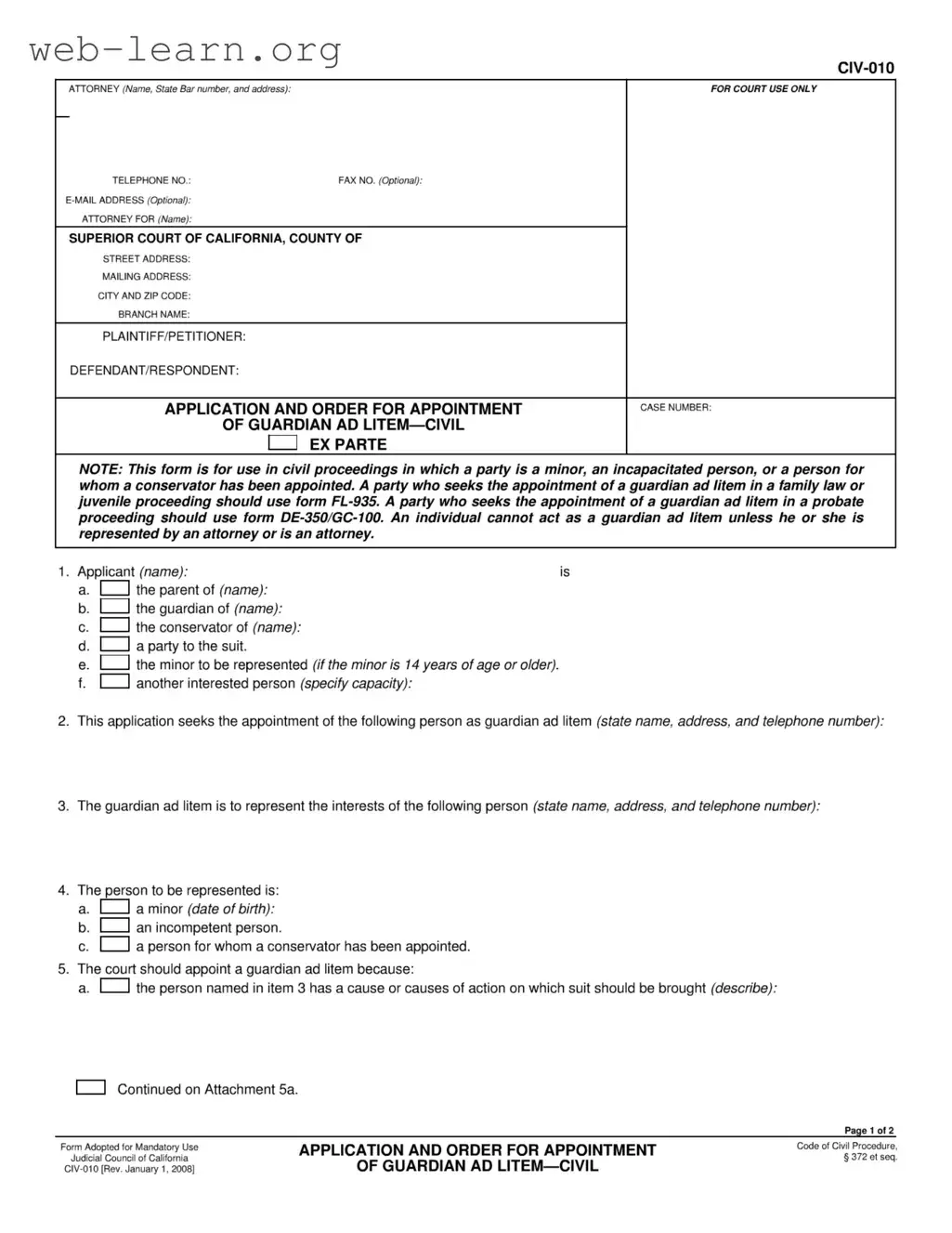
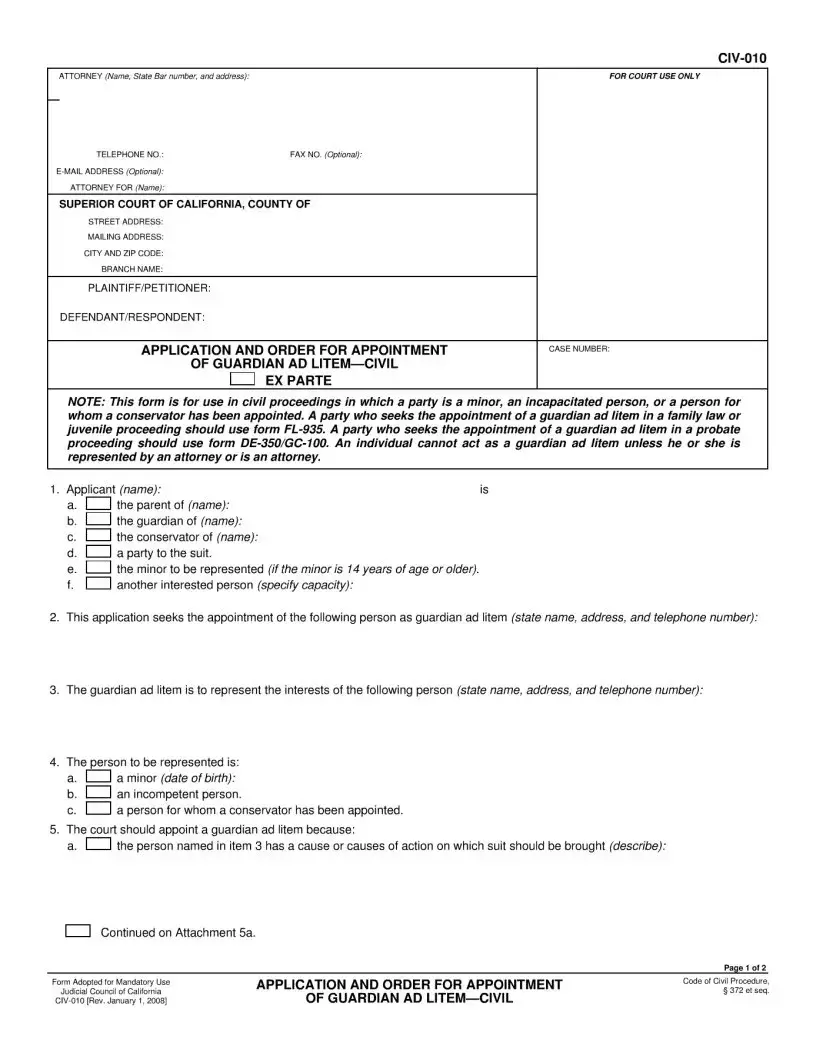
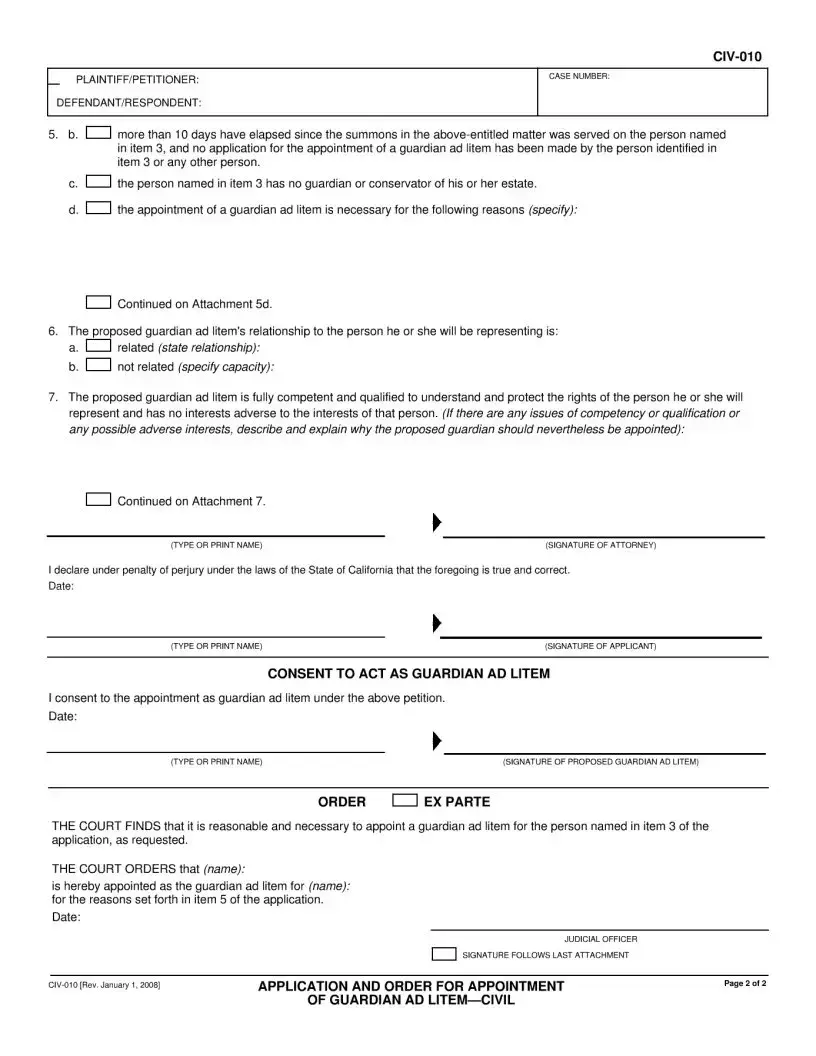
The California Guardian Ad Litem form, designated as CIV-010, plays a crucial role in civil proceedings where a party is a minor, incapacitated, or under conservatorship. This form is essential for individuals seeking to appoint a guardian ad litem, ensuring that the interests of vulnerable parties are adequately represented in legal matters. The form requires specific details, including the applicant's relationship to the person needing representation, which can range from a parent to another interested individual. It also necessitates the identification of the proposed guardian, along with their qualifications to advocate for the individual's rights. Notably, the application must outline the reasons for appointing a guardian ad litem, such as the absence of a current guardian or the necessity of legal action on behalf of the represented party. The form concludes with a judicial order, affirming the court's decision to appoint the guardian, thereby formalizing the process. Understanding this form is vital for those navigating the complexities of civil law in California, as it ensures that the rights of those unable to advocate for themselves are protected.
| Fact Name | Details |
|---|---|
| Purpose | This form is used to request the appointment of a guardian ad litem in civil cases involving minors, incapacitated persons, or individuals under conservatorship. |
| Governing Law | The form is governed by California Code of Civil Procedure § 372 et seq. |
| Eligibility | Only individuals who are either attorneys or represented by an attorney can act as guardians ad litem. |
| Alternative Forms | For family law or juvenile cases, form FL-935 should be used. In probate proceedings, form DE-350/GC-100 is appropriate. |
| Application Requirements | The application must include the name and contact information of the proposed guardian ad litem and the person they will represent. |
| Representation Criteria | The proposed guardian must be competent to protect the rights of the person they represent and have no conflicting interests. |
| Filing Process | The application is typically filed in the Superior Court of California in the relevant county. |
| Ex Parte Nature | This application can be made ex parte, meaning it may be submitted without notifying the other party in certain circumstances. |
Completing the California Guardian Ad Litem form requires careful attention to detail. After filling out the form, you will need to submit it to the appropriate court for consideration. The court will review the application and determine whether to appoint the requested guardian ad litem.
What is the purpose of the California Guardian Ad Litem form?
The California Guardian Ad Litem form (CIV-010) is used to request the appointment of a guardian ad litem in civil cases. This form is specifically for situations where a party is a minor, an incapacitated person, or someone under conservatorship. The guardian ad litem represents the interests of that party in court.
Who can apply for a guardian ad litem?
Any interested person can apply for a guardian ad litem, including:
What information is required on the form?
The form requires details such as:
Can a non-attorney act as a guardian ad litem?
No, a non-attorney cannot act as a guardian ad litem unless they are represented by an attorney or are an attorney themselves. This ensures that the rights of the person being represented are adequately protected.
What happens after the form is submitted?
Once the form is submitted, the court will review the application. If the court finds it reasonable and necessary, it will issue an order appointing the guardian ad litem. This order will specify who is appointed and for whom they will act.
Is there a specific timeline for submitting this form?
It is important to submit the form promptly. If more than 10 days have passed since the summons was served and no application has been made, the court may require justification for the delay.
What if there are concerns about the proposed guardian's qualifications?
If there are any concerns regarding the proposed guardian's competency or potential conflicts of interest, these should be detailed in the application. The court will consider these factors before making a decision.
Do I need an attorney to fill out this form?
While it is not mandatory to have an attorney to fill out the form, having legal representation is highly recommended. An attorney can help ensure that the application is completed correctly and that all necessary information is included.
What should I do if my application is denied?
If the court denies your application, you may have the option to revise your application and resubmit it. It’s advisable to consult with an attorney to understand the reasons for the denial and how to address them.
Where can I obtain the California Guardian Ad Litem form?
The form can be obtained from the California Courts website or at your local Superior Court clerk’s office. Ensure you are using the most current version of the form.
Filling out the California Guardian ad Litem form can be a straightforward process, but several common mistakes can lead to delays or complications. One frequent error is failing to provide complete information in the applicant section. It's essential to clearly indicate your relationship to the minor or incapacitated person. Omitting this detail can create confusion and may result in the application being rejected.
Another mistake is neglecting to specify the name and contact information of the proposed guardian ad litem. This information is crucial for the court to assess the suitability of the guardian. If this section is left blank or incomplete, it could lead to unnecessary delays in the appointment process.
Some applicants mistakenly choose the wrong form for their situation. The Guardian ad Litem form is specifically for civil cases. If you are dealing with family law or probate matters, you must use the appropriate forms, such as FL-935 or DE-350/GC-100. Using the wrong form can result in the application being dismissed.
Additionally, applicants often forget to explain why a guardian ad litem is necessary. The form requires a clear statement of the reasons for the appointment. Failing to provide this justification can leave the court without sufficient information to make a decision.
Another common oversight is not indicating the correct status of the person to be represented. It’s vital to specify whether they are a minor, an incompetent person, or someone under conservatorship. Misclassifying their status can lead to legal complications.
Inaccurate or incomplete responses regarding the proposed guardian's qualifications can also be problematic. The form asks if the guardian is competent and has no adverse interests. If there are any concerns about their qualifications, these should be clearly addressed to avoid challenges later on.
Some applicants fail to sign the form, which is a critical step. Both the applicant and the proposed guardian must provide their signatures. Without these, the application is not valid and cannot be processed.
Moreover, applicants sometimes overlook the importance of including all necessary attachments. If additional information or documentation is required, it should be submitted along with the application. Failing to do so can result in delays or the need for resubmission.
Finally, applicants may not keep copies of the submitted form and any attachments. Having a record of what was submitted is crucial for tracking the application's progress and addressing any issues that may arise.
When navigating the legal system in California, particularly in cases involving minors or incapacitated individuals, several forms accompany the Guardian Ad Litem application. These documents help ensure that the rights and interests of vulnerable parties are adequately represented and protected. Below are some commonly used forms that you might encounter alongside the California Guardian Ad Litem form.
Understanding these accompanying forms can streamline the process of appointing a Guardian Ad Litem. Each document plays a vital role in protecting the interests of those who may not be able to advocate for themselves. Familiarity with these forms can help individuals navigate the complexities of the legal system more effectively.
The California Guardian ad Litem form serves a specific purpose in legal proceedings involving minors or incapacitated individuals. Several other legal documents share similarities with this form. Here’s a breakdown:
Each of these forms plays a vital role in protecting the rights of individuals who may not be able to advocate for themselves in legal settings. Understanding their similarities helps clarify the legal landscape for those involved in such proceedings.
When filling out the California Guardian Ad Litem form, there are several important considerations to keep in mind. Here’s a list of things you should and shouldn’t do:
Many people have misunderstandings about the California Guardian Ad Litem form. Here are eight common misconceptions:
Understanding these points can help clarify the purpose and function of the California Guardian Ad Litem form. It’s important to approach this process with accurate information.
When filling out the California Guardian Litem form, keep the following key points in mind:
Completing this form accurately and thoroughly is essential for the protection of minors or incapacitated individuals in legal proceedings.