Homepage Blank California Gc 340 Form
Outline

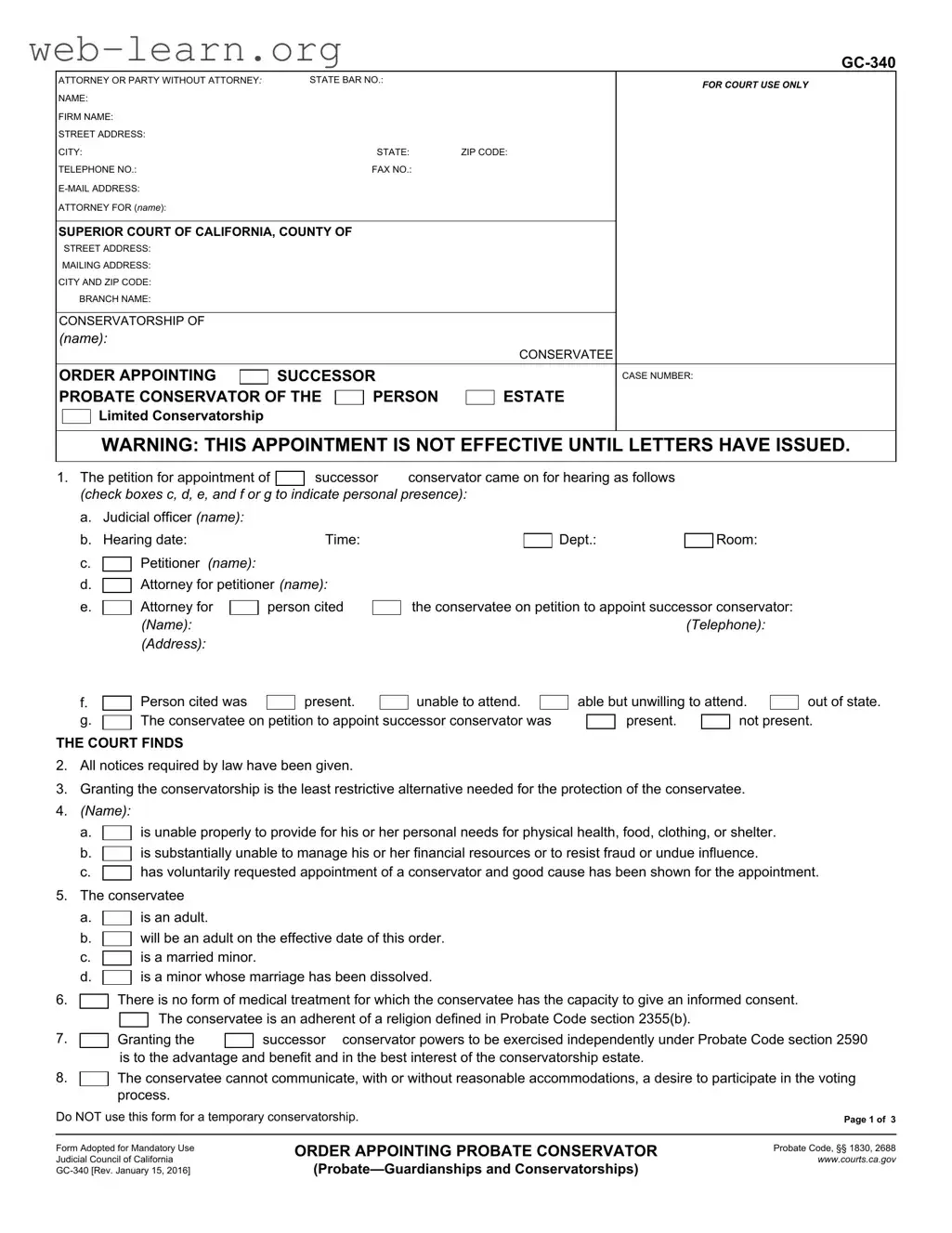
The California GC-340 form is a critical document utilized in the probate court system, specifically for the appointment of a successor conservator. This form plays a significant role in conservatorship proceedings, where individuals are deemed unable to manage their personal or financial affairs due to various reasons, such as mental incapacity or developmental disabilities. The GC-340 outlines essential details including the names of the parties involved, the court's findings regarding the conservatee's ability to provide for their needs, and the legal representation assigned to the conservatee. It also addresses the necessity of the conservatorship as the least restrictive alternative for the conservatee's protection. The form requires specific information about the conservator's qualifications, including whether they are a professional fiduciary and if they hold the necessary licenses. Additionally, it stipulates the powers granted to the successor conservator, which may include making decisions about medical treatment or managing financial resources. Notably, the GC-340 emphasizes that the appointment is not effective until certain legal requirements, such as the issuance of letters of conservatorship, are met. This form is indispensable for ensuring that the rights and welfare of individuals unable to care for themselves are adequately safeguarded through a structured legal process.


Sample - California Gc 340 Form

The petition for appointment of
(check boxes c, d, e, and f or g to indicate personal presence):
THE COURT FINDS
All notices required by law have been given.
The conservatee
5.
6.
Page 1 of 3
Form Adopted for Mandatory Use
Judicial Council of California
GC-340 [Rev. January 15, 2016]
Probate Code, §§ 1830, 2688
www.courts.ca.gov
1.
a.
c.
d.
e.
f.
g.
a.
b.
c.
a.
b.
c.
d.
3.
2.
4.
is to the advantage and benefit and in the best interest of the conservatorship estate.
ORDER APPOINTING PROBATE CONSERVATOR
(Probate—Guardianships and Conservatorships)
Do NOT use this form for a temporary conservatorship.
7.
8.
b.
Granting the conservatorship is the least restrictive alternative needed for the protection of the conservatee.
successor
Judicial officer (name):
Hearing date: Time: Dept.: Room:
Petitioner
(name):
Attorney for petitioner
(name):
Attorney for person cited the conservatee on petition to appoint successor conservator:
(Name): (Telephone):
(Address):
Person cited was out of state.
The conservatee on petition to appoint successor conservator was present. not present.
(Name):
is unable properly to provide for his or her personal needs for physical health, food, clothing, or shelter.
is substantially unable to manage his or her financial resources or to resist fraud or undue influence.
has voluntarily requested appointment of a conservator and good cause has been shown for the appointment.
is an adult.
will be an adult on the effective date of this order.
is a married minor.
is a minor whose marriage has been dissolved.
There is no form of medical treatment for which the conservatee has the capacity to give an informed consent.
The conservatee is an adherent of a religion defined in Probate Code section 2355(b).
Granting the
successor
The conservatee cannot communicate, with or without reasonable accommodations, a desire to participate in the voting
process.
SUPERIOR COURT OF CALIFORNIA, COUNTY OF
BRANCH NAME:
CITY AND ZIP CODE:
STREET ADDRESS:
MAILING ADDRESS:
(name):
CONSERVATORSHIP OF
CONSERVATEE
FOR COURT USE ONLY
CASE NUMBER:
ORDER APPOINTING
PROBATE CONSERVATOR OF THE
SUCCESSOR
PERSON ESTATE
Limited Conservatorship
GC-340
ATTORNEY OR PARTY WITHOUT ATTORNEY:
STATE: ZIP CODE:CITY:
STREET ADDRESS:
FIRM NAME:
NAME:
STATE BAR NO.:
TELEPHONE NO.: FAX NO.:
E-MAIL ADDRESS:
ATTORNEY FOR (name):
WARNING: THIS APPOINTMENT IS NOT EFFECTIVE UNTIL LETTERS HAVE ISSUED.
conservator came on for hearing as follows
conservator powers to be exercised independently under Probate Code section 2590
present. unable to attend. able but unwilling to attend.
13.
(Either a, b, or c must be checked):
conservator is the spouse of the conservatee and is a party to an action or proceeding against
the conservatee for legal separation, dissolution, annulment, or adjudication of nullity of their marriage.
c.
THE COURT ORDERS
is appointed
and Letters of Conservatorship shall issue upon qualification.
18.
19.
to be furnished by an authorized surety company or as otherwise provided by law.
c.
and receipts shall be filed. No withdrawals shall be made without a court order.
GC-340 [Rev. January 15, 2016] Page 2 of 3
ORDER APPOINTING PROBATE CONSERVATOR
(Probate—Guardianships and Conservatorships)
12.
10.
11.
conservator is a professional fiduciary as defined by Business and Professions Code section
6501(f).
14.
conservator holds a valid, unexpired, unsuspended license as a professional fiduciary issued by
the Professional Fiduciaries Bureau of the California Department of Consumer Affairs under chapter 6 (commencing with
section 6500) of division 3 of the Business and Professions Code.
15.
conservator is not the domestic partner or former domestic partner of the conservatee.
conservator is the domestic partner or former domestic partner of the conservatee and intends
to terminate or has terminated their domestic partnership. It is in the best interest of the conservatee to appoint the
domestic partner or former domestic partner as conservator.
c.
16.
(Either a, b, or c must be checked):
conservator is the domestic partner of the conservatee and has neither terminated nor
intends to terminate their domestic partnership.
It is in the best interest of the conservatee to appoint the spouse as conservator.
a.
b.
a.
b.
17.
a.
of the PERSON of (name):
of the ESTATE of (name):
a.
b.
b.
9.
has been appointed by the court as legal
counsel to represent the conservatee in these proceedings.
The conservatee has the ability to pay
GC-340
(name):
CONSERVATORSHIP OF
CONSERVATEE
CASE NUMBER:
conservator is not the spouse of the conservatee.
conservator is the spouse of the conservatee and is not a party to an action or proceeding
against the conservatee for legal separation, dissolution, annulment, or adjudication of nullity of their marriage.
20.
The conservatee has dementia as defined in Probate Code section 2356.5, and the court finds all other facts required to
make the orders specified in item 28.
Attorney
(name):
The cost for representation is: $
all none a portion
of this sum (specify): $
The conservatee need not attend the hearing.
The appointed court investigator is
(name):
(Address and telephone):
(For limited conservatorship only) The limited conservatee is developmentally disabled as defined in Probate Code section
1420.
The successor
License no.: Issuance or last renewal date: Expiration date:
(Name): (Telephone):
(Address):
conservator limited conservator successor
(Name):
(Address):
(Telephone):
The conservatee need not attend the hearing.
Bond is not required.
Bond is fixed at: $
Deposits of: $
are ordered to be placed in a blocked account at (specify institution and location):
Additional orders in attachment 20c.
The successor
The successor
The successor
The successor
The successor
The successor
The successor
successor
successor
is appointed conservator limited conservator successor
(specify terms, including any combination of payors):
31.
limited conservator of the person under Probate Code section 2351.5 as specified in attachment 31 are granted.
32.
limited conservator of the estate under Probate Code section 1830(b) as specified in attachment 32 are granted.
33.
34.
JUDICIAL OFFICER
22.
23.
conservator of the person is granted the powers specified in Probate Code section 2355.
24. conservator of the estate is granted authorization under Probate Code section 2590 to exercise
independently the powers specified in attachment 24
25.
conservator of the person under Probate Code
sections 2351–2358 as specified in attachment 26 are granted. (Do not include orders under Probate Code section 2356.5
relating to dementia.)
26.
27.
28. conservator of the person is granted authority to place the conservatee in a care or
nursing facility described in Probate Code section 2356.5(b).
b. conservator of the person is granted authority to authorize the administration of
medications appropriate for the care and treatment of dementia described in Probate Code section 2356.5(c).
21.
conservator
a.
29.
35.
36.
of the estate as specified in attachment 27 are granted.
30.
d. conservator is not authorized to take possession of money or any other property
without a specific court order.
The successor
20.
(cont.)
For legal services rendered, conservatee conservatee's estate shall pay the sum of: $
to (name):
forthwith as follows
Continued in attachment 21.
The conservatee is disqualified from voting.
The conservatee lacks the capacity to give informed consent for medical treatment and the
successor
The treatment shall be performed by an accredited practitioner of a religion as defined in Probate Code
section 2355(b).
subject to the conditions provided.
Orders relating to the capacity of the conservatee under Probate Code sections 1873 or 1901 as specified in attachment 25
are granted.
Orders relating to the powers and duties of the
Orders relating to the conditions imposed under Probate Code section 2402 on the
Other orders as specified in attachment 29 are granted.
The probate referee appointed is
(name and address):
(For limited conservatorship only) Orders relating to the powers and duties of the
(For limited conservatorship only) Orders limiting the civil and legal rights of the limited conservatee as specified in
attachment 33 are granted.
This order is effective on the date signed date minor attains majority
(specify):
Number of boxes checked in items 18–34:
Number of pages attached:
Date:
SIGNATURE FOLLOWS LAST ATTACHMENT
GC-340
(name):
CONSERVATORSHIP OF
CONSERVATEE
CASE NUMBER:
The successor
successor
successor
The successor
The successor
successor
successor
GC-340 [Rev. January 15, 2016] Page 3 of 3
ORDER APPOINTING PROBATE CONSERVATOR
(Probate—Guardianships and Conservatorships)
For your protection and privacy, please press the Clear
This Form button after you have printed the form.

Form Information

Fact Name Details
Purpose The GC-340 form is used to appoint a successor conservator for individuals who are unable to manage their personal or financial affairs.
Governing Law This form is governed by the California Probate Code, specifically sections 1830 and 2688.
Hearing Requirement A hearing must be conducted to grant the conservatorship, and all required notices must be given prior to this hearing.
Conservatee's Condition The form requires evidence that the conservatee is unable to provide for their own physical needs or manage their financial resources.
Legal Representation The conservatee may have legal counsel appointed to represent them during the proceedings, and the costs for this representation must be addressed.
Voting Rights The conservatee is disqualified from voting and lacks the capacity to give informed consent for medical treatment.
Bond Requirements The court may require a bond from the successor conservator, or it may determine that a bond is not necessary.

Detailed Guide for Filling Out California Gc 340

Completing the California GC-340 form is a crucial step in the conservatorship process. Once the form is filled out correctly, it will need to be submitted to the appropriate court for review. Following the outlined steps will help ensure that all necessary information is provided and that the form is completed accurately.

  1. Begin by entering the name of the attorney or party without an attorney at the top of the form. Include the State Bar number, if applicable.
  2. Fill in the firm name, street address, city, state, and ZIP code of the attorney or party.
  3. Provide the telephone number, fax number, and email address of the attorney or party.
  4. Indicate who the attorney is representing by writing the name of the conservatee.
  5. Enter the street address, mailing address, city, and ZIP code of the court where the form will be submitted.
  6. Specify the branch name of the court and the case number related to the conservatorship.
  7. Check the appropriate box to indicate whether the conservatorship is for the person, the estate, or both.
  8. Complete the section regarding the hearing details, including the name of the judicial officer, hearing date, time, department, and room.
  9. Provide the names and contact information for the petitioner and the attorney for the petitioner.
  10. Indicate the presence or absence of the person cited and the conservatee during the hearing by checking the relevant boxes.
  11. Confirm that all required notices have been given by checking the appropriate box.
  12. Fill in the necessary information about the conservatee's ability to provide for personal needs and manage financial resources.
  13. Complete the section regarding the conservatee's marital status and age, checking the relevant boxes.
  14. Indicate whether the conservatee has dementia and whether legal counsel has been appointed.
  15. Provide details about the bond requirement, if any, and the financial obligations of the conservatee.
  16. Complete any additional orders or attachments as specified in the form.
  17. Sign and date the form at the bottom, ensuring that the judicial officer's signature will follow last attachment.

Obtain Answers on California Gc 340

  1. What is the purpose of the California GC 340 form?

    The California GC 340 form is used to appoint a successor conservator for an individual who is unable to manage their personal or financial affairs. This form is part of the conservatorship process and ensures that the conservatee's needs are met in a legal and structured manner. It is essential for protecting the rights and interests of individuals who may not be able to make decisions for themselves.

  2. Who can file the GC 340 form?

    The GC 340 form can be filed by an attorney representing a petitioner or by a party without an attorney. The petitioner is typically someone who has a vested interest in the welfare of the conservatee, such as a family member or close friend. It's crucial that all required information is accurately completed to avoid delays in the appointment process.

  3. What happens after the form is submitted?

    Once the GC 340 form is submitted, a hearing will be scheduled. During this hearing, the court will review the petition and any supporting documents. The presence of the conservatee may not be necessary, depending on their capacity and circumstances. If the court approves the petition, it will issue Letters of Conservatorship, allowing the appointed successor conservator to act on behalf of the conservatee.

  4. Are there any specific requirements for the successor conservator?

    Yes, there are specific requirements. The successor conservator must not be a spouse or domestic partner involved in legal proceedings against the conservatee. Additionally, if the conservatee is developmentally disabled, the successor conservator must hold a valid license as a professional fiduciary. It’s important to ensure that the appointed conservator is suitable for the role, as they will be responsible for making significant decisions regarding the conservatee's welfare.

Common mistakes

Filling out the California GC-340 form is a critical step in the conservatorship process, and mistakes can lead to delays or even denials. One common error is failing to provide complete contact information for all parties involved. Ensure that names, addresses, and phone numbers are accurate and fully detailed. Missing this information can hinder communication and complicate the court's ability to process your request.

Another frequent mistake is neglecting to check all necessary boxes. Each checkbox on the form serves a specific purpose, indicating the presence or absence of certain parties or circumstances. Omitting a checkbox can create confusion or misrepresent the situation, which may affect the court's decision. Always double-check that all relevant boxes are marked appropriately.

Inaccurate or vague descriptions of the conservatee's condition can also pose a problem. The form requires clear, specific details about the conservatee's ability to manage personal needs and finances. Providing insufficient information can lead to questions from the court, delaying the appointment process. Be thorough and precise in your descriptions to avoid unnecessary complications.

Many people forget to include the required attachments. The GC-340 form often requires supporting documents that provide additional context or evidence for the conservatorship request. Failing to attach these documents can result in a rejection of the application. Always review the checklist of necessary attachments before submitting the form.

Another mistake involves misunderstanding the type of conservatorship being applied for. There are different types of conservatorships, such as general and limited, and each has its own requirements. Ensure that you are applying for the correct type and that all relevant sections of the form are completed accordingly. Misclassification can lead to significant delays.

Omitting to mention any existing legal proceedings related to the conservatee can also be a critical oversight. If there are ongoing legal matters, they must be disclosed on the form. Failure to do so may result in legal consequences and could jeopardize the conservatorship application.

Additionally, people often overlook the importance of signing and dating the form. A missing signature or date can render the application invalid, causing further delays. Always ensure that the form is signed by the appropriate parties and that the date is clearly indicated.

Lastly, not reviewing the form for errors before submission is a common pitfall. Simple typos or inaccuracies can lead to misunderstandings or complications. Take the time to carefully proofread the form and ensure all information is correct. This small step can save significant time and effort in the long run.

Documents used along the form

The California GC-340 form is an important document used in the process of appointing a successor conservator. However, it is often accompanied by other forms and documents that play a crucial role in the conservatorship proceedings. Below are four such documents, each serving a specific purpose in the process.

  • GC-350: Petition for Appointment of Conservator - This form initiates the conservatorship process. It details the reasons for seeking a conservatorship and provides information about the proposed conservator and the conservatee.
  • GC-341: Letters of Conservatorship - Once the court approves the appointment of a conservator, this document is issued. It formally grants the conservator the legal authority to act on behalf of the conservatee.
  • GC-348: Notice of Hearing - This document informs all interested parties about the date and time of the hearing regarding the conservatorship. It ensures that those affected by the decision have an opportunity to attend and voice their opinions.
  • GC-322: Confidential Supplemental Information - This form provides additional, sensitive information about the conservatee that may be necessary for the court's consideration but is not made public. It helps protect the privacy of the conservatee while ensuring the court has all relevant details.

Each of these documents plays a vital role in the conservatorship process, ensuring that the rights and needs of the conservatee are respected and addressed. Understanding these forms can help navigate the complexities of conservatorship in California.

Similar forms

The California GC-340 form, which is used for appointing a successor conservator, shares similarities with several other legal documents. Below is a list of ten documents that are comparable to the GC-340 form, along with explanations of how they are similar.

  • GC-350: Order Appointing Conservator - This document serves a similar purpose by officially appointing a conservator for an individual, outlining the responsibilities and powers granted to that conservator.
  • GC-341: Letters of Conservatorship - Like the GC-340, this form provides official recognition of a conservator's authority to act on behalf of a conservatee, detailing the scope of that authority.
  • GC-200: Petition for Appointment of Guardian - This document initiates the process of appointing a guardian for a minor or incapacitated adult, paralleling the conservatorship process initiated by the GC-340.
  • GC-240: Order Appointing Guardian - Similar to the GC-340, this order formalizes the appointment of a guardian, outlining the responsibilities and powers granted to the guardian.
  • GC-130: Petition for Appointment of Probate Conservator - This petition is used to request the appointment of a conservator, similar to the initial steps taken in the GC-340 process.
  • GC-140: Order Appointing Temporary Conservator - This document provides temporary authority to a conservator, akin to the permanent authority established in the GC-340.
  • GC-420: Petition for Termination of Conservatorship - This form is used to end a conservatorship, which is a related process to establishing one, as outlined in the GC-340.
  • Form 1: Notice of Hearing on Petition for Conservatorship - This notice informs relevant parties about the hearing regarding the conservatorship, similar to the notification requirements in the GC-340.
  • Form 2: Consent to Appointment of Conservator - This document is used to obtain consent from the proposed conservatee or interested parties, similar to the consent aspects found in the GC-340.
  • Form 3: Report of Court Investigator - This report provides the court with an investigation into the proposed conservatee's situation, paralleling the court's findings required in the GC-340.

Dos and Don'ts

Things to Do When Filling Out the California GC-340 Form:

  • Provide accurate and complete information in all required fields.
  • Check all applicable boxes to indicate the presence or absence of parties involved.
  • Ensure that the conservatee's name is spelled correctly throughout the form.
  • Attach any necessary documents that support your application.
  • Review the completed form for any errors before submission.

Things Not to Do When Filling Out the California GC-340 Form:

  • Do not leave any required fields blank.
  • Avoid using unclear or ambiguous language.
  • Do not submit the form without the necessary signatures.
  • Refrain from using this form for temporary conservatorships.
  • Do not forget to keep a copy of the completed form for your records.

Misconceptions

Understanding the California GC-340 form is essential for those involved in conservatorship proceedings. However, several misconceptions often arise regarding this form. Below is a list of common misunderstandings, along with clarifications to ensure a better grasp of the form's purpose and requirements.

  • Misconception 1: The GC-340 form is only for permanent conservatorships.
  • In reality, the GC-340 form is specifically designed for appointing a successor conservator, which can occur in both temporary and permanent conservatorship situations. It is crucial to ensure that the form is used appropriately for the specific type of conservatorship.

  • Misconception 2: The conservatee must attend the hearing for the appointment to be valid.
  • Contrary to this belief, the conservatee is not required to attend the hearing. The court can proceed with the appointment even if the conservatee is unable to be present, provided that all legal notices have been given.

  • Misconception 3: The GC-340 form allows for unlimited powers to the successor conservator.
  • This form does not grant unlimited powers. The successor conservator's authority is defined by the court and is subject to specific conditions outlined in the Probate Code. It is important to understand the limitations and responsibilities that come with the appointment.

  • Misconception 4: Only family members can be appointed as successor conservators.
  • This is not accurate. While family members often serve in this role, professional fiduciaries can also be appointed as successor conservators. The court considers the best interest of the conservatee when making this decision.

  • Misconception 5: The form is only applicable to adults.
  • The GC-340 form can apply to both adults and minors. For minors, the form includes specific provisions regarding their status and needs, ensuring that all relevant factors are considered during the appointment process.

  • Misconception 6: The conservatee loses all rights once a successor conservator is appointed.
  • This belief is misleading. While the conservatee may have certain rights limited, they do not lose all rights. The conservatorship is intended to protect the conservatee's interests, and they retain some rights, such as the right to participate in decisions about their care, to the extent they are able.

  • Misconception 7: Completing the GC-340 form guarantees approval from the court.
  • Filing the form does not guarantee that the court will approve the appointment. The court must review the circumstances surrounding the request, including the conservatee's needs and the qualifications of the proposed successor conservator. Approval is contingent upon the court's findings.

Key takeaways

When filling out and using the California GC-340 form, consider the following key takeaways:

  • Understand the Purpose: The GC-340 form is used to appoint a successor conservator for an individual who is unable to manage their personal or financial affairs due to incapacity.
  • Complete Required Information: Ensure that all necessary details, such as names, addresses, and case numbers, are accurately filled out to avoid delays in processing.
  • Presence at Hearing: Indicate whether the conservatee or other parties are present or unable to attend the hearing. This information is crucial for the court's decision-making.
  • Legal Representation: If applicable, note the appointed attorney's details and their role in representing the conservatee throughout the proceedings.
  • Review Notices: Confirm that all legal notices required by law have been provided to relevant parties before the hearing, as this is essential for the validity of the proceedings.

By keeping these points in mind, individuals can navigate the process of filling out and utilizing the GC-340 form more effectively.