Homepage Blank California Gc 320 Form
Outline

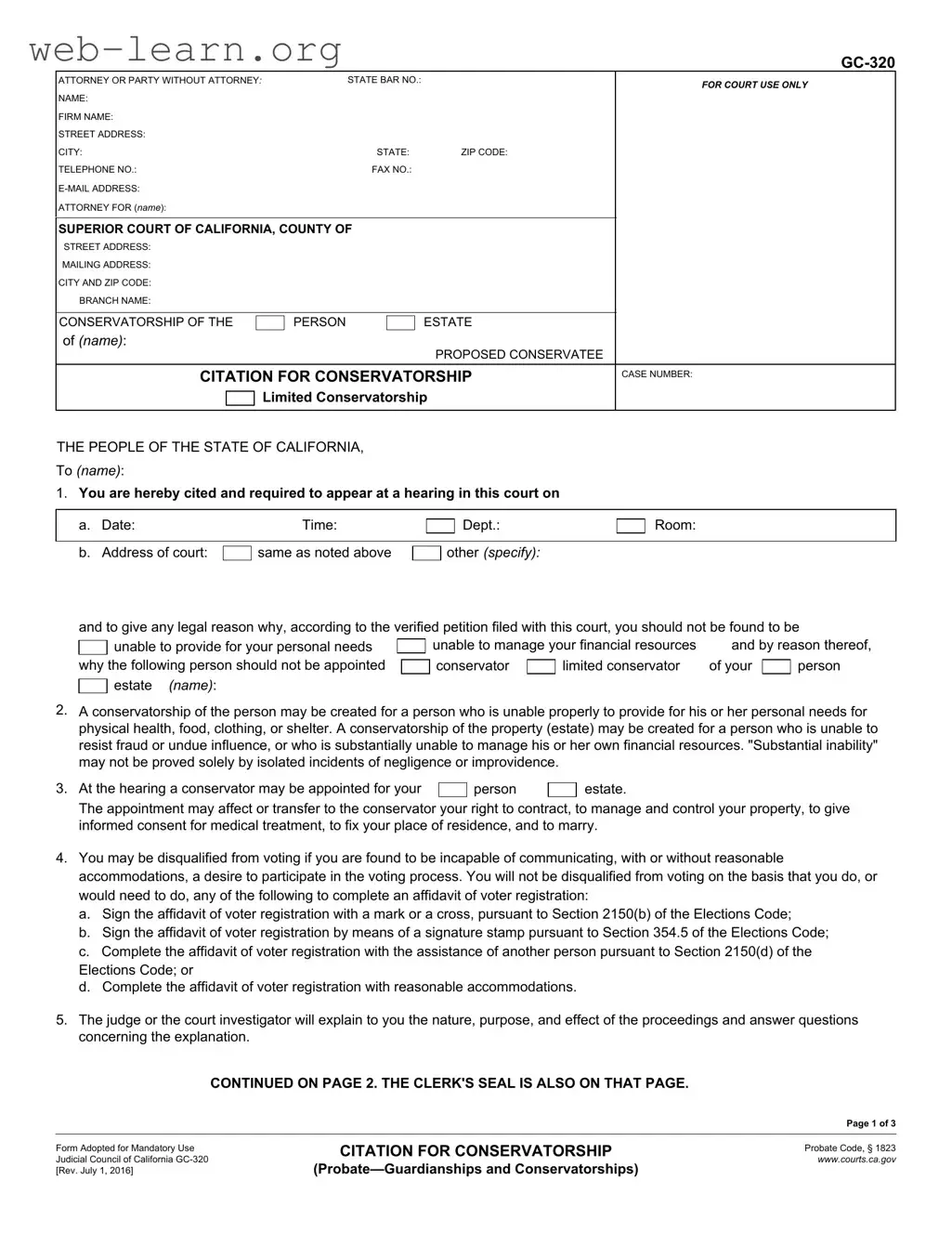
The California GC 320 form serves as a critical document in the conservatorship process, specifically addressing the needs of individuals who may be unable to care for themselves or manage their finances. This form initiates legal proceedings by citing the proposed conservatee, requiring their appearance in court to discuss their ability to provide for personal needs such as health, food, and shelter. It outlines the potential appointment of a conservator, who may gain authority over various aspects of the conservatee's life, including financial decisions and medical consent. The form also highlights the rights of the proposed conservatee, including the right to contest the conservatorship, seek legal representation, and request a jury trial. Additionally, it emphasizes the importance of understanding the implications of the conservatorship, including the potential impact on voting rights. With clear instructions and necessary details, the GC 320 form ensures that all parties involved are aware of their rights and responsibilities throughout the conservatorship process.


Sample - California Gc 320 Form

THE PEOPLE OF THE STATE OF CALIFORNIA,
You are hereby cited and required to appear at a hearing in this court on
Address of court:
and to give any legal reason why, according to the verified petition filed with this court, you should not be found to be
why the following person should not be appointed
At the hearing a conservator may be appointed for your
CITATION FOR CONSERVATORSHIP
(Probate—Guardianships and Conservatorships)
Probate Code, § 1823
www.courts.ca.gov
Form Adopted for Mandatory Use
Judicial Council of California GC-320
[Rev. July 1, 2016]
Page 1 of 3
3.
A conservatorship of the person may be created for a person who is unable properly to provide for his or her personal needs for
physical health, food, clothing, or shelter. A conservatorship of the property (estate) may be created for a person who is unable to
resist fraud or undue influence, or who is substantially unable to manage his or her own financial resources. "Substantial inability"
may not be proved solely by isolated incidents of negligence or improvidence.
2.
b.
1.
To (name):
same as noted above other
(specify):
unable to provide for your personal needs
unable to manage your financial resources
conservator limited conservator person
estate
(name):
person estate.
SUPERIOR COURT OF CALIFORNIA, COUNTY OF
BRANCH NAME:
CITY AND ZIP CODE:
STREET ADDRESS:
MAILING ADDRESS:
of (name):
CONSERVATORSHIP OF THE
PROPOSED CONSERVATEE
PERSON ESTATE
FOR COURT USE ONLY
CASE NUMBER:
CITATION FOR CONSERVATORSHIP
Limited Conservatorship
GC-320
ATTORNEY OR PARTY WITHOUT ATTORNEY:
STATE: ZIP CODE:CITY:
STREET ADDRESS:
FIRM NAME:
NAME:
STATE BAR NO.:
TELEPHONE NO.: FAX NO.:
E-MAIL ADDRESS:
ATTORNEY FOR (name):
and by reason thereof,
of your
a. Date:
Time:
Dept.: Room:
5.
4.
The appointment may affect or transfer to the conservator your right to contract, to manage and control your property, to give
informed consent for medical treatment, to fix your place of residence, and to marry.
The judge or the court investigator will explain to you the nature, purpose, and effect of the proceedings and answer questions
concerning the explanation.
CONTINUED ON PAGE 2. THE CLERK'S SEAL IS ALSO ON THAT PAGE.
You may be disqualified from voting if you are found to be incapable of communicating, with or without reasonable
accommodations, a desire to participate in the voting process. You will not be disqualified from voting on the basis that you do, or
would need to do, any of the following to complete an affidavit of voter registration:
a. Sign the affidavit of voter registration with a mark or a cross, pursuant to Section 2150(b) of the Elections Code;
b. Sign the affidavit of voter registration by means of a signature stamp pursuant to Section 354.5 of the Elections Code;
c. Complete the affidavit of voter registration with the assistance of another person pursuant to Section 2150(d) of the
Elections Code; or
d. Complete the affidavit of voter registration with reasonable accommodations.
CITATION FOR CONSERVATORSHIP
(Probate—Guardianships and Conservatorships)
Page 2 of 3GC-320 [Rev. July 1, 2016]
CASE NUMBER:
of (name):
CONSERVATORSHIP OF THE
PROPOSED CONSERVATEE
PERSON ESTATE
GC-320
(SEAL)
Assistive listening systems, computer-assisted real-time captioning, or sign language
interpreter services are available upon request if at least 5 days notice is provided. Contact
the clerk's office for Request for Accommodations by Persons With Disabilities and Order
(form MC-410). (Civil Code section 54.8.)
Date:
Clerk, by
, Deputy
You have the right to appear at the hearing and oppose the petition. You have the right to hire an attorney of your choice to
represent you. The court will appoint an attorney to represent you if you are unable to retain one. You must pay the cost of that
attorney if you are able. You have the right to a jury trial if you wish.
(For limited conservatorship only) In addition to the rights stated in item 6 above, you have the right to oppose the petition in part
by objecting to any or all of the requested duties or powers of the limited conservator.
6.
7.
CASE NUMBER:
of (name):
CONSERVATORSHIP OF THE
PROPOSED CONSERVATEE
PERSON ESTATE
GC-320
PROOF OF SERVICE
Person served:
I served the person named in item 2
(1) (2)
c.
(3)
(4)
(SIGNATURE OF PERSON SERVING)
(1)
(2)
(3)
(4)
4.
5.
6.
At the time of service I was at least 18 years of age and not a party to this proceeding. I served copies of the Citation for
Conservatorship and the Petition for Appointment of Probate Conservator (form GC-310) as follows:
a.2.
b.
c.
3.
a.
b.
(2)(1)
b.
c.
d.
e.
(1)
(2)
Person cited (name):
person in item 2a
other
(specify name and title or relationship to the person named in item 2a):
Address (specify):
by personally delivering the copies
on (date): at (time):
by mailing the copies to the person served, addressed as shown in item 2c, by first-class mail, postage prepaid,
on (date): from (city):
with two copies of the Notice and Acknowledgment of Receipt—Civil and a postage-paid return envelope
addressed to me. (Attach completed Notice and Acknowledgment of Receipt—Civil (form POS-015).)
to an address outside California with return receipt requested. (Attach completed return receipt.)
other
(specify other manner of service, and the authorizing code section and order of the court):
Person serving (name, address, and telephone number):
Fee for service: $
Not a registered California process server.
Exempt from registration under Business and Professions Code section 22350(b).
Registered California process server.
Employee or independent contractor.
Registration no. (specify):
County (specify):
Expiration (date):
I declare under penalty of perjury under the laws of the State of California that the foregoing is true and correct.
I am a California sheriff or marshal and I certify that the foregoing is true and correct.
Date:
1.
a.
CITATION FOR CONSERVATORSHIP
(Probate—Guardianships and Conservatorships)
Page 3 of 3GC-320 [Rev. July 1, 2016]

Form Information

Fact Name Details
Purpose of Form The GC-320 form is used in California to issue a citation for conservatorship, ensuring that individuals who may be unable to care for themselves are given legal representation and a fair hearing.
Governing Law This form is governed by the California Probate Code, specifically Section 1823, which outlines the procedures and requirements for establishing conservatorships.
Hearing Rights Individuals cited have the right to appear at the hearing, oppose the petition, and hire an attorney. If they cannot afford one, the court will appoint an attorney for them.
Limited Conservatorship In cases of limited conservatorship, individuals can object to specific duties or powers requested for the conservator, allowing for tailored arrangements based on their needs.
Voting Rights Being found incapable of managing personal affairs does not automatically disqualify someone from voting. They retain the right to register and vote with certain accommodations.

Detailed Guide for Filling Out California Gc 320

Filling out the California GC-320 form is an important step in the conservatorship process. This form requires specific information to ensure that all parties involved are properly notified and that the legal proceedings can move forward. Follow these steps to complete the form accurately.

  1. Identify the Attorney or Party: In the top section, provide the name of the attorney or party without an attorney. Include the State Bar number, if applicable.
  2. Enter Contact Information: Fill in the firm name, street address, city, state, zip code, telephone number, fax number, and email address.
  3. Specify Attorney for: Indicate the name of the person for whom you are acting as attorney or party.
  4. Fill in Court Information: Provide the name of the Superior Court, street address, mailing address, city, zip code, and branch name.
  5. Complete Conservatorship Details: Write the name of the proposed conservatee and the case number. Specify whether it is a limited conservatorship.
  6. Provide Citation Details: Include the date, time, department, and room of the hearing. Specify the address of the court if different from the above.
  7. Outline Legal Reasons: State the legal reasons why the proposed conservatee should not be found unable to provide for personal needs or manage financial resources.
  8. Review Rights: Ensure that the rights of the proposed conservatee are clearly outlined, including the right to oppose the petition and to have legal representation.
  9. Proof of Service Section: Complete the proof of service section, detailing how the citation and petition were served to the person cited.
  10. Sign and Date: Finally, sign and date the form where indicated, ensuring all information is accurate and complete.

Obtain Answers on California Gc 320

  1. What is the purpose of the California GC-320 form?

    The GC-320 form serves as a citation for conservatorship in California. It notifies a proposed conservatee that a hearing will take place regarding their ability to manage personal and financial affairs. The court issues this citation to ensure that the proposed conservatee is informed of the proceedings and has the opportunity to respond.

  2. Who is required to appear at the hearing?

    The proposed conservatee, the individual named in the citation, is required to appear at the hearing. This is essential for the court to assess their ability to manage their personal needs and financial resources. The citation outlines the specific date, time, and location of the hearing.

  3. What are the potential consequences of being found unable to manage personal needs?

    If the court determines that the proposed conservatee cannot provide for their personal needs—such as health, food, clothing, or shelter—a conservatorship may be established. This could result in the appointment of a conservator who will have authority over the conservatee's personal and financial decisions.

  4. Can the proposed conservatee contest the conservatorship?

    Yes, the proposed conservatee has the right to appear at the hearing and contest the petition. They can hire an attorney to represent them, and if they cannot afford one, the court will appoint an attorney at no cost to them. The proposed conservatee can also request a jury trial if they choose.

  5. What rights does a proposed conservatee retain during the process?

    The proposed conservatee retains several rights, including the right to contest the petition and the right to legal representation. They can also oppose specific duties or powers requested for the conservator, especially in cases of limited conservatorship.

  6. What happens if the proposed conservatee is found incapable of voting?

    If the court finds that the proposed conservatee is incapable of communicating their desire to vote, they may be disqualified from participating in elections. However, they cannot be disqualified solely based on their need for assistance in completing voter registration forms.

  7. How is the citation served to the proposed conservatee?

    The citation is typically served by personally delivering copies of the citation and the petition to the proposed conservatee. Alternatively, it can be mailed to them, ensuring that all required documentation is included. Proper proof of service must be filed with the court.

  8. What accommodations are available for individuals with disabilities?

    The court provides assistive services, such as listening systems or sign language interpreters, upon request. It is important to notify the court at least five days in advance to arrange these accommodations.

  9. Where can I find more information about the GC-320 form?

    Additional information about the GC-320 form and the conservatorship process can be found on the California courts website. It is advisable to consult legal resources or an attorney for specific questions related to individual circumstances.

Common mistakes

Filling out the California GC-320 form can be a straightforward process, but many people make common mistakes that can lead to delays or complications. One frequent error occurs when individuals fail to provide complete information. Missing details, such as the proposed conservatee's full name or the correct case number, can result in the form being rejected or returned for correction. It's essential to double-check that all required fields are filled out accurately.

Another mistake is overlooking the importance of the date and time of the hearing. People sometimes forget to specify these details, which are critical for scheduling. Without this information, the court cannot properly notify the involved parties, potentially causing unnecessary delays in the proceedings.

Many applicants also misinterpret the section regarding the rights of the proposed conservatee. They may not fully understand what rights are being waived or retained. This misunderstanding can lead to confusion during the hearing. It's crucial to read this section carefully and ensure that you comprehend the implications of the conservatorship.

Additionally, some individuals neglect to provide proof of service. The form requires a declaration of how and when the citation was served to the involved parties. Failing to complete this section can lead to significant issues, as the court needs to confirm that all parties have been properly notified of the proceedings.

Another common error is not retaining copies of the completed form and any related documents. Keeping these records is vital for your own reference and for any future hearings. Without copies, it may be challenging to track the progress of the case or respond to any inquiries from the court.

People often forget to sign the form. A missing signature can render the entire submission invalid. Always remember to sign and date the form before submitting it to the court. This simple step is crucial for ensuring that your petition is taken seriously.

Lastly, applicants sometimes fail to seek assistance when needed. The process can be complex, and not everyone is familiar with legal terminology or procedures. If you find yourself confused, consider reaching out to an attorney or a legal aid organization for guidance. Getting help can prevent costly mistakes and ensure that your rights are protected throughout the conservatorship process.

Documents used along the form

The California GC-320 form is an essential document in the conservatorship process, particularly for those seeking to establish a limited conservatorship. Alongside this form, several other documents are commonly used. Each of these documents plays a crucial role in ensuring that the legal process is followed correctly and that the rights of all parties involved are protected.

  • GC-310 Petition for Appointment of Probate Conservator: This form initiates the conservatorship process. It outlines the reasons for the request and the proposed conservator's qualifications.
  • GC-311 Notice of Hearing: This document provides notice to all interested parties about the upcoming hearing regarding the conservatorship petition, ensuring transparency in the process.
  • GC-312 Citation: Similar to the GC-320, this form is used to summon the proposed conservatee to appear at the hearing. It informs them of their rights and the nature of the proceedings.
  • GC-320A Proof of Service: This document verifies that the necessary parties have been served with the citation and petition. It details how and when service was completed.
  • GC-313 Capacity Declaration: This form provides an assessment of the proposed conservatee's mental and physical capacity, which is essential for the court's decision-making.
  • GC-314 Order Appointing Probate Conservator: If the court approves the petition, this document formally appoints the conservator and outlines their powers and responsibilities.
  • GC-315 Letters of Conservatorship: This document serves as official proof of the conservatorship, granting the conservator the legal authority to act on behalf of the conservatee.
  • GC-316 Inventory and Appraisal: This form lists the assets of the conservatee's estate and is crucial for managing their financial resources responsibly.
  • GC-317 Annual Accountings: This document requires the conservator to report on the financial activities and status of the conservatorship, ensuring accountability.

Understanding these documents and their purposes is vital for anyone involved in the conservatorship process. Each plays a specific role in protecting the interests of the proposed conservatee and ensuring that the legal proceedings are conducted fairly and transparently.

Similar forms

The California GC-320 form, known as the Citation for Conservatorship, serves a specific purpose in legal proceedings related to conservatorships. Several other documents share similarities with this form, each addressing different aspects of conservatorship or legal representation. Here are six documents that are comparable to the GC-320 form:

  • GC-310: Petition for Appointment of Probate Conservator - This document initiates the conservatorship process by formally requesting the court to appoint a conservator. Like the GC-320, it outlines the need for a conservatorship and provides details about the proposed conservatee.
  • GC-200: Notice of Hearing - This notice informs interested parties about the upcoming hearing regarding the conservatorship. Similar to the GC-320, it ensures that those affected by the conservatorship are aware of the proceedings and can prepare accordingly.
  • GC-021: Order Appointing Probate Conservator - After a conservatorship hearing, this order officially appoints a conservator. It parallels the GC-320 in that it outlines the rights and responsibilities of the conservator and the conservatee.
  • GC-022: Letters of Conservatorship - This document grants the conservator the legal authority to act on behalf of the conservatee. Like the GC-320, it confirms the establishment of the conservatorship and details the powers granted to the conservator.
  • GC-341: Status Report of the Conservator - This report is submitted periodically by the conservator to update the court on the conservatorship's status. It shares the GC-320's focus on the conservatee's well-being and the management of their affairs.
  • GC-400: Petition for Termination of Conservatorship - This petition requests the court to end an existing conservatorship. It is similar to the GC-320 as it involves legal proceedings concerning the conservatee's capacity and rights.

Dos and Don'ts

When filling out the California GC-320 form, it is essential to adhere to specific guidelines to ensure accuracy and compliance. Below is a list of things you should and shouldn't do.

  • Do provide accurate information for all fields, including your name, address, and the proposed conservatee's details.
  • Do read the instructions carefully to understand the requirements and implications of the conservatorship.
  • Do ensure that you sign and date the form where indicated to validate your submission.
  • Do keep a copy of the completed form for your records after submission.
  • Don't leave any fields blank unless explicitly allowed; incomplete forms may delay the process.
  • Don't use legal jargon or complex language; clarity is crucial for understanding.
  • Don't submit the form without reviewing it for errors or omissions.
  • Don't forget to serve the necessary parties as required by the court rules.

Misconceptions

Understanding the California GC-320 form is crucial for anyone involved in conservatorship proceedings. However, several misconceptions can lead to confusion. Here are ten common misconceptions about the GC-320 form, along with clarifications for each.

  1. It is only for financial conservatorships. The GC-320 form can be used for both personal and financial conservatorships. It addresses the needs of individuals who may struggle with personal care as well as managing their finances.
  2. Filing the form means you will automatically be appointed a conservator. Submitting the GC-320 does not guarantee appointment. A court hearing will determine if a conservatorship is necessary.
  3. You cannot oppose the conservatorship. Individuals have the right to appear at the hearing and oppose the petition. They can also hire an attorney to represent them.
  4. The conservator has unlimited power. A conservator's powers are limited to what the court specifies. The person under conservatorship can object to certain powers granted to the conservator.
  5. Being served the citation means you are guilty of being unable to care for yourself. The citation is merely a notice for a hearing. It does not imply guilt or incapacity.
  6. You lose your voting rights automatically. A person is not disqualified from voting solely based on the conservatorship. The ability to vote depends on the individual's capacity to communicate their voting preference.
  7. Legal representation is optional. While individuals can choose to represent themselves, the court will appoint an attorney if they cannot afford one. However, the individual may be responsible for the attorney's fees if they have the means.
  8. The hearing is a formality. The hearing is a significant legal proceeding where evidence is presented. It is not a mere formality and can have lasting implications.
  9. Only family members can be conservators. While family members often serve as conservators, anyone deemed suitable by the court can be appointed, including professionals.
  10. Once a conservator is appointed, it cannot be changed. A conservatorship can be modified or terminated if circumstances change or if the person under conservatorship regains capacity.

By clarifying these misconceptions, individuals can better navigate the conservatorship process and understand their rights and responsibilities.

Key takeaways

Here are some key takeaways regarding the California GC-320 form, which is used for conservatorship proceedings:

  • Purpose of the Form: The GC-320 form is a citation for conservatorship, which is a legal process for appointing someone to make decisions for a person who cannot manage their own affairs.
  • Hearing Requirement: The form requires the proposed conservatee to appear at a court hearing. This hearing is scheduled to determine whether the conservatorship is necessary.
  • Rights of the Proposed Conservatee: The individual has the right to oppose the conservatorship. They can hire an attorney or request that the court appoint one if they cannot afford one.
  • Impact of Conservatorship: If appointed, the conservator may gain control over personal and financial decisions, including medical consent and living arrangements.
  • Voting Rights: Being found incapable of managing personal affairs may disqualify the individual from voting, but they retain rights to register with assistance or accommodations.
  • Service of Process: Proper service of the citation is crucial. The form outlines how to serve the proposed conservatee and requires proof of service to be filed with the court.

Understanding these points can help navigate the conservatorship process more effectively.