Homepage Blank California Gc 240 Form
Outline

The California GC 240 form serves as a crucial legal document in the process of appointing or extending guardianships for individuals, particularly minors or those unable to care for themselves. This form is utilized by petitioners seeking the court's approval for a guardian to manage the personal and, in some cases, financial affairs of a proposed ward. Key sections of the form require information about the petitioner, the proposed guardian, and the ward. It includes details such as names, addresses, and contact information, ensuring that all parties are clearly identified. The court must find that the appointment of a guardian is necessary or convenient, and the form includes provisions for dispensing with certain notices if appropriate. Importantly, the GC 240 also addresses the financial responsibilities associated with guardianship, including any required bonds and the handling of the ward's estate. Furthermore, it outlines the powers granted to the guardian and any conditions that may apply, all aimed at safeguarding the best interests of the ward. This comprehensive approach ensures that the legal process surrounding guardianship is thorough and transparent, providing necessary protections for those in vulnerable positions.

Sample - California Gc 240 Form

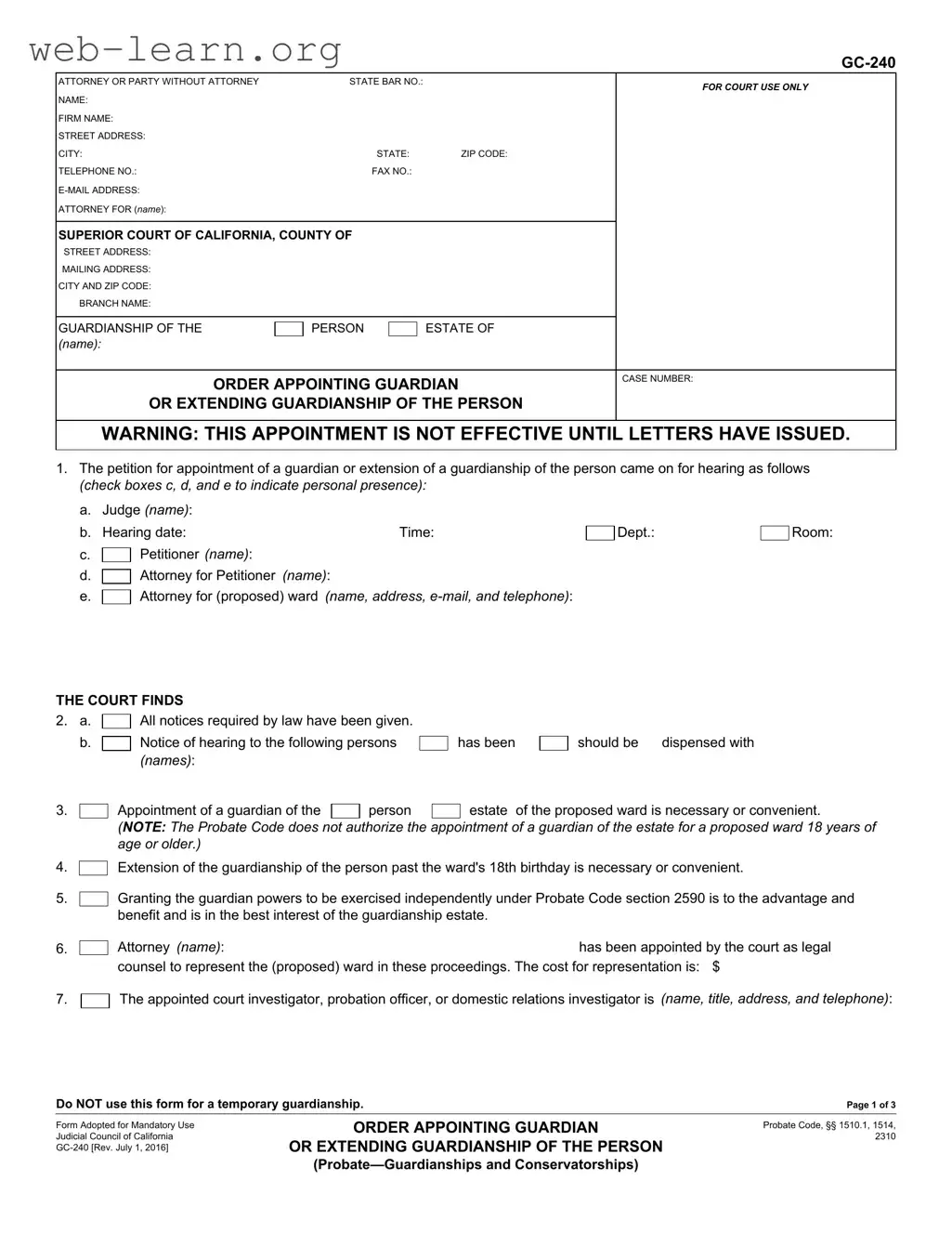
FOR COURT USE ONLY
CASE NUMBER:
ORDER APPOINTING GUARDIAN
OR EXTENDING GUARDIANSHIP OF THE PERSON
GC-240
ATTORNEY OR PARTY WITHOUT ATTORNEY
STATE: ZIP CODE:CITY:
STREET ADDRESS:
FIRM NAME:
NAME:
STATE BAR NO.:
TELEPHONE NO.: FAX NO.:
E-MAIL ADDRESS:
ATTORNEY FOR (name):
GUARDIANSHIP OF THE ESTATE OF
(name):
PERSON
SUPERIOR COURT OF CALIFORNIA, COUNTY OF
BRANCH NAME:
CITY AND ZIP CODE:
STREET ADDRESS:
MAILING ADDRESS:
WARNING: THIS APPOINTMENT IS NOT EFFECTIVE UNTIL LETTERS HAVE ISSUED.
1. The petition for appointment of a guardian or extension of a guardianship of the person came on for hearing as follows
(check boxes c, d, and e to indicate personal presence):
a.
Judge (name):
b. Hearing date: Time:
Dept.: Room:
c.
Petitioner
(name):
d.
Attorney for Petitioner
(name):
e.
(name, address, e-mail, and telephone):
THE COURT FINDS
2. a.
All notices required by law have been given.
b. Notice of hearing to the following persons
has been should be dispensed with
(names):
3. Appointment of a guardian of the person
5.
Granting the guardian powers to be exercised independently under Probate Code section 2590 is to the advantage and
benefit and is in the best interest of the guardianship estate.
6.
Attorney has been appointed by the court as legal
(name):
counsel to represent the (proposed) ward in these proceedings. The cost for representation is: $
7.
(name, title, address, and telephone):
of the proposed ward is necessary or convenient.
4.
Extension of the guardianship of the person past the ward's 18th birthday is necessary or convenient.
Do NOT use this form for a temporary guardianship.
Page 1 of 3
Form Adopted for Mandatory Use
Judicial Council of California
GC-240 [Rev. July 1, 2016]
ORDER APPOINTING GUARDIAN
OR EXTENDING GUARDIANSHIP OF THE PERSON
(Probate—Guardianships and Conservatorships)
Probate Code, §§ 1510.1, 1514,
2310
Attorney for (proposed) ward
(NOTE: The Probate Code does not authorize the appointment of a guardian of the estate for a proposed ward 18 years of
age or older.)
estate
The appointed court investigator, probation officer, or domestic relations investigator is
(specify terms, including any combination of payers):
GC-240
GUARDIANSHIP OF THE
ESTATE
(name):
PERSON
OF
CASE NUMBER:
THE COURT ORDERS
8. a.
(name):
(address): (telephone):
is appointed guardian of the PERSON of (name):
and Letters shall issue upon qualification.
b.
(name):
(address): (telephone):
is appointed guardian of the ESTATE of (name):
and Letters shall issue upon qualification.
9.
Notice of hearing to the persons named in item 2b is dispensed with.
10. a.
Bond is not required.
b. Bond is fixed at:
$
to be furnished by an authorized surety company or as otherwise provided by law.
c.
are ordered to be placed in a blocked account at (specify institution and location):
and receipts shall be filed. No withdrawals shall be made without a court order.
d.
11.
(name):
the sum of: $
forthwith
as follows
12.
13.
GC-240 [Rev. July 1, 2016]
ORDER APPOINTING GUARDIAN
OR EXTENDING GUARDIANSHIP OF THE PERSON
(Probate—Guardianships and Conservatorships)
Page 2 of 3
c.
(name):
(address): (telephone):
as guardian of the PERSON of (name):
is extended past the ward's 18th birthday and new Letters shall issue forthwith.
(Not applicable to a proposed ward 18 years of age or older.)
$
Deposits of:
Additional orders in Attachment 10c.
The guardian is not authorized to take possession of money or any other property without a specific court order.
the parents of the (proposed) ward
For legal services rendered on behalf of the (proposed) ward,
the (proposed) ward's estate shall pay to
Orders are granted relating to the powers and duties of the guardian of the person under Probate Code sections 2351–2358
as specified in Attachment 13.
The guardian of the estate is granted authorization under Probate Code section 2590 to exercise independently the powers
specified in Attachment 12
subject to the conditions provided.
The appointment of
GC-240
14.
15.
Other orders as specified in Attachment 15 are granted.
16.
(name and address):
17.
18.
Date:
JUDGE OF THE SUPERIOR COURT
SIGNATURE FOLLOWS LAST ATTACHMENT
GC-240 [Rev. July 1, 2016]
ORDER APPOINTING GUARDIAN
OR EXTENDING GUARDIANSHIP OF THE PERSON
(Probate—Guardianships and Conservatorships)
Page 3 of 3
GUARDIANSHIP OF THE
ESTATE
(name):
PERSON
OF
CASE NUMBER:
Number of pages attached:
Number of boxes checked in items 9–16:
Orders are granted relating to the conditions imposed under Probate Code section 2402 upon the guardian of the estate as
specified in Attachment 14.
The probate referee appointed is

Form Information

Fact Name Details
Form Purpose The GC-240 form is used to appoint a guardian or extend an existing guardianship for a person, particularly for minors or individuals unable to care for themselves.
Governing Law This form is governed by the California Probate Code, specifically sections 1510.1 and 1514.
Filing Requirements All necessary notices must be given before the hearing. The court may dispense with notice to certain individuals if appropriate.
Age Consideration Guardianship appointments for individuals aged 18 or older are not permitted for the estate, only for the person.
Legal Representation The court may appoint an attorney to represent the proposed ward, and the cost for this representation must be disclosed.
Bond Requirements Depending on the court's decision, a bond may be required. If so, the amount will be specified in the order.

Detailed Guide for Filling Out California Gc 240

Filling out the California GC-240 form is a critical step in the process of appointing or extending a guardianship. Once completed, this form will be submitted to the court for review and approval. It is essential to ensure that all information is accurate and complete to avoid delays in the proceedings.

  1. Begin by entering the attorney or party's information at the top of the form. Fill in the State Bar number, name, firm name, street address, city, state, ZIP code, telephone number, fax number, and email address.
  2. Indicate the name of the person you are representing as the attorney in the section labeled "Attorney for (name):".
  3. Next, provide the court information. Fill in the street address, mailing address, city, ZIP code, and branch name of the Superior Court of California where the case will be filed.
  4. In the section titled Guardianship of the Person, enter the name of the proposed ward and the case number.
  5. Proceed to the hearing details. Fill in the judge's name, hearing date, time, department, and room number. Check the boxes for the petitioner, attorney for the petitioner, and attorney for the proposed ward to indicate their presence.
  6. In the court findings section, ensure that all required notices have been given. If any notices should be dispensed with, list the names of those individuals.
  7. State whether the appointment of a guardian is necessary or convenient and if the guardianship needs to be extended past the ward's 18th birthday.
  8. Indicate the name of the attorney appointed to represent the proposed ward and the cost for their representation.
  9. Provide the name, title, address, and telephone number of the appointed court investigator, probation officer, or domestic relations investigator.
  10. Fill in the details of the guardian appointment. Include the name, address, and telephone number of the appointed guardian, ensuring that Letters will issue upon qualification.
  11. Complete the sections regarding bond requirements, including whether a bond is required, the fixed amount, and any deposits.
  12. Clearly state any additional orders or conditions related to the powers and duties of the guardian, as well as any other relevant information.
  13. Finally, sign and date the form where indicated, ensuring that all required attachments are included.

Obtain Answers on California Gc 240

  1. What is the California GC-240 form?

    The California GC-240 form is a legal document used in the probate court system. It is specifically designed for appointing a guardian for a person, or extending an existing guardianship. This form is crucial for ensuring that the rights and well-being of individuals who cannot care for themselves—often minors or individuals with disabilities—are protected.

  2. Who can file the GC-240 form?

    Any individual who wishes to become a guardian for someone else can file this form. Typically, this includes family members, close friends, or other interested parties. It's essential that the person filing has a genuine interest in the welfare of the proposed ward.

  3. What information is required on the form?

    The GC-240 form requires several pieces of information, including:

    • The names and addresses of the petitioner and the proposed guardian.
    • The name of the proposed ward.
    • The date and time of the hearing.
    • Details about any legal representation involved in the case.

    Providing accurate information is vital for the court's consideration.

  4. What happens after the form is submitted?

    Once the GC-240 form is submitted, a hearing will be scheduled. During this hearing, the court will review the petition and any evidence presented. It's important for the petitioner to attend the hearing and be prepared to answer questions about why the guardianship is necessary.

  5. Can the guardianship be extended past the ward's 18th birthday?

    Yes, the GC-240 form can be used to extend guardianship beyond the ward's 18th birthday. In such cases, the form must clearly state that the extension is necessary for the continued protection and care of the individual.

  6. What are the responsibilities of a guardian?

    A guardian has several responsibilities, including making decisions about the ward's health, education, and overall welfare. The guardian must act in the best interest of the ward, ensuring their needs are met and their rights are protected.

  7. Is there a fee associated with filing the GC-240 form?

    Yes, there may be filing fees associated with submitting the GC-240 form. These fees can vary by county. Additionally, if legal representation is involved, there may be costs for attorney services as well.

  8. What if I need to make changes to the guardianship?

    If changes to the guardianship are necessary, such as modifying the guardian's powers or responsibilities, a new petition must be filed with the court. This ensures that all changes are legally recognized and documented.

  9. Can the court appoint an attorney for the proposed ward?

    Yes, the court can appoint an attorney to represent the proposed ward during the proceedings. This attorney will advocate for the best interests of the ward, ensuring their rights are upheld throughout the guardianship process.

Common mistakes

Filling out the California GC-240 form can be a straightforward process, but several common mistakes often occur. One frequent error is neglecting to provide all required contact information. Individuals sometimes forget to include their telephone number or email address, which can hinder communication with the court. Ensuring that all contact details are accurate and complete is essential for the processing of the form.

Another common mistake involves failing to check the appropriate boxes in Section 1. This section requires specific information about the hearing, including the presence of the petitioner and attorney. Omitting this information can lead to delays or complications in the appointment process. Each box serves a purpose, and it is crucial to ensure that all relevant parties are accounted for.

Additionally, people often misinterpret the requirements for notice. In Section 2, it is important to indicate whether notice has been given or if it should be dispensed with. Misunderstanding these requirements can result in legal challenges or the need to restart the process. It is vital to review the notice requirements carefully and comply with them fully.

Errors in naming the proposed ward can also occur. The form requires accurate identification of the individual for whom guardianship is being sought. Mistakes in spelling or incorrect names can create confusion and may necessitate additional court hearings. Double-checking names against official documents can help prevent this issue.

Another mistake involves misunderstanding the age-related stipulations. The form clearly states that a guardian cannot be appointed for individuals 18 years of age or older concerning their estate. Some individuals mistakenly attempt to apply for guardianship over adults, which is not permitted. Understanding the age limits is crucial to avoid unnecessary applications.

Furthermore, applicants sometimes overlook the financial aspects of guardianship. Section 10 addresses the bond requirement and financial deposits. Failing to specify the bond amount or neglecting to mention any financial arrangements can lead to complications. It is important to be clear and thorough regarding financial obligations associated with guardianship.

Lastly, individuals may not attach necessary documentation or attachments as specified in the form. Each attachment serves to provide additional context or information that supports the application. Neglecting to include these can result in delays or even the rejection of the application. Reviewing the form's requirements for attachments is essential to ensure a complete submission.

Documents used along the form

The California GC-240 form is an important document used in guardianship proceedings. However, there are several other forms and documents that often accompany it. These documents help ensure that the process is clear, organized, and legally sound. Below is a list of some of the key forms that may be used alongside the GC-240.

  • GC-211: Petition for Appointment of Guardian - This form initiates the guardianship process. It outlines the reasons for seeking a guardian and provides necessary information about the proposed ward and the petitioner.
  • GC-120: Notice of Hearing - This document informs all interested parties about the date and time of the hearing regarding the guardianship. It ensures that everyone who has a stake in the case is aware of the proceedings.
  • GC-340: Letters of Guardianship - Once a guardian is appointed, this form serves as official documentation of the appointment. It grants the guardian legal authority to act on behalf of the ward.
  • GC-251: Consent of Proposed Guardian - This form is used to obtain the consent of the person proposed to be the guardian. It confirms that the proposed guardian agrees to take on the responsibilities involved.
  • GC-220: Declaration of Due Diligence - This document is used to show that the petitioner has made reasonable efforts to notify all necessary parties about the guardianship proceedings.
  • GC-240(A): Attachment to Order Appointing Guardian - This form provides additional information or conditions related to the guardianship that may not be included in the GC-240.
  • GC-300: Petition for Appointment of Temporary Guardian - If immediate action is needed, this form allows for the appointment of a temporary guardian until a permanent guardian can be appointed.
  • GC-400: Accounting for Guardian - This form is used by guardians to report on the financial status of the ward’s estate. It ensures transparency and accountability in managing the ward’s assets.

Understanding these forms can help navigate the guardianship process more effectively. Each document plays a specific role in ensuring that the rights and needs of the proposed ward are protected throughout the proceedings.

Similar forms

The California GC-240 form is specifically designed for the appointment or extension of guardianship for a person. However, there are several other documents that share similarities with the GC-240 form in terms of purpose, structure, and legal implications. Here are five such documents:

  • GC-210: Petition for Appointment of Guardian - This document initiates the process of appointing a guardian. Like the GC-240, it requires information about the proposed guardian and the person needing protection. Both forms ensure that the court has all necessary details before making a decision.
  • GC-251: Letters of Guardianship - Once a guardian is appointed, this document is issued to provide official recognition of the guardian's authority. Similar to the GC-240, it formalizes the relationship and grants specific powers to the guardian, ensuring that the needs of the ward are met.
  • GC-320: Report of the Guardian - This form is used by guardians to report on the status of the ward and the management of their estate. Like the GC-240, it emphasizes accountability and transparency in the guardian's actions, ensuring that the ward's best interests remain a priority.
  • GC-340: Petition for Termination of Guardianship - This document is filed when a guardian seeks to end the guardianship. It shares similarities with the GC-240 as it involves a court hearing and requires a justification for the request, ensuring that all parties are heard before a decision is made.
  • GC-600: Petition for Appointment of Conservator - This form is used when someone needs to be appointed as a conservator for an adult who cannot manage their own affairs. Like the GC-240, it involves a legal process to protect the interests of the individual, highlighting the need for oversight and care in both guardianship and conservatorship situations.

Dos and Don'ts

When filling out the California GC 240 form, it's important to follow certain guidelines to ensure accuracy and compliance. Here’s a list of what to do and what to avoid:

  • Do read the instructions carefully before starting.
  • Do fill in all required fields completely and accurately.
  • Do use clear and legible handwriting or type the information.
  • Do double-check the names and addresses for spelling errors.
  • Do sign and date the form where indicated.
  • Don't leave any required sections blank; incomplete forms may be rejected.
  • Don't use correction fluid or tape on the form; it can lead to confusion.
  • Don't forget to provide copies of the form for all interested parties.
  • Don't submit the form without confirming that all necessary attachments are included.

Misconceptions

Understanding the California GC-240 form is crucial for those involved in guardianship proceedings. However, several misconceptions persist regarding its use and implications. Below is a list of common misunderstandings:

  • The GC-240 form is only for minors. Many believe this form is exclusively for appointing guardians for individuals under 18. In fact, it can also be used to extend guardianships for individuals who are 18 years or older, though certain limitations apply.
  • Filing the GC-240 guarantees immediate guardianship. Some assume that submitting this form automatically grants guardianship. However, the appointment is not effective until letters of guardianship have been issued by the court.
  • All guardianship cases require a hearing. There is a misconception that every case necessitates a court hearing. In some instances, notice of hearing can be dispensed with, depending on the circumstances and the court's findings.
  • The form can be used for temporary guardianships. Some individuals mistakenly believe the GC-240 is suitable for temporary guardianships. This form is specifically designed for permanent guardianship appointments or extensions.
  • Guardians can access funds without restrictions. A common misunderstanding is that guardians have unrestricted access to the ward's funds. The form explicitly states that guardians cannot take possession of money or property without a specific court order.
  • Legal counsel is not necessary. Some individuals think that legal representation is optional in guardianship cases. While it is not always required, having legal counsel can significantly benefit the proposed ward and ensure proper adherence to legal procedures.
  • Guardianship of the estate is automatically included. Many believe that appointing a guardian for the person also includes guardianship of the estate. The GC-240 form distinguishes between these roles, and separate appointments may be necessary.
  • Once appointed, a guardian's powers are permanent. There is a belief that once a guardian is appointed, their powers remain unchanged indefinitely. In reality, guardianship powers can be modified or revoked by the court as circumstances evolve.

Clarifying these misconceptions is essential for anyone involved in the guardianship process in California. Understanding the proper use of the GC-240 form can help ensure that the rights and needs of the proposed ward are adequately protected.

Key takeaways

When filling out the California GC 240 form, keep these key takeaways in mind:

  • Accurate Information: Ensure all names, addresses, and contact details are correct. This includes the guardian, proposed ward, and any attorneys involved.
  • Petition Requirements: The form is specifically for appointing or extending guardianships. Do not use it for temporary guardianships.
  • Hearing Details: Clearly indicate the judge's name, hearing date, and time. This information is crucial for the court's records.
  • Notice of Hearing: Confirm that all required notices have been given. If not, you may need to request that notice be dispensed with.
  • Financial Obligations: Be aware of any costs associated with legal representation and the need for bonds. Specify amounts clearly.
  • Attachments: Include any necessary attachments that detail additional orders or conditions related to the guardianship.

Completing the GC 240 form accurately and thoroughly will help streamline the guardianship process. Double-check your entries to avoid delays.