Homepage Blank California Gc 111 Form
Outline

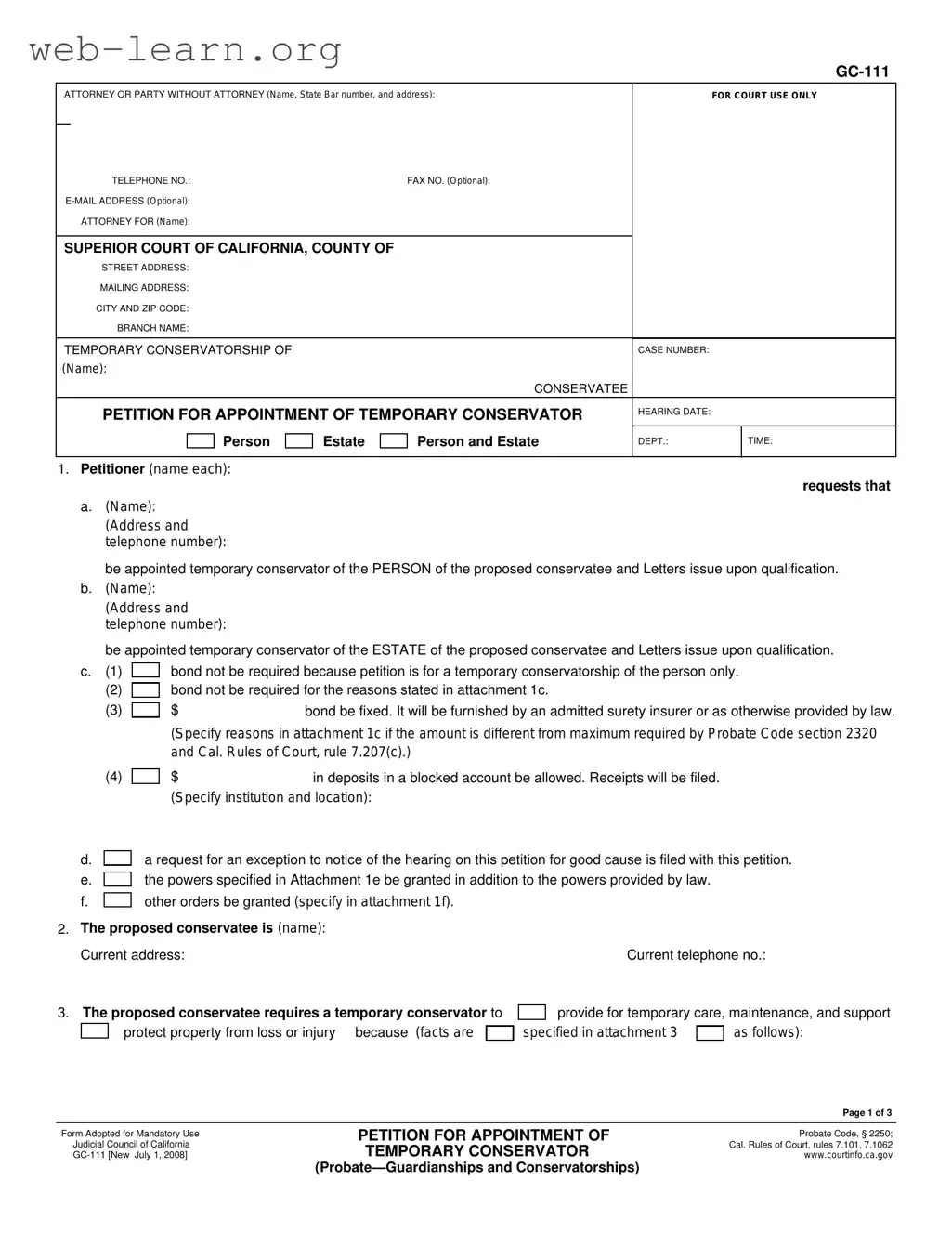
The California GC 111 form is a crucial document used in the process of appointing a temporary conservator for individuals who may be unable to care for themselves or manage their financial affairs. This form serves multiple purposes, allowing petitioners to request the appointment of a temporary conservator for either the person, the estate, or both. It outlines essential details, including the names and contact information of the petitioner and proposed conservator, as well as the reasons necessitating the temporary conservatorship. The form also addresses the financial aspects of the conservatorship, such as the requirement for a bond and the estimated value of the conservatee's property. Furthermore, the GC 111 includes sections for detailing the proposed conservatee's current situation, any necessary medical treatment, and the petitioner's relationship to the conservatee. The form requires the inclusion of attachments that provide additional context and justification for the requests made. Overall, the GC 111 is designed to ensure that the needs of the proposed conservatee are met promptly and effectively while adhering to California's legal standards.


Sample - California Gc 111 Form

GC-111
FOR COURT USE ONLY
SUPERIOR COURT OF CALIFORNIA, COUNTY OF
CONSERVATEE
CASE NUMBER:
Person Estate
requests that
Petitioner (name each):
(Name):
bond be fixed. It will be furnished by an admitted surety insurer or as otherwise provided by law.
$
(Specify reasons in attachment 1c if the amount is different from maximum required by Probate Code section 2320
and Cal. Rules of Court, rule 7.207(c).)
(3)
$
(Specify institution and location):
e. the powers specified in Attachment 1e be granted in addition to the powers provided by law.
d. a request for an exception to notice of the hearing on this petition for good cause is filed with this petition.
f.
Current telephone no.:Current address:
as follows):specified in attachment 3
Probate Code, § 2250;
Cal. Rules of Court, rules 7.101, 7.1062
www.courtinfo.ca.gov
PETITION FOR APPOINTMENT OF
TEMPORARY CONSERVATOR
(Probate—Guardianships and Conservatorships)
Form Adopted for Mandatory Use
Judicial Council of California
GC-111 [New July 1, 2008]
(Name):
in deposits in a blocked account be allowed. Receipts will be filed.
ATTORNEY OR PARTY WITHOUT ATTORNEY (Name, State Bar number, and address):
FAX NO. (Optional):TELEPHONE NO.:
E-MAIL ADDRESS (Optional):
ATTORNEY FOR (Name):
Page 1 of 3
a.
1.
b.
c.
bond not be required because petition is for a temporary conservatorship of the person only.
bond not be required for the reasons stated in attachment 1c.
(1)
(2)
(4)
other orders be granted (specify in attachment 1f).
2.
3.
STREET ADDRESS:
MAILING ADDRESS:
CITY AND ZIP CODE:
BRANCH NAME:
(Address and
telephone number):
(Address and
telephone number):
PETITION FOR APPOINTMENT OF TEMPORARY CONSERVATOR
TEMPORARY CONSERVATORSHIP OF
(Name):
be appointed temporary conservator of the PERSON of the proposed conservatee and Letters issue upon qualification.
be appointed temporary conservator of the ESTATE of the proposed conservatee and Letters issue upon qualification.
HEARING DATE:
DEPT.:
TIME:
The proposed conservatee is (name):
The proposed conservatee requires a temporary conservator to provide for temporary care, maintenance, and support
protect property from loss or injury because (facts are
Person and Estate
CASE NUMBER:
CONSERVATEE
a.
b.
c.
Character and estimated value of the property of the estate (complete if a temporary conservatorship of the estate or the
person and estate is requested):
Petitioner requests authority to change the proposed conservatee's residence during the temporary conservatorship
a. Petitioner proposes to change the residence of the proposed conservatee to (address):
The proposed conservatee will suffer irreparable harm if his or her residence is not changed as requested and no means
less restrictive of the proposed conservatee's liberty will suffice to prevent the harm because (reasons are
specified in attachment 6a as follows):
The proposed conservatee must be removed from the State of California to permit the performance of the following
nonpsychiatric medical treatment essential to the proposed conservatee's physical survival. The proposed conservatee
b.
as follows):specified in attachment 6bconsents to this medical treatment. (Facts and place of treatment are
Petitioner is a professional fiduciary
GC-111 [New July 1, 2008]
PETITION FOR APPOINTMENT OF
TEMPORARY CONSERVATOR
(Probate—Guardianships and Conservatorships)
Page 2 of 3
pending the appeal under Probate Code section 1301.
GC-111
4.
5.
Annual gross income from all sources, including real and
personal property, wages, pensions, and public benefits:
a.
b.
Personal property:
c.
Total:
6.
7.
$
Temporary conservatorship is required
pending the hearing on the petition for appointment of a general conservator.
during the suspension of powers of the conservator.
TEMPORARY CONSERVATORSHIP OF
(Name):
b.
Petitioner holds license no. (specify):
of Consumer Affairs issued or last renewed on (specify later date of initial issuance or renewal):
from the Professional Fiduciaries Bureau of the Department
.
Petitioner was requested to file this petition by (name):
.
The circumstances leading to petitioner's engagement to file this petition are described in attachment 7c.
Petitioner had:
c.
d.
No relationship to the proposed conservatee, his or her family, or his or her friends before
engagement to file this petition.
(1)
(2) A relationship to the proposed conservatee, his or her family, or his or her friends before
engagement to file this petition. That relationship is described in
attachment 7d.
Petition for Appointment of Probate Conservator (form GC-310) filed with this petition or an
attachment to that petition (specify attachment to general petition):
the
a.
d.
Additional amount for cost of recovery on the bond, calculated as
required under Cal. Rules of Court, rule 7.207(c):
$
$
$
CASE NUMBER:
CONSERVATEE
Petitioner is informed and believes that the proposed conservatee
a.
b.
is unable to attend the hearing because of medical inability. An affidavit or certificate of a licensed medical
practitioner or an accredited religious practitioner is affixed as attachment 9c.
c.
d.
Filed with this petition is a proposed Order Appointing Court Investigator (form GC-330).
10.
Date:
* (Signature of all petitioners also required (Prob. Code, § 1020).)
(SIGNATURE OF ATTORNEY*)
I declare under penalty of perjury under the laws of the State of California that the foregoing is true and correct.
Date:
(TYPE OR PRINT NAME)
(SIGNATURE OF PETITIONER)
(TYPE OR PRINT NAME)
(SIGNATURE OF PETITIONER)
GC-111 [New July 1, 2008]
PETITION FOR APPOINTMENT OF
TEMPORARY CONSERVATOR
(Probate—Guardianships and Conservatorships)
Page 3 of 3
GC-111
9.
is able but unwilling to attend the hearing, does not wish to contest the establishment of a conservatorship, does not
object to the proposed conservator, and does not prefer that another person act as conservator.
will attend the hearing.
is not the petitioner, is out of state, and will not attend the hearing.
11.
All attachments to this form are incorporated by this reference as though placed here in this form. There are
attached to this form.
pages
TEMPORARY CONSERVATORSHIP OF
(Name):
8.
Petitioner's contact with persons named in Petition for Appointment of Probate Conservator
Petitioner is not the proposed conservatee. Facts showing the preferences of the proposed conservatee concerning the
appointment of any temporary conservator, and the appointment of the temporary conservator proposed in this petition,
or why it was not feasible to ascertain those preferences, are specified in one or more declarations attached to this
petition as attachment 8c.
c.
b. Petitioner is not the proposed conservatee. All persons other than the proposed conservatee named in the Petition for
Appointment of Probate Conservator filed with this petition:
(1) Have been found and contacted. All will be given notice of the hearing on this petition.
(2)
Have not been found or have not been contacted. Efforts to find the persons who have not been found and
the reasons why any person cannot be contacted are described in one or more declarations under penalty of
perjury attached to this petition as attachment 8b. (Attachment 8b is not a request for a good cause exception
to notice. See Prob. Code, § 2250(e) and rule 7.1062 of the Cal. Rules of Court.)
a.
Petitioner is the proposed conservatee. (If this item is selected, go to item 9.)

Form Information

Fact Name Description
Form Purpose The GC-111 form is used to petition for the appointment of a temporary conservator for an individual who is unable to care for themselves or their estate.
Governing Law This form is governed by California Probate Code, § 2250 and the California Rules of Court, rules 7.101 and 7.1062.
Filing Requirements Petitioners must provide their name, address, and contact information, along with details about the proposed conservatee.
Temporary Nature The conservatorship is temporary and is intended to protect the proposed conservatee until a general conservatorship can be established.
Bond Requirements Depending on the circumstances, a bond may not be required, or it may need to be specified in the petition.
Hearing Date A hearing date must be set and included in the petition for the court to review the request.
Proposed Conservatee The form requires detailed information about the proposed conservatee, including their current address and reasons for needing a conservator.
Attachments Various attachments may be required to support the petition, including declarations and proposed orders.
Petitioner’s Role The petitioner can be an attorney or a party without an attorney, and must sign the form to validate the petition.
Confidentiality Information provided in the petition is sensitive and should be handled with care to protect the proposed conservatee's privacy.

Detailed Guide for Filling Out California Gc 111

Filling out the California GC 111 form is an important step in the process of appointing a temporary conservator. This form requires specific information about the proposed conservatee and the reasons for needing a temporary conservator. Once completed, the form should be submitted to the appropriate court for review and consideration.

  1. Begin by entering the name, State Bar number, and address of the attorney or party filling out the form at the top section.
  2. Provide the telephone number, fax number (if applicable), and email address (optional).
  3. Indicate the name of the attorney representing the petitioner.
  4. Fill in the name of the proposed conservatee and the case number.
  5. Complete the court's address, including street address, city, and zip code.
  6. Specify the branch name of the Superior Court of California.
  7. Check the appropriate box for the type of temporary conservatorship being requested: Person, Estate, or both.
  8. List the names and contact information of the petitioners requesting the appointment of a temporary conservator.
  9. Indicate whether a bond is required and provide details if applicable, including reasons for any exceptions.
  10. Describe the proposed conservatee, including their current address and telephone number.
  11. State the reasons why a temporary conservator is needed, including any specific facts that support the request.
  12. Provide details about the character and estimated value of the proposed conservatee’s property, including personal property and annual gross income.
  13. Indicate if authority is requested to change the proposed conservatee's residence and provide the new address.
  14. If applicable, mention any medical treatment that requires the proposed conservatee to be removed from California.
  15. State whether the petitioner is a professional fiduciary and provide relevant license details.
  16. Discuss the petitioner's contact with other persons named in the Petition for Appointment of Probate Conservator.
  17. Indicate the proposed conservatee's ability to attend the hearing and provide any necessary documentation.
  18. Attach the proposed Order Appointing Court Investigator (form GC-330) with the petition.
  19. Sign and date the form, ensuring that all petitioners also sign where required.

Obtain Answers on California Gc 111

  1. What is the purpose of the California GC 111 form?

    The GC 111 form is used to petition the court for the appointment of a temporary conservator for an individual, known as the proposed conservatee. This form allows the petitioner to request temporary authority to manage the personal or estate affairs of the proposed conservatee when they are unable to do so themselves.

  2. Who can file a GC 111 form?

    Any individual or professional fiduciary who has a legitimate interest in the welfare of the proposed conservatee can file the GC 111 form. This includes family members, friends, or professionals who have been engaged to assist the proposed conservatee.

  3. What information is required on the GC 111 form?

    The form requires detailed information about the petitioner, the proposed conservatee, and the reasons for requesting a temporary conservatorship. This includes:

    • The names and addresses of the petitioner and proposed conservatee.
    • The reasons the proposed conservatee requires a temporary conservator.
    • Details about the property and assets involved.
  4. Is a bond required for a temporary conservatorship?

    A bond may be required depending on the circumstances. The petitioner can request that no bond be required if the petition is for the person only or specify an amount if it is for the estate. Reasons for any bond exceptions should be included in the attachments.

  5. What happens after the GC 111 form is filed?

    Once the GC 111 form is filed, the court will set a hearing date. Notice of the hearing must be given to all interested parties, unless an exception is granted for good cause. The court will then review the petition and determine whether to appoint a temporary conservator.

  6. Can the proposed conservatee's residence be changed during the temporary conservatorship?

    Yes, the petitioner can request authority to change the proposed conservatee's residence. The petition must include reasons why the change is necessary and how it will benefit the proposed conservatee.

  7. What if the proposed conservatee cannot attend the hearing?

    If the proposed conservatee is unable to attend the hearing due to medical reasons or other circumstances, the petitioner must provide documentation, such as a medical affidavit, explaining the situation. This information should be included in the attachments to the petition.

  8. How long does a temporary conservatorship last?

    A temporary conservatorship generally lasts until the court holds a hearing on the petition for a general conservatorship or until the court determines that it is no longer necessary. The specific duration will depend on the circumstances and the court's decision.

  9. What should be included in the attachments to the GC 111 form?

    Attachments should provide additional details supporting the petition. This can include:

    • Reasons for the temporary conservatorship.
    • Financial information regarding the proposed conservatee's estate.
    • Any relevant medical documentation.

Common mistakes

Filling out the California GC-111 form can be a daunting task, and many people make common mistakes that can delay the process. One frequent error is neglecting to provide complete contact information. Incomplete addresses or missing phone numbers can hinder communication with the court and other parties involved. Ensuring that all sections are filled out accurately is crucial for a smooth application process.

Another common mistake is failing to specify the reasons for requesting a bond waiver. If you believe a bond is not necessary, you must clearly outline your reasons in the designated attachment. Without this information, the court may deny your request, which can prolong the proceedings.

Some individuals overlook the importance of detailing the proposed conservatee’s needs. Inadequate explanations regarding why a temporary conservatorship is required can lead to confusion or rejection of the petition. It's essential to provide clear, factual information about the proposed conservatee's circumstances to justify the need for a conservator.

Many applicants also forget to include all necessary attachments. The GC-111 form references several attachments that must accompany the petition. Missing these documents can result in delays or even dismissal of the application. Always double-check to ensure that all required paperwork is included before submission.

Another mistake involves the misunderstanding of the proposed conservatee's preferences. If you are unable to ascertain their preferences, this must be clearly stated in the petition. Failing to address this can raise concerns and potentially complicate the approval process.

Some people mistakenly believe that the court will automatically grant the request for a temporary conservatorship without sufficient evidence. It is vital to provide compelling reasons and documentation to support your request. Courts take these matters seriously and require substantial justification.

Additionally, not being aware of the timeline can lead to issues. Each step in the process has specific deadlines, and missing these can result in delays. Familiarizing yourself with the timeline will help you stay on track and ensure that your petition is heard promptly.

Another frequent oversight is the lack of proper signatures. All petitioners must sign the form, and if any signatures are missing, the petition may be rejected. This simple step is often overlooked but is essential for the validity of the form.

Lastly, individuals sometimes underestimate the importance of clarity and organization in their responses. Clear and concise language helps convey your message effectively. Disorganized or vague responses can lead to misunderstandings and complications in the approval process.

By being aware of these common mistakes and taking steps to avoid them, individuals can enhance their chances of successfully navigating the temporary conservatorship process in California.

Documents used along the form

The California GC-111 form is an essential document used in the process of establishing a temporary conservatorship. However, it is often accompanied by several other forms and documents that help provide a comprehensive picture of the situation. Below is a list of related documents frequently utilized alongside the GC-111.

  • GC-310: Petition for Appointment of Probate Conservator - This form is used to request the appointment of a general conservator for an individual who is unable to manage their personal or financial affairs. It outlines the reasons for the conservatorship and details about the proposed conservator.
  • GC-330: Order Appointing Court Investigator - This document requests the court to assign an investigator to assess the proposed conservatee’s situation and the appropriateness of the conservatorship. The investigator reports back to the court with findings.
  • GC-320: Notice of Hearing - This form notifies interested parties about the hearing date regarding the conservatorship petition. It ensures that all relevant individuals have the opportunity to attend and voice any concerns.
  • GC-211: Capacity Declaration - This declaration is completed by a qualified professional, such as a doctor, to assess and confirm the proposed conservatee's mental and physical capacity. It serves as critical evidence in the conservatorship process.
  • GC-140: Letters of Conservatorship - Once a conservator is appointed, this document officially grants them the legal authority to act on behalf of the conservatee. It outlines the scope of the conservator's powers.
  • GC-400: Petition for Appointment of Guardian - In cases where a minor is involved, this petition is used to seek guardianship instead of conservatorship. It provides an alternative for protecting the interests of minors.
  • GC-200: Notice of Proposed Action - This form is used by the conservator to inform interested parties about any significant decisions or actions they plan to take regarding the conservatee’s estate or personal matters.
  • GC-400(P): Petition for Termination of Conservatorship - If circumstances change and the conservatorship is no longer needed, this petition is filed to request the court to terminate the conservatorship and restore the conservatee's rights.

These forms and documents work together to ensure that the process of establishing a temporary conservatorship is thorough and legally sound. Each document plays a specific role in protecting the rights and interests of the proposed conservatee while facilitating the court's decision-making process.

Similar forms

  • GC-310: Petition for Appointment of Probate Conservator - This form initiates the process for appointing a general conservator, similar to GC-111, which seeks a temporary conservator. Both documents require details about the proposed conservatee and the reasons for the appointment.
  • GC-330: Order Appointing Court Investigator - This form is filed alongside GC-111 and serves to appoint a court investigator. It ensures that the conservatorship is in the best interest of the proposed conservatee, much like how GC-111 seeks immediate protection for the conservatee.
  • GC-120: Notice of Hearing - This document provides notice of the hearing date for the conservatorship petition. Like GC-111, it is essential for ensuring that interested parties are informed and can participate in the proceedings.
  • GC-140: Letters of Conservatorship - Once a conservator is appointed, this form grants the conservator authority to act on behalf of the conservatee. Both GC-111 and GC-140 are critical in establishing legal authority over the conservatee's person or estate.
  • GC-200: Petition for Appointment of Guardian - While focused on guardianship rather than conservatorship, GC-200 shares similarities with GC-111 in that both petitions address the need for a protective arrangement for individuals unable to care for themselves.

Dos and Don'ts

When filling out the California GC-111 form, it's essential to approach the process with care. Here are some key dos and don'ts to keep in mind:

  • Do read the entire form thoroughly before starting.
  • Do provide accurate and complete information for all required fields.
  • Do ensure that all attachments are included and referenced correctly.
  • Do double-check for any spelling or typographical errors.
  • Don't leave any required sections blank; this can delay the process.
  • Don't use legal jargon or complex language; keep it simple and clear.
  • Don't forget to sign and date the form where indicated.
  • Don't submit the form without making copies for your records.

By following these guidelines, you can help ensure that your petition is processed smoothly and efficiently.

Misconceptions

  • Misconception 1: The GC-111 form is only for permanent conservatorships.
  • This form is specifically designed for temporary conservatorships. It allows for immediate protection of a person's or estate's interests until a more permanent solution is established.

  • Misconception 2: You need an attorney to file the GC-111 form.
  • While having an attorney can be beneficial, individuals can file the form on their own. It is important to ensure that all information is filled out correctly.

  • Misconception 3: The GC-111 form is only for financial matters.
  • This form can address both personal and estate matters. It provides a means to appoint a temporary conservator for the person, the estate, or both.

  • Misconception 4: Filing the GC-111 guarantees the appointment of a conservator.
  • Filing the form initiates the process, but the court must still review the petition and hold a hearing before making a decision.

  • Misconception 5: A bond is always required when filing the GC-111.
  • In certain cases, such as when only a temporary conservatorship of the person is requested, a bond may not be necessary. This can be specified in the form.

  • Misconception 6: The proposed conservatee has no say in the process.
  • The proposed conservatee's preferences and situation must be considered. The form includes sections to address their wishes and ability to participate in the hearing.

  • Misconception 7: The GC-111 form is only for elderly individuals.
  • This form can be used for any individual who requires a temporary conservator, regardless of age. It is applicable in various situations where protection is needed.

  • Misconception 8: You cannot make changes to the proposed conservatee's living situation.
  • The form allows for requests to change the proposed conservatee's residence if it is necessary for their well-being or medical treatment.

  • Misconception 9: All attachments are optional when filing the GC-111.
  • Attachments are often necessary to provide additional context and support for the petition. They help the court understand the situation better.

Key takeaways

When filling out the California GC-111 form, several important considerations should be kept in mind. This form is used to petition for the appointment of a temporary conservator for an individual who is unable to manage their own affairs.

  • Identify the Proposed Conservatee: Clearly provide the name and current address of the proposed conservatee. This information is crucial for the court to understand who will be affected by the conservatorship.
  • Specify the Type of Conservatorship: Indicate whether the petition is for a conservatorship of the person, the estate, or both. This distinction will guide the court in determining the necessary authority and responsibilities of the conservator.
  • Provide Justification for Temporary Conservatorship: Clearly outline the reasons why a temporary conservatorship is necessary. This may include the need for immediate protection of the conservatee’s assets or care.
  • Include Financial Information: Disclose details about the proposed conservatee’s financial situation, including personal property and annual income. This information helps the court assess the conservatorship's scope and requirements.
  • Attachments are Essential: Ensure all relevant attachments are included with the petition. These may provide additional context, such as declarations regarding the conservatee’s preferences or medical condition.

Completing the GC-111 form accurately and thoroughly is essential for a successful petition. The information provided will influence the court's decision regarding the appointment of a temporary conservator.