Homepage Blank California Gc 110 Form
Outline

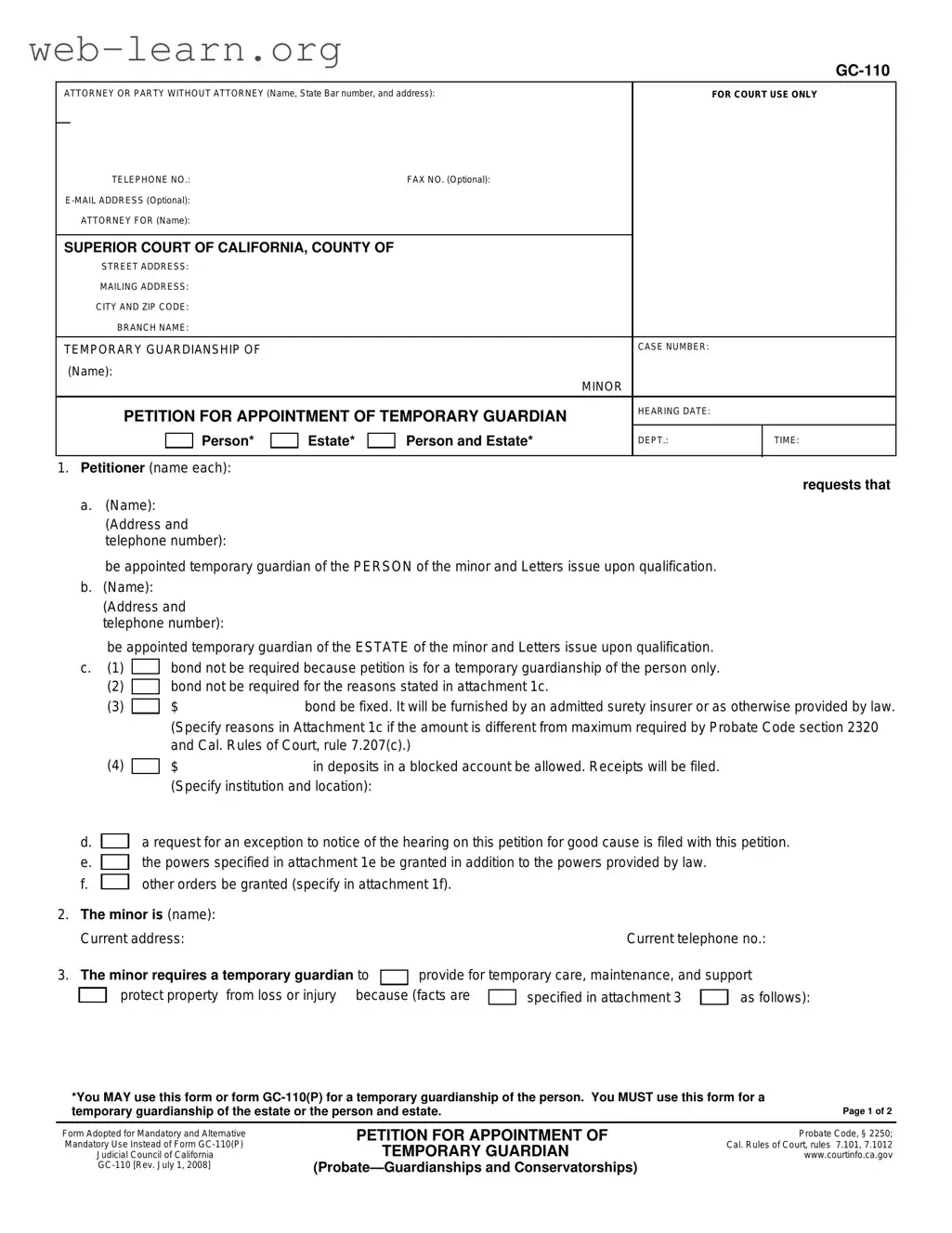
The California GC 110 form serves as a crucial legal document for individuals seeking temporary guardianship over a minor. This form is primarily utilized to petition the court for the appointment of a temporary guardian, ensuring that the minor receives necessary care and protection. Within its structured format, the form requires detailed information about the petitioner, the minor, and the specific reasons necessitating the guardianship. It outlines whether the guardianship pertains to the minor's person, estate, or both, allowing for flexibility based on individual circumstances. Additionally, the form addresses the potential need for a bond, which may or may not be required, depending on the nature of the guardianship being sought. The petitioner must provide supporting facts that justify the request, emphasizing the minor's need for immediate assistance. Furthermore, the form incorporates provisions for any additional powers the temporary guardian may require and allows for exceptions to standard notice requirements. By clearly delineating these elements, the GC 110 form facilitates a streamlined process for securing the well-being of minors during times of uncertainty.


Sample - California Gc 110 Form

GC-110
FOR COURT USE ONLY
SUPERIOR COURT OF CALIFORNIA, COUNTY OF
MINOR
CASE NUMBER:
Person* Estate*
requests that
Petitioner (name each):
(Name):
bond be fixed. It will be furnished by an admitted surety insurer or as otherwise provided by law.$
(Specify reasons in Attachment 1c if the amount is different from maximum required by Probate Code section 2320
and Cal. Rules of Court, rule 7.207(c).)
(3)
$
(Specify institution and location):
Current telephone no.:Current address:
provide for temporary care, maintenance, and support
as follows):specified in attachment 3
Probate Code, § 2250;
Cal. Rules of Court, rules 7.101, 7.1012
www.courtinfo.ca.gov
PETITION FOR APPOINTMENT OF
TEMPORARY GUARDIAN
(Probate—Guardianships and Conservatorships)
Form Adopted for Mandatory and Alternative
Mandatory Use Instead of Form GC-110(P)
Judicial Council of California
GC-110 [Rev. July 1, 2008]
(Name):
in deposits in a blocked account be allowed. Receipts will be filed.
ATTORNEY OR PARTY WITHOUT ATTORNEY (Name, State Bar number, and address):
FAX NO. (Optional):TELEPHONE NO.:
E-MAIL ADDRESS (Optional):
ATTORNEY FOR (Name):
Page 1 of 2
a.
1.
b.
c.
bond not be required because petition is for a temporary guardianship of the person only.
bond not be required for the reasons stated in attachment 1c.
(1)
(2)
(4)
2.
3.
STREET ADDRESS:
MAILING ADDRESS:
CITY AND ZIP CODE:
BRANCH NAME:
(Address and
telephone number):
(Address and
telephone number):
*You MAY use this form or form GC-110(P) for a temporary guardianship of the person. You MUST use this form for a
temporary guardianship of the estate or the person and estate.
(Name):
TEMPORARY GUARDIANSHIP OF
PETITION FOR APPOINTMENT OF TEMPORARY GUARDIAN
HEARING DATE:
DEPT.:
TIME:
be appointed temporary guardian of the PERSON of the minor and Letters issue upon qualification.
be appointed temporary guardian of the ESTATE of the minor and Letters issue upon qualification.
e. the powers specified in attachment 1e be granted in addition to the powers provided by law.
d. a request for an exception to notice of the hearing on this petition for good cause is filed with this petition.
f.
other orders be granted (specify in attachment 1f).
The minor is (name):
The minor requires a temporary guardian to
Person and Estate*
protect property from loss or injury because (facts are
CASE NUMBER:
MINOR
a.
b.
c.
Character and estimated value of the property of the estate (complete if a temporary guardianship of the estate or
person and estate is requested):
will will not attend the hearing.
Date:
* (Signature of all petitioners also required (Prob. Code, § 1020).)
(SIGNATURE OF ATTORNEY*)
I declare under penalty of perjury under the laws of the State of California that the foregoing is true and correct.
Date:
(TYPE OR PRINT NAME)
(SIGNATURE OF PETITIONER)
(TYPE OR PRINT NAME)
(SIGNATURE OF PETITIONER)
GC-110 [Rev. July 1, 2008]
PETITION FOR APPOINTMENT OF
TEMPORARY GUARDIAN
(Probate—Guardianships and Conservatorships)
Page 2 of 2
pending the appeal under Probate Code section 1301.
GC-110
4.
5.
Annual gross income from all sources, including real and
personal property, wages, pensions, and public benefits:
a.
b.
Personal property:
c.
Total:
6.
7.
$
$
$
$
All attachments to this form are incorporated by this reference as though placed here in this form. There are
attached to this form.
pages
Temporary guardianship is required
pending the hearing on the petition for appointment of a general guardian.
during the suspension of powers of the guardian.
(Name):
TEMPORARY GUARDIANSHIP OF
Petitioner believes the minor
3. (Facts supporting appointment of a temporary guardian (continued)):
d.
Additional amount for cost of recovery on the bond, calculated
as required under Cal. Rules of Court, rule 7.207(c):

Form Information

Fact Name Description
Form Purpose The GC-110 form is used to petition for the appointment of a temporary guardian for a minor's person, estate, or both.
Governing Laws This form is governed by the California Probate Code, specifically section 2250, and California Rules of Court, rules 7.101 and 7.1012.
Attachments Requirement All attachments submitted with the GC-110 form are considered part of the petition and must be referenced within the form.
Signature Requirement Both the attorney and all petitioners must sign the form, as required by California Probate Code section 1020.

Detailed Guide for Filling Out California Gc 110

Filling out the California GC-110 form is an important step in the process of appointing a temporary guardian for a minor. Once completed, this form will need to be submitted to the appropriate court. Follow these steps carefully to ensure all necessary information is provided.

  1. At the top of the form, fill in the name of the attorney or party without an attorney, along with the State Bar number and address.
  2. Provide the telephone number, optional fax number, and optional email address.
  3. Indicate the name of the attorney for the case, if applicable.
  4. Fill in the street address, mailing address, city, and zip code of the Superior Court of California, County of.
  5. Write the branch name and case number.
  6. Specify the name of the minor for whom the temporary guardianship is being requested.
  7. Indicate the hearing date, department, and time for the case.
  8. In the section for the petitioner, list the names of each petitioner requesting the guardianship.
  9. Choose whether the request is for the person, estate, or both of the minor.
  10. Decide if a bond is required and indicate the reasons for your choice in attachment 1c.
  11. If applicable, provide details about any deposits in a blocked account.
  12. State if a request for an exception to notice of the hearing is included.
  13. List any additional powers or orders requested in attachments 1e and 1f.
  14. Fill in the current address and telephone number of the minor.
  15. Provide facts supporting the need for a temporary guardian in attachment 3.
  16. Explain why the temporary guardianship is required, including any pending hearings or appeals.
  17. Complete the section regarding the character and estimated value of the property if applicable.
  18. Indicate whether the minor will attend the hearing.
  19. Attach any necessary documents and ensure they are referenced in the form.
  20. Finally, sign and date the form, ensuring all petitioners also sign as required.

Obtain Answers on California Gc 110

  1. What is the purpose of the California GC 110 form?

    The California GC 110 form is used to petition for the appointment of a temporary guardian for a minor. This form allows individuals to request that the court appoint a temporary guardian to provide care, maintenance, and support for a minor when immediate action is necessary. It may also be used to protect the minor's property from loss or injury.

  2. Who can file the GC 110 form?

    Any interested party, such as a relative or close family friend of the minor, can file the GC 110 form. This person is referred to as the petitioner. The petitioner must provide their name, contact information, and the reasons why a temporary guardian is needed. It is essential that the petitioner demonstrates a clear need for guardianship to protect the minor's welfare.

  3. What information must be included in the GC 110 form?

    The GC 110 form requires several key pieces of information:

    • The name and contact information of the petitioner.
    • The name of the minor who requires a guardian.
    • Details about the minor's current situation and why a temporary guardian is necessary.
    • Information regarding the minor's property, if applicable, including its estimated value.
    • Any specific powers requested for the temporary guardian, which should be detailed in attachments.

    Providing complete and accurate information is crucial, as it helps the court make an informed decision regarding the appointment of a temporary guardian.

  4. What happens after the GC 110 form is submitted?

    Once the GC 110 form is submitted, the court will schedule a hearing to review the petition. During this hearing, the petitioner must present their case for why a temporary guardian is necessary. The court will consider the information provided in the form and any attachments before making a decision. If the court grants the petition, the appointed temporary guardian will have the authority to act in the best interests of the minor until a more permanent solution is established.

Common mistakes

Filling out the California GC-110 form can be a complex process, and mistakes can lead to delays or complications in obtaining temporary guardianship. One common mistake is failing to provide complete contact information for all parties involved. The form requires names, addresses, and telephone numbers for the petitioner and the proposed guardian. Incomplete information can hinder the court's ability to contact relevant parties.

Another frequent error is neglecting to specify the reasons for requesting a bond exemption. Section 1c of the form allows for a bond to be waived under certain conditions. However, if the petitioner does not clearly articulate these reasons in Attachment 1c, the court may require a bond, which could complicate the process and delay the appointment of the temporary guardian.

Many individuals also overlook the importance of including all necessary attachments. The form explicitly states that all attachments are incorporated by reference. If a petitioner fails to attach crucial documents, such as evidence supporting the need for guardianship or the minor’s current situation, the court may not have enough information to make an informed decision.

Additionally, some people mistakenly believe that the form can be submitted without signatures from all petitioners. The law requires the signature of every petitioner listed on the form. Omitting a signature can result in the court rejecting the petition, causing further delays in the process.

Lastly, misinterpreting the requirements for the type of guardianship being requested can lead to errors. The GC-110 form is specifically for temporary guardianship of the estate or both the person and estate. If a petitioner mistakenly uses this form for a situation that only requires guardianship of the person, it could result in unnecessary complications. Understanding the distinctions between the forms is essential for a smooth application process.

Documents used along the form

When navigating the process of establishing a temporary guardianship in California, several other forms and documents may be required alongside the California GC-110 form. Each of these documents serves a specific purpose to ensure the proper handling of the case. Below is a list of commonly used forms in conjunction with the GC-110.

  • GC-110(P): This form is an alternative petition for temporary guardianship of the person. It is used when the petitioner seeks guardianship solely for the minor’s personal care and not for their estate.
  • GC-020: This is the "Petition for Appointment of Guardian" form, which is used for requesting the appointment of a general guardian, as opposed to a temporary one.
  • GC-210: This form is used to report the status of the guardianship. It provides updates on the minor’s well-being and the guardian's actions during the guardianship period.
  • GC-212: This is the "Order Appointing Guardian" form. It officially grants the guardian their powers and responsibilities after the court's approval.
  • GC-030: This form is used to request a change in the guardianship arrangement, including changes to the guardian or the scope of their authority.
  • GC-040: This document is a "Notice of Hearing" form, which informs interested parties of the upcoming court hearing regarding the guardianship petition.
  • GC-050: This is the "Confidential Guardian Screening Form." It collects personal information about the proposed guardian to ensure their suitability for the role.
  • GC-140: This is the "Petition for Termination of Guardianship" form. It is used when a guardian wishes to end the guardianship arrangement, either voluntarily or due to a change in circumstances.

Understanding these additional forms can help streamline the process and ensure that all necessary information is submitted to the court. Each document plays a crucial role in protecting the minor's best interests and facilitating the guardianship process.

Similar forms

  • GC-110(P) - Petition for Appointment of Temporary Guardian of the Person: This form serves a similar purpose as the GC-110 but is specifically for appointing a temporary guardian solely for the minor's personal care, rather than their estate.

  • GC-120 - Petition for Appointment of General Guardian: While the GC-110 is for temporary guardianship, the GC-120 is used for seeking a permanent guardianship, providing a more comprehensive approach to the minor's care and estate management.

  • GC-140 - Order Appointing Guardian: This document is issued by the court after approving a guardianship petition, similar to the GC-110 in that it formalizes the guardian's role and responsibilities.

  • GC-150 - Letters of Guardianship: Once a guardian is appointed, this form provides official documentation of the guardian's authority, paralleling the GC-110 in its function of establishing legal guardianship.

  • GC-211 - Petition for Appointment of Conservator: This form is for individuals seeking to appoint a conservator for an adult, similar to how the GC-110 addresses the needs of minors, focusing on care and support.

  • GC-310 - Petition for Appointment of Guardian of the Estate: This form is specifically for cases where a guardian is needed for the estate of a minor, akin to the estate provisions in the GC-110.

  • GC-200 - Notice of Hearing: This document informs interested parties about the upcoming hearing related to guardianship petitions, similar to the notification aspects present in the GC-110 process.

  • GC-370 - Report of Guardian: After a guardian is appointed, this form is used for reporting on the guardian's actions and the welfare of the minor, reflecting the ongoing responsibilities outlined in the GC-110.

  • GC-220 - Petition for Modification of Guardianship: If circumstances change, this form allows for modifications to the guardianship arrangement, similar to how the GC-110 can initiate a temporary guardianship.

  • GC-400 - Petition for Termination of Guardianship: This document is used to formally end a guardianship, providing a closure process that relates to the initiation of guardianship seen in the GC-110.

Dos and Don'ts

When filling out the California GC-110 form, there are several important dos and don’ts to keep in mind. This form is crucial for petitioning for the appointment of a temporary guardian for a minor. Ensuring accuracy and completeness can make a significant difference in the process.

  • Do double-check all personal information. Ensure the names, addresses, and contact details are correct. This helps avoid delays.
  • Do provide clear reasons for the guardianship. Be specific about why the minor needs a temporary guardian. This information is vital for the court's understanding.
  • Do attach all necessary documents. Include any attachments that support your petition, such as reasons for requesting a temporary guardianship or details about the minor's needs.
  • Do sign the form. Remember that both the attorney and all petitioners must sign the form. An unsigned form may be rejected.
  • Don’t leave any sections blank. Fill out every required section. Incomplete forms can lead to rejection or delays.
  • Don’t forget to keep copies. Make copies of the completed form and all attachments for your records. This will be useful for future reference.

By following these guidelines, you can navigate the process more smoothly and increase the likelihood of a favorable outcome for the minor involved.

Misconceptions

Understanding the California GC-110 form is essential for those involved in the temporary guardianship process. However, there are several misconceptions that can lead to confusion. Here are eight common misconceptions:

  • It is only for guardianship of the person. The GC-110 form can be used for both the person and the estate of the minor, depending on the situation.
  • All temporary guardianships require a bond. In some cases, a bond may not be required, especially when the petition is solely for the guardianship of the person.
  • Attachments are optional. Attachments are necessary to provide supporting information and must be included with the form.
  • The minor must attend the hearing. It is not mandatory for the minor to attend the hearing. The petitioner can indicate whether the minor will attend.
  • Only attorneys can file the form. While attorneys can assist, any eligible petitioner can file the GC-110 form on behalf of the minor.
  • The form is the same for all counties. While the form is standardized, local rules may vary, so it’s important to check specific county requirements.
  • The process is quick and easy. The temporary guardianship process can take time and requires careful preparation and documentation.
  • Once filed, the guardianship is permanent. A temporary guardianship is just that—temporary. It is meant to last until a more permanent solution is determined.

By clarifying these misconceptions, individuals can better navigate the guardianship process and ensure the best interests of the minor are prioritized.

Key takeaways

When filling out the California GC-110 form for temporary guardianship, keep these key takeaways in mind:

  • Understand the Purpose: The GC-110 form is specifically designed for requesting the appointment of a temporary guardian for a minor, either for the person, estate, or both.
  • Complete Identification: Clearly provide your name, address, and contact information as the petitioner. This helps the court identify you and communicate effectively.
  • Specify Guardian Details: Include the name and contact information of the person you wish to appoint as the temporary guardian. Ensure accuracy to avoid delays.
  • Attachments are Crucial: Include all necessary attachments, such as reasons for the guardianship and any requests for exceptions to notice. These documents support your petition.
  • Financial Information: If requesting guardianship of the estate, detail the character and estimated value of the minor's property. This information is essential for the court's evaluation.
  • Signature Requirement: Ensure that all petitioners sign the form. Without the required signatures, the petition may be rejected.
  • Stay Informed: Understand that the minor may or may not attend the hearing. This impacts how the court views the necessity of the guardianship.

By following these takeaways, you can navigate the process of filling out the GC-110 form more effectively and increase your chances of a successful petition.