Homepage Blank California G 6 Form
Outline

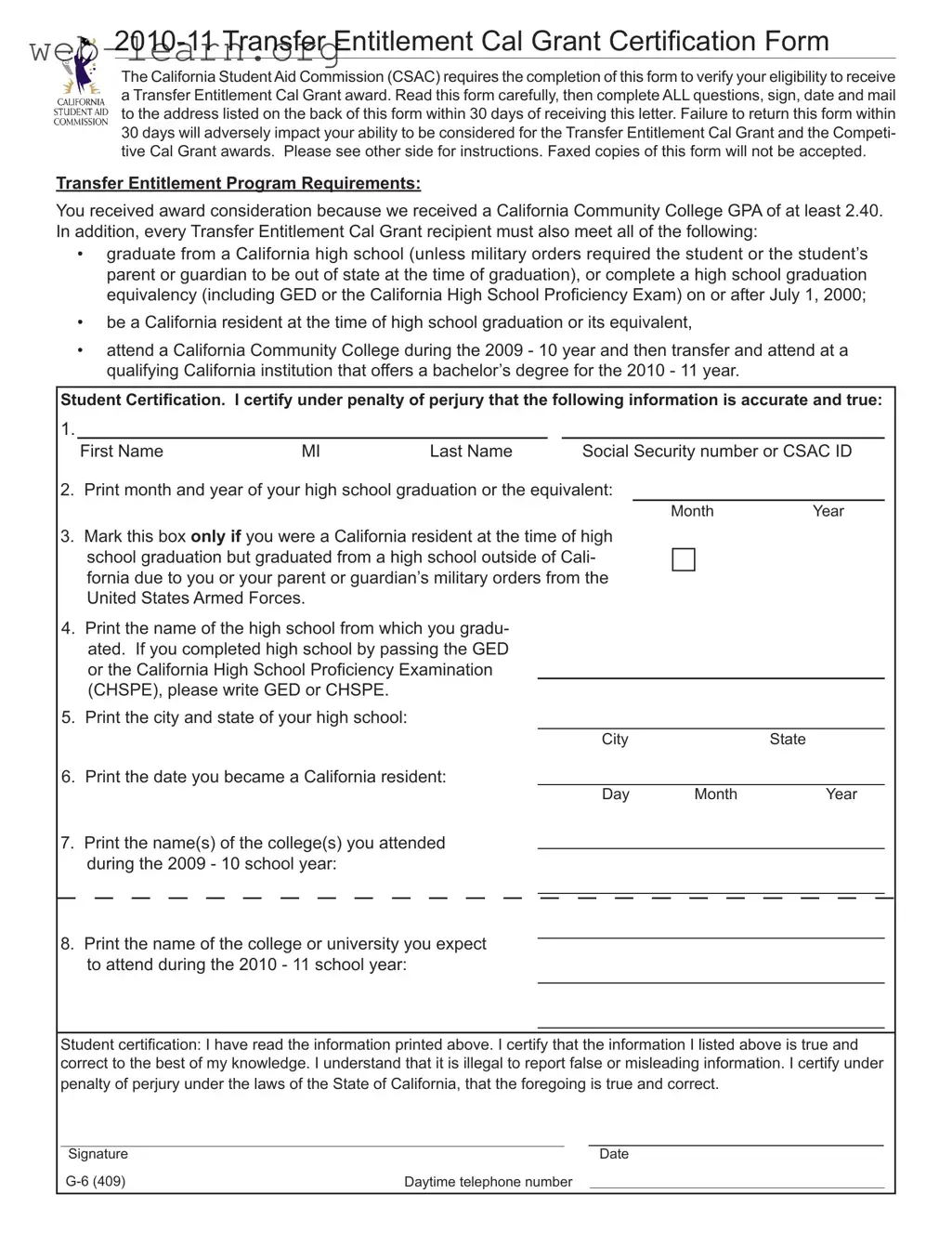
The California G 6 form plays a crucial role for students seeking financial assistance through the Transfer Entitlement Cal Grant program. This form is not just a piece of paper; it serves as a gateway for eligible students to secure funding for their education at qualifying California institutions. To be considered for this award, students must meet specific requirements, such as having a minimum GPA of 2.40 from a California Community College and graduating from a California high school or obtaining an equivalent diploma. Completing the form accurately is essential, as it includes personal information, high school graduation details, and the names of colleges attended. Students must return the completed form within 30 days of receipt to ensure their eligibility is maintained. The process emphasizes the importance of attention to detail, as any missing information could jeopardize a student's chance for funding. Additionally, the California Student Aid Commission (CSAC) requires that all questions be answered fully, and faxed copies are not accepted, reinforcing the need for careful submission. Understanding these elements can help students navigate the often complex world of financial aid and make informed decisions about their educational futures.

Sample - California G 6 Form

7. Print the name(s) of the college(s) you attended
during the 2009 - 10 school year:
8. Print the name of the college or university you expect
to attend during the 2010 - 11 school year:
graduate from a California high school (unless military orders required the student or the student’s
parent or guardian to be out of state at the time of graduation), or complete a high school graduation

be a California resident at the time of high school graduation or its equivalent,
attend a California Community College during the 2009 - 10 year and then transfer and attend at a
qualifying California institution that offers a bachelor’s degree for the 2010 - 11 year.

The California Student Aid Commission (CSAC) requires the completion of this form to verify your eligibility to receive
a Transfer Entitlement Cal Grant award. Read this form carefully, then complete ALL questions, sign, date and mail

30 days will adversely impact your ability to be considered for the Transfer Entitlement Cal Grant and the Competi-

 


penalty of perjury under the laws of the State of California, that the foregoing is true and correct.
Signature Date
G-6 (409)

You received award consideration because we received a California Community College GPA of at least 2.40.



1.
 
 
City State
Daytime telephone number
2. Print month and year of your high school graduation or the equivalent:
 you were a California resident at the time of high
school graduation but graduated from a high school outside of Cali-
fornia due to you or your parent or guardian’s military orders from the

4. Print the name of the high school from which you gradu-


(CHSPE), please write GED or CHSPE.
5. Print the city and state of your high school:
6. Print the date you became a California resident:

When completing this form, please print clearly using black ink only.




2. Print the month and year you graduated from high school or achieved the equivalent by passing the GED or

3.  you were a California resident at the time of high school graduation but graduated from
a high school outside of California due to you or your parent or guardian’s military orders from the United

4. 



your date of birth.
7. P-
woods.


Signature: By signing this form, you certify that you have read the instructions and the information you provided

Cal Grant award being revoked and CSAC potentially seeking repayment of any grant amount that is obtained
based on the submission of inaccurate information.


California Student Aid Commission
Cal Grant Operations Branch
PO Box 419028
Rancho Cordova, CA 95741-9028


for a Cal Grant Transfer Entitlement award, you may be considered for a Competitive Cal
Grant award, but only if you complete and return this


 
(888) 224-7268 or by email at [email protected].
G-6 (4/09)

Form Information

Fact Name Details
Purpose of the Form The California G-6 form is used to verify eligibility for the Transfer Entitlement Cal Grant award, as mandated by the California Student Aid Commission (CSAC).
Submission Deadline Applicants must complete and return the form within 30 days of receiving the notification letter to avoid jeopardizing their eligibility.
Eligibility Criteria To qualify, students must have a minimum GPA of 2.40 from a California Community College and meet specific residency and graduation requirements.
Prohibition on Faxed Copies Faxed copies of the G-6 form are not accepted. Only original, signed forms should be mailed to CSAC.
Governing Laws This form is governed by California Education Code Sections 69430-69433, which outline the Cal Grant program's requirements and stipulations.

Detailed Guide for Filling Out California G 6

Completing the California G 6 form is essential for verifying your eligibility for a Transfer Entitlement Cal Grant award. To ensure a smooth process, follow the steps outlined below. It’s important to fill out every section completely and accurately, as missing information can delay your application.

  1. Begin by printing your name as it appears on your Social Security card. Include your first name, middle initial, and last name.
  2. Enter your Social Security number or CSAC ID as it appears on your notification letter.
  3. Indicate the month and year you graduated from high school or obtained your equivalency by writing it in the format: Month Year (e.g., June 2006).
  4. If you were a California resident at the time of graduation but graduated from out-of-state due to military orders, mark the appropriate box. Leave it blank if you graduated from a California high school.
  5. Print the name of the high school you graduated from. If you completed your education through GED or CHSPE, write “GED” or “CHSPE.”
  6. Provide the city and state where your high school is located.
  7. Write the date you became a California resident in the format: Day Month Year. If you have always lived in California, you can use your date of birth.
  8. List the names of the colleges you attended during the 2009 - 10 school year.
  9. Write the name of the college or university you plan to attend during the 2010 - 11 school year. If you are unsure, you can list multiple institutions.
  10. Sign and date the form to certify that all information provided is accurate and true. Understand that providing false information is illegal and may affect your eligibility.

After completing the form, mail it to the address provided on the back. Make sure to send it within 30 days of receiving your notification letter to avoid any issues with your application. Remember, faxed copies will not be accepted.

Obtain Answers on California G 6

  1. What is the California G 6 form?

    The California G 6 form is the Transfer Entitlement Cal Grant Certification Form required by the California Student Aid Commission (CSAC). It verifies your eligibility for a Transfer Entitlement Cal Grant award, which can significantly aid in funding your education.

  2. Who needs to fill out the G 6 form?

    This form is necessary for students who have received a California Community College GPA of at least 2.40 and wish to apply for a Transfer Entitlement Cal Grant. If you graduated from high school or completed an equivalent program after July 1, 2000, and meet the residency requirements, this form applies to you.

  3. What are the requirements to be eligible for the Transfer Entitlement Cal Grant?

    • You must have graduated from a California high school or completed a high school equivalency.
    • You must be a California resident at the time of high school graduation or its equivalent.
    • You must have attended a California Community College during the 2009-2010 academic year and plan to transfer to a qualifying California institution for the 2010-2011 academic year.
  4. What happens if I don’t return the form within 30 days?

    Failing to return the G 6 form within 30 days of receiving it can adversely affect your eligibility for the Transfer Entitlement Cal Grant and the Competitive Cal Grant awards. Timeliness is crucial, so be sure to act quickly!

  5. Can I submit a faxed copy of the G 6 form?

    No, faxed copies of the completed G 6 form will not be accepted. You must mail the original signed form to the address provided on the back of the form.

  6. What information do I need to provide on the form?

    You will need to provide personal details such as your name, Social Security number or CSAC ID, graduation date, high school information, and the names of the colleges you attended. Ensure all questions are answered completely and accurately.

  7. What should I do if I have questions about filling out the form?

    If you have any questions or need assistance with the G 6 form, you can contact the CSAC at (888) 224-7268 or email [email protected]. They are there to help you navigate the process.

  8. Where do I send the completed G 6 form?

    Once you have completed and signed the form, mail it to:

    California Student Aid Commission
    Cal Grant Operations Branch
    PO Box 419028
    Rancho Cordova, CA 95741-9028

Common mistakes

Filling out the California G 6 form can be a straightforward process, but many individuals make common mistakes that can jeopardize their eligibility for financial aid. Understanding these pitfalls can help ensure that your application is processed smoothly and efficiently.

One frequent error is leaving questions unanswered. The form explicitly states, “DO NOT LEAVE ANY QUESTION BLANK.” Omitting information can lead to delays or even disqualification from receiving a Cal Grant. It is crucial to provide complete answers to all questions, as each piece of information is necessary for the California Student Aid Commission to assess eligibility.

Another mistake occurs when applicants fail to sign and date the form. The certification section emphasizes the importance of this step. Without a signature, the form is incomplete, and the application cannot be processed. This oversight can easily be avoided by double-checking the form before submission.

Many people also incorrectly fill out their names. The instructions specify that names should be printed exactly as they appear on the Social Security card. Errors in this section can cause confusion and may lead to delays in processing. It is advisable to verify the spelling and order of names to match official documents.

Some applicants misunderstand the residency requirements. For instance, if a student graduated from a high school outside of California due to military orders, they must check the appropriate box. Failing to do so can result in misinterpretation of their residency status, which is a critical factor in determining eligibility for the Cal Grant.

Finally, applicants often neglect to provide accurate dates. Whether it’s the date of high school graduation or the date they became a California resident, inaccuracies can complicate the verification process. It is essential to take the time to ensure that all dates are correct and clearly written.

By avoiding these common mistakes, applicants can enhance their chances of successfully receiving a Transfer Entitlement Cal Grant award. Taking care to follow instructions carefully and reviewing the form before submission can make a significant difference in the outcome of the application process.

Documents used along the form

The California G 6 form is a critical document for students seeking financial assistance through the Transfer Entitlement Cal Grant program. However, it is often accompanied by other forms and documents that help facilitate the application process and ensure that applicants meet all necessary requirements. Below are four additional forms and documents commonly used alongside the California G 6 form.

  • Cal Grant Application (CAA): This application is essential for students applying for any Cal Grant program. It collects comprehensive information about the student’s academic history, financial status, and residency, helping the California Student Aid Commission assess eligibility for various grant awards.
  • Verification of High School Graduation: This document serves as proof that a student has graduated from high school or obtained an equivalent qualification, such as a GED. It is often required to confirm eligibility for the Cal Grant programs, ensuring that applicants meet the educational prerequisites.
  • Financial Aid Transcript (FAT): A Financial Aid Transcript provides a detailed record of a student's financial aid history. This document is crucial for understanding past aid received and ensuring that students are not exceeding the limits set by various financial aid programs, including Cal Grants.
  • California Community College Transcripts: These transcripts are necessary to verify a student’s GPA and coursework completed at a California Community College. Since a minimum GPA of 2.40 is required for the Transfer Entitlement Cal Grant, these transcripts play a vital role in the application process.

In summary, while the California G 6 form is pivotal for students seeking Cal Grant assistance, understanding the additional forms and documents that accompany it is equally important. Each of these documents plays a specific role in verifying eligibility and ensuring that students receive the financial support they need to pursue their educational goals.

Similar forms

The California G 6 form serves as a crucial document for students seeking financial assistance through the Transfer Entitlement Cal Grant program. Several other forms share similarities with the G 6 form in purpose, structure, and requirements. Below is a list of six such documents, each accompanied by a brief explanation of its relationship to the G 6 form.

  • FAFSA (Free Application for Federal Student Aid): Like the G 6 form, the FAFSA is essential for students seeking financial aid. Both require personal information and verification of eligibility for funding, ensuring that students meet specific criteria before receiving assistance.
  • Cal Grant A and B Application: This form is used by students applying for Cal Grant A or B awards. Similar to the G 6, it requires the submission of personal details and academic history, aimed at determining eligibility for state-funded grants.
  • California Dream Act Application: For undocumented students, this application allows access to state financial aid. Like the G 6 form, it necessitates the completion of personal and academic information to verify eligibility for funding.
  • Verification Worksheet: This document is often required by financial aid offices to confirm the information provided in aid applications. The G 6 form also demands accuracy and truthfulness in reporting personal and academic details, underscoring the importance of verification in the aid process.
  • Student Aid Report (SAR): Generated after submitting the FAFSA, the SAR summarizes the information provided. Both the SAR and G 6 form serve as official documents that students must review for accuracy, impacting their financial aid eligibility.
  • College Scholarship Application: Many colleges have their own scholarship applications that require similar information to the G 6 form. These applications often ask for academic history, personal details, and residency status, paralleling the requirements of the G 6 for determining eligibility for specific awards.

Dos and Don'ts

When filling out the California G 6 form, it is important to follow specific guidelines to ensure proper processing. Below is a list of things to do and avoid.

  • Do read the entire form carefully before starting.
  • Do complete all questions without leaving any blank.
  • Do print clearly using black ink.
  • Do sign and date the form before mailing it.
  • Don't submit a faxed copy of the form; only original documents will be accepted.
  • Don't provide false or misleading information; this can result in penalties.
  • Don't mail the form late; it must be sent within 30 days of receiving the letter.
  • Don't forget to include your daytime telephone number for any follow-up.

Misconceptions

Misconceptions about the California G 6 form can lead to confusion and missed opportunities for students. Here are ten common misunderstandings:

  1. Only high school graduates can apply. Some believe that only those who graduated from high school can fill out the form. However, students who completed a GED or the California High School Proficiency Exam are also eligible.
  2. Faxing the form is acceptable. Many think they can fax the completed form to expedite the process. In reality, faxed copies are not accepted, and the form must be mailed.
  3. There is no deadline for submission. Some assume they can take their time with the form. In fact, it must be submitted within 30 days of receiving the notification letter to be considered for a Cal Grant.
  4. All community college GPAs are accepted. It's a common belief that any GPA from a community college qualifies. However, a minimum GPA of 2.40 is required to be eligible for the Transfer Entitlement Cal Grant.
  5. California residency is not a requirement. Some individuals think they can apply regardless of their residency status. To qualify, applicants must be California residents at the time of high school graduation or its equivalent.
  6. It is acceptable to leave questions blank. Some may think it's fine to skip questions they find difficult. However, leaving any question unanswered can jeopardize eligibility.
  7. Once submitted, the form cannot be changed. Many believe that after mailing the form, they cannot make any changes. If there are errors, it's important to contact CSAC immediately for guidance.
  8. Only one college can be listed. Some applicants think they can only mention one college for the upcoming year. They can actually list multiple colleges if they are uncertain about their choice.
  9. Military orders exempt all out-of-state graduates. There is a misconception that all students who graduated out of state due to military orders automatically qualify. Only those who were California residents at the time of graduation are eligible.
  10. Signing the form is just a formality. Some may view the signature as a mere formality. In reality, signing the form certifies that all information is accurate and can have legal consequences if false information is provided.

Understanding these misconceptions can help ensure that students navigate the application process smoothly and maximize their chances of receiving financial aid.

Key takeaways

When filling out the California G 6 form, keep the following key points in mind:

  • Timeliness is crucial. Submit the completed form within 30 days of receiving it to avoid losing your eligibility for the Transfer Entitlement Cal Grant.
  • Complete all sections. Do not leave any questions unanswered. Each item must be filled out accurately.
  • Residency requirements apply. Ensure you meet the residency criteria, including being a California resident at the time of high school graduation or its equivalent.
  • Provide accurate information. Report your name, Social Security number, and other details exactly as they appear on official documents.
  • Military exceptions exist. If you graduated from a high school outside California due to military orders, mark the appropriate box on the form.
  • Mail, don’t fax. Faxed copies will not be accepted. Always mail the original completed form to the designated address.
  • Review before signing. Read through the entire form to ensure all information is correct before signing and dating it.

Following these guidelines will help ensure your application process goes smoothly.