Homepage Blank California G 23 Form
Outline

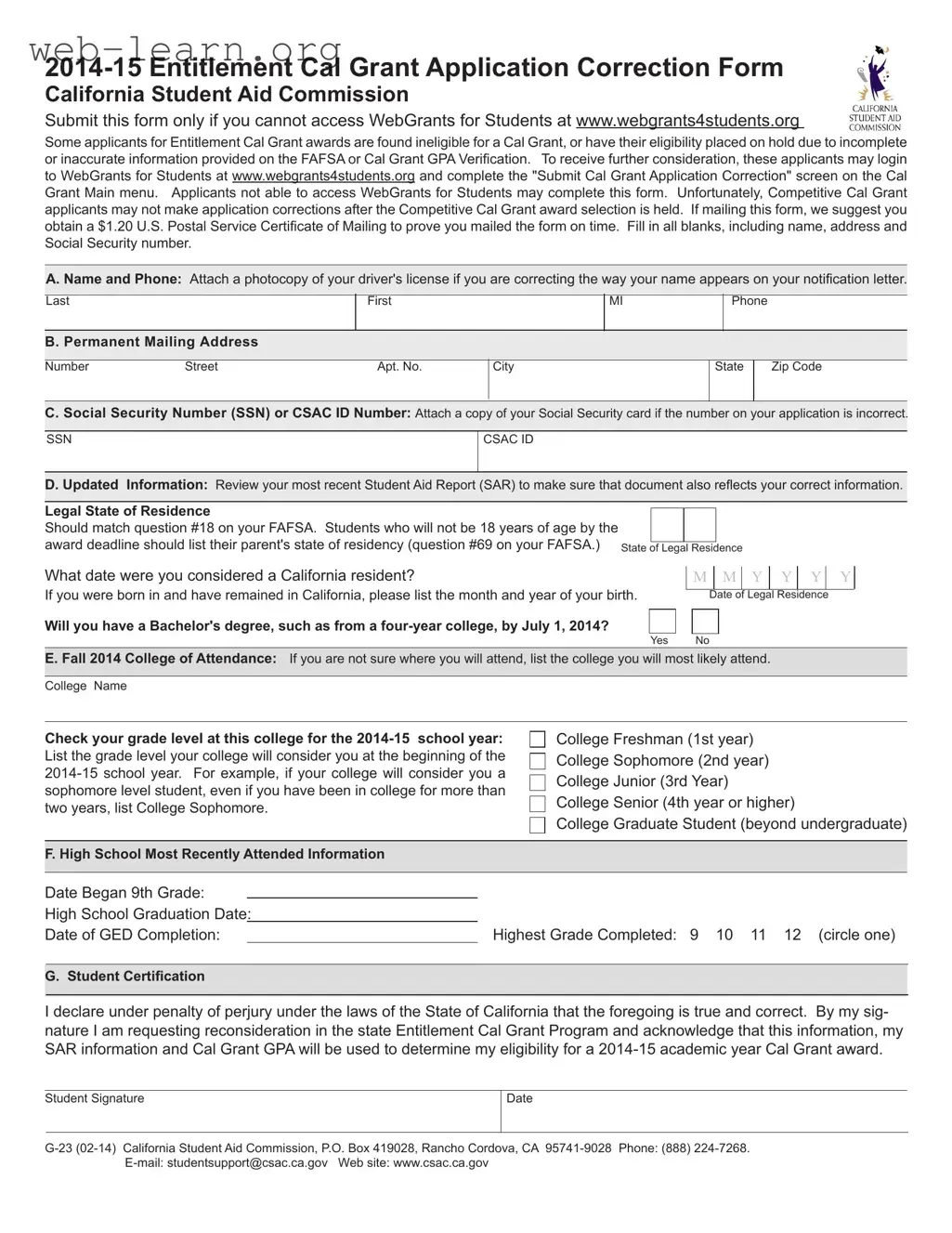
The California G 23 form serves as a crucial tool for students seeking to rectify their Entitlement Cal Grant applications. Designed for those who cannot access the online WebGrants for Students system, this form allows applicants to correct any inaccuracies or incomplete information that may have led to their ineligibility. It is important to note that while this form is available for Entitlement Cal Grant applicants, Competitive Cal Grant applicants cannot make corrections once the award selection process is complete. The G 23 form requires applicants to provide essential personal details, including their name, address, and Social Security number, ensuring that the information aligns with their Student Aid Report. Additionally, it asks for updated residency information and college attendance details for the 2014-15 academic year. A declaration of accuracy, made under penalty of perjury, emphasizes the seriousness of the information provided. To ensure timely processing, applicants are advised to obtain a Certificate of Mailing if they choose to submit the form by mail. This form is not just a bureaucratic requirement; it represents an opportunity for students to secure the financial aid necessary for their educational pursuits.
Sample - California G 23 Form

G-23 (02-14) California Student Aid Commission, P.O. Box 419028, Rancho Cordova, CA 95741-9028 Phone: (888) 224-7268.
E-mail: [email protected] Web site: www.csac.ca.gov
2014-15 Entitlement Cal Grant Application Correction Form
California Student Aid Commission
Some applicants for Entitlement Cal Grant awards are found ineligible for a Cal Grant, or have their eligibility placed on hold due to incomplete

to WebGrants for Students at www.webgrants4students.org and complete the "Submit Cal Grant Application Correction" screen on the Cal
Grant Main menu. Applicants not able to access WebGrants for Students may complete this form. Unfortunately, Competitive Cal Grant
applicants may not make application corrections after the Competitive Cal Grant award selection is held. If mailing this form, we suggest you

Social Security number.
A. Name and Phone: 
Last First MI Phone
B. Permanent Mailing Address
Number Street Apt. No. City State Zip Code
D. Updated Information: 
Legal State of Residence
Should match question #18 on your FAFSA. Students who will not be 18 years of age by the
award deadline should list their parent's state of residency (question #69 on your FAFSA.)
Will you have a Bachelor's degree, such as from a four-year college, by July 1, 2014?
Check your grade level at this college for the 2014-15 school year:
List the grade level your college will consider you at the beginning of the
2014-15 school year. For example, if your college will consider you a
sophomore level student, even if you have been in college for more than
two years, list College Sophomore.
E. Fall 2014 College of Attendance: If you are not sure where you will attend, list the college you will most likely attend.
Yes No
College Freshman (1st year)
College Sophomore (2nd year)
College Junior (3rd Year)
College Senior (4th year or higher)
College Graduate Student (beyond undergraduate)
College Name

I declare under penalty of perjury under the laws of the State of California that the foregoing is true and correct. By my sig-
nature I am requesting reconsideration in the state Entitlement Cal Grant Program and acknowledge that this information, my
SAR information and Cal Grant GPA will be used to determine my eligibility for a 2014-15 academic year Cal Grant award.
Student Signature Date
State of Legal Residence
C. Social Security Number (SSN) or CSAC ID Number: Attach a copy of your Social Security card if the number on your application is incorrect.
F. High School Most Recently Attended Information
Date Began 9th Grade:
High School Graduation Date:
Date of GED Completion: Highest Grade Completed: 9 10 11 12 (circle one)
What date were you considered a California resident?
If you were born in and have remained in California, please list the month and year of your birth.
M M Y Y Y Y
Date of Legal Residence
SSN CSAC ID
Submit this form only if you cannot access WebGrants for Students at www.webgrants4students.org

Form Information

Fact Name Description
Purpose The California G 23 form is used for applicants who need to correct their Entitlement Cal Grant application due to ineligibility or incomplete information.
Submission Method Applicants can submit the form by mail if they cannot access the online platform, WebGrants for Students.
Eligibility Criteria Only certain applicants can use this form; Competitive Cal Grant applicants cannot make corrections after the award selection process.
Required Information Applicants must provide personal details, including their name, address, Social Security number, and updated information to ensure accuracy.
Governing Law This form is governed by the laws of the State of California, specifically under the California Education Code.

Detailed Guide for Filling Out California G 23

Filling out the California G 23 form is essential for applicants who need to correct information on their Cal Grant application. This process ensures that the California Student Aid Commission has accurate details to assess eligibility for the Entitlement Cal Grant awards. Follow these steps carefully to complete the form accurately.

  1. Obtain the form: Access the California G 23 form from the California Student Aid Commission's website or through other official channels.
  2. Fill in your name and phone number: Write your last name, first name, middle initial, and phone number. If correcting your name, attach a photocopy of your driver's license.
  3. Provide your permanent mailing address: Enter your street address, apartment number (if applicable), city, state, and zip code.
  4. Enter your Social Security Number or CSAC ID: Fill in your Social Security Number or California Student Aid Commission ID. If correcting, attach a copy of your Social Security card.
  5. Update your legal state of residence: Confirm that your state of legal residence matches your FAFSA response. Include the date you were considered a California resident and your birth month and year if applicable.
  6. Indicate your college of attendance: List the name of the college you plan to attend for the 2014-15 school year and your grade level (freshman, sophomore, junior, senior, or graduate).
  7. Provide high school information: Fill in the date you began 9th grade, your high school graduation date, GED completion date (if applicable), and circle the highest grade completed (9, 10, 11, or 12).
  8. Sign and date the form: Certify that the information provided is true and correct by signing and dating the form.
  9. Mail the form: If you are submitting the form by mail, consider obtaining a Certificate of Mailing from the U.S. Postal Service to verify timely submission.

After completing the form, ensure all sections are filled out accurately. Gather any required attachments and send the form to the California Student Aid Commission. This will help facilitate the review process for your Cal Grant eligibility.

Obtain Answers on California G 23

  1. What is the California G 23 form?

    The California G 23 form is a correction form for the Entitlement Cal Grant application. It is designed for applicants who cannot access the online WebGrants for Students system. This form allows applicants to correct incomplete or inaccurate information that may have affected their eligibility for a Cal Grant.

  2. Who should use the G 23 form?

    This form is for applicants who have been found ineligible for a Cal Grant or whose eligibility is on hold due to errors in their FAFSA or Cal Grant GPA verification. If you cannot access WebGrants for Students, you should complete this form to ensure your application is considered.

  3. Can Competitive Cal Grant applicants use the G 23 form?

    No, Competitive Cal Grant applicants cannot make corrections after the award selection process has been completed. If you are applying for a Competitive Cal Grant, ensure that all information is accurate before the selection takes place.

  4. What information do I need to provide on the G 23 form?

    You will need to fill in your name, address, and Social Security number. Additionally, you should provide updated information such as your legal state of residence, college of attendance, and high school information. Be sure to attach any necessary documents, like a driver's license or Social Security card, if corrections are needed.

  5. How do I submit the G 23 form?

    You can submit the G 23 form by mailing it to the California Student Aid Commission. If you choose to mail it, it is advisable to obtain a $1.20 U.S. Postal Service Certificate of Mailing to confirm that you mailed the form on time. Ensure that all sections of the form are completed before sending it.

  6. What if I am unsure about my college of attendance?

    If you are uncertain about which college you will attend, list the college you are most likely to attend. You should also indicate your expected grade level at that college for the upcoming school year.

  7. What happens after I submit the G 23 form?

    Once you submit the G 23 form, the California Student Aid Commission will review your corrections. Your updated information will be used to determine your eligibility for a Cal Grant award for the 2014-15 academic year. Keep an eye on your email or mail for any updates regarding your application status.

Common mistakes

Filling out the California G 23 form can be a straightforward process, but several common mistakes can lead to complications. One frequent error is leaving blanks in required fields. Applicants often overlook the importance of providing complete information, such as their name, address, and Social Security number. Each section must be filled out to avoid delays in processing.

Another common mistake is not attaching necessary documents. For instance, if you are correcting your name, you should include a photocopy of your driver's license. Similarly, if there’s an error with your Social Security number, a copy of your Social Security card is essential. Failing to include these documents can result in your application being deemed incomplete.

Many applicants also misinterpret the residency questions. It’s crucial to ensure that the state of legal residence matches the information provided in question #18 on the FAFSA. Additionally, if you are under 18, you must list your parent's state of residency. Misunderstanding these requirements can lead to ineligibility for the Cal Grant.

Some individuals mistakenly believe they can make corrections after submitting their application. However, this is not the case for Competitive Cal Grant applicants, who cannot make changes after the award selection is held. It is vital to submit accurate information from the start to avoid missing out on funding opportunities.

Another oversight occurs with the college of attendance section. Applicants often list a college they are unsure about instead of the institution they are most likely to attend. This can create confusion and may affect the processing of the grant. It’s best to provide the name of the college you plan to attend to ensure proper allocation of funds.

Lastly, many forget to sign and date the certification section. This signature is not just a formality; it confirms that the information provided is true and correct. Without this signature, the application may be considered invalid, leading to further delays or denial of the grant.

Documents used along the form

The California G 23 form is an essential document for students seeking to correct their information for the Cal Grant application. Alongside this form, several other documents may be required to ensure that your application is complete and accurate. Below are some forms and documents that are often used in conjunction with the California G 23 form.

  • FAFSA (Free Application for Federal Student Aid): This federal form is crucial for students seeking financial aid. It collects information about the student’s financial situation and is used to determine eligibility for federal, state, and institutional aid. Accurate information on the FAFSA is essential, as discrepancies can lead to delays or ineligibility for financial assistance.
  • Student Aid Report (SAR): After submitting the FAFSA, students receive a SAR that summarizes the information provided. This report includes the Expected Family Contribution (EFC) and highlights any issues that may need correction. Reviewing the SAR is vital for ensuring that all information is accurate before submitting the G 23 form.
  • Cal Grant GPA Verification Form: This form is used to verify a student's GPA for Cal Grant eligibility. It is typically submitted by the student's high school or college. An accurate GPA is a critical factor in determining eligibility for Cal Grant awards, making this form important for applicants.
  • Proof of Residency Documents: These documents may include utility bills, lease agreements, or other official papers that demonstrate a student's legal residency in California. Such proof is necessary to establish eligibility for state-funded financial aid programs, including the Cal Grant.

By ensuring that all necessary forms and documents are accurately completed and submitted, students can improve their chances of securing financial aid through the Cal Grant program. Proper preparation and attention to detail can make a significant difference in the application process.

Similar forms

The California G 23 form is essential for students who need to correct their Cal Grant application information. Several other documents serve similar purposes, each aimed at ensuring accurate and complete information for financial aid applications. Here are six documents that share similarities with the G 23 form:

  • FAFSA Correction Form: Like the G 23, this form allows students to update their financial information after submitting the Free Application for Federal Student Aid (FAFSA). Corrections are crucial for determining eligibility for federal aid.
  • Cal Grant GPA Verification Form: This document is used to verify a student's GPA for Cal Grant eligibility. Similar to the G 23, it helps ensure that the information on file is accurate and up-to-date.
  • California Dream Act Application: This application is for undocumented students seeking financial aid. It shares the goal of updating and correcting information to ensure eligibility for state financial aid programs.
  • Verification Worksheet: Often required by colleges, this worksheet allows students to clarify discrepancies in their FAFSA information. Like the G 23, it helps resolve issues that could affect financial aid eligibility.
  • Dependency Status Appeal Form: Students who wish to change their dependency status for financial aid purposes can use this form. It serves a similar function by allowing applicants to correct or clarify their situation.
  • Institutional Financial Aid Appeal Form: Colleges often have their own forms for students to appeal financial aid decisions. This document, like the G 23, allows students to provide updated information to reconsider their financial aid status.

Dos and Don'ts

When filling out the California G 23 form, it is crucial to follow specific guidelines to ensure your application is processed smoothly. Here is a list of things you should and shouldn't do:

  • Do fill in all required blanks completely, including your name, address, and Social Security number.
  • Do attach necessary documents, such as a photocopy of your driver's license if correcting your name.
  • Do review your most recent Student Aid Report (SAR) to ensure all information is accurate.
  • Do provide your legal state of residence as it appears on your FAFSA.
  • Don't submit the form if you are a Competitive Cal Grant applicant after the award selection has been held.
  • Don't forget to include your updated information, especially if there are discrepancies in your application.
  • Don't skip the student certification section; your signature is required to validate your application.

Misconceptions

There are several misconceptions surrounding the California G 23 form. Understanding these can help applicants navigate the process more effectively. Below are nine common misconceptions:

  • Misconception 1: The G 23 form is only for new applicants.
  • This form is intended for applicants who need to correct information on their existing Cal Grant application, not just for new submissions.

  • Misconception 2: All applicants can make corrections at any time.
  • Competitive Cal Grant applicants cannot make corrections after the award selection has occurred.

  • Misconception 3: You do not need to provide identification.
  • Applicants must attach a photocopy of their driver's license or Social Security card if they are correcting their name or Social Security number.

  • Misconception 4: The G 23 form can be submitted without a mailing proof.
  • It is advisable to obtain a Certificate of Mailing from the U.S. Postal Service to confirm timely submission.

  • Misconception 5: You can submit the G 23 form online.
  • This form is specifically for those who cannot access the online WebGrants for Students platform.

  • Misconception 6: Only financial information needs to be corrected.
  • Corrections can include personal information such as name, address, and Social Security number, not just financial data.

  • Misconception 7: There is no deadline for submitting the G 23 form.
  • Applicants must be aware of deadlines related to their specific award year and submission requirements.

  • Misconception 8: The G 23 form guarantees a Cal Grant award.
  • Submitting the form does not guarantee eligibility or approval; it simply allows for corrections to be considered.

  • Misconception 9: The G 23 form is only for California residents.
  • While it is primarily for California residents, applicants who are in the process of establishing residency may also need to use this form.

Key takeaways

Filling out the California G 23 form can be a crucial step for students seeking Cal Grant funding. Here are key takeaways to consider:

  • Purpose of the Form: The G 23 form is used to correct information on the Cal Grant application when access to WebGrants for Students is unavailable.
  • Eligibility Issues: Applicants may need to use this form if they are found ineligible due to incomplete or inaccurate information on their FAFSA or GPA verification.
  • Submission Timing: Corrections for Competitive Cal Grant applicants cannot be made after the award selection has occurred.
  • Mailing Recommendations: If mailing the form, obtaining a $1.20 U.S. Postal Service Certificate of Mailing is advisable to prove timely submission.
  • Complete All Sections: Ensure all blanks are filled out, including name, address, and Social Security number, to avoid delays.
  • Documentation: Attach necessary documents, such as a driver's license or Social Security card, if corrections pertain to those details.
  • Residency Information: The legal state of residence must align with your FAFSA details. If under 18, list your parent's state of residency.
  • College Attendance: Indicate the college you plan to attend and your expected grade level for the upcoming school year.
  • High School Details: Provide accurate information regarding your high school attendance and graduation dates.
  • Student Certification: The form must be signed by the student, confirming that the information is true and correct under penalty of perjury.

Understanding these points can streamline the process and enhance the likelihood of receiving the necessary financial aid.