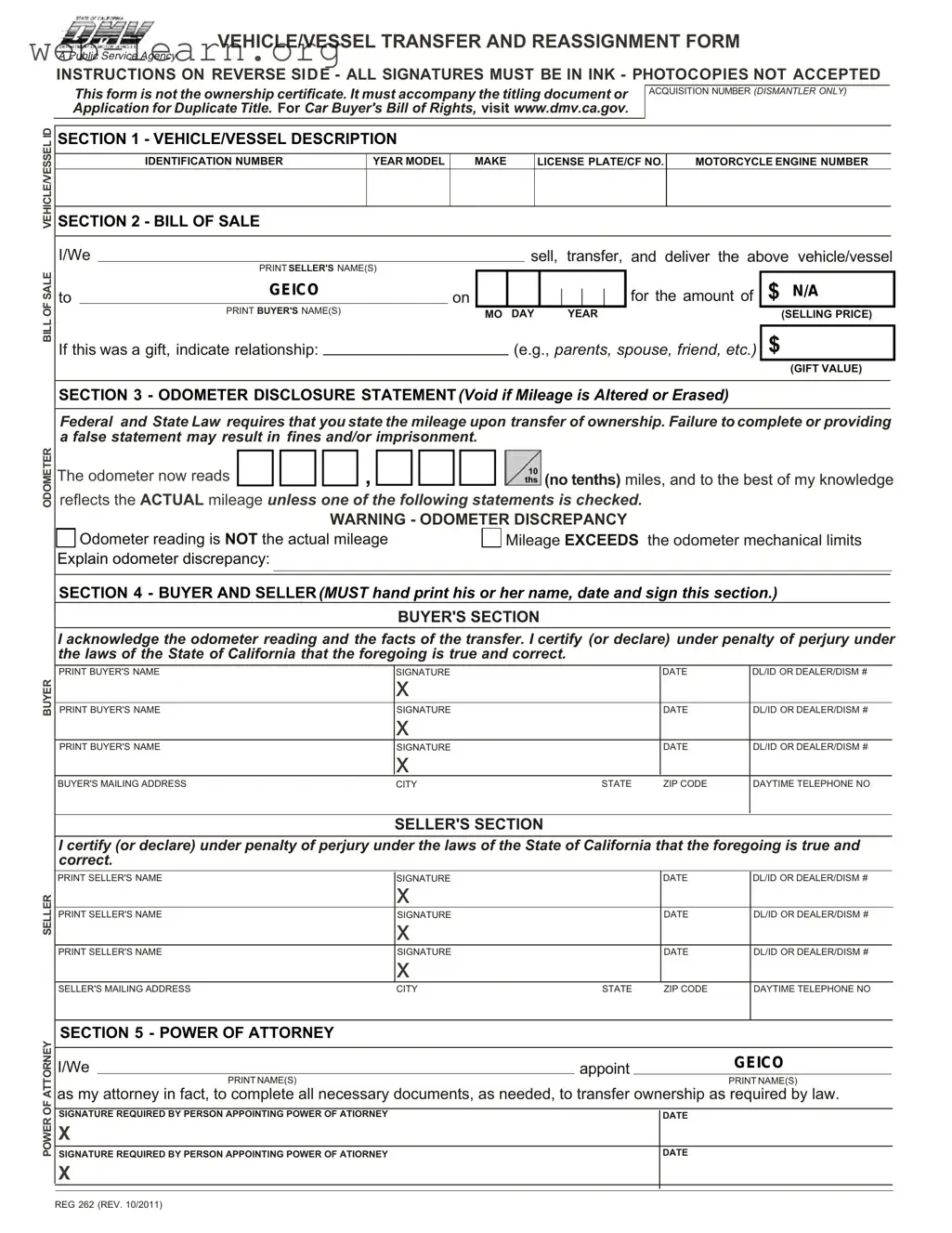
The California Form REG 262 is an essential document used during the transfer and reassignment of vehicle or vessel ownership. This form is not a certificate of ownership; instead, it must accompany the title or an application for a duplicate title. It serves multiple purposes, including documenting the details of the vehicle or vessel, such as its identification number, make, model, and year. The form also includes a bill of sale section, where the seller identifies the buyer and states the selling price or gift value. It requires both parties to acknowledge the odometer reading at the time of transfer, ensuring transparency regarding the vehicle's mileage. Additionally, it features sections for both the buyer and seller to provide their names, signatures, and contact information. If a party wishes to appoint someone else to handle the transfer process, the form allows for the designation of a power of attorney. Completing this form accurately is crucial, as any alterations can void certain sections, particularly the odometer disclosure. Understanding the requirements and sections of the REG 262 is vital for a smooth transaction.
VEHICLE/VESSEL TRANSFER AND REASSIGNMENT FORM
A Public Service Agency
INSTRUCTIONS ON REVERSE SIDE - ALL SIGNATURES MUST BE IN INK - PHOTOCOPIES NOT ACCEPTED
This form is not the ownership certificate. It must accompany the titling document or Application for Duplicate Title. For Car Buyer's Bill of Rights, visit www.dmv.ca.gov.
ACQUISITION NUMBER (DISMANTLER ONLY)
BILL OF SALE VEHICLE/VESSEL ID
ODOMETER
BUYER
SELLER
POWER OF ATTORNEY
SECTION 1 - VEHICLE/VESSEL DESCRIPTION
|
|
IDENTIFICATION NUMBER |
YEAR MODEL |
|
MAKE |
|
|
LICENSE PLATE/CF NO. |
MOTORCYCLE ENGINE NUMBER |
|
||||
|
|
|
|
|
|
|
|
|
|
|
|
|
|
|
SECTION 2 - BILL OF SALE |
|
|
|
|
|
|
|
|
|
|
|
|||
|
|
|
|
|
|
|
|
|
|
|
|
|
||
I/We |
|
|
|
|
|
|
sell, |
transfer, and |
deliver the above |
vehicle/vessel |
||||
PRINT SELLER'S NAME(S) |
|
|
||||||||||||
|
|
|
|
|
|
|
|
|
|
|
||||
to |
GEICO |
|
on |
|
|
|
|
for the amount of |
$ |
N/A |
||||
|
|
PRINT BUYER'S NAME(S) |
|
|
MO |
DAY |
YEAR |
|
(SELLING PRICE) |
|||||
If this was a gift, indicate relationship: |
|
|
|
|
(e.g., parents, spouse, friend, etc.) |
$ |
(GIFT VALUE) |
|||||||
|
|
|
|
|||||||||||
|
|
|
|
|
|
|
|
|
|
|
|
|
||
SECTION 3 - ODOMETER DISCLOSURE STATEMENT (Void if Mileage is Altered or Erased)
Federal and State Law requires that you state the mileage upon transfer of ownership. Failure to complete or providing a false statement may result in fines and/or imprisonment.
The odometer now reads |
, |
ths (no tenths) miles, and to the best of my knowledge |
|
|
|
10 |
|
reflects the ACTUAL mileage unless one of the following statements is checked. |
|||
|
WARNING - ODOMETER DISCREPANCY |
||
Odometer reading is NOT the actual mileage |
Mileage EXCEEDS the odometer mechanical limits |
||
Explain odometer discrepancy: |
|
|
|
SECTION 4 - BUYER AND SELLER (MUST hand print his or her name, date and sign this section.)
BUYER'S SECTION
I acknowledge the odometer reading and the facts of the transfer. I certify (or declare) under penalty of perjury under the laws of the State of California that the foregoing is true and correct.
PRINT BUYER'S NAME |
SIGNATURE |
|
DATE |
DL/ID OR DEALER/DISM # |
|
x |
|
|
|
PRINT BUYER'S NAME |
SIGNATURE |
|
DATE |
DL/ID OR DEALER/DISM # |
|
x |
|
|
|
PRINT BUYER'S NAME |
SIGNATURE |
|
DATE |
DL/ID OR DEALER/DISM # |
|
x |
|
|
|
BUYER'S MAILING ADDRESS |
CITY |
STATE |
ZIP CODE |
DAYTIME TELEPHONE NO |
|
|
|
|
|
SELLER'S SECTION
I certify (or declare) under penalty of perjury under the laws of the State of California that the foregoing is true and correct.
PRINT SELLER'S NAME |
SIGNATURE |
|
|
DATE |
|
DL/ID OR DEALER/DISM # |
|
|
|
x |
|
|
|
|
|
PRINT SELLER'S NAME |
SIGNATURE |
|
|
DATE |
|
DL/ID OR DEALER/DISM # |
|
|
|
x |
|
|
|
|
|
PRINT SELLER'S NAME |
SIGNATURE |
|
|
DATE |
|
DL/ID OR DEALER/DISM # |
|
|
|
x |
|
|
|
|
|
SELLER'S MAILING ADDRESS |
CITY |
STATE |
ZIP CODE |
|
DAYTIME TELEPHONE NO |
||
|
|
|
|
|
|
|
|
SECTION 5 - POWER OF ATTORNEY |
|
|
|
|
|
|
|
|
|
|
|
|
|
|
|
I/We |
|
|
appoint |
|
|
GEICO |
|
|
PRINT NAME(S) |
|
|
|
|
PRINT NAME(S) |
|
as my attorney in fact, to complete all necessary documents, as needed, to transfer ownership as required by law. |
|||||||
SIGNATURE REQUIRED BY PERSON APPOINTING POWER OF ATIORNEY |
|
|
|
DATE |
|
|
|
x |
|
|
|
|
|
|
|
SIGNATURE REQUIRED BY PERSON APPOINTING POWER OF ATIORNEY |
|
|
|
DATE |
|
|
|
x |
|
|
|
|
|
|
|
|
|
|
|
|
|
|
|
REG 262 (REV. 10/2011) |
|
|
|
|
|
|
|
| Fact Name | Fact Description |
|---|---|
| Form Purpose | The California Form REG 262 is used for the transfer and reassignment of vehicles and vessels. |
| Not Ownership Certificate | This form does not serve as the ownership certificate and must accompany the title or application for a duplicate title. |
| Signature Requirement | All signatures on the form must be in ink; photocopies are not accepted. |
| Odometer Disclosure | Federal and state law requires the disclosure of the vehicle's odometer reading at the time of transfer. |
| Consequences of False Statements | Providing false information regarding the odometer can lead to fines and/or imprisonment. |
| Bill of Sale Section | The form includes a section for the bill of sale, detailing the seller, buyer, and transaction specifics. |
| Power of Attorney | A power of attorney can be appointed to complete necessary documents for ownership transfer, but not for the odometer disclosure. |
| Retention of Copies | Dealers must retain a photocopy of the odometer disclosure for five years. |
| Governing Laws | The form is governed by California Vehicle Code Sections 5900-5904 and federal odometer disclosure laws. |
| Car Buyer's Bill of Rights | Buyers are encouraged to read the Car Buyer's Bill of Rights available at www.dmv.ca.gov before signing. |
Filling out the California Form REG 262 is a straightforward process. This form is essential for transferring ownership of a vehicle or vessel. Follow these steps carefully to ensure all necessary information is provided accurately.
After completing the form, submit it along with the necessary titling documents to the DMV. Make sure to keep a copy for your records. If you have any questions, consult the DMV website for additional resources or assistance.
The California Form REG 262, also known as the Vehicle/Vessel Transfer and Reassignment Form, is used to facilitate the transfer of ownership of a vehicle or vessel in California. This form must accompany the title or an application for a duplicate title. It serves as a record of the sale or transfer and includes necessary details such as the buyer and seller's information, vehicle identification, and odometer disclosure.
Both the seller and the buyer of the vehicle or vessel are required to complete the REG 262 form. The seller must provide their name, address, and the details of the transaction, including the selling price or gift value. The buyer must also provide their information and acknowledge the odometer reading. If there are multiple owners, signatures from all parties may be necessary depending on how the ownership is structured.
The odometer disclosure statement is a section of the REG 262 form where the seller must disclose the mileage of the vehicle or vessel at the time of sale. It is crucial because federal and state laws require accurate reporting of mileage to prevent fraud. If the odometer reading is altered or erased, the disclosure is void, and a new statement must be completed. Providing false information can lead to fines or other legal consequences.
No, photocopies of the REG 262 form are not accepted for the transfer of ownership. The original form must be filled out and submitted. However, individuals can retain photocopies for their personal records after the original has been submitted. It is important to ensure that all signatures are in ink, as electronic or printed signatures will not be valid.
If you are unable to complete the REG 262 form yourself, you can appoint someone to act as your attorney-in-fact. This is done by filling out the Power of Attorney section on the form. The appointed person can then sign the necessary documents on your behalf. However, the odometer disclosure statement cannot be completed by someone acting under a power of attorney; it must be filled out by the seller directly.
Filling out the California Form REG 262 can be straightforward, but many people make mistakes that can lead to delays or complications. One common error is failing to complete all required sections. Every part of the form must be filled out accurately, including the vehicle identification number, year, make, and model. Incomplete information can cause processing issues.
Another frequent mistake is not providing the correct signatures. All signatures must be in ink, and photocopies are not accepted. This requirement is crucial. If a signature is missing or not in ink, the form will be rejected, leading to further delays in the transfer process.
Many people also overlook the odometer disclosure statement. It is essential to report the correct mileage at the time of sale. Altering or erasing the mileage will void this section of the document. Therefore, it is vital to ensure that the mileage is accurately reported and that both the buyer and seller sign this section.
Some individuals forget to indicate the relationship when the vehicle is a gift. This information is necessary to clarify the nature of the transaction. If the relationship is not stated, it may lead to confusion or additional questions from the DMV.
Using incorrect or outdated forms is another mistake. The REG 262 form must be the most current version. Using an older version can result in rejection, so always check the date on the form before submitting it.
Additionally, people often fail to include their complete mailing address and contact information. Providing accurate contact details is essential for any follow-up communication from the DMV. Missing this information can lead to further complications.
Another common error is not retaining a copy of the completed form for personal records. While the DMV keeps records, having your own copy can be helpful for future reference. It’s wise to keep a copy of all documents submitted.
Lastly, individuals sometimes underestimate the importance of reviewing the entire form before submission. Taking a moment to double-check all entries can prevent simple mistakes from becoming significant issues. A thorough review ensures that everything is correct and complete, allowing for a smoother transfer process.
When dealing with vehicle or vessel transfers in California, several documents often accompany the California Form REG 262. Each of these forms plays a crucial role in ensuring a smooth and legal transfer of ownership. Below is a list of commonly used documents that you may encounter during this process.
Understanding these documents can help facilitate a smoother transaction. Each form serves a specific purpose and contributes to the legal transfer of ownership. It is always advisable to ensure that all necessary paperwork is completed accurately to avoid any complications in the future.
The California Form REG 262 serves a specific purpose in the vehicle transfer process. Several other documents share similarities with it, each playing a crucial role in vehicle ownership transfer. Here’s a list of those documents:
When filling out the California Form REG 262, it is essential to ensure accuracy and compliance with the requirements. Below is a list of things to do and avoid during this process.
Misunderstandings about the California Form REG 262 can lead to confusion during vehicle transfers. Here are nine common misconceptions:
Understanding these misconceptions is crucial for a smooth vehicle transfer process in California. Ensure that all requirements are met to avoid complications and legal issues.
When filling out the California Form REG 262, there are several important points to keep in mind. Understanding these can help ensure a smooth vehicle or vessel transfer process.
By following these guidelines, you can navigate the process of transferring ownership of a vehicle or vessel in California more effectively.