Homepage Blank California Fl140 Form
Outline

The California FL-140 form plays a crucial role in family law proceedings, particularly in cases involving dissolution, legal separation, or nullity. This form is part of the declaration of disclosure process, which mandates that both parties exchange financial information to ensure transparency. Specifically, it requires the petitioner to serve a preliminary declaration of disclosure at the same time as the filing of the petition, while the respondent must do the same with their response. Notably, these declarations are not filed with the court; instead, a separate declaration confirming that these disclosures were served must be filed. The form outlines the necessary attachments, including a Schedule of Assets and Debts, an Income and Expense Declaration, and relevant tax returns. It also highlights exceptions, such as in summary dissolution cases where final disclosures are not required. The FL-140 emphasizes the importance of timely and accurate disclosures, with specific deadlines and conditions for waiving certain disclosures, thereby fostering a fair process for both parties involved.
Sample - California Fl140 Form

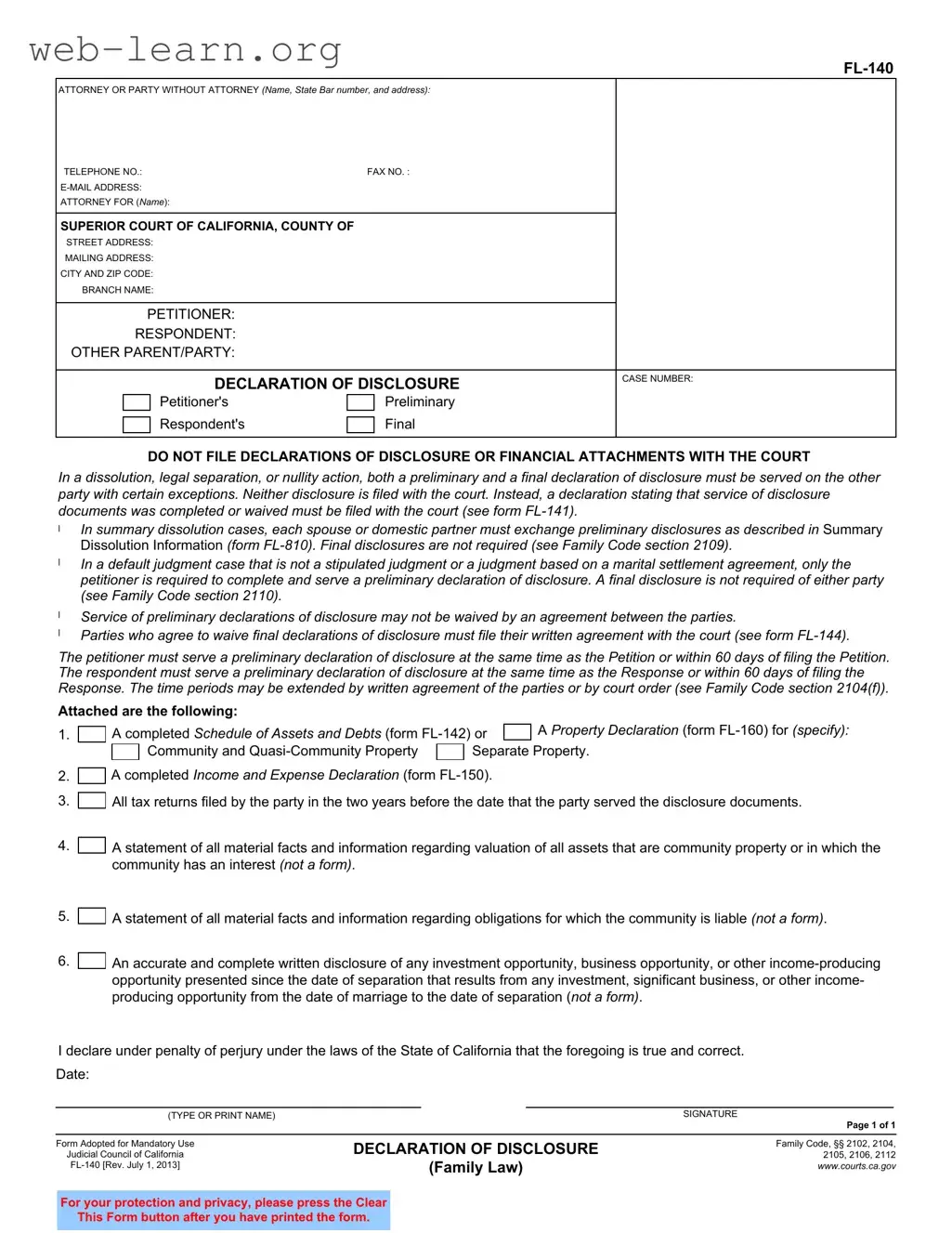
ATTORNEY OR PARTY WITHOUT ATTORNEY (Name, State Bar number, and address):
TELEPHONE NO.: FAX NO. :
E-MAIL ADDRESS:
ATTORNEY FOR (Name):
SUPERIOR COURT OF CALIFORNIA, COUNTY OF
BRANCH NAME:
CITY AND ZIP CODE:
STREET ADDRESS:
MAILING ADDRESS:
PETITIONER:
RESPONDENT:
OTHER PARENT/PARTY:
CASE NUMBER:
DECLARATION OF DISCLOSURE
Petitioner's
Respondent's
Preliminary
Final
DO NOT FILE DECLARATIONS OF DISCLOSURE OR FINANCIAL ATTACHMENTS WITH THE COURT
FL-140
Page 1 of 1
Form Adopted for Mandatory Use
Judicial Council of California
FL-140 [Rev. July 1, 2013]
DECLARATION OF DISCLOSURE
(Family Law)
Family Code, §§ 2102, 2104,
2105, 2106, 2112
www.courts.ca.gov
A completed Schedule of Assets and Debts (form FL-142) or
A statement of all material facts and information regarding valuation of all assets that are community property or in which the
community has an interest (not a form).
A statement of all material facts and information regarding obligations for which the community is liable (not a form).
All tax returns filed by the party in the two years before the date that the party served the disclosure documents.
Community and Quasi-Community Property Separate Property.
A Property Declaration (form FL-160) for (specify):
SIGNATURE
An accurate and complete written disclosure of any investment opportunity, business opportunity, or other income-producing
opportunity presented since the date of separation that results from any investment, significant business, or other income-
producing opportunity from the date of marriage to the date of separation (not a form).
Attached are the following:
1.
2.
3.
4.
5.
6.
I declare under penalty of perjury under the laws of the State of California that the foregoing is true and correct.
(TYPE OR PRINT NAME)
In a dissolution, legal separation, or nullity action, both a preliminary and a final declaration of disclosure must be served on the other
party with certain exceptions. Neither disclosure is filed with the court. Instead, a declaration stating that service of disclosure
documents was completed or waived must be filed with the court (see form FL-141).
The petitioner must serve a preliminary declaration of disclosure at the same time as the Petition or within 60 days of filing the Petition.
The respondent must serve a preliminary declaration of disclosure at the same time as the Response or within 60 days of filing the
Response. The time periods may be extended by written agreement of the parties or by court order (see Family Code section 2104(f)).
In summary dissolution cases, each spouse or domestic partner must exchange preliminary disclosures as described in Summary
Dissolution Information (form FL-810). Final disclosures are not required (see Family Code section 2109).
l
l
Parties who agree to waive final declarations of disclosure must file their written agreement with the court (see form FL-144).
l
Service of preliminary declarations of disclosure may not be waived by an agreement between the parties.
l
In a default judgment case that is not a stipulated judgment or a judgment based on a marital settlement agreement, only the
petitioner is required to complete and serve a preliminary declaration of disclosure. A final disclosure is not required of either party
(see Family Code section 2110).
A completed Income and Expense Declaration (form FL-150).
Date:
For your protection and privacy, please press the Clear
This Form button after you have printed the form.

Form Information

Fact Name Details
Form Purpose The FL-140 form is used for the Declaration of Disclosure in family law cases.
Governing Laws This form is governed by Family Code sections 2102, 2104, 2105, 2106, and 2112.
Filing Requirement Neither the preliminary nor the final declaration of disclosure is filed with the court.
Service Requirement Both parties must serve their disclosures to each other unless exceptions apply.
Preliminary Disclosure The petitioner must serve a preliminary declaration of disclosure with the Petition or within 60 days of filing.
Final Disclosure Final disclosures are not required in default judgment cases.
Waiving Disclosures Parties may agree to waive final disclosures, but must file this agreement with the court.
Summary Dissolution In summary dissolution cases, each spouse must exchange preliminary disclosures.
Attached Documents Parties must attach various financial documents, including tax returns and asset valuations.
Penalty of Perjury The form requires a declaration under penalty of perjury regarding the truthfulness of the information provided.

Detailed Guide for Filling Out California Fl140

After gathering the necessary information, you can begin filling out the California FL-140 form. This form is crucial in family law cases, particularly in matters of dissolution, legal separation, or nullity. Follow these steps carefully to ensure all required information is accurately provided.

  1. At the top of the form, enter the name of the attorney or party without an attorney. Include the State Bar number and address.
  2. Provide a telephone number, fax number, and email address in the designated fields.
  3. Indicate the name of the attorney for the petitioner, if applicable.
  4. Fill in the name of the Superior Court of California, the county, and the street address where the case is being filed.
  5. Write the mailing address, city, and zip code of the court.
  6. Specify the branch name of the court.
  7. Identify the petitioner, respondent, and other parent/party in the respective sections.
  8. Enter the case number assigned by the court.
  9. Mark whether you are submitting a Petitioner's Preliminary or Respondent's Final declaration.
  10. Remember that you do not need to file the declarations of disclosure or financial attachments with the court.
  11. Gather and attach any necessary documents, such as the completed Schedule of Assets and Debts (form FL-142) or a Property Declaration (form FL-160), as well as the Income and Expense Declaration (form FL-150).
  12. List all tax returns filed in the last two years, along with any statements regarding material facts related to community property or obligations.
  13. Include any written disclosures of investment or business opportunities since the date of separation.
  14. At the bottom of the form, type or print your name and provide your signature, along with the date.

Once you have completed the form and gathered all necessary documents, review everything for accuracy. Ensure that all required information is included before submitting it to the court. This will help streamline the process and reduce the chances of delays.

Obtain Answers on California Fl140

  1. What is the purpose of the California FL-140 form?

    The FL-140 form is used for the Declaration of Disclosure in family law cases in California, specifically during divorce, legal separation, or nullity actions. It ensures that both parties provide necessary financial information to each other. This form is crucial for maintaining transparency and fairness in the division of assets and debts.

  2. Who needs to complete the FL-140 form?

    Both the petitioner and the respondent in a dissolution, legal separation, or nullity case must complete the FL-140 form. The petitioner must serve a preliminary declaration of disclosure at the same time as the Petition or within 60 days of filing. The respondent must do the same with their Response.

  3. Do I need to file the FL-140 form with the court?

    No, the FL-140 form itself is not filed with the court. Instead, a separate declaration stating that service of disclosure documents was completed or waived must be filed using form FL-141. This helps the court verify that both parties have exchanged the required financial information.

  4. What documents must accompany the FL-140 form?

    Along with the FL-140 form, parties must provide several documents, including:

    • A completed Schedule of Assets and Debts (form FL-142) or a Property Declaration (form FL-160).
    • A completed Income and Expense Declaration (form FL-150).
    • All tax returns filed in the two years prior to serving the disclosure documents.
    • A statement of all material facts regarding the valuation of community property assets.
    • A statement of all material facts regarding community liabilities.
    • A written disclosure of any income-producing opportunities since separation.
  5. Can parties waive the requirement for final declarations of disclosure?

    Yes, parties can agree to waive final declarations of disclosure. However, they must file their written agreement with the court using form FL-144. It's important to note that preliminary declarations of disclosure cannot be waived by agreement.

  6. What happens if I do not serve the FL-140 form on time?

    If the preliminary declaration of disclosure is not served within the required timeframe, it may affect the proceedings. The court could impose penalties or delays in the case. It is advisable to adhere to the 60-day timeline to avoid complications.

  7. Is there a specific format for the information provided in the FL-140 form?

    Yes, the FL-140 form must be completed accurately and truthfully. The information provided should include all relevant financial details, such as assets, debts, income, and expenses. Failing to provide complete and accurate information can lead to legal consequences.

  8. What is the significance of the declaration under penalty of perjury?

    By signing the FL-140 form, parties declare under penalty of perjury that the information provided is true and correct. This statement emphasizes the importance of honesty in financial disclosures. Misrepresentation can lead to serious legal repercussions.

  9. Where can I find more information about the FL-140 form?

    Additional information about the FL-140 form and related processes can be found on the official California courts website. This resource provides guidance on family law procedures, required forms, and other pertinent information.

Common mistakes

Completing the California FL-140 form can be a daunting task, and many individuals make mistakes that could affect their case. One common error is failing to provide complete contact information. The form requires the name, address, and contact details of the attorney or party without an attorney. Omitting any of this information can lead to delays and complications in the legal process.

Another frequent mistake involves the declaration of disclosure. Some individuals mistakenly file their preliminary or final declarations of disclosure with the court. It’s essential to remember that these documents should not be filed but rather served to the other party. Misunderstanding this requirement can lead to unnecessary confusion and may hinder the progress of the case.

Many people also overlook the specific deadlines associated with serving the preliminary declaration of disclosure. The petitioner must serve this document within 60 days of filing the petition, while the respondent has the same timeframe after filing their response. Ignoring these timelines can result in missed opportunities to present crucial financial information.

Additionally, individuals often fail to attach the necessary supporting documents. The FL-140 form requires a completed Schedule of Assets and Debts or a Property Declaration, along with an Income and Expense Declaration. Not including these documents can weaken one’s position and may lead to further legal complications.

Another mistake is not providing accurate information regarding assets and debts. When detailing community and separate property, it is vital to be thorough and honest. Inaccuracies can lead to disputes and may even be viewed as an attempt to conceal information.

Some individuals do not understand the importance of providing tax returns from the past two years. These documents are essential for assessing financial status and obligations. Failing to include them can result in a lack of clarity regarding income and financial responsibilities.

Moreover, a common oversight is neglecting to disclose material facts about any investment or business opportunities that arose since the date of separation. This information is crucial for a fair assessment of financial circumstances. Omitting such details may create mistrust between parties and complicate negotiations.

Finally, individuals sometimes forget to sign and date the form. A signature is a declaration under penalty of perjury that the information provided is true and correct. Without a signature, the form may be deemed incomplete, leading to potential legal repercussions.

Documents used along the form

The California FL-140 form is an essential document in family law cases, particularly during divorce or separation proceedings. Along with this form, several other documents are commonly used to ensure that both parties fully disclose their financial situations. Below is a list of these forms, each serving a specific purpose in the disclosure process.

  • FL-141: Declaration of Disclosure - This form is used to declare that the preliminary and final declarations of disclosure have been served on the other party. It is filed with the court to confirm compliance with disclosure requirements.
  • FL-142: Schedule of Assets and Debts - This document lists all assets and debts owned by the parties. It helps provide a clear picture of the financial situation during the divorce process.
  • FL-150: Income and Expense Declaration - This form details the income and expenses of each party. It is crucial for determining support obligations and property division.
  • FL-160: Property Declaration - This form is used to provide additional information about specific properties owned by the parties. It helps clarify ownership and value during the proceedings.
  • FL-144: Request to Waive Final Declaration of Disclosure - If both parties agree to waive the final declaration, this form must be filed with the court to document their agreement.
  • FL-810: Summary Dissolution Information - This document outlines the requirements for summary dissolution cases, including the preliminary disclosures that must be exchanged.
  • Tax Returns - Both parties must provide copies of their tax returns for the past two years. These documents help verify income and financial stability.
  • Statements of Material Facts - These are written statements that detail the valuation of community property and any obligations for which the community is liable. They are not standardized forms but are essential for accurate disclosure.
  • Investment Opportunity Disclosure - This is a written disclosure of any investment or business opportunities that arose since the date of separation. It ensures transparency regarding potential income sources.
  • Financial Attachments - Any additional documents that support the financial disclosures, such as bank statements or proof of income, may also be included to provide a complete financial picture.

These forms and documents play a critical role in ensuring that both parties are transparent about their financial situations. Proper completion and submission of these documents can facilitate a smoother divorce process and help avoid future disputes.

Similar forms

  • FL-141: Declaration Regarding Service of Disclosure - This form is used to confirm that the preliminary and final declarations of disclosure have been served on the other party. Similar to FL-140, it focuses on the disclosure process, ensuring compliance with legal requirements.
  • FL-150: Income and Expense Declaration - This document provides a detailed account of a party's income and expenses. Like FL-140, it is part of the financial disclosure process in family law cases, helping both parties understand each other's financial situations.
  • FL-142: Schedule of Assets and Debts - This form lists all assets and debts of the parties involved. It complements FL-140 by offering a clear view of the financial landscape that must be disclosed during a dissolution or separation.
  • FL-160: Property Declaration - Similar to FL-140, this form is used to declare the nature and value of property owned by the parties. It plays a crucial role in financial transparency during divorce proceedings.
  • FL-144: Stipulation to Waive Final Declaration of Disclosure - This form allows parties to agree to waive the final declaration of disclosure. It is similar to FL-140 in that it addresses the disclosure process, but it focuses on the mutual agreement to bypass certain requirements.

Dos and Don'ts

Filling out the California FL-140 form requires careful attention to detail. Here are some important dos and don’ts to keep in mind:

  • Do ensure that all required fields are completed accurately.
  • Do provide your contact information, including phone number and email address.
  • Do serve the preliminary declaration of disclosure to the other party within the specified time frame.
  • Do include all necessary attachments, such as the Schedule of Assets and Debts.
  • Do declare under penalty of perjury that the information provided is true and correct.
  • Don't file the declarations of disclosure or financial attachments with the court.
  • Don't forget to keep copies of all documents for your records.
  • Don't assume that the other party will not check your disclosures; accuracy is key.
  • Don't overlook the requirement to file a declaration stating that the disclosures were served or waived.

By adhering to these guidelines, you can help ensure that your completion of the FL-140 form is smooth and compliant with California law.

Misconceptions

Understanding the California FL-140 form can be challenging. Here are five common misconceptions that people often have:

  • Misconception 1: The FL-140 must be filed with the court.
  • This is incorrect. The FL-140 is not filed with the court. Instead, it is used to serve the other party with disclosures. A declaration confirming that these disclosures have been served must be filed with the court.

  • Misconception 2: Final disclosures are always required.
  • This is not true in all cases. In default judgment cases that are not based on a marital settlement agreement, only the petitioner needs to provide a preliminary declaration. No final disclosure is required from either party.

  • Misconception 3: Parties can waive the preliminary declaration of disclosure.
  • This is a misunderstanding. Parties cannot waive the preliminary declaration of disclosure by agreement. It must be served as required.

  • Misconception 4: All disclosures must be exchanged immediately.
  • While timely exchange is important, the law allows for certain time frames. The petitioner must serve their preliminary declaration within 60 days of filing the petition, and the respondent must do the same within 60 days of filing their response.

  • Misconception 5: The FL-140 is the only form needed for financial disclosures.
  • This is misleading. While the FL-140 is essential, it is part of a larger process. Other forms, such as the Income and Expense Declaration (FL-150) and the Schedule of Assets and Debts (FL-142), are also necessary for complete financial disclosure.

Being aware of these misconceptions can help ensure that all parties meet their obligations and protect their rights during legal proceedings.

Key takeaways

When filling out and using the California FL-140 form, keep these key takeaways in mind:

  • Understand the Purpose: The FL-140 form is a Declaration of Disclosure used in family law cases, including divorce and legal separation.
  • Do Not File with the Court: Neither the preliminary nor the final declarations of disclosure should be filed with the court. Instead, a declaration confirming that service has been completed must be filed.
  • Timelines Matter: The petitioner must serve a preliminary declaration at the same time as the Petition or within 60 days of filing. The respondent has the same timeline for their response.
  • Waivers Require Documentation: If parties agree to waive final disclosures, they must file their written agreement with the court using form FL-144.
  • Complete Required Attachments: Attach necessary documents such as the Schedule of Assets and Debts (form FL-142) and the Income and Expense Declaration (form FL-150).
  • Accuracy is Key: Ensure all information provided is accurate and complete to avoid potential legal issues later on.

Following these guidelines can help streamline the process and ensure compliance with California family law requirements.