Homepage Blank California Fl 662 Form
Outline

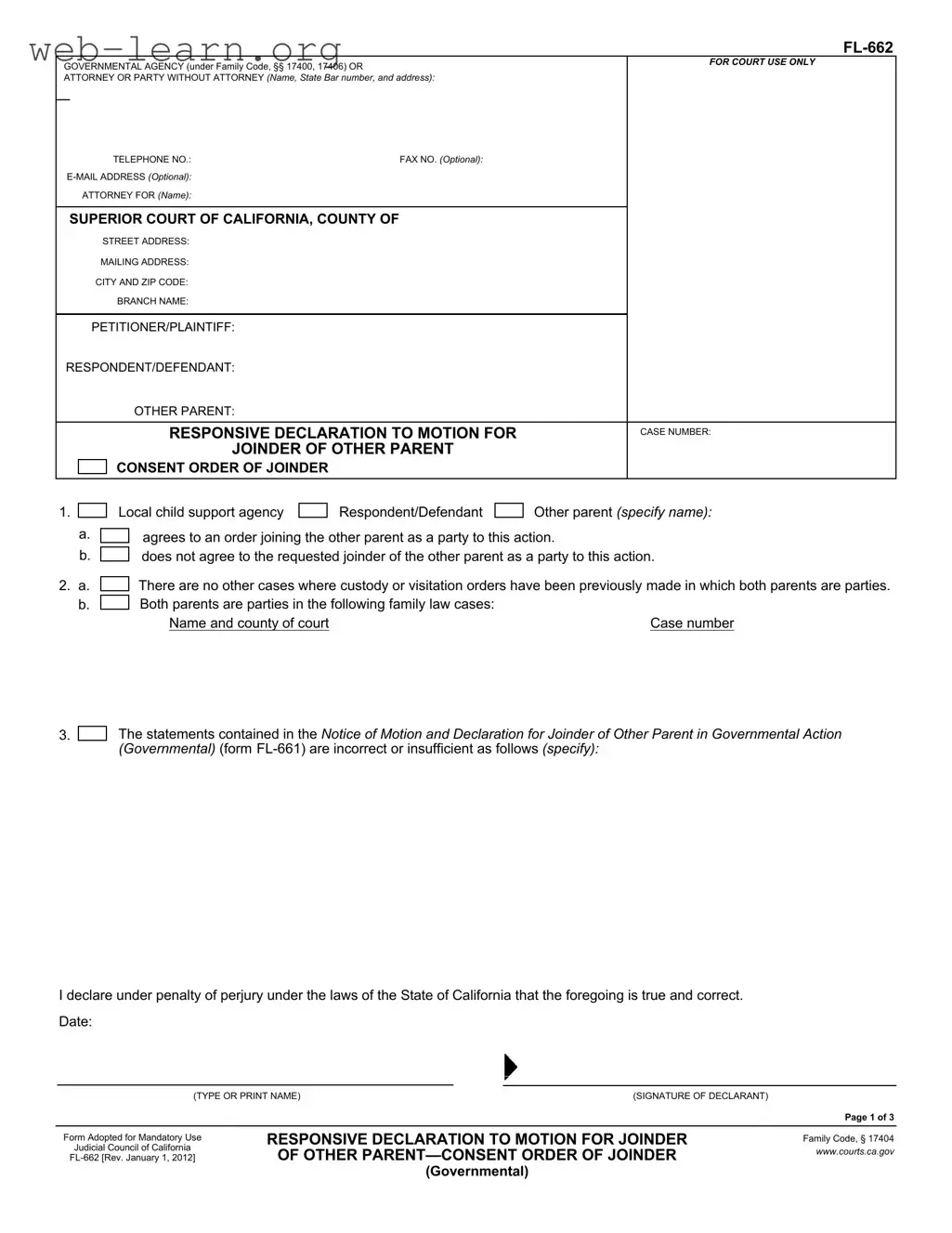
The California FL-662 form plays a crucial role in family law proceedings, particularly in matters involving child support and custody. This form is designed for use by governmental agencies and is also applicable in court situations where parties seek to join another parent in ongoing legal actions. The FL-662 provides a structured way for the petitioner or plaintiff to declare their intent regarding the joinder of another parent, whether they agree to it or not. It includes sections for detailing any existing family law cases involving both parents, as well as a mechanism for responding to motions for joinder. The form also requires a declaration under penalty of perjury, ensuring that the information provided is accurate and truthful. Additionally, it contains provisions for proof of service, which confirms that all relevant parties have been properly notified about the proceedings. By utilizing the FL-662, individuals can navigate the complexities of family law while ensuring compliance with California's legal requirements.
Sample - California Fl 662 Form

FL-662
FOR COURT USE ONLY
SUPERIOR COURT OF CALIFORNIA, COUNTY OF
STREET ADDRESS:
MAILING ADDRESS:
CITY AND ZIP CODE:
BRANCH NAME:
PETITIONER/PLAINTIFF:
RESPONDENT/DEFENDANT:
OTHER PARENT:
RESPONSIVE DECLARATION TO MOTION FOR
JOINDER OF OTHER PARENT
CASE NUMBER:
CONSENT ORDER OF JOINDER
1. Respondent/DefendantLocal child support agency Other parent (specify name):
agrees to an order joining the other parent as a party to this action.
a.
b.
2. a. There are no other cases where custody or visitation orders have been previously made in which both parents are parties.
Both parents are parties in the following family law cases:
b.
Name and county of court
Case number
The statements contained in the Notice of Motion and Declaration for Joinder of Other Parent in Governmental Action
(Governmental) (form
3.
I declare under penalty of perjury under the laws of the State of California that the foregoing is true and correct.
Date:
(TYPE OR PRINT NAME) (SIGNATURE OF DECLARANT)
Page 1 of 3
Family Code, § 17404
Form Adopted for Mandatory Use
Judicial Council of California
FL-662 [Rev. January 1, 2012]
RESPONSIVE DECLARATION TO MOTION FOR JOINDER
OF OTHER PARENT—CONSENT ORDER OF JOINDER
(Governmental)
www.courts.ca.gov
does not agree to the requested joinder of the other parent as a party to this action.
FL-661) are incorrect or insufficient as follows (specify):
TELEPHONE NO.: FAX NO. (Optional):
E-MAIL ADDRESS (Optional):
ATTORNEY FOR (Name):
GOVERNMENTAL AGENCY (under Family Code, §§ 17400, 17406) OR
ATTORNEY OR PARTY WITHOUT ATTORNEY (Name, State Bar number, and address):
PETITIONER/PLANTIFF:
CASE NUMBER:
RESPONDENT/DEFENDANT:
OTHER PARENT:
CONSENT ORDER
Defendant
1.
Plaintiff Other parent having consented and good cause appearing,
IT IS ORDERED that
the other parent is joined as a party to this proceeding.
a.
is taken off calendar.
b.
Date:
JUDICIAL OFFICER
Page 2 of 3
FL-662 [Rev. January 1, 2012]
RESPONSIVE DECLARATION TO MOTION FOR JOINDER
OF OTHER PARENT—CONSENT ORDER OF JOINDER
(Governmental)
the hearing on the motion for joinder set on (date):
FL-662
PROOF OF SERVICE
At the time of service I was at least 18 years of age and not a party to the legal action.
My residence or business address is (specify):
I served a copy of the foregoing Responsive Declaration as follows (check either a or b for each person served):
a.
Personal delivery. I personally delivered a copy and all attachments as follows:
(1)
(2)
Name of party or attorney served: Name of local child support agency served:
(a) Address where delivered: (a) Address where delivered:
(b) Date delivered:
b. Mail. I am a resident of or employed in the county where the mailing occurred.
(1) I enclosed a copy in an envelope and
(a)
(b)
(2) The envelope was addressed and mailed as follows:
Name of party or attorney served:
(b)
Name of local child support agency served:
(a)
(i) Address:
(i) Address:
(ii) Date mailed: (ii) Date mailed:
(iii) Place of mailing (city and state): (iii) Place of mailing (city and state):
I declare under penalty of perjury under the laws of the State of California that the foregoing is true and correct.
Date:
(TYPE OR PRINT NAME) (SIGNATURE OF PERSON WHO SERVED MOTION)
Page 3 of 3
RESPONSIVE DECLARATION TO MOTION FOR JOINDER
OF OTHER PARENT—CONSENT ORDER OF JOINDER
(Governmental)
PETITIONER/PLANTIFF:
CASE NUMBER:
RESPONDENT/DEFENDANT:
OTHER PARENT:
2.
1.
3.
(c) Time delivered:
(b) Date delivered:
(c) Time delivered:
placed the envelope for collection and mailing on the date and at the place shown below following our
ordinary business practices. I am readily familiar with this business’s practice for collecting and
processing correspondence for mailing. On the same day that correspondence is placed for collection and
mailing, it is deposited in the ordinary course of business with the U.S. Postal Service in a sealed envelope
with postage fully prepaid.
deposited the sealed envelope with the U.S. Postal Service with the postage fully prepaid.
FL-662 [Rev. January 1, 2012]
FL-662
(3) Address Verification (please specify):
(a)
(b)
(i)
verified by the California Child Support Enforcement System (CSE) as the current primary mailing
address on file.
other (specify):
The address for each individual identified in items 3a and 3b was
(ii)
I served a request to modify a child custody, visitation, or child support judgment or permanent order,
which included an address verification declaration (Declaration Regarding Address Verification—
Postjudgment Request to Modify a Child Custody, Visitation, or Child Support Order (form FL-334) may be
used for this purpose).

Form Information

Fact Name Details
Governing Law The FL-662 form is governed by California Family Code, sections 17400 and 17406.
Purpose This form is used for a responsive declaration to a motion for joinder of another parent in a child support case.
Parties Involved The form involves three parties: the Petitioner/Plaintiff, the Respondent/Defendant, and the Other Parent.
Consent Requirement The form includes sections where the other parent can agree or disagree to be joined as a party in the action.
Proof of Service A section for proof of service is included, ensuring that all parties receive the necessary documents.
Declaration Under Penalty The declarant must declare under penalty of perjury that the information provided is true and correct.
Form Revision Date The FL-662 form was last revised on January 1, 2012, and is adopted for mandatory use by the Judicial Council of California.

Detailed Guide for Filling Out California Fl 662

Filling out the California FL-662 form is an important step in legal proceedings involving child support and parental rights. Ensure you have all necessary information before you begin. Follow these steps to complete the form accurately.

  1. At the top of the form, provide the name of the governmental agency or court using the form.
  2. Fill in your name, state bar number (if applicable), and address in the section for the attorney or party without an attorney.
  3. Include your telephone number, and optionally, your fax number and email address.
  4. Identify the attorney representing the other party, if applicable, by entering their name.
  5. Fill in the name of the court, the street address, mailing address, city, and zip code of the court.
  6. List the names of the petitioner/plaintiff, respondent/defendant, and other parent involved in the case.
  7. Enter the case number in the designated space.
  8. Indicate whether the other parent agrees to be joined as a party to the action by checking the appropriate box.
  9. Specify if there are any other cases with custody or visitation orders involving both parents. If so, provide the names and case numbers of those cases.
  10. If there are inaccuracies in the Notice of Motion and Declaration for Joinder of Other Parent, specify them in the provided space.
  11. Sign and date the form, typing or printing your name beneath your signature.
  12. Complete the Proof of Service section by indicating your age and status as a non-party to the action.
  13. Provide your residence or business address.
  14. Choose how you served the Responsive Declaration: either by personal delivery or by mail. Fill in the required details for the method chosen.
  15. Confirm that you have verified the addresses of the individuals served, if applicable.
  16. Finally, declare under penalty of perjury that the information provided is true and correct, sign and date this section as well.

Obtain Answers on California Fl 662

  1. What is the purpose of the California FL-662 form?

    The California FL-662 form is used to respond to a motion for the joinder of another parent in a child support case. It allows parties to either consent to or contest the joining of the other parent as a party in the legal action. This form is essential for ensuring that all relevant parties are involved in matters related to child support and custody.

  2. Who should fill out the FL-662 form?

    The FL-662 form should be completed by the respondent or defendant in a child support case, as well as the other parent if they are being joined in the action. If you are involved in a child support case and have received a motion for joinder, it is important to respond appropriately using this form.

  3. What information is required on the FL-662 form?

    When filling out the FL-662 form, you will need to provide:

    • Your name and contact information.
    • The name of the petitioner or plaintiff.
    • The name of the respondent or defendant.
    • The name of the other parent being joined.
    • The case number associated with the child support action.
  4. What happens if I agree to the joinder of the other parent?

    If you agree to the joinder of the other parent, you will indicate your consent on the form. This means you accept that the other parent will be included as a party in the case. The court will then issue an order confirming this joinder, and the hearing for the motion may be removed from the calendar.

  5. What if I do not agree to the joinder?

    If you do not agree to the joinder of the other parent, you must clearly state your objections on the form. You may also provide reasons why you believe the joinder should not occur. The court will consider your response before making a decision on the motion.

  6. How do I serve the FL-662 form?

    You must serve the FL-662 form to all relevant parties involved in the case. This can be done through personal delivery or by mailing a copy of the form. Ensure you follow the proper procedures for service, including documenting the date and time of service, as well as the method used.

  7. What is the significance of the Proof of Service section?

    The Proof of Service section is crucial because it verifies that all parties have received the necessary documents. This section must be completed accurately, as it provides evidence to the court that you have fulfilled your obligation to notify others involved in the case.

  8. Can I submit the FL-662 form electronically?

    Whether you can submit the FL-662 form electronically depends on the specific court's rules. Many courts in California allow for electronic filing, but it is important to check with the local court to confirm their procedures. If electronic submission is permitted, follow the guidelines provided by the court.

  9. What should I do if I have more questions about the FL-662 form?

    If you have additional questions about the FL-662 form or the joinder process, consider reaching out to a legal professional or the local child support agency. They can provide guidance tailored to your specific situation and help ensure you understand the process fully.

Common mistakes

Filling out the California FL 662 form can be a straightforward process, but several common mistakes can lead to complications. One frequent error is failing to provide complete contact information. This includes not listing the full names, addresses, and phone numbers of all parties involved. Incomplete information can delay the processing of the case and create confusion about who is involved.

Another mistake is neglecting to specify whether the other parent agrees to the joinder. The form requires a clear indication of consent or disagreement. Skipping this step can result in misunderstandings and may require additional court appearances to clarify the situation.

People often overlook the requirement to disclose any previous custody or visitation orders involving both parents. This information is crucial for the court to understand the context of the case. Failing to mention existing orders can lead to complications or even the dismissal of the request.

Additionally, some individuals may not provide adequate details regarding any incorrect or insufficient statements from the Notice of Motion and Declaration for Joinder. This section allows the party to clarify issues, and omitting it can weaken their position. Clear and specific explanations are essential for the court's understanding.

Finally, individuals sometimes forget to complete the proof of service section accurately. This part of the form is vital for demonstrating that all parties have been properly notified of the proceedings. Errors in this section can lead to delays or challenges in the legal process.

Documents used along the form

The California FL-662 form, known as the Responsive Declaration to Motion for Joinder of Other Parent, is an essential document used in family law cases, particularly those involving child support. It facilitates the inclusion of another parent in legal proceedings, ensuring that all relevant parties are considered. Alongside this form, several other documents are frequently utilized to support the legal process and ensure compliance with state regulations. Below is a list of some of these important forms and documents.

  • FL-661: This is the Notice of Motion and Declaration for Joinder of Other Parent in Governmental Action. It outlines the request for the other parent to be joined in the case and provides the necessary declarations to support this motion.
  • FL-334: The Declaration Regarding Address Verification is often used when requesting modifications to child custody, visitation, or child support orders. It includes an address verification declaration to ensure all parties are properly notified.
  • FL-300: The Request for Order form is used to ask the court for specific orders regarding child custody, visitation, or support. This form initiates the court process for modifications or new requests.
  • FL-320: The Child Custody and Visitation Application form is essential for detailing custody arrangements and visitation schedules. It helps the court understand the proposed living arrangements for the child.
  • FL-150: The Income and Expense Declaration is required to assess the financial situation of the parties involved. This document provides crucial information regarding income, expenses, and financial obligations.
  • FL-685: The Child Support Information and Order Attachment form is used to provide detailed information about child support calculations and is often attached to other motions or requests for orders.
  • FL-610: The Request for Child Support Order form is utilized to formally request child support from the other parent. This document outlines the specifics of the support needed and the reasons for the request.
  • FL-400: The Response to Request for Order form allows a responding party to provide their input regarding the requests made by the other party. It is essential for ensuring both sides are heard in court.
  • FL-680: The Child Support Case Registry form is necessary for registering child support cases with the local child support agency. This helps in tracking and managing child support payments and obligations.

Each of these documents plays a significant role in the family law process, ensuring that all necessary information is presented to the court. They help facilitate communication between parties and support the legal framework surrounding child custody and support matters in California. Understanding these forms can greatly assist individuals navigating the complexities of family law proceedings.

Similar forms

The California FL-662 form, which addresses the joinder of another parent in family law cases, shares similarities with several other legal documents. Each of these documents serves a specific purpose in family law proceedings, particularly concerning child support and custody matters. Below is a list of documents similar to the FL-662 form:

  • FL-661: Notice of Motion and Declaration for Joinder of Other Parent in Governmental Action - This form initiates the process for joining another parent in a child support case. It outlines the request for joinder and provides the necessary declarations.
  • FL-334: Declaration Regarding Address Verification - Used to verify the addresses of involved parties, this form ensures that all communications regarding custody or support modifications are sent to the correct locations.
  • FL-300: Request for Order - This document is filed to request a court order regarding child custody, visitation, or support. It functions similarly by seeking judicial intervention in family law matters.
  • FL-310: Responsive Declaration to Request for Order - Similar to the FL-662, this form allows a party to respond to a request for order, providing their position on the matters presented.
  • FL-150: Income and Expense Declaration - This form is essential for determining child support obligations. It requires parties to disclose their financial information, paralleling the need for transparency found in the FL-662.
  • FL-320: Child Custody and Visitation Application - This document addresses custody arrangements and visitation rights. It is similar in that it involves the rights and responsibilities of parents regarding their children.
  • FL-610: Application for Child Support Services - This form is used to request child support services from the local child support agency. It shares the focus on parental responsibilities and support obligations highlighted in the FL-662.

Understanding these documents can help ensure that all necessary steps are taken in family law proceedings, particularly when addressing the complexities of parental involvement and support obligations.

Dos and Don'ts

When filling out the California FL-662 form, it is important to follow specific guidelines to ensure accuracy and compliance. Below is a list of things you should and shouldn't do:

  • Do read the entire form carefully before starting to fill it out. Understanding each section is crucial.
  • Do provide complete and accurate information for all required fields. Incomplete forms can lead to delays.
  • Do sign and date the form where indicated. Your signature is necessary for the form to be valid.
  • Do keep a copy of the completed form for your records. This can be useful for future reference.
  • Do check for any additional documents that may need to be submitted along with the form.
  • Don't leave any required fields blank. Omissions can result in rejection of your submission.
  • Don't use correction fluid or tape to alter any information. This can make your form appear unprofessional.
  • Don't forget to verify the mailing addresses for all parties involved. Incorrect addresses can cause issues in communication.
  • Don't submit the form without ensuring that all necessary signatures are obtained.
  • Don't ignore deadlines. Timeliness is essential when submitting legal documents.

Misconceptions

Understanding the California FL-662 form can be challenging due to various misconceptions. Here are ten common misunderstandings along with clarifications:

  1. It is only for child support cases. Many believe that the FL-662 form is exclusively related to child support. In reality, it is used for joining another parent in any family law action, not just those involving child support.
  2. Only governmental agencies can use this form. While the form is often associated with governmental agencies, private parties can also file it. Anyone involved in a family law case can utilize the FL-662 to seek joinder of another parent.
  3. Filing the form guarantees a court order. Some assume that submitting the FL-662 automatically results in a court order for joinder. However, the court must review the request and determine whether to grant it based on the merits of the case.
  4. The form is not necessary if both parents agree. Even if both parents consent to joinder, the FL-662 form is still required to formally document that agreement and to ensure that the court recognizes the other parent as a party to the action.
  5. It can be filed at any time during the proceedings. There are specific timelines for filing the FL-662. It must be submitted within certain timeframes relative to other motions or actions in the case.
  6. All family law cases require this form. Not every family law case necessitates the FL-662. It is specifically used when there is a need to join another parent in the proceedings, which may not be relevant in all cases.
  7. Completing the form is straightforward. While the FL-662 may seem simple, it requires careful attention to detail. Incorrect or incomplete information can lead to delays or rejections of the request.
  8. It is only relevant for custody and visitation issues. The FL-662 is often linked to custody and visitation, but it is also applicable in cases involving child support and other family law matters.
  9. Once filed, the form is no longer needed. After filing the FL-662, parties must keep track of any subsequent actions or hearings. It is important to remain engaged in the process, as additional forms or responses may be required.
  10. Legal representation is not necessary. While individuals can file the FL-662 without an attorney, having legal representation can provide valuable guidance and ensure that all procedural requirements are met.

By addressing these misconceptions, individuals can better navigate the complexities of family law in California and utilize the FL-662 form effectively.

Key takeaways

When filling out and using the California FL-662 form, it is essential to understand its purpose and the requirements involved. Here are some key takeaways to keep in mind:

  • The FL-662 form is used for joining another parent as a party in a child support case.
  • It is important to provide accurate information about all parties involved, including names and addresses.
  • The form must be completed and submitted to the Superior Court of California in the appropriate county.
  • Both parents must agree to the joinder for it to be processed smoothly.
  • If there are existing family law cases involving both parents, this must be disclosed on the form.
  • Any inaccuracies in the Notice of Motion and Declaration for Joinder must be specified clearly.
  • A declaration under penalty of perjury is required, affirming the truthfulness of the information provided.
  • Proof of service must be included, showing how and when the other parent was notified of the joinder.
  • Ensure that all relevant dates, such as the hearing date, are correctly noted on the form.
  • It is advisable to keep copies of the completed form and any attachments for your records.

Completing the FL-662 form accurately and promptly can significantly impact the resolution of child support matters. Therefore, attention to detail is crucial.