Homepage Blank California Fl 605 Form
Outline

The California FL-605 form plays a crucial role in family law proceedings, particularly when it comes to the service of legal documents. This form is primarily used for acknowledging the receipt of documents served by mail, ensuring that the recipient is aware of the legal actions being taken against them. It is important to note that the acknowledgment must be signed by the individual receiving the documents or an authorized representative if the recipient is an entity such as a corporation or partnership. The form includes essential details such as the names of the parties involved, the case number, and the specific documents being served, which may include a Summons and Complaint, proposed judgments, and various declarations. Failure to return the acknowledgment within 20 days can result in additional legal expenses for the sender, highlighting the importance of timely response. This form not only facilitates communication between parties but also serves as a safeguard against potential disputes regarding service of process in family law cases.
Sample - California Fl 605 Form

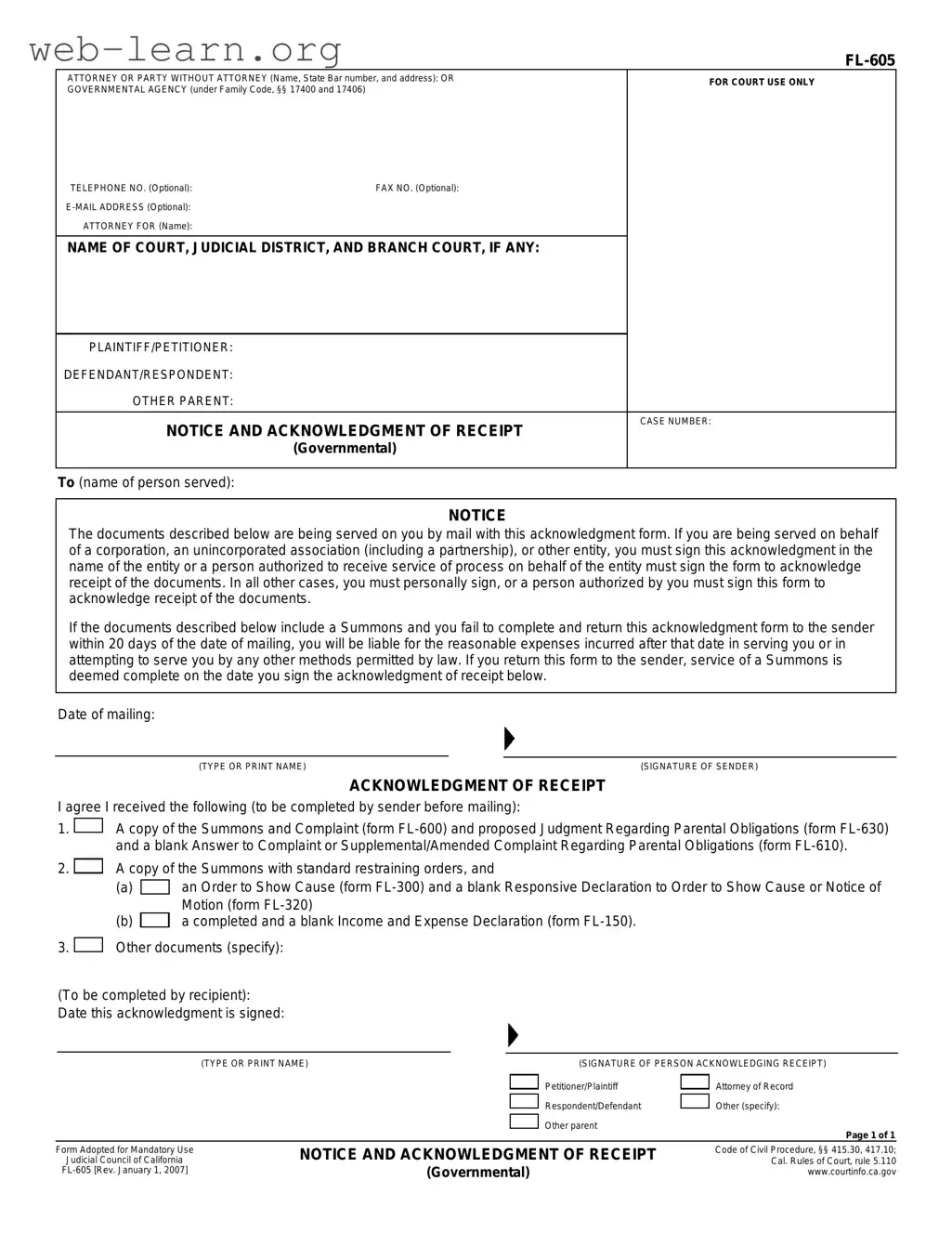
FL-605
ATTORNEY OR PARTY WITHOUT ATTORNEY (Name, State Bar number, and address): OR
GOVERNMENTAL AGENCY (under Family Code, §§ 17400 and 17406)
FOR COURT USE ONLY
TELEPHONE NO. (Optional): FAX NO. (Optional):
E-MAIL ADDRESS (Optional):
ATTORNEY FOR (Name):
NAME OF COURT, JUDICIAL DISTRICT, AND BRANCH COURT, IF ANY:
PLAINTIFF/PETITIONER:
DEFENDANT/RESPONDENT:
OTHER PARENT:
CASE NUMBER:
NOTICE AND ACKNOWLEDGMENT OF RECEIPT
(Governmental)
To (name of person served):
NOTICE
The documents described below are being served on you by mail with this acknowledgment form. If you are being served on behalf
of a corporation, an unincorporated association (including a partnership), or other entity, you must sign this acknowledgment in the
name of the entity or a person authorized to receive service of process on behalf of the entity must sign the form to acknowledge
receipt of the documents. In all other cases, you must personally sign, or a person authorized by you must sign this form to
acknowledge receipt of the documents.
If the documents described below include a Summons and you fail to complete and return this acknowledgment form to the sender
within 20 days of the date of mailing, you will be liable for the reasonable expenses incurred after that date in serving you or in
attempting to serve you by any other methods permitted by law. If you return this form to the sender, service of a Summons is
deemed complete on the date you sign the acknowledgment of receipt below.
Date of mailing:
(TYPE OR PRINT NAME) (SIGNATURE OF SENDER)
ACKNOWLEDGMENT OF RECEIPT
I agree I received the following (to be completed by sender before mailing):
A copy of the Summons and Complaint (form FL-600) and proposed Judgment Regarding Parental Obligations (form FL-630)
and a blank Answer to Complaint or Supplemental/Amended Complaint Regarding Parental Obligations (form FL-610).
1.
2.
A copy of the Summons with standard restraining orders, and
an Order to Show Cause (form FL-300) and a blank Responsive Declaration to Order to Show Cause or Notice of
(a)
Motion (form FL-320)
a completed and a blank Income and Expense Declaration (form FL-150).
(b)
3.
Other documents (specify):
(To be completed by recipient):
(TYPE OR PRINT NAME) (SIGNATURE OF PERSON ACKNOWLEDGING RECEIPT)
Petitioner/Plaintiff Attorney of Record
Respondent/Defendant Other (specify):
Other parent
Page 1 of 1
Code of Civil Procedure, §§ 415.30, 417.10;
Cal. Rules of Court, rule 5.110
NOTICE AND ACKNOWLEDGMENT OF RECEIPT
(Governmental)
Form Adopted for Mandatory Use
Judicial Council of California
FL-605 [Rev. January 1, 2007]
www.courtinfo.ca.gov
Date this acknowledgment is signed:

Form Information

Fact Name Details
Purpose The FL-605 form is used for acknowledging the receipt of legal documents in family law cases, particularly when served by a governmental agency.
Governing Laws This form is governed by the California Family Code, specifically sections 17400 and 17406, as well as the California Code of Civil Procedure, sections 415.30 and 417.10.
Signature Requirement Individuals must sign the acknowledgment to confirm receipt. If an entity is being served, an authorized person must sign on behalf of that entity.
Timeframe for Acknowledgment Recipients have 20 days from the mailing date to return the acknowledgment form. Failure to do so may result in liability for additional service costs.
Form Adoption The FL-605 form is adopted for mandatory use by the Judicial Council of California and was last revised on January 1, 2007.

Detailed Guide for Filling Out California Fl 605

Filling out the California FL 605 form is a crucial step in the legal process. This form serves as a notice and acknowledgment of receipt for documents being served. It is important to ensure that all information is accurately provided to avoid any complications. Following the steps below will guide you through the completion of the form.

  1. Begin by entering your name, state bar number (if applicable), and address at the top of the form in the designated section.
  2. If applicable, include your telephone number, fax number, and email address. These fields are optional.
  3. Indicate the name of the attorney for whom you are filling out the form, if relevant.
  4. Fill in the name of the court, judicial district, and branch court, if any, where the case is being filed.
  5. Clearly state the names of the parties involved: the plaintiff/petitioner, defendant/respondent, and other parent.
  6. Enter the case number in the specified area.
  7. In the section labeled "To (name of person served)," write the name of the individual receiving the documents.
  8. Document the date of mailing in the appropriate field.
  9. Complete the acknowledgment section by typing or printing your name and signing as the sender.
  10. In the acknowledgment of receipt section, list the documents being served. Be specific about each document, including any forms such as the Summons and Complaint, proposed Judgment, or any other relevant documents.
  11. Have the recipient of the documents sign and date the acknowledgment of receipt section. This should be done after they have received the documents.

Once the form is filled out, it is essential to ensure that all signatures are obtained and that the acknowledgment is returned to the sender promptly. This will help establish that the documents have been properly served and received.

Obtain Answers on California Fl 605

  1. What is the purpose of the California FL-605 form?

    The California FL-605 form is used for acknowledging the receipt of legal documents, specifically in family law cases. It ensures that the person receiving the documents is aware of what has been sent and confirms their receipt.

  2. Who needs to sign the FL-605 form?

    The form must be signed by the person who receives the documents. If the documents are being served to a corporation or another entity, an authorized representative must sign on behalf of that entity.

  3. What happens if I do not return the FL-605 form?

    If you do not return the FL-605 form within 20 days, you may be responsible for the costs incurred in attempting to serve you the documents again. This can include reasonable expenses for additional service methods allowed by law.

  4. What documents are typically included with the FL-605 form?

    Common documents that may accompany the FL-605 form include:

    • A copy of the Summons and Complaint (form FL-600).
    • A proposed Judgment Regarding Parental Obligations (form FL-630).
    • A blank Answer to Complaint or Supplemental/Amended Complaint Regarding Parental Obligations (form FL-610).
    • Other related documents as specified by the sender.
  5. How should the FL-605 form be filled out?

    The sender must complete the form by filling in their name, contact information, and the details of the documents being sent. The recipient will then sign and date the acknowledgment section to confirm receipt.

  6. Is there a specific format for mailing the FL-605 form?

    While there is no strict format, it is important to ensure that the FL-605 form is included with the other documents being sent. It should be mailed to the recipient in a manner that allows for confirmation of delivery.

  7. Can I email the FL-605 form instead of mailing it?

    The FL-605 form is generally used for documents served by mail. However, if both parties agree, alternative methods of service may be possible. Always check the specific court rules or consult with a legal professional.

  8. What if I receive the FL-605 form but do not recognize the sender?

    If you receive the FL-605 form and do not recognize the sender, you should contact them for clarification. It is important to understand the nature of the documents being served, especially in legal matters.

  9. Where can I find more information about the FL-605 form?

    More information about the FL-605 form can be found on the California Courts website. This site offers resources and guidance related to family law and court procedures.

  10. What should I do if I have further questions about the FL-605 form?

    If you have additional questions, consider reaching out to a legal professional or the court clerk's office. They can provide specific guidance based on your situation.

Common mistakes

When filling out the California FL-605 form, individuals often overlook critical details that can lead to complications in their legal proceedings. One common mistake is failing to include the correct name of the court, judicial district, and branch court. This information is essential for the court to properly identify the case. If this section is left blank or filled out incorrectly, it can delay the processing of documents and create confusion about jurisdiction.

Another frequent error is neglecting to sign the acknowledgment of receipt. The form requires a signature from the person acknowledging receipt of the documents. If the signature is missing, the acknowledgment may not be considered valid, potentially leading to issues with service of process. This can result in additional costs and delays as parties may need to re-serve documents.

People also often misinterpret the requirement for who can sign the form. If the documents are served on behalf of a corporation or other entity, the acknowledgment must be signed by an authorized representative of that entity. Failing to adhere to this requirement can invalidate the acknowledgment and complicate the legal process. It’s crucial to ensure that the correct individual signs on behalf of the entity to avoid these pitfalls.

Lastly, individuals sometimes forget to complete the section specifying the documents being acknowledged. This section should detail the items being served, such as the Summons and Complaint or other related documents. If this information is omitted, it can create ambiguity about what has been received, potentially leading to disputes about whether all necessary documents were properly served. Clarity in this section is vital for maintaining the integrity of the legal process.

Documents used along the form

The California FL-605 form is often used in family law cases, particularly for acknowledging the receipt of legal documents. When dealing with family law matters, several other forms and documents may also be required to ensure that all legal procedures are followed correctly. Below is a list of some commonly used forms that complement the FL-605.

  • FL-600: Summons and Complaint - This form initiates a family law case and notifies the other party of the legal action being taken. It outlines the nature of the case and the specific requests being made.
  • FL-630: Proposed Judgment Regarding Parental Obligations - This document proposes the terms of parental responsibilities and obligations, including custody and support arrangements, for the court's consideration.
  • FL-610: Answer to Complaint - This form allows the respondent to formally reply to the claims made in the complaint. It is essential for the respondent to express their position regarding the case.
  • FL-300: Order to Show Cause - This form is used to request a court hearing to address specific issues, such as changes in custody or support, and requires the other party to respond.
  • FL-320: Responsive Declaration to Order to Show Cause - The respondent uses this form to provide their side of the story in response to the Order to Show Cause. It is crucial for presenting their arguments in court.
  • FL-150: Income and Expense Declaration - This document provides a detailed account of an individual's income and expenses, helping the court assess financial situations for support determinations.
  • FL-140: Declaration of Disclosure - This form ensures that both parties disclose their financial information to each other, promoting transparency in financial matters during the case.
  • FL-200: Request for Order - This form is used to request specific court orders related to child custody, support, or other family law matters. It is essential for initiating motions in ongoing cases.
  • FL-310: Notice of Motion - This document notifies the other party about a motion being filed with the court, providing details about the request and the hearing date.

Understanding these forms can help you navigate the family law process more effectively. Each document serves a specific purpose and contributes to the overall case, ensuring that all parties are informed and that legal requirements are met.

Similar forms

  • FL-600 - Summons and Complaint: This form initiates a family law case. Like FL-605, it requires acknowledgment of receipt, ensuring that all parties are informed of the legal proceedings.
  • FL-610 - Answer to Complaint: This document allows the responding party to formally reply to the allegations in the complaint. It also follows the same acknowledgment process as FL-605.
  • FL-630 - Proposed Judgment Regarding Parental Obligations: Similar to FL-605, this form outlines proposed terms for parental responsibilities. It requires acknowledgment to ensure all parties are aware of the proposed terms.
  • FL-300 - Order to Show Cause: This form requests a court hearing. Like FL-605, it must be acknowledged by the recipient to confirm they are aware of the hearing.
  • FL-320 - Responsive Declaration to Order to Show Cause: This document allows a party to respond to the Order to Show Cause. It shares the acknowledgment requirement found in FL-605.
  • FL-150 - Income and Expense Declaration: This form provides the court with financial information. Acknowledgment of receipt is important to ensure compliance with financial disclosures, similar to FL-605.
  • FL-200 - Petition for Dissolution of Marriage: This document starts divorce proceedings. Like FL-605, it requires acknowledgment to confirm that the other party is informed of the legal action.
  • FL-235 - Declaration Under Uniform Child Custody Jurisdiction and Enforcement Act: This form addresses custody jurisdiction issues. Acknowledgment is necessary to ensure all parties understand the custody matters being addressed.
  • FL-310 - Request for Order: This form requests specific court orders. Similar to FL-605, it requires acknowledgment to confirm that the other party is aware of the requests being made.
  • FL-140 - Declaration of Disclosure: This document is used to disclose financial information in family law cases. Acknowledgment is crucial to ensure that all parties are aware of the disclosures made, just like in FL-605.

Dos and Don'ts

When filling out the California FL-605 form, it is crucial to follow certain guidelines to ensure accuracy and compliance. Here is a list of things you should and shouldn't do:

  • Do provide your full name and address at the top of the form.
  • Do include your telephone number, fax number, and email address if applicable.
  • Do clearly state the name of the court and the case number.
  • Do ensure that the acknowledgment of receipt is signed by the correct individual or authorized representative.
  • Do mail the form promptly to avoid delays in the legal process.
  • Don't leave any required fields blank; all sections must be completed.
  • Don't sign the form without reading the acknowledgment section carefully.
  • Don't forget to keep a copy of the completed form for your records.
  • Don't submit the form late, as this may result in additional expenses for service of process.

Completing the FL-605 form accurately is essential for effective communication within the legal system. Adhering to these guidelines can help prevent complications in your case.

Misconceptions

Understanding the California FL-605 form is crucial for anyone involved in legal proceedings. However, several misconceptions can lead to confusion. Here are seven common misunderstandings about this form:

  • It is only for attorneys. The FL-605 form can be used by any party involved in a case, not just attorneys. Individuals representing themselves can also complete this form.
  • It is optional to acknowledge receipt. Acknowledging receipt is not optional. If you receive a Summons and fail to return the acknowledgment within 20 days, you may incur additional expenses.
  • Only the recipient can sign the acknowledgment. While the recipient must sign, if the documents are being served on behalf of an entity, an authorized person can sign on behalf of that entity.
  • The form is only for family law cases. Although the FL-605 is commonly used in family law, it can apply to other legal matters where service of process is required.
  • Returning the form is the same as responding to the complaint. Acknowledging receipt does not equate to responding to the complaint. A separate response is required to address the claims made.
  • Service is complete upon mailing. Service is only considered complete when the acknowledgment form is signed and returned. This is a critical distinction.
  • There is no time limit for returning the acknowledgment. There is a strict 20-day deadline for returning the acknowledgment. Missing this deadline can lead to additional legal complications.

Clarifying these misconceptions can help ensure that individuals navigate their legal obligations effectively and avoid unnecessary complications.

Key takeaways

Filling out and using the California FL 605 form requires attention to detail and understanding of its purpose. Here are some key takeaways:

  • Purpose of the Form: The FL 605 form serves as a Notice and Acknowledgment of Receipt for documents being served. It is particularly important in family law cases involving governmental agencies.
  • Signature Requirements: The recipient must sign the form to acknowledge receipt. If the documents are served on behalf of an entity, an authorized representative must sign.
  • Timely Response: The recipient has 20 days to return the acknowledgment form. Failure to do so may result in liability for additional service expenses.
  • Documentation Included: The sender must specify the documents being acknowledged, such as the Summons and Complaint, as well as any additional forms relevant to the case.

Understanding these points can help ensure proper completion and use of the FL 605 form, facilitating smoother legal processes.