Homepage Blank California Fl 360 Form
Outline

The California FL 360 form is a crucial document used in family law proceedings, particularly when individuals seek to challenge or modify existing child support orders. This form serves multiple purposes, including a request for a hearing and an application to set aside a support order under Family Code Section 3691. It requires the petitioner or party without an attorney to provide essential details such as their name, contact information, and the case number. The form outlines the grounds for the request, which may include fraud, perjury, or lack of notice regarding the support order. Additionally, it emphasizes the importance of adhering to specific time limits for filing the request, ensuring that parties act promptly. The FL 360 also includes a section where individuals can present facts in support of their request, which must be accompanied by a declaration under penalty of perjury. Furthermore, it informs parties about the possibility of their case being referred to a court commissioner, who may act as a temporary judge unless objections are raised. This comprehensive form is designed to facilitate fair hearings and ensure that all parties have the opportunity to present their case effectively.
Sample - California Fl 360 Form

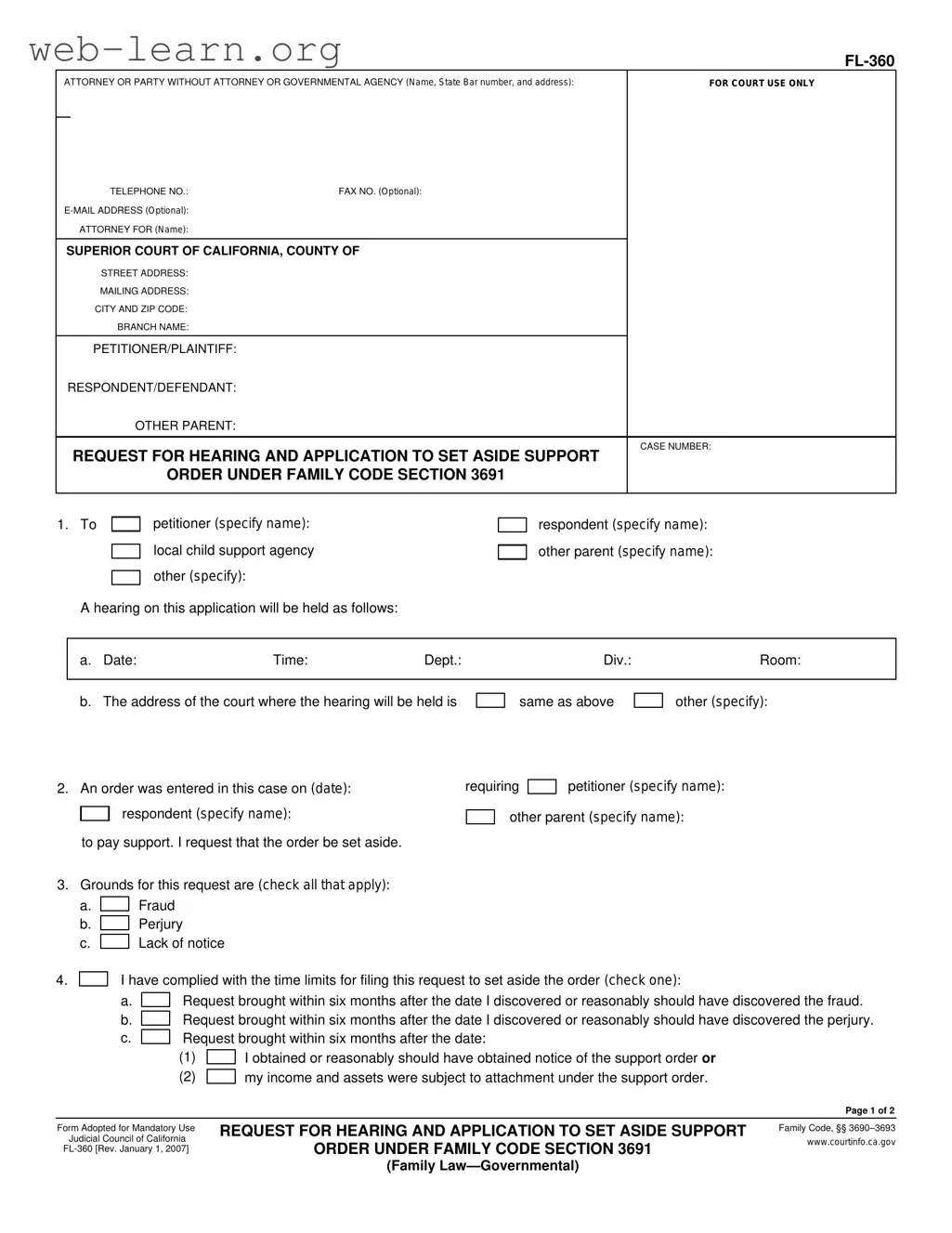
FL-360
ATTORNEY OR PARTY WITHOUT ATTORNEY OR GOVERNMENTAL AGENCY (Name, State Bar number, and address):
FOR COURT USE ONLY
TELEPHONE NO.: FAX NO. (Optional):
E-MAIL ADDRESS (Optional):
ATTORNEY FOR (Name):
SUPERIOR COURT OF CALIFORNIA, COUNTY OF
STREET ADDRESS:
MAILING ADDRESS:
CITY AND ZIP CODE:
BRANCH NAME:
PETITIONER/PLAINTIFF:
RESPONDENT/DEFENDANT:
OTHER PARENT:
CASE NUMBER:
REQUEST FOR HEARING AND APPLICATION TO SET ASIDE SUPPORT
ORDER UNDER FAMILY CODE SECTION 3691
1. To
Div.:Dept.:
Room:
a. Date: Time:
other (specify):same as aboveb. The address of the court where the hearing will be held is
requiring
2. An order was entered in this case on (date):
to pay support. I request that the order be set aside.
3. Grounds for this request are (check all that apply):
Frauda.
Perjuryb.
Lack of notice
4. I have complied with the time limits for filing this request to set aside the order (check one):
Request brought within six months after the date I discovered or reasonably should have discovered the fraud. a.
b.
c.
(1)
I obtained or reasonably should have obtained notice of the support order or
(2)
Page 1 of 2
Form Adopted for Mandatory Use
Judicial Council of California
FL-360 [Rev. January 1, 2007]
Family Code, §§ 3690–3693
www.courtinfo.ca.gov
REQUEST FOR HEARING AND APPLICATION TO SET ASIDE SUPPORT
ORDER UNDER FAMILY CODE SECTION 3691
(Family Law—Governmental)
c.
my income and assets were subject to attachment under the support order.
Request brought within six months after the date:
Request brought within six months after the date I discovered or reasonably should have discovered the perjury.
A hearing on this application will be held as follows:
petitioner (specify name):
respondent (specify name):
local child support agency
other parent (specify name):
petitioner (specify name):
respondent (specify name):
other parent (specify name):
other (specify):
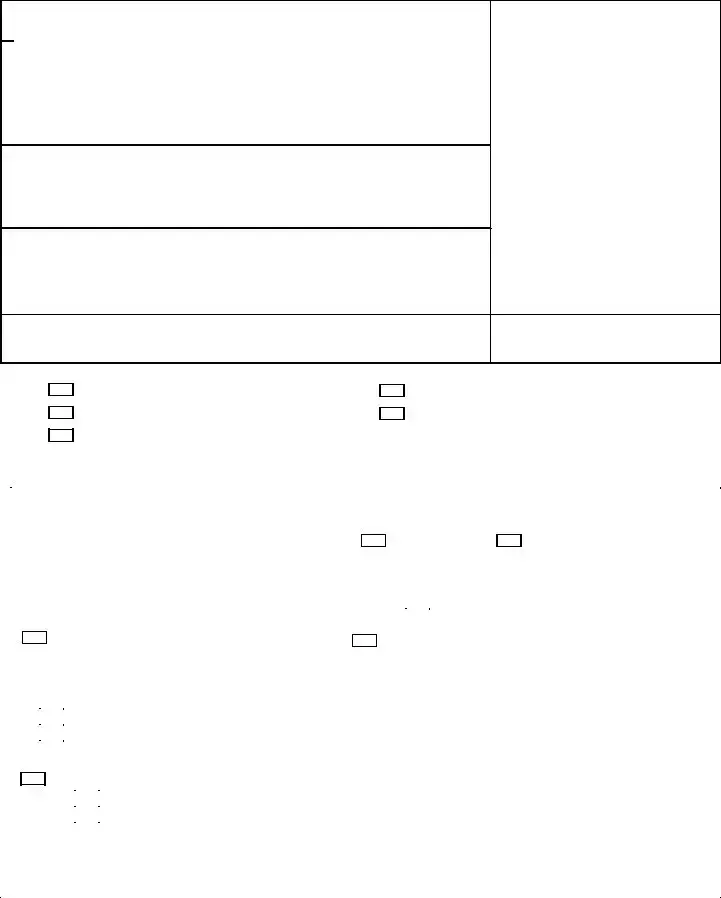
PETITIONER/PLAINTIFF:
CASE NUMBER:
FACTS IN SUPPORT of relief requested are (specify):
5.
Contained in the attached declaration.
I declare under penalty of perjury under the laws of the State of California that the foregoing is true and correct.
Date:
(TYPE OR PRINT NAME) (SIGNATURE OF DECLARANT)
FL-360 [Rev. January 1, 2007]
REQUEST FOR HEARING AND APPLICATION
TO SET ASIDE SUPPORT ORDER
(Family Law—Governmental)
Page 2 of 2
RESPONDENT/DEFENDANT:
OTHER PARENT:
FL-360
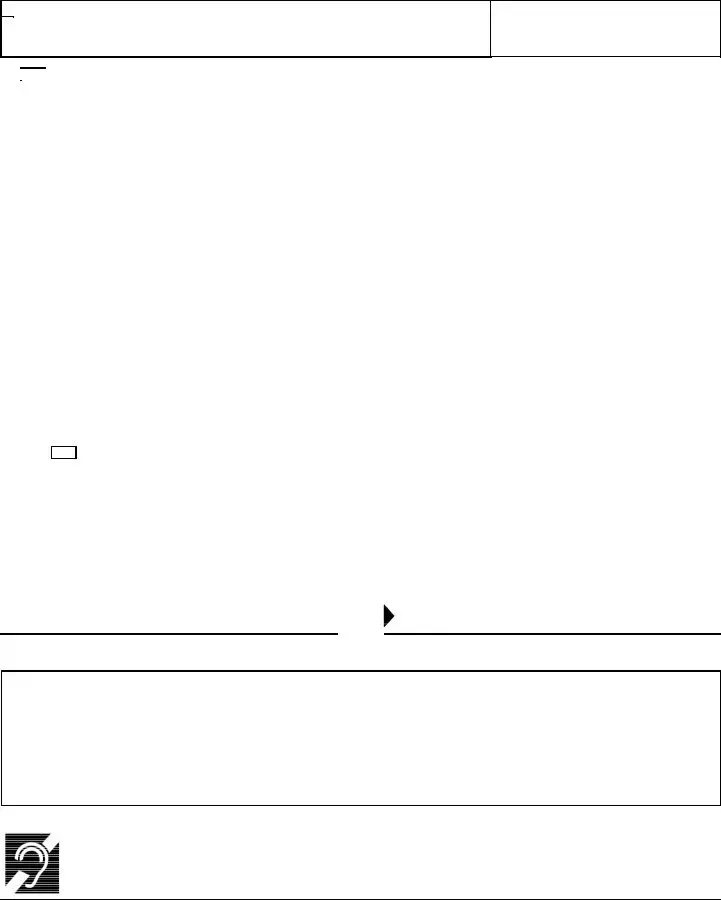
Request for Accommodations
Assistive listening systems, computer-assisted real-time captioning, or sign language interpreter services are available if
you ask at least five days before the proceeding. Contact the clerk's office or go to www.courtinfo.ca.gov/forms for
Request for Accommodations by Persons With Disabilities and Response (form MC-410). (Civil Code, § 54.8)
NOTICE FOR CASES INVOLVING A LOCAL CHILD SUPPORT AGENCY
This case may be referred to a court commissioner for hearing. By law, court commissioners do not have the authority to issue final
orders and judgments in contested cases unless they are acting as temporary judges. The court commissioner in your case will act
as a temporary judge unless, before the hearing, you or any other party objects to the commissioner acting as a temporary judge.
The court commissioner may still hear your case to make findings and a recommended order. If you do not like the recommended
order, you must object to it within 10 court days; otherwise, the recommended order will become a final order of the court. If you
object to the recommended order, a judge will make a temporary order and set a new hearing.

Form Information

Fact Name Details
Form Purpose The FL-360 form is used to request a hearing and apply to set aside a support order under California Family Code Section 3691.
Governing Laws This form is governed by California Family Code Sections 3690 to 3693.
Eligibility Petitioners, respondents, or other parents involved in a support order can use this form to request a hearing.
Filing Time Limits Requests must be filed within six months of discovering fraud, perjury, or lack of notice related to the support order.
Hearing Details The form requires specific details about the hearing, including date, time, department, and room number.
Commissioner Authority Court commissioners may hear cases but cannot issue final orders unless acting as temporary judges, unless an objection is raised.

Detailed Guide for Filling Out California Fl 360

Filling out the California FL 360 form is an important step if you need to request a hearing and apply to set aside a support order. Following the instructions carefully will help ensure that your application is complete and accurately reflects your situation. Here’s how to fill out the form:

  1. At the top of the form, enter the name, state bar number, and address of the attorney or party without attorney. If applicable, include the telephone number, fax number, and email address.
  2. Indicate the attorney for the party, if there is one.
  3. Fill in the court information, including the street address, mailing address, city, zip code, and branch name.
  4. Identify the parties involved by entering the names of the petitioner/plaintiff, respondent/defendant, and other parent.
  5. Write the case number in the designated space.
  6. In section 1, specify the name of the petitioner and respondent. Provide the date, time, department, division, and room for the hearing.
  7. Indicate the court address where the hearing will take place, if different from the above.
  8. In section 2, state the date when the original support order was entered and specify the names of the parties required to pay support.
  9. For section 3, check all applicable grounds for your request to set aside the order (fraud, perjury, lack of notice).
  10. In section 4, confirm compliance with the time limits for filing the request by checking the appropriate box.
  11. In section 5, provide facts in support of your request. You may refer to an attached declaration if needed.
  12. Sign and date the form, typing or printing your name where indicated.

Once you have completed the form, make sure to review it for accuracy. After that, you will need to file it with the appropriate court and follow any additional instructions provided by the court. This may include attending a hearing or submitting further documentation as required.

Obtain Answers on California Fl 360

  1. What is the purpose of the California FL-360 form?

    The California FL-360 form is used to request a hearing and to apply for setting aside a support order under Family Code Section 3691. This can be necessary if there are grounds such as fraud, perjury, or lack of notice regarding the original support order.

  2. Who can file the FL-360 form?

    The form can be filed by any party involved in the support order case, including the petitioner, respondent, or other parent. Additionally, a local child support agency may also be involved in the process.

  3. What information is required on the form?

    Essential information includes the names of the parties involved, the case number, the date of the original support order, and the grounds for requesting to set aside the order. You must also provide a declaration that supports your request.

  4. What are the grounds for setting aside a support order?

    The form allows you to check multiple grounds for your request, which include:

    • Fraud
    • Perjury
    • Lack of notice

  5. Are there time limits for filing the FL-360 form?

    Yes, there are specific time limits. You must file your request within six months of discovering the fraud or perjury, or within six months of obtaining notice of the support order. Adhering to these deadlines is crucial for your request to be considered.

  6. What happens after I file the FL-360 form?

    After filing, a hearing will be scheduled. You will receive a notice with the date, time, and location of the hearing. It is essential to attend this hearing to present your case.

  7. What if a local child support agency is involved?

    If a local child support agency is involved, the case may be referred to a court commissioner for hearing. Keep in mind that court commissioners do not have the authority to issue final orders unless they are acting as temporary judges. You have the right to object to this arrangement prior to the hearing.

  8. What accommodations are available for individuals with disabilities?

    Assistive listening systems, computer-assisted real-time captioning, and sign language interpreter services are available upon request. It is important to ask for these accommodations at least five days before the hearing to ensure they can be provided.

  9. Where can I find more information about the FL-360 form?

    Additional information and resources regarding the FL-360 form can be found on the California Judicial Council's website or by contacting the clerk's office at your local court. It is advisable to review these resources to ensure you are fully prepared for your hearing.

Common mistakes

Completing the California FL-360 form can be a straightforward process, but there are common mistakes that individuals often make. Awareness of these pitfalls can help ensure a smoother experience.

One frequent error is neglecting to provide complete contact information. The form requires the names, addresses, and phone numbers of all parties involved. Omitting any of this information can lead to delays in processing the application. Additionally, failing to include an email address, if available, can hinder communication with the court.

Another mistake is not clearly specifying the grounds for requesting to set aside the support order. The form lists options such as fraud, perjury, and lack of notice. Individuals should check all applicable boxes and provide adequate explanations to support their claims. Incomplete or vague responses may result in the court rejecting the request.

People often overlook the importance of adhering to filing deadlines. The form requires that the request to set aside the order be made within six months of discovering the relevant fraud or perjury. Ignoring this timeline can lead to automatic dismissal of the application, regardless of its merits.

Many individuals also fail to attach the necessary declaration that supports their request. The form indicates that facts in support of the relief requested should be included in an attached declaration. Without this document, the application may be considered insufficient and could be denied.

It is crucial to ensure that the signature on the form is valid. Some individuals mistakenly submit the form without signing it, which can result in delays. A signature is required to affirm that the information provided is true and correct under penalty of perjury.

In addition, individuals sometimes do not specify the correct court location for the hearing. The address provided should match the court where the application is filed. Mismatched information can lead to confusion and potential rescheduling of hearings.

Another common oversight is failing to check the box indicating compliance with the time limits for filing. This step is essential, as it confirms to the court that the request is timely. Neglecting to check this box may cause the application to be dismissed.

People often misunderstand the role of court commissioners. They may not realize that commissioners can only issue temporary orders unless there is an objection before the hearing. This misunderstanding can lead to confusion regarding the finality of orders issued during the proceedings.

Lastly, individuals frequently forget to request accommodations if needed. The form provides information about assistive listening systems and other services. Failing to make these requests at least five days in advance can result in inadequate support during the hearing.

By avoiding these common mistakes, individuals can enhance their chances of successfully navigating the process of filling out the California FL-360 form. Attention to detail and adherence to guidelines are key to ensuring a smoother experience in court.

Documents used along the form

The California FL-360 form is a critical document used in family law cases, particularly concerning support orders. Alongside this form, several other documents may be necessary to effectively navigate the legal process. Below is a list of commonly used forms and documents that often accompany the FL-360.

  • FL-300: Request for Order - This form is used to request a court order for various family law issues, including child custody, visitation, and support. It outlines the specific relief sought by the requesting party.
  • FL-150: Income and Expense Declaration - This document provides the court with a detailed account of an individual's income, expenses, and financial situation. It is crucial for determining support obligations.
  • FL-310: Declaration Under Uniform Child Custody Jurisdiction and Enforcement Act - This form is necessary when there are custody issues involving more than one state. It helps establish jurisdiction for custody matters.
  • FL-340: Child Support Information and Order Attachment - This form provides essential information regarding child support, including calculations and guidelines, and is typically attached to support orders.
  • FL-200: Response to Petition - This document is filed by a respondent to respond to the initial petition. It allows the respondent to present their side of the case and raise any counterclaims.
  • FL-250: Proof of Service - This form is used to confirm that all parties involved have been properly notified of court proceedings. It is essential for ensuring due process.
  • FL-311: Child Custody and Visitation Application - This document is used to request specific custody and visitation arrangements for children involved in family law disputes.
  • MC-410: Request for Accommodations - This form is utilized by individuals needing assistance due to disabilities. It ensures that necessary accommodations are provided during court proceedings.

Understanding these forms and their purposes can significantly aid individuals navigating family law matters in California. Each document plays a vital role in ensuring that the legal process is fair and thorough, ultimately serving the best interests of all parties involved.

Similar forms

  • FL-300: Petition for Dissolution of Marriage - This form initiates the process for ending a marriage, similar to how FL-360 requests a hearing to modify support obligations.
  • FL-310: Response to Petition for Dissolution of Marriage - Responds to the FL-300 petition, allowing parties to present their side, akin to how FL-360 allows for challenges to support orders.
  • FL-140: Declaration of Disclosure - Requires parties to disclose financial information, similar to FL-360, which may involve financial grounds for modifying support.
  • FL-150: Income and Expense Declaration - This form provides a detailed account of income and expenses, just as FL-360 requests financial grounds for setting aside a support order.
  • FL-200: Summons - Notifies the other party of a legal action, paralleling FL-360’s requirement to notify parties involved in support modification.
  • FL-310: Request for Order - Allows a party to request specific orders from the court, similar to FL-360's function of requesting a hearing for support modification.
  • FL-320: Response to Request for Order - This form allows a party to respond to a request for order, just as FL-360 facilitates responses to support order challenges.
  • FL-335: Income Withholding Order - This document enables the court to enforce support payments, akin to how FL-360 seeks to set aside existing support obligations.
  • FL-341: Child Custody and Visitation Order - Establishes custody arrangements, similar to how FL-360 addresses financial responsibilities in family law.

Dos and Don'ts

When filling out the California FL-360 form, it’s essential to approach the task with care and attention to detail. Here’s a list of things to do and avoid to ensure a smooth process.

  • Do read the entire form carefully before starting. Understanding the requirements will help you provide accurate information.
  • Do fill in all required fields completely. Missing information can delay your application.
  • Do check your spelling and grammar. Clear communication is vital, and errors can lead to misunderstandings.
  • Do keep a copy of the completed form for your records. This will be helpful for future reference.
  • Don't leave any sections blank unless instructed. Each part of the form serves a purpose.
  • Don't submit the form without reviewing it. A second look can catch mistakes you might have missed.
  • Don't ignore deadlines. Ensure your request is filed within the time limits specified.
  • Don't hesitate to seek help if you’re unsure about any part of the form. Resources are available to assist you.

By following these guidelines, you can navigate the process of completing the FL-360 form with confidence. Remember, thoroughness and accuracy are your best allies in this endeavor.

Misconceptions

Misconceptions can lead to confusion and hinder the effective use of legal forms. Below are six common misconceptions about the California FL-360 form, along with clarifications to help you better understand its purpose and usage.

  • The FL-360 form is only for attorneys. This form can be completed by either an attorney or a party representing themselves. It is designed for individuals who wish to request a hearing to set aside a support order.
  • Filing the FL-360 guarantees that the support order will be set aside. Submitting this form does not automatically cancel the support order. A hearing will be scheduled where the court will consider the request and make a decision based on the presented grounds.
  • Only fraud can be cited as a reason to set aside a support order. While fraud is one ground, the form allows for other reasons, such as perjury or lack of notice. It is essential to check all applicable reasons when completing the form.
  • The request must be filed immediately after discovering an issue. There are specific time limits for filing this request, generally within six months of discovering fraud, perjury, or lack of notice. Understanding these timeframes is crucial for a successful application.
  • A court commissioner can issue final orders in all cases. Court commissioners do not have the authority to issue final orders in contested cases unless they are acting as temporary judges. If you have concerns, you can object to the commissioner acting as a temporary judge before the hearing.
  • Accommodations for disabilities are not available. The court provides various accommodations, such as assistive listening systems and sign language interpreter services. These can be requested at least five days before the proceeding to ensure accessibility for all individuals.

Understanding these misconceptions can help individuals navigate the process with greater confidence and clarity. It is essential to approach the FL-360 form with accurate information to ensure that your rights and interests are protected.

Key takeaways

Here are some key takeaways about filling out and using the California FL 360 form:

  • The FL 360 form is used to request a hearing and apply to set aside a support order under Family Code Section 3691.
  • Clearly identify the parties involved, including the petitioner, respondent, and any other parents, to avoid confusion.
  • Provide accurate contact information, including phone numbers and email addresses, to facilitate communication.
  • Be mindful of the deadlines. Requests must be made within six months of discovering fraud, perjury, or lack of notice.
  • Include specific grounds for your request, such as fraud, perjury, or lack of notice, by checking the appropriate boxes on the form.
  • Attach a declaration that supports your request. This should detail the facts relevant to your case.
  • If a local child support agency is involved, be aware that a court commissioner may handle your case, but they can only issue temporary orders unless otherwise specified.
  • Know that if you disagree with a recommended order from the court commissioner, you must object within 10 court days to prevent it from becoming final.
  • If you need accommodations, such as assistive listening systems or sign language interpreters, request these services at least five days before the hearing.