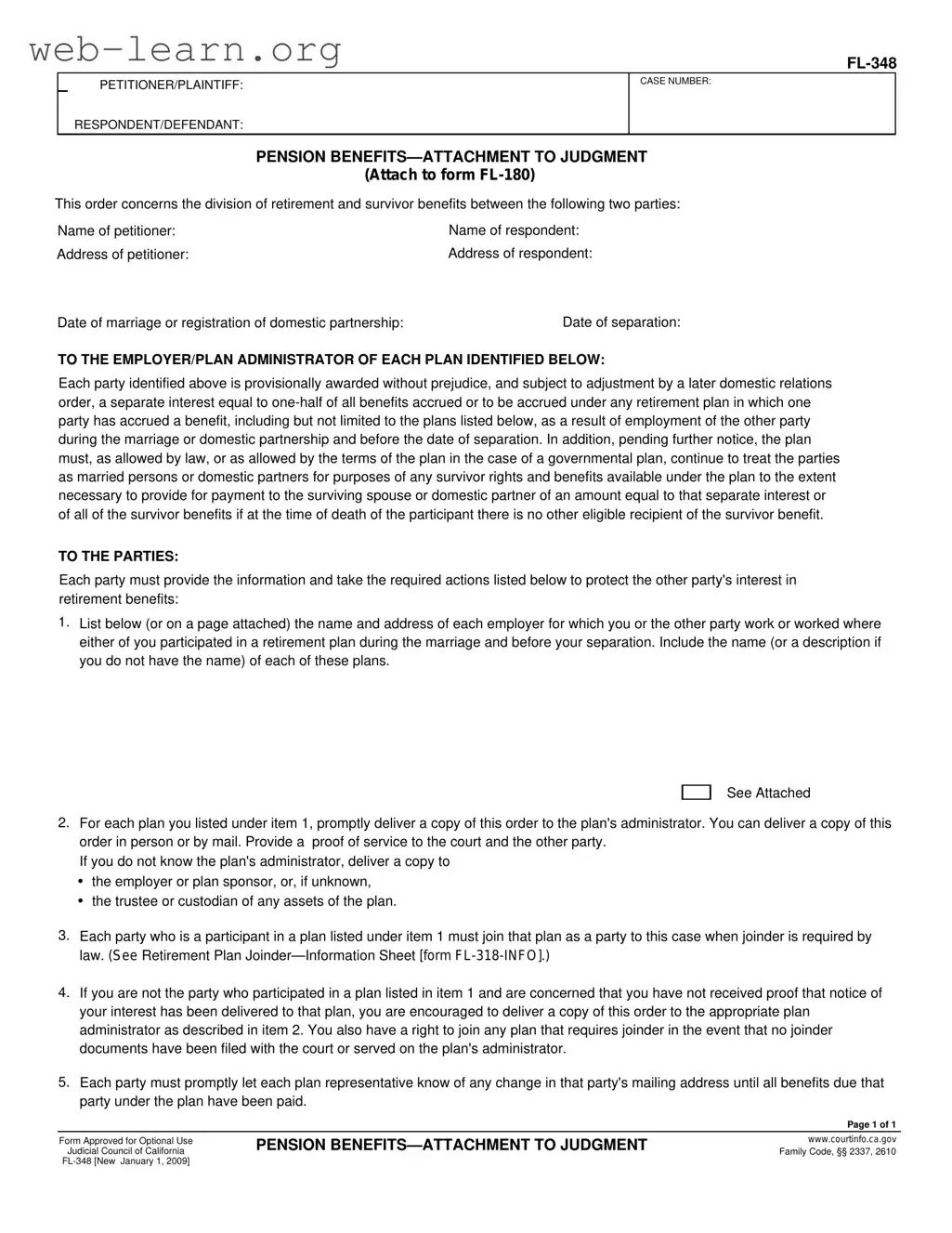
Homepage Blank California Fl 348 Form
Outline

The California FL-348 form plays a crucial role in the division of pension benefits during divorce or separation proceedings. This form, formally titled "Pension Benefits—Attachment to Judgment," is attached to the FL-180 form and outlines how retirement and survivor benefits will be divided between the parties involved. It requires both the petitioner and respondent to provide essential information, including their names, addresses, and details about their marriage or domestic partnership. The form instructs employers and plan administrators to recognize each party's right to a separate interest in the retirement benefits accrued during the marriage. This includes a provision that ensures the parties are treated as married for survivor benefits, safeguarding the financial interests of the surviving spouse or partner. Additionally, the FL-348 outlines specific actions that both parties must take to protect their interests, such as notifying plan administrators and providing proof of service to the court. Understanding this form is vital for anyone navigating the complexities of pension division in California family law.
Sample - California Fl 348 Form

FL-348
PETITIONER/PLAINTIFF:
CASE NUMBER:
RESPONDENT/DEFENDANT:
PENSION BENEFITS—ATTACHMENT TO JUDGMENT
(Attach to form FL-180)
This order concerns the division of retirement and survivor benefits between the following two parties:
Page 1 of 1
Form Approved for Optional Use
Judicial Council of California
FL-348 [New January 1, 2009]
www.courtinfo.ca.gov
Each party identified above is provisionally awarded without prejudice, and subject to adjustment by a later domestic relations
order, a separate interest equal to one-half of all benefits accrued or to be accrued under any retirement plan in which one
party has accrued a benefit, including but not limited to the plans listed below, as a result of employment of the other party
during the marriage or domestic partnership and before the date of separation. In addition, pending further notice, the plan
must, as allowed by law, or as allowed by the terms of the plan in the case of a governmental plan, continue to treat the parties
as married persons or domestic partners for purposes of any survivor rights and benefits available under the plan to the extent
necessary to provide for payment to the surviving spouse or domestic partner of an amount equal to that separate interest or
of all of the survivor benefits if at the time of death of the participant there is no other eligible recipient of the survivor benefit.
TO THE EMPLOYER/PLAN ADMINISTRATOR OF EACH PLAN IDENTIFIED BELOW:
List below (or on a page attached) the name and address of each employer for which you or the other party work or worked where
either of you participated in a retirement plan during the marriage and before your separation. Include the name (or a description if
you do not have the name) of each of these plans.
1.
For each plan you listed under item 1, promptly deliver a copy of this order to the plan's administrator. You can deliver a copy of this
order in person or by mail. Provide a proof of service to the court and the other party.
2.
Name of petitioner:
Address of petitioner:
Name of respondent:
Address of respondent:
Date of marriage or registration of domestic partnership:
Date of separation:
Each party must provide the information and take the required actions listed below to protect the other party's interest in
retirement benefits:
TO THE PARTIES:
If you do not know the plan's administrator, deliver a copy to
the employer or plan sponsor, or, if unknown,
the trustee or custodian of any assets of the plan.
Each party who is a participant in a plan listed under item 1 must join that plan as a party to this case when joinder is required by
law. (See Retirement Plan Joinder—Information Sheet [form FL-318-INFO].)
3.
If you are not the party who participated in a plan listed in item 1 and are concerned that you have not received proof that notice of
your interest has been delivered to that plan, you are encouraged to deliver a copy of this order to the appropriate plan
administrator as described in item 2. You also have a right to join any plan that requires joinder in the event that no joinder
documents have been filed with the court or served on the plan's administrator.
4.
Each party must promptly let each plan representative know of any change in that party's mailing address until all benefits due that
party under the plan have been paid.
5.
PENSION BENEFITS—ATTACHMENT TO JUDGMENT
Family Code, §§ 2337, 2610
See Attached

Form Information

Fact Name Details
Purpose The FL-348 form is used to address the division of retirement and survivor benefits between parties in a divorce or domestic partnership dissolution.
Governing Law This form is governed by California Family Code sections 2337 and 2610, which outline the distribution of pension benefits in family law cases.
Required Actions Parties must provide information about retirement plans, deliver a copy of the order to plan administrators, and notify any changes in mailing address.
Filing Date The form FL-348 was approved for optional use starting January 1, 2009, reflecting updates in California's family law procedures.

Detailed Guide for Filling Out California Fl 348

Filling out the California FL-348 form requires careful attention to detail. The form is designed to facilitate the division of pension benefits between two parties. It is essential to ensure that all information is accurate and complete to avoid any complications later in the process.

  1. Identify the Parties: In the designated sections, clearly write the name of the petitioner/plaintiff and the respondent/defendant. Include the case number.
  2. Provide Addresses: Enter the address of both the petitioner and the respondent in the appropriate fields.
  3. Marriage or Partnership Dates: Fill in the date of marriage or registration of domestic partnership, as well as the date of separation.
  4. List Employers: Below the section labeled "TO THE EMPLOYER/PLAN ADMINISTRATOR," list the names and addresses of each employer where either party participated in a retirement plan during the marriage and before separation. Include the name or description of each retirement plan.
  5. Deliver the Order: For each plan listed, promptly deliver a copy of this order to the plan's administrator. You can do this in person or by mail. Ensure to provide proof of service to the court and the other party.
  6. Join Plans as Required: If you are a participant in a plan listed, join that plan as a party to the case when required by law. Refer to the Retirement Plan Joinder—Information Sheet (form FL-318-INFO) for guidance.
  7. Notify of Changes: Each party must inform the plan representatives of any changes in their mailing address until all benefits due have been paid.

After completing the form, ensure that all necessary copies are made and that you keep a record of any deliveries made to plan administrators. This will help protect your interests and maintain clear communication throughout the process.

Obtain Answers on California Fl 348

  1. What is the purpose of the California FL-348 form?

    The California FL-348 form is used to outline the division of pension and retirement benefits between two parties in a divorce or separation. It serves as an attachment to the judgment form FL-180 and ensures that each party receives their fair share of benefits accrued during the marriage or domestic partnership. This form is particularly important for protecting the interests of both parties regarding retirement assets.

  2. Who needs to complete the FL-348 form?

    Both parties involved in a divorce or separation need to complete the FL-348 form. The petitioner (the person who initiates the case) and the respondent (the other party) must provide information about their retirement plans and any benefits accrued during the marriage. This ensures that both parties are aware of their rights and responsibilities concerning pension benefits.

  3. What information must be included in the FL-348 form?

    The FL-348 form requires several pieces of information, including:

    • The names and addresses of both parties.
    • The date of marriage or registration of domestic partnership.
    • The date of separation.
    • A list of employers for both parties where retirement plans were participated in during the marriage.
    • The names or descriptions of the retirement plans.

    Providing complete and accurate information is crucial for the proper division of benefits.

  4. What actions must each party take after completing the FL-348 form?

    After completing the FL-348 form, each party must take several actions to protect their interests:

    • Deliver a copy of the order to the plan administrator of each retirement plan listed.
    • Provide proof of service to the court and the other party.
    • Join the retirement plan as a party to the case if required by law.
    • Notify the plan representatives of any changes in mailing address until all benefits have been paid.
  5. What happens if one party does not participate in a retirement plan?

    If one party did not participate in a retirement plan, they still have rights regarding the benefits accrued by the other party. They can deliver a copy of the FL-348 order to the appropriate plan administrator to ensure their interests are recognized. Additionally, they have the right to join any plan that requires their involvement if necessary documentation has not been filed.

  6. How does the FL-348 form affect survivor benefits?

    The FL-348 form also addresses survivor benefits. It requires that, pending further notice, the retirement plan must continue to treat the parties as married or domestic partners for the purpose of survivor rights. This means that if one party passes away, the surviving spouse or partner may be entitled to benefits, ensuring that both parties are protected even after separation.

Common mistakes

Filling out the California FL-348 form can be a daunting task, and many individuals make mistakes that can complicate the process. One common error is failing to provide complete and accurate information about the parties involved. Each section requires specific details, including the names and addresses of both the petitioner and respondent. Missing or incorrect information can lead to delays and misunderstandings.

Another frequent mistake is neglecting to list all relevant employers and retirement plans. The form specifically asks for the name and address of each employer where either party participated in a retirement plan during the marriage. Omitting any employer can jeopardize the division of benefits and may require additional legal steps later on.

Many individuals also overlook the importance of notifying the plan administrator promptly. After listing the retirement plans, each party must deliver a copy of the order to the plan's administrator. Failing to do so can result in complications in enforcing the order, as the plan may not recognize the parties' interests in the benefits.

Additionally, some parties forget to provide proof of service to the court and the other party. This step is crucial, as it demonstrates that the necessary notifications have been made. Without this proof, the court may not accept the form, leading to further delays in the proceedings.

Joining the retirement plan as a party to the case is another critical step that is often missed. If a party is a participant in a plan listed on the form, they must ensure that the plan is joined in the case. Not doing so can result in the inability to enforce the order regarding the retirement benefits.

Moreover, individuals sometimes fail to communicate changes in their mailing address to the plan representatives. Keeping the plan informed of any address changes is vital until all benefits have been paid. If the plan does not have the correct address, it may not send important information or payments, causing unnecessary complications.

Lastly, some people do not take the time to read the instructions thoroughly. The FL-348 form comes with specific guidelines and requirements that must be followed closely. Ignoring these instructions can lead to incomplete forms and ultimately hinder the process of dividing retirement benefits.

Documents used along the form

The California FL-348 form, which addresses the division of pension benefits in a divorce or separation, often requires additional documentation to ensure that all parties' rights are protected. Below are other forms and documents commonly used alongside the FL-348 form. Each plays a crucial role in the process of dividing retirement benefits.

  • FL-180 - This is the Judgment form that finalizes the divorce or legal separation. It outlines the terms agreed upon by both parties, including asset division, child custody, and support obligations. The FL-348 is typically attached to this form to specify how pension benefits will be divided.
  • FL-318-INFO - This document provides information about the requirements for joining a retirement plan as a party to the case. It outlines the necessary steps and legal obligations for both parties regarding retirement benefits, ensuring compliance with the law.
  • FL-342 - This form is used to request a court order for the division of retirement benefits. It provides a detailed account of the retirement plans involved and the specifics of how the benefits should be divided, complementing the FL-348.
  • FL-321 - This form is a declaration of disclosure that parties must complete to disclose all financial information. It ensures transparency about assets, including retirement accounts, which is essential for equitable division.
  • Proof of Service - This document is necessary to confirm that all parties have received copies of relevant forms, including the FL-348. It serves as evidence that the required notifications were properly delivered to the appropriate plan administrators and other parties involved.
  • Retirement Plan Joinder - This document is necessary for formally adding a retirement plan to the case. It is required when a party has an interest in a retirement plan that needs to be addressed in the divorce proceedings, ensuring that all legal rights are preserved.

These documents work together to facilitate a fair and legal division of pension benefits. Proper completion and submission of each form can help avoid complications and ensure that both parties' rights are adequately protected throughout the process.

Similar forms

The California FL-348 form, which pertains to the division of pension benefits in divorce or separation proceedings, shares similarities with several other legal documents related to family law and retirement benefits. Below are six documents that are comparable to the FL-348 form:

  • FL-180: Judgment - This form is used to finalize a divorce or legal separation. Like the FL-348, it addresses the division of property, including retirement benefits, ensuring that all aspects of the marital estate are considered.
  • FL-318-INFO: Retirement Plan Joinder Information Sheet - This document provides information on how to join a retirement plan in divorce proceedings. Similar to the FL-348, it emphasizes the importance of recognizing retirement benefits as part of the marital estate.
  • FL-350: Spousal Support Order - This form establishes spousal support obligations. Both the FL-348 and FL-350 involve financial considerations post-separation, focusing on fair distribution of assets and support.
  • FL-310: Declaration for Default or Uncontested Dissolution - This document is used when one party does not respond to a divorce petition. It shares similarities with the FL-348 in that it can address the division of benefits without extensive litigation.
  • FL-300: Request for Order - This form is used to request a court order regarding various family law matters. Like the FL-348, it can be utilized to seek specific orders concerning the division of retirement assets.
  • FL-345: Notice of Motion to Modify Support - This document is used to request changes to existing support orders. Similar to the FL-348, it involves financial interests and the need for adjustments based on changing circumstances.

Dos and Don'ts

When filling out the California FL-348 form, it's important to follow certain guidelines to ensure accuracy and compliance. Here are five things you should and shouldn't do:

  • Do provide complete and accurate information for both parties, including names and addresses.
  • Don't leave any sections blank. Every part of the form must be filled out to avoid delays.
  • Do promptly deliver a copy of the order to the plan's administrator as required.
  • Don't forget to keep a proof of service. This is essential for your records and for the court.
  • Do inform each plan representative of any changes to your mailing address until all benefits have been paid.

Following these guidelines will help protect your interests and ensure that the process goes smoothly.

Misconceptions

Understanding the California FL-348 form can be challenging. Here are ten common misconceptions about this form, along with clarifications.

  • The FL-348 form is only for divorce cases. This form can also be used in domestic partnership cases where retirement benefits need to be divided.
  • You don’t need to inform the retirement plan administrator. Each party must deliver a copy of the order to the plan administrator to protect their interests.
  • The form guarantees immediate access to retirement benefits. The benefits are provisionally awarded and subject to adjustment by a later domestic relations order.
  • Only one party needs to fill out the form. Both parties must provide information and take required actions to ensure fair division of benefits.
  • The FL-348 form is a standalone document. It must be attached to form FL-180 to be valid.
  • You can ignore changes in mailing addresses. Each party must inform the plan representatives of any address changes until benefits are fully paid.
  • The form is only relevant during the divorce process. It remains important until all retirement benefits are paid out, even after the divorce is finalized.
  • All retirement plans are treated the same. Each plan may have different rules, so it’s important to check the specifics of each plan listed.
  • Joining a retirement plan is optional. If required by law, each party must join the relevant plans as parties to the case.
  • Proof of service is not necessary. Providing proof of service to the court and the other party is essential for compliance.

Key takeaways

Filling out the California FL-348 form can seem daunting, but understanding its key components can make the process smoother. Here are some important takeaways:

  • Identify the Parties: Clearly list the names and addresses of both the petitioner and the respondent. This ensures that all parties are accurately represented in the document.
  • Document Employment: Include the names and addresses of all employers where either party participated in a retirement plan during the marriage. This is crucial for identifying which plans may be affected by the division of benefits.
  • Notify Plan Administrators: Each party must deliver a copy of the FL-348 order to the plan's administrator. This can be done in person or by mail, and it’s important to provide proof of service to the court and the other party.
  • Join Relevant Plans: If you are a participant in any retirement plan listed, you need to formally join that plan as a party to the case, as required by law. This step is essential to protect your interests.
  • Stay Informed: If you are not the participant in a retirement plan but are concerned about your interest, you have the right to deliver a copy of the order to the plan administrator. Keeping communication open is key.
  • Update Contact Information: Each party must inform plan representatives of any changes to their mailing addresses until all benefits due have been received. This ensures that important communications are not missed.

By following these guidelines, individuals can better navigate the complexities of the FL-348 form and ensure their rights regarding pension benefits are protected.