Homepage Blank California Fl 344 Form
Outline

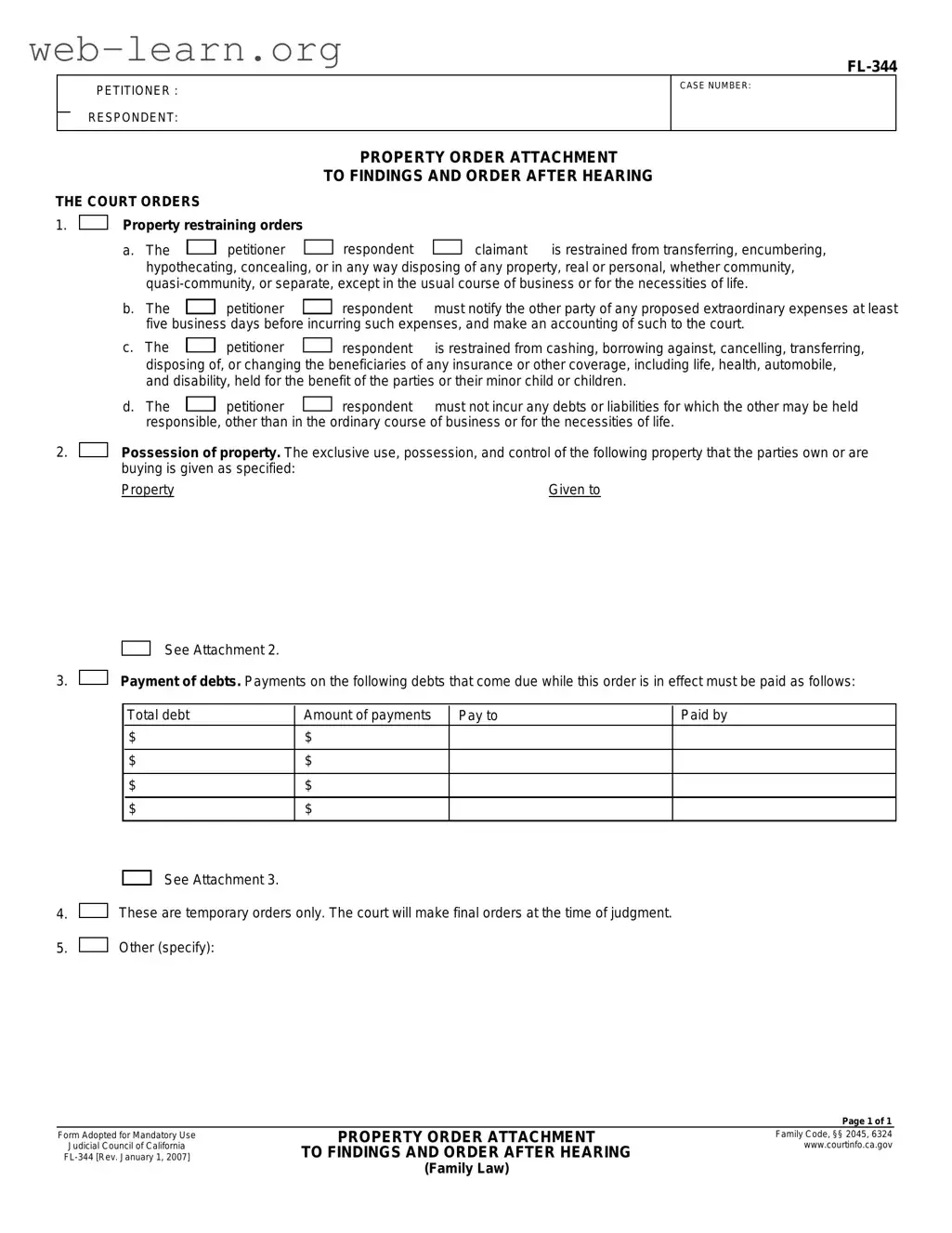
The California FL 344 form plays a crucial role in family law proceedings, particularly in cases involving property disputes. This form is designed to facilitate temporary orders concerning the management and control of property during the course of legal proceedings. It outlines specific restrictions on both parties, preventing them from transferring or encumbering property without consent. The form also mandates that any extraordinary expenses incurred by one party must be communicated to the other party at least five business days in advance, ensuring transparency and accountability. Additionally, it prohibits either party from making significant changes to insurance policies or incurring debts that could impact the other party's financial obligations. The FL 344 form also specifies the exclusive use and possession of property, detailing how debts should be managed while the order is in effect. It is important to note that these orders are temporary and subject to finalization by the court at the time of judgment, emphasizing the need for careful compliance during this interim period. Overall, the FL 344 form serves as a structured approach to managing property-related issues, promoting fairness and clarity for all parties involved.
Sample - California Fl 344 Form

CASE NUMBER:
PETITIONER :
RESPONDENT:
PROPERTY ORDER ATTACHMENT
TO FINDINGS AND ORDER AFTER HEARING
Property restraining orders
petitioner
a. The
five business days before incurring such expenses, and make an accounting of such to the court.
petitioner
is restrained from cashing, borrowing against, cancelling, transferring,
c. The
must not incur any debts or liabilities for which the other may be held d. The petitioner
Possession of property. The exclusive use, possession, and control of the following property that the parties own or are
buying is given as specified:
Property
Given to
See Attachment 2.
Payment of debts. Payments on the following debts that come due while this order is in effect must be paid as follows:
Other (specify):
PROPERTY ORDER ATTACHMENT
TO FINDINGS AND ORDER AFTER HEARING
(Family Law)
Form Adopted for Mandatory Use
Judicial Council of California
FL-344 [Rev. January 1, 2007]
Family Code, §§ 2045, 6324
www.courtinfo.ca.gov
THE COURT ORDERS
b. The
1.
2.
3.
5.
See Attachment 3.
FL-344
Page 1 of 1
respondent
is restrained from transferring, encumbering, claimant
hypothecating, concealing, or in any way disposing of any property, real or personal, whether community,
quasi-community, or separate, except in the usual course of business or for the necessities of life.
These are temporary orders only. The court will make final orders at the time of judgment.
4.
must notify the other party of any proposed extraordinary expenses at least
petitioner
respondent
disposing of, or changing the beneficiaries of any insurance or other coverage, including life, health, automobile,
and disability, held for the benefit of the parties or their minor child or children.
responsible, other than in the ordinary course of business or for the necessities of life.
respondent
respondent
Pay to
Amount of payments
Total debt
Paid by
$
$
$
$
$
$
$
$

Form Information

Fact Name Details
Form Title FL-344 is known as the Property Order Attachment to Findings and Order After Hearing.
Governing Law This form is governed by California Family Code sections 2045 and 6324.
Purpose The form is used to outline temporary property orders during family law proceedings.
Key Provisions The form includes restrictions on transferring, encumbering, or disposing of property.
Notification Requirement The petitioner must notify the other party of extraordinary expenses at least five business days in advance.
Temporary Nature Orders made using this form are temporary and will be finalized at the time of judgment.

Detailed Guide for Filling Out California Fl 344

Filling out the California FL-344 form is a straightforward process that requires careful attention to detail. This form is essential for presenting property orders and related matters to the court. Once completed, it will be submitted as part of your case, helping to clarify the arrangements regarding property and debts.

  1. Begin by entering the Petitioner name in the designated space at the top of the form.
  2. Next, fill in the Respondent name in the corresponding section.
  3. Provide the Case Number associated with your legal matter.
  4. In the section labeled Property Restraining Orders, list any restrictions on property transfers. Specify if the petitioner or respondent is restrained from transferring, encumbering, or disposing of property.
  5. Indicate that the petitioner must notify the other party of any extraordinary expenses at least five business days in advance.
  6. Complete the section regarding insurance coverage. Specify any restrictions on cashing, borrowing against, or changing beneficiaries of insurance policies.
  7. Document any debts or liabilities that the petitioner or respondent should not incur, except in the ordinary course of business.
  8. In the Possession of Property section, clearly state which party has exclusive use, possession, and control of the property. Reference any attachments as needed.
  9. For Payment of Debts, list the total debts that are due while the order is in effect. Include the amount of payments and specify who is responsible for each payment.
  10. Make sure to note that these are temporary orders only, and final orders will be made at the time of judgment.
  11. If there are any additional instructions or specifications, include them in the Other section.

Once you have completed the form, review it for accuracy before submitting it to the court. Ensure that all necessary attachments are included, as they will support the information provided in the FL-344 form.

Obtain Answers on California Fl 344

  1. What is the purpose of the California FL-344 form?

    The California FL-344 form is used in family law cases to outline temporary property orders after a hearing. It aims to protect the interests of both parties involved in a legal dispute by placing restrictions on the transfer or management of property. This ensures that neither party can make significant changes to their assets or incur debts that could affect the other party before a final decision is made by the court.

  2. What restrictions does the FL-344 impose on the parties involved?

    The FL-344 form includes several important restrictions:

    • The petitioner and respondent are restrained from transferring, encumbering, or disposing of any property, whether it is community, quasi-community, or separate.
    • Both parties must notify each other of any extraordinary expenses at least five business days prior to incurring them.
    • Neither party can cash, borrow against, or change beneficiaries on any insurance policies held for their benefit or their children’s.
    • They are also prohibited from incurring debts that the other party might be held responsible for, except in the ordinary course of business or for necessities.
  3. How long do the orders from the FL-344 last?

    The orders outlined in the FL-344 form are temporary. They remain in effect until the court makes final orders at the time of judgment. This means that while the restrictions are in place to protect both parties, they are not permanent and will be reviewed in the context of the final court decision.

  4. What should I do if I need to make changes to the property or debts listed in the FL-344?

    If you find yourself needing to make changes to property or debts specified in the FL-344, it is crucial to communicate with the other party. You must notify them of any extraordinary expenses at least five business days before you incur them. Additionally, you should document any changes and account for them in court, ensuring that you comply with the restrictions set forth in the order.

Common mistakes

Filling out the California FL-344 form can be a straightforward process, but mistakes can lead to complications. One common error is failing to accurately identify the petitioner and respondent. It’s essential to ensure that the names listed match those on other court documents. Any discrepancies can cause delays or even rejection of the form.

Another frequent mistake involves omitting necessary details regarding property. When specifying the property in question, it’s crucial to include all relevant information. This includes the type of property, its location, and any pertinent ownership details. Incomplete information can result in misunderstandings or disputes later on.

Many individuals also overlook the section on debts and payments. It’s important to provide a clear breakdown of debts that need to be paid while the order is in effect. Missing this information can lead to financial issues and may affect the court’s decisions. Make sure to double-check that all amounts and payment details are correct.

Some people mistakenly think that the orders on the FL-344 form are permanent. However, these are temporary orders only. Understanding this distinction is vital, as it affects how parties manage their property and debts until the court makes final decisions. Clarifying this point can prevent future confusion.

Lastly, failing to adhere to the notification requirements can be a significant oversight. The petitioner must notify the other party of any extraordinary expenses at least five business days in advance. Ignoring this requirement can lead to complications in enforcing the order and may even affect the outcome of the case.

Documents used along the form

The California FL-344 form is used in family law cases to establish temporary property orders during legal proceedings. Alongside this form, several other documents are commonly utilized to support the legal process. Below is a list of these related forms and documents.

  • FL-300 Request for Order: This form is used to ask the court for a specific order regarding various matters, such as child custody, visitation, or support. It outlines the requests being made and provides a basis for the hearing.
  • FL-150 Income and Expense Declaration: This document provides the court with detailed information about an individual's income, expenses, and financial situation. It is often required when financial issues are being addressed in family law cases.
  • FL-310 Declaration for Default or Uncontested Dissolution: This form is used in cases where one party does not respond to the divorce petition. It helps the petitioner obtain a default judgment without the need for a trial.
  • FL-341 Declaration Under Uniform Child Custody Jurisdiction and Enforcement Act: This document is essential for cases involving child custody. It provides information about the child's residence and any prior custody orders from other jurisdictions.

These forms play a crucial role in ensuring that the court has all the necessary information to make informed decisions regarding property and custody matters. Proper completion and submission of these documents can significantly impact the outcome of a case.

Similar forms

  • California FL-350: This form is used to request a court order for spousal support. Similar to FL-344, it outlines the financial responsibilities of each party and can include provisions about property and debts during the support period.
  • California FL-300: The FL-300 form is a request for order that can address various issues, including property division. Like FL-344, it is used in family law cases to establish temporary orders until a final decision is made.
  • California FL-341: This is a declaration regarding service of the summons and petition. It is similar to FL-344 in that it ensures that all parties are aware of the proceedings, which is crucial when property orders are involved.
  • California FL-145: This form is a declaration for disclosure of assets and liabilities. It is similar to FL-344 as it requires both parties to disclose their financial information, which is essential when determining property orders.
  • California FL-360: The FL-360 form is a request for a domestic violence restraining order. It shares similarities with FL-344 in that it can impose restrictions on property and financial transactions to protect a party from harm.
  • California FL-341(C): This is a property declaration form that outlines the community and separate property of both parties. Like FL-344, it helps the court understand the assets that may be affected by property orders.
  • California FL-230: This form is used for a notice of motion and motion for a temporary restraining order. It is similar to FL-344 because it also seeks immediate court intervention regarding property or financial matters.
  • California FL-385: This is a request for an order to modify or terminate spousal support. It is similar to FL-344 as it can involve changes to property and financial responsibilities as circumstances change.
  • California FL-150: This form is a financial statement used to disclose income and expenses. It is similar to FL-344 since both documents require transparency about financial situations, which impacts property orders.
  • California FL-200: This is a summons in family law cases. Like FL-344, it informs the parties of their rights and obligations, particularly regarding property and financial matters during legal proceedings.

Dos and Don'ts

When filling out the California FL-344 form, it's important to follow specific guidelines to ensure accuracy and compliance. Here’s a list of things you should and shouldn't do:

  • Do read the instructions carefully before starting.
  • Do provide complete and accurate information for both parties.
  • Do use clear and concise language throughout the form.
  • Do double-check all calculations related to debts and payments.
  • Do ensure that any attachments referenced are included.
  • Don't leave any sections blank unless instructed to do so.
  • Don't use legal jargon or complex terms that may confuse the reader.
  • Don't forget to sign and date the form before submitting.
  • Don't submit the form without making copies for your records.

By following these guidelines, you can navigate the process more smoothly and help ensure that your form is processed without unnecessary delays.

Misconceptions

Understanding the California FL-344 form can be challenging, especially with the various misconceptions that surround it. Here are six common misunderstandings about this important legal document:

  • The FL-344 form is only for divorce cases. Many believe that this form is exclusively used in divorce proceedings. However, it can also apply in other family law situations, such as legal separations or child custody disputes.
  • Filing the FL-344 guarantees immediate possession of property. Some individuals think that completing this form will automatically grant them possession of property. In reality, the form outlines temporary orders that must be confirmed by the court.
  • Once the FL-344 is filed, the terms are permanent. A common misconception is that the orders established through the FL-344 are permanent. In fact, these orders are temporary and will be reviewed and finalized during the court's judgment.
  • Only one party needs to sign the FL-344. Many people assume that only the petitioner’s signature is necessary. However, both parties may need to be involved in the process, depending on the circumstances of the case.
  • The FL-344 does not require any documentation. Some believe that this form can be submitted without any supporting documents. In truth, additional attachments may be necessary to provide clarity on property division and debt responsibilities.
  • All property is automatically protected under the FL-344. There is a misconception that all assets are automatically safeguarded once the form is filed. The FL-344 specifically outlines which properties are protected and under what conditions.

By dispelling these misconceptions, individuals can better navigate the complexities of family law and ensure they are fully informed when dealing with the FL-344 form.

Key takeaways

Filling out and using the California FL-344 form can seem daunting, but understanding its key components can simplify the process. Here are some important takeaways to keep in mind:

  • Understand the Purpose: The FL-344 form is used to request temporary property orders in family law cases. It helps ensure that both parties are clear about their rights and responsibilities regarding property during legal proceedings.
  • Property Restraints: The form includes specific orders that prevent either party from transferring or disposing of property without consent. This is crucial for protecting assets while the case is ongoing.
  • Notification Requirements: If you are the petitioner, you must notify the other party about any significant expenses you plan to incur at least five business days in advance. This requirement fosters transparency and accountability.
  • Temporary Nature of Orders: Remember that the orders issued through this form are temporary. The court will establish final orders at the time of judgment, so it’s important to stay informed and engaged throughout the process.

By keeping these key points in mind, you can navigate the use of the FL-344 form more effectively and ensure that your rights are protected during the proceedings.