Homepage Blank California Fl 341 B Form
Outline

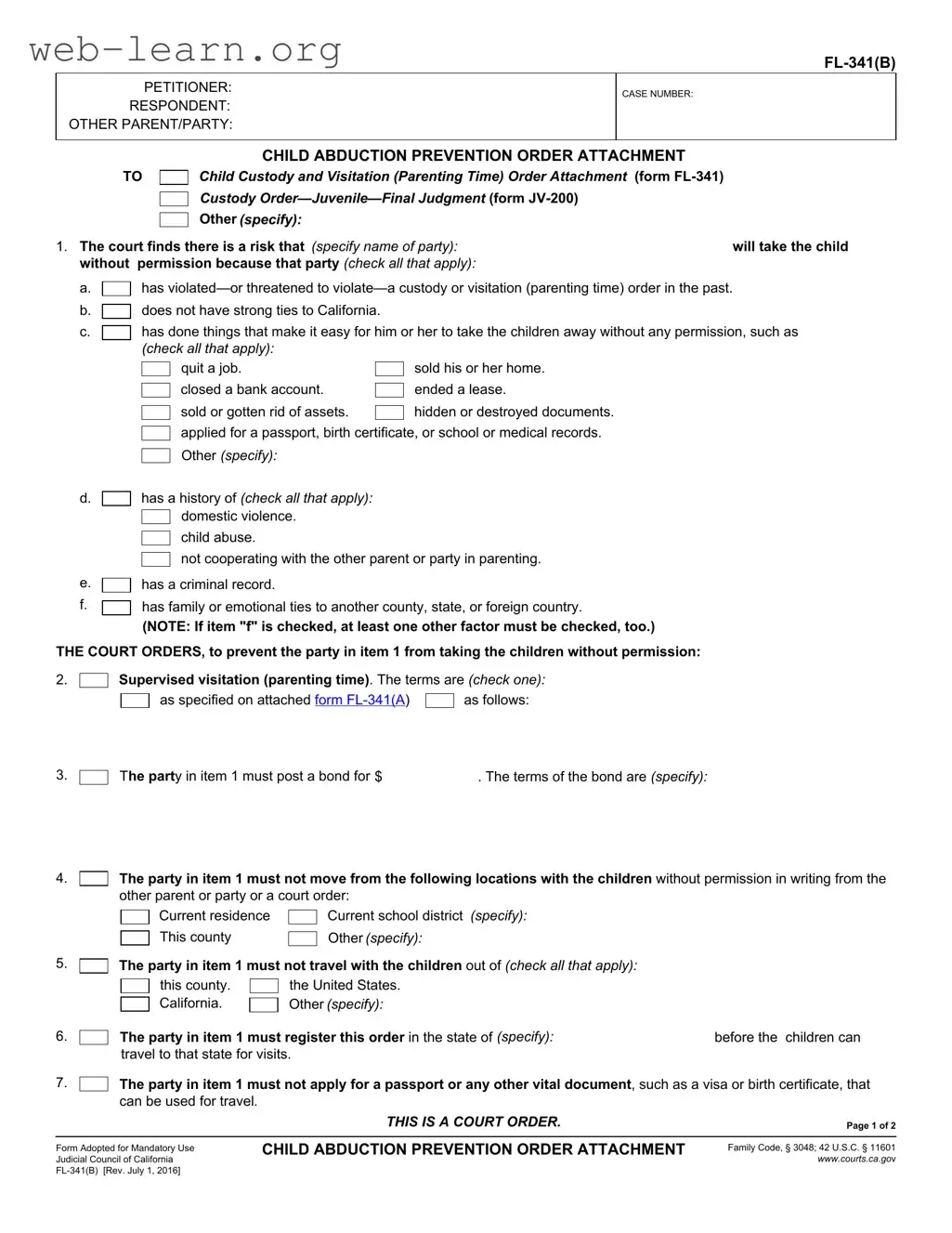
The California FL-341(B) form serves as a critical tool in child custody cases, particularly when there is a concern about the potential for child abduction. This form is utilized by the court to outline specific orders aimed at preventing one parent or party from unlawfully taking a child without permission. It includes various findings that may indicate a risk of abduction, such as past violations of custody orders, lack of ties to California, or a history of domestic violence. The court may impose conditions such as supervised visitation, the posting of a bond, and restrictions on travel. Additionally, the form mandates the surrender of any passports and vital documents related to the child, ensuring that both parents remain informed about travel plans and itineraries. The FL-341(B) also emphasizes the enforcement of these orders by law enforcement agencies, providing a comprehensive framework to protect the child's welfare and maintain parental rights.

Sample - California Fl 341 B Form

. The terms of the bond are (specify):
before the children can
travel to that state for visits.
(specify):
(specify):
$
Supervised visitation (parenting time). The terms are (check one):
as follows:as specified on attached form FL-341(A)
The party in item 1 must post a bond for
The party in item 1 must not move from the following locations with the children without permission in writing from the
other parent or party or a court order:
The party in item 1 must not travel with the children out of (check all that apply):
The party in item 1 must register this order in the state of
The party in item 1 must not apply for a passport or any other vital document, such as a visa or birth certificate, that
can be used for travel.
Current residence
This county
Current school district
Other
(specify):
this county. the United States.
California.
Other
(specify):
a.
The court finds there is a risk that will take the child
without permission because that party (check all that apply):
(specify name of party):
1.
b.
c.
d.
e.
f.
(NOTE: If item "f" is checked, at least one other factor must be checked, too.)
has violated—or threatened to violate—a custody or visitation (parenting time) order in the past.
does not have strong ties to California.
has done things that make it easy for him or her to take the children away without any permission, such as
(check all that apply):
quit a job.
closed a bank account.
sold or gotten rid of assets.
applied for a passport, birth certificate, or school or medical records.
Other (specify):
has a history of (check all that apply):
has a criminal record.
has family or emotional ties to another county, state, or foreign country.
domestic violence.
child abuse.
not cooperating with the other parent or party in parenting.
hidden or destroyed documents.
ended a lease.
sold his or her home.
THE COURT ORDERS, to prevent the party in item 1 from taking the children without permission:
2.
3.
4.
CHILD ABDUCTION PREVENTION ORDER ATTACHMENT
Form Adopted for Mandatory Use
Judicial Council of California
FL-341(B) [Rev. July 1, 2016]
Page 1 of 2
Family Code, § 3048; 42 U.S.C. § 11601
www.courts.ca.gov
CHILD ABDUCTION PREVENTION ORDER ATTACHMENT
TO
5.
6.
7.
FL-341(B)
CASE NUMBER:
PETITIONER:
RESPONDENT:
OTHER PARENT/PARTY:
Child Custody and Visitation (Parenting Time) Order Attachment (form FL-341)
(specify):
Other
Custody Order—Juvenile—Final Judgment (form JV-200)
THIS IS A COURT ORDER.
(List the documents that must be turned in. Include the details for turning in the documents to
the court, one of the attorneys, the other party, or another person):
this order and provide the court with proof of that notification within (specify number):
11.
13.
NOTICE TO AUTHORITIES IN OTHER STATES AND COUNTRIES
This court has jurisdiction to make child custody orders under California's Uniform Child Custody Jurisdiction and Enforcement Act
(Fam. Code, § 3400 et seq.) and the Hague Convention on Civil Aspects of International Child Abduction (42 U.S.C.
§ 11601 et seq.). If jurisdiction is based on other factors, they are listed above in item 13.
Date:
JUDICIAL OFFICER
CHILD ABDUCTION PREVENTION ORDER ATTACHMENT
FL-341(B) [Rev. July 1, 2016]
Page 2 of 2
12.
This order is valid in other states and in any country that has signed the Hague Convention on Child Abduction.
about
days.
Other (specify):
An open airline ticket for the other parent in case the children are not returned
Addresses and telephone numbers where the children can be reached at all times
Copies of round-trip airline tickets
The children's travel itinerary
The party in item 1 must give the other parent or party the following before traveling with the children:
9.
The party in item 1 must notify the embassy or consulate of (specify country):
10.
The party in item 1 must get a custody and visitation (parenting time) order equivalent to the most recent U.S. order
before the children may travel to that country for visits. The court recognizes that foreign orders may be changed or enforced
according to the laws of that country.
Enforcing the order. The court authorizes any law enforcement officer to enforce this order. In this county, contact the Child
Abduction Unit of the Office of the District Attorney at (phone number and address):
Other orders (specify):
THIS IS A COURT ORDER.
The party in item 1 must turn in all the children's passports and other vital documents in the party's possession or
control as specified below
8.
FL-341(B)
CASE NUMBER:
PETITIONER:
RESPONDENT:
OTHER PARENT/PARTY:
14.

Form Information

Fact Name Details
Form Title The FL-341(B) form is known as the Child Abduction Prevention Order Attachment.
Governing Laws This form is governed by California Family Code § 3048 and 42 U.S.C. § 11601.
Purpose The form is used to outline specific conditions to prevent a parent from abducting a child.
Risk Assessment The court assesses risks based on various factors, including past violations of custody orders.
Supervised Visitation The form allows for supervised visitation, with terms specified either on an attached form or within the document itself.
Bond Requirement The court may require the party deemed at risk to post a bond to ensure compliance with the order.
Travel Restrictions The order may restrict travel with children outside of specified locations without prior permission.
Document Submission Parties must turn in all children's passports and vital documents as specified in the order.
Notification Requirement The party must notify the relevant embassy or consulate about the order and provide proof of notification.
Enforcement Authority The order authorizes law enforcement to enforce its terms, ensuring compliance.

Detailed Guide for Filling Out California Fl 341 B

Filling out the California FL-341 B form involves providing specific information regarding child custody and visitation to ensure the safety and well-being of the child. Follow the steps below to complete the form accurately.

  1. At the top of the form, enter the names of the Petitioner, Respondent, and Other Parent/Party.
  2. Write the Case Number assigned to your case.
  3. Specify the name of the party that poses a risk of taking the child without permission in the designated area.
  4. Check all applicable boxes in section 1 to indicate reasons for the risk, including past violations of custody orders or lack of ties to California.
  5. If applicable, check boxes under section 1(c) to detail actions taken by the party that may facilitate abduction.
  6. In section 1(d), check any relevant history of domestic violence, child abuse, or other issues.
  7. Check the box in section 1(f) if the party has a criminal record or ties to another location.
  8. In section 2, choose the type of visitation arrangement by checking the appropriate box.
  9. Specify the bond amount and terms in section 3 if required.
  10. List the locations where the party must not move with the children in section 4.
  11. Indicate any travel restrictions in section 5 by checking the appropriate boxes.
  12. In section 6, state the state where the order must be registered before travel.
  13. In section 8, list all vital documents that must be turned in by the party.
  14. In section 10, detail what information the party must provide before traveling with the children.
  15. Specify the embassy or consulate notification requirements in section 11.
  16. In section 12, include any additional orders or instructions in section 13.
  17. Sign and date the form at the bottom, ensuring that the judicial officer's signature is also included.

Obtain Answers on California Fl 341 B

  1. What is the purpose of the California FL-341(B) form?

    The FL-341(B) form is designed to create a Child Abduction Prevention Order. This order aims to protect children from being taken without permission by a parent or party who may pose a risk of abduction. The court assesses various factors to determine the level of risk and establishes specific conditions to prevent unauthorized travel or relocation.

  2. Who can file the FL-341(B) form?

    Any party involved in a child custody case can file the FL-341(B) form. This includes parents, guardians, or other individuals who have a legal interest in the child's welfare. The filing typically occurs in conjunction with other custody or visitation orders.

  3. What factors does the court consider when issuing this order?

    The court evaluates several factors to determine the risk of child abduction. These factors include:

    • Past violations of custody or visitation orders.
    • Lack of strong ties to California.
    • Actions that may facilitate abduction, such as quitting a job or selling property.
    • History of domestic violence or child abuse.
    • Criminal records.
    • Emotional ties to other states or countries.
  4. What restrictions can the court impose on the party identified as a risk?

    The court can impose various restrictions, including:

    • Supervised visitation arrangements.
    • Posting a bond.
    • Prohibiting relocation without written permission.
    • Restricting travel out of the county, state, or country.
    • Turning in all children's passports and vital documents.
  5. How does the court enforce the FL-341(B) order?

    The court authorizes law enforcement officers to enforce the FL-341(B) order. In cases of non-compliance, the Child Abduction Unit of the local District Attorney's Office can be contacted for assistance. This ensures that the order is upheld and that the children's safety is prioritized.

  6. Is the FL-341(B) order valid outside of California?

    Yes, the FL-341(B) order is valid in other states and countries that are signatories to the Hague Convention on Child Abduction. This international recognition helps enforce the order beyond California's borders, providing additional protection against abduction.

  7. What should a parent do if they believe the order has been violated?

    If a parent suspects that the FL-341(B) order has been violated, they should contact local law enforcement immediately. It is also advisable to document any incidents and seek legal advice to understand the next steps in addressing the violation and protecting the child's welfare.

Common mistakes

Filling out the California FL-341 B form can be a complex task, and many individuals make common mistakes that can lead to complications in their case. One prevalent error is failing to provide complete and accurate information about all parties involved. This includes the petitioner, respondent, and any other parent or party. Incomplete details can delay the process and may result in the court dismissing the form.

Another mistake often seen is neglecting to check all applicable boxes in the section regarding risks of child abduction. Individuals may overlook important factors that indicate a risk, such as a history of domestic violence or a lack of strong ties to California. Omitting these details can undermine the effectiveness of the order.

Additionally, some people forget to specify the terms of supervised visitation. It is crucial to clearly outline the conditions under which visitation will occur. This includes attaching the appropriate form FL-341(A) or detailing the visitation terms directly on the form. Vague or unclear terms can lead to misunderstandings and enforcement issues later on.

Providing insufficient information about the bond requirement is another common error. The form requires that the party in question must post a bond, and failing to specify the amount or terms can create confusion. Clear and precise instructions regarding the bond are essential for compliance.

People also frequently neglect to indicate travel restrictions accurately. The form includes specific options regarding travel with the children, such as out of the county or state. Failing to check these boxes can lead to unauthorized travel, which may violate the court order.

Moreover, individuals sometimes forget to list all required documents that must be turned in, such as passports or vital records. Listing these documents clearly ensures that the other party and the court have all necessary information to enforce the order effectively.

Another mistake involves not notifying the relevant embassy or consulate about the order. This notification is crucial for preventing unauthorized travel, and failing to provide proof of this notification within the specified timeframe can weaken the order’s enforceability.

Lastly, individuals often overlook the need to obtain a custody and visitation order that aligns with the most recent U.S. order before international travel. This step is vital, as it ensures that the order is recognized and enforceable in other jurisdictions. Missing this requirement can complicate travel plans and legal standing in foreign countries.

Documents used along the form

The California FL-341 B form is an important document used in child custody cases, specifically for preventing child abduction. It outlines the court's findings and orders related to custody and visitation. Several other forms and documents may accompany this form to ensure a comprehensive legal process. Below is a list of these documents, along with brief descriptions of each.

  • FL-341: This form is the Child Custody and Visitation (Parenting Time) Order Attachment. It provides detailed information regarding custody arrangements and visitation schedules, ensuring clarity for both parents.
  • JV-200: The Custody Order—Juvenile—Final Judgment form is used in juvenile court cases. It finalizes custody decisions for minors and outlines the responsibilities of each parent.
  • FL-300: The Request for Order form allows a parent to ask the court for specific orders regarding child custody, visitation, or other related matters. This form initiates the process for seeking modifications or enforcement of existing orders.
  • FL-150: The Income and Expense Declaration form is used to provide the court with financial information. This document helps in determining child support obligations and financial capabilities of each parent.
  • FL-140: The Declaration Under Uniform Child Custody Jurisdiction and Enforcement Act form is necessary when a parent claims that the court has jurisdiction over a custody matter based on the child's residence or other factors.
  • FL-200: The Petition for Custody and Support of Minor Children form is used to start a custody case. It outlines the requesting parent's desired custody arrangements and support requests.
  • FL-310: The Child Custody and Visitation Mediation Agreement form is utilized when parents agree on custody and visitation terms through mediation. This document formalizes their agreement for the court.
  • FL-341(E): The Child Custody and Visitation (Parenting Time) Order Attachment—Additional Information form provides extra details that may be necessary for the court to consider when making custody decisions.
  • FL-350: The Child Support Information and Order form is used to provide the court with information regarding child support and to establish or modify support orders as needed.
  • FL-400: The Notice of Motion form is used to inform the other party and the court of a motion being filed, which may include requests for changes to custody or visitation arrangements.

These documents work together to provide a clear framework for custody and visitation matters, helping to protect the best interests of the child. It is essential to ensure that all relevant forms are completed accurately and submitted as required to facilitate the legal process effectively.

Similar forms

The California FL-341(B) form serves as a crucial tool in child custody cases, particularly when there are concerns about potential child abduction. Its purpose aligns with several other legal documents that address similar issues of custody, visitation, and child protection. Below are eight documents that share similarities with the FL-341(B) form:

  • FL-341 - This is the Child Custody and Visitation (Parenting Time) Order Attachment. Like FL-341(B), it outlines specific terms regarding custody and visitation, but does not specifically address abduction risks.
  • FL-300 - This is the Request for Order form. It is used to ask the court for various orders, including child custody and visitation. Both forms are essential in initiating custody proceedings.
  • FL-210 - The Declaration Under Uniform Child Custody Jurisdiction and Enforcement Act (UCCJEA) is similar in that it helps establish jurisdiction for custody matters. Both forms aim to protect the child's best interests.
  • JV-200 - The Custody Order—Juvenile—Final Judgment form is used in juvenile court. It addresses custody in cases involving minors, similar to how FL-341(B) addresses custody concerns in family court.
  • FL-350 - This is the Child Custody and Visitation Order. It is similar to FL-341(B) in that it provides the court's decision on custody and visitation but does not include specific abduction prevention measures.
  • FL-320 - The Child Custody and Visitation Order Attachment (form FL-320) is used to detail custody arrangements, much like FL-341(B), but without the specific focus on abduction risks.
  • FL-180 - The Judgment form is used to finalize custody and visitation orders. It shares the goal of establishing clear guidelines for child custody, similar to the FL-341(B) form.
  • FL-350 - The Child Custody and Visitation Order is another document that outlines custody arrangements. While FL-341(B) focuses on preventing abduction, FL-350 establishes the basic custody terms.

Understanding these documents can help ensure that parents are well-informed about their rights and responsibilities in custody matters. Each form plays a role in the larger framework of child custody law, emphasizing the importance of safeguarding children's welfare.

Dos and Don'ts

When filling out the California FL-341 B form, it's crucial to be thorough and accurate. Here’s a list of important dos and don'ts to guide you through the process.

  • Do read the entire form carefully before starting.
  • Do provide complete and accurate information about all parties involved.
  • Do check all applicable boxes to indicate the reasons for the risk of child abduction.
  • Do include specific details about any past violations of custody or visitation orders.
  • Do specify the terms of supervised visitation clearly.
  • Don't leave any sections blank unless instructed to do so.
  • Don't provide misleading information or omit important facts.
  • Don't forget to sign and date the form before submission.
  • Don't ignore the requirement to notify the embassy or consulate if applicable.
  • Don't assume that verbal agreements are sufficient; everything must be documented.

Completing the FL-341 B form correctly is essential for ensuring the safety and legal protection of the children involved. Take the time to follow these guidelines closely.

Misconceptions

Misconceptions about the California FL-341(B) form can lead to confusion for parents navigating custody issues. Here are five common misunderstandings:

  • It is only for parents with a history of abduction. Many believe that the FL-341(B) form is only applicable to parents who have previously attempted to abduct their children. In reality, this form can be utilized whenever there is a perceived risk of abduction, regardless of past behavior.
  • Supervised visitation is always required. Some assume that the use of this form automatically results in supervised visitation. However, the court will evaluate each case individually and may only impose supervised visitation if it deems it necessary based on the specific circumstances.
  • It is only relevant for international travel. A common misconception is that the FL-341(B) form is only pertinent when children are traveling abroad. In fact, the form addresses both domestic and international travel, and restrictions can apply to travel within California or even to other states.
  • The order is temporary and not enforceable. Some individuals believe that orders issued under the FL-341(B) form are not legally binding. In truth, this form results in a court order that is enforceable by law, and law enforcement can intervene if the order is violated.
  • Only one parent needs to be concerned about the order. It is often thought that only the parent identified in the order needs to comply with its terms. However, both parents have responsibilities regarding the order, and both must adhere to its stipulations to ensure the safety and well-being of the child.

Key takeaways

  • The California FL-341(B) form is used to request a Child Abduction Prevention Order, aimed at protecting children from being taken without permission.

  • When filling out the form, specify the party at risk of abducting the child and check all relevant factors that indicate a risk, such as past violations of custody orders or lack of ties to California.

  • The court may impose conditions, such as supervised visitation or requiring the at-risk party to post a bond, to mitigate the risk of abduction.

  • It is essential to provide accurate details about the children’s current residence and school district, as restrictions may be placed on moving or traveling with them.

  • Any order issued is enforceable by law enforcement, ensuring that the terms are followed and providing a means of recourse if violations occur.