Homepage Blank California Fl 145 Form
Outline

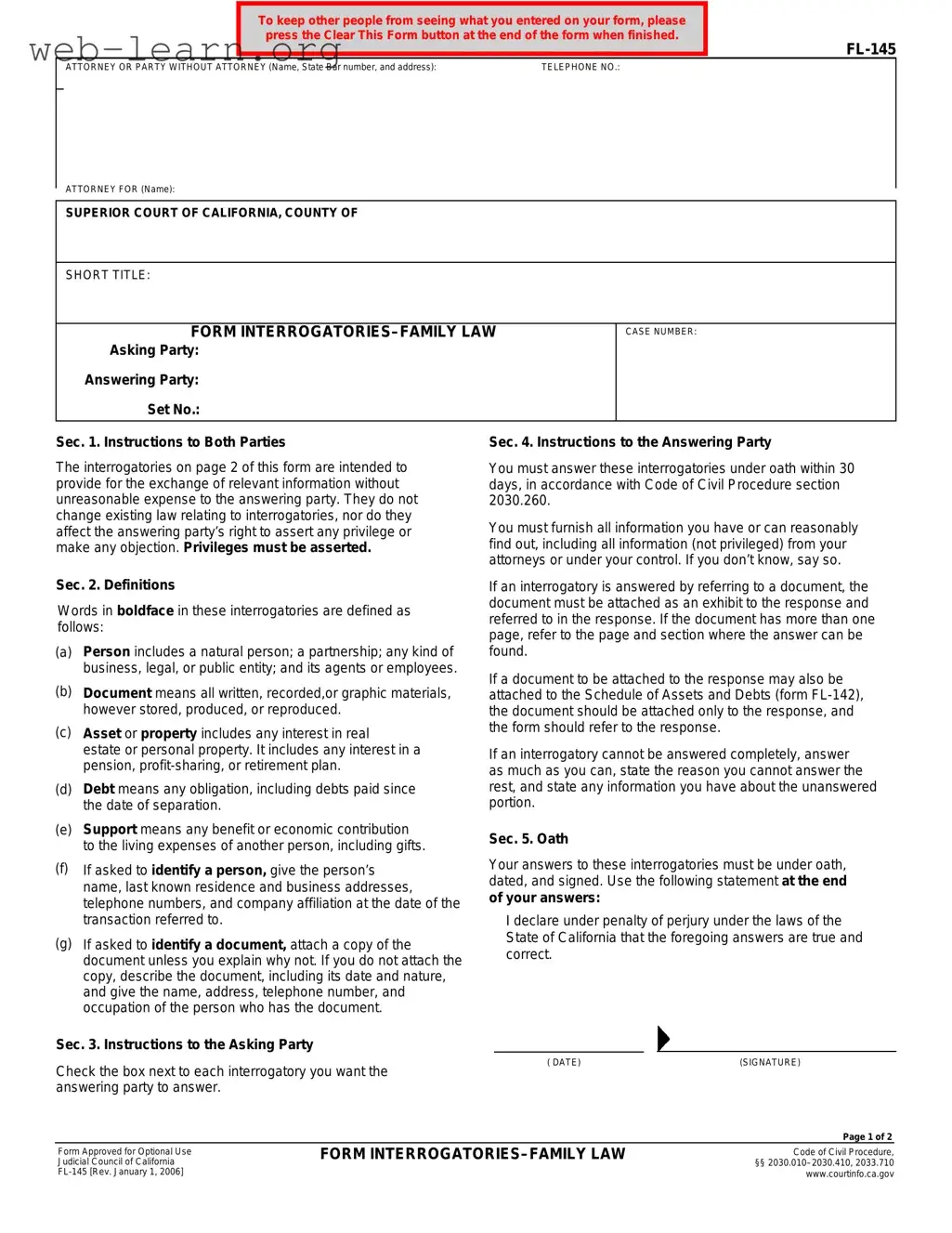
The California FL-145 form is a crucial document used in family law proceedings, specifically designed to facilitate the exchange of pertinent information between parties involved in a case. This form includes a series of interrogatories that require both the asking and answering parties to provide detailed responses under oath. It aims to streamline the discovery process while ensuring that the parties can share relevant information without incurring unreasonable expenses. Key sections of the form outline specific instructions for both parties, detailing how to complete and respond to the interrogatories, which cover various aspects such as personal history, financial agreements, income, and support provided or received. Additionally, the form emphasizes the importance of attaching relevant documents when necessary and provides definitions for terms used within the interrogatories. The completion of the FL-145 is governed by established legal procedures, ensuring that parties assert their rights while maintaining the integrity of the information exchanged. Ultimately, this form serves as a foundational tool in family law cases, promoting transparency and accountability in the legal process.


Sample - California Fl 145 Form

FL-145
ATTORNEY OR PARTY WITHOUT ATTORNEY (Name, State Bar number, and address): TELEPHONE NO.:
ATTORNEY FOR (Name):
SUPERIOR COURT OF CALIFORNIA, COUNTY OF
SHORT TITLE:
FORM INTERROGATORIES–FAMILY LAW
CASE NUMBER:
Asking Party:
Answering Party:
Set No.:
Sec. 1. Instructions to Both Parties
The interrogatories on page 2 of this form are intended to
provide for the exchange of relevant information without
unreasonable expense to the answering party. They do not
change existing law relating to interrogatories, nor do they
affect the answering party’s right to assert any privilege or
make any objection. Privileges must be asserted.
Sec. 4. Instructions to the Answering Party
You must answer these interrogatories under oath within 30
days, in accordance with Code of Civil Procedure section
2030.260.
Sec. 2. Definitions
You must furnish all information you have or can reasonably
find out, including all information (not privileged) from your
attorneys or under your control. If you don’t know, say so.
Person includes a natural person; a partnership; any kind of
business, legal, or public entity; and its agents or employees.
If an interrogatory is answered by referring to a document, the
document must be attached as an exhibit to the response and
referred to in the response. If the document has more than one
page, refer to the page and section where the answer can be
found.
Document means all written, recorded,or graphic materials,
however stored, produced, or reproduced.
If a document to be attached to the response may also be
attached to the Schedule of Assets and Debts (form FL-142),
the document should be attached only to the response, and
the form should refer to the response.
Asset or property includes any interest in real
estate or personal property. It includes any interest in a
pension, profit-sharing, or retirement plan.
If an interrogatory cannot be answered completely, answer
as much as you can, state the reason you cannot answer the
rest, and state any information you have about the unanswered
portion.
Debt means any obligation, including debts paid since
the date of separation.
Support means any benefit or economic contribution
to the living expenses of another person, including gifts.
Sec. 5. Oath
If asked to identify a person, give the person’s
name, last known residence and business addresses,
telephone numbers, and company affiliation at the date of the
transaction referred to.
Your answers to these interrogatories must be under oath,
dated, and signed. Use the following statement at the end
of your answers:
I declare under penalty of perjury under the laws of the
State of California that the foregoing answers are true and
correct.
If asked to identify a document, attach a copy of the
document unless you explain why not. If you do not attach the
copy, describe the document, including its date and nature,
and give the name, address, telephone number, and
occupation of the person who has the document.
(SIGNATURE)( DATE)
Page 1 of 2
Form Approved for Optional Use
Judicial Council of California
FL-145 [Rev. January 1, 2006]
Code of Civil Procedure,
§§ 2030.010–2030.410, 2033.710
www.courtinfo.ca.gov
FORM INTERROGATORIES–FAMILY LAW
(a)
(b)
(c)
(d)
(e)
(f)
(g)
Sec. 3. Instructions to the Asking Party
Check the box next to each interrogatory you want the
answering party to answer.
Words in boldface in these interrogatories are defined as
follows:
To keep other people from seeing what you entered on your form, please 
press the Clear This Form button at the end of the form when finished.
1. Personal history. State your full name, current
12. Property valuations. During the past 12 months,
have you received written offers to purchase or had
written appraisals of any of the assets listed on your
completed Schedule of Assets and Debts? If your
answer is yes, identify the document.
residence address and work address, social security
number, any other names you have used, and the
dates between which you used each name.
2. Agreements. Are there any agreements between you
and your spouse or domestic partner, made before or
during your marriage or domestic partnership or after
your separation, that affect the disposition of assets,
debts, or support in this proceeding? If your answer is
yes, for each agreement state the date made and whether
it was written or oral, and attach a copy of the agreement
or describe its contents.
13. Property held by others. Is there any property
held by any third party in which you have any interest or
over which you have any control? If your answer is yes,
indicate whether the property is shown on the Schedule
of Assets and Debts completed by you. If it is not,
describe and identify each such asset, state its present
value and the basis for your valuation, and identify the
person holding the asset.
3. Legal actions. Are you a party or do you anticipate
being a party to any legal or administrative proceeding
other than this action? If your answer is yes, state your
role and the name, jurisdiction, case number, and a brief
description of each proceeding.
14. Retirement and other benefits. Do you have an
interest in any disability, retirement, profit-sharing, or
deferred compensation plan? If your answer is yes,
identify each plan and provide the name, address,
and telephone number of the administrator and
custodian of records.
4. Persons sharing residence. State the name, age,
and relationship to you of each person at your present
address.
15. Claims of reimbursement. Do you claim the legal
right to be reimbursed for any expenditures of your
separate or community property? If your answer is
yes, state all supporting facts.
5. Support provided others. State the name, age,
address, and relationship to you of each person for
whom you have provided support during the past 12
months and the amount provided per month for each.
16. Credits. Have you claimed reimbursement credits
6. Support received for others. State the name, age,
for payments of community debts since the date of
separation? If your answer is yes, identify the
source of payment, the creditor, the date paid, and
the amount paid. State whether you have added to
the debt since the separation.
address, and relationship to you of each person for
whom you have received support during the past 12
months and the amount received per month for each.
7. Current income. List all income you received during
17. Insurance. Identify each health, life, automobile,
the past 12 months, its source, the basis for its
computation, and the total amount received from
each. Attach your last three paycheck stubs.
and disability insurance policy or plan that you now
own or that covers you, your children, or your
assets. State the policy type, policy number, and
name of the company. Identify the agent and give
the address.
8. Other income. During the past three years, have you
received cash or other property from any source not
identified in item 7? If so, list the source, the date, and
the nature and value of the property.
18. Health. Is there any physical or emotional condition
that limits your ability to work? If your answer is yes,
state each fact on which you base your answer.
9. Tax returns. Attach copies of all tax returns and tax
19. Children’s needs. Do you contend that any of
schedules filed by or for you in any jurisdiction for the
past three calendar years.
your children have any special needs? If so, identify
the child with the need, the reason for the need, its
cost, and its expected duration.
10. Schedule of assets and debts. Complete the
Schedule of Assets and Debts (form FL-142) served
with these interrogatories.
20. Attorney fees. State the total amount of attorney
fees and costs incurred by you in this proceeding,
the amount paid, and the source of the money paid.
Describe the billing arrangements.
11. Separate property contentions. State the facts that
support your contention that an asset or debt is
separate property.
21. Gifts. List any gifts you have made without the
consent of your spouse or domestic partner in the
past 24 months, their values, and the recipients.
FORM INTERROGATORIES–FAMILY LAW
Page 2 of 2
FL-145 [Rev. January 1, 2006]
FL-145
For your protection and privacy, please press the Clear This Form
button after you have printed the form.
Save This Form
Print This Form
Clear This Form

Form Information

Fact Name Details
Form Purpose The FL-145 form is designed to facilitate the exchange of information in family law cases, specifically through a series of interrogatories.
Governing Law This form is governed by the California Code of Civil Procedure, specifically sections 2030.010 to 2030.410 and 2033.710.
Response Timeline The answering party must respond to the interrogatories within 30 days, as mandated by California law.
Oath Requirement All answers provided must be under oath, affirming their truthfulness under penalty of perjury.
Document Attachment If an interrogatory refers to a document, that document must be attached as an exhibit to the response.
Information Scope Parties are required to furnish all non-privileged information they possess or can reasonably obtain.
Definition of Terms Key terms such as "Person," "Document," "Asset," and "Debt" are specifically defined within the form to ensure clarity.
Form Approval The FL-145 form is approved for optional use by the Judicial Council of California, reflecting its official standing.

Detailed Guide for Filling Out California Fl 145

Completing the California FL-145 form requires careful attention to detail. This form is part of the discovery process in family law cases, allowing parties to exchange relevant information. After filling out the form, it is essential to ensure that all required information is accurate and complete before submission.

  1. Begin by entering your name, State Bar number (if applicable), and address in the section labeled ATTORNEY OR PARTY WITHOUT ATTORNEY.
  2. Provide your telephone number and the name of the attorney representing you, if applicable.
  3. In the SHORT TITLE section, write the title of your case.
  4. Fill in the CASE NUMBER assigned to your family law case.
  5. Identify the ASKING PARTY and the ANSWERING PARTY in the designated sections.
  6. Check the box next to each interrogatory that you want the answering party to respond to.
  7. In the PERSONAL HISTORY section, provide your full name, current residence address, work address, social security number, any other names used, and the dates of use for each name.
  8. Answer the interrogatories regarding agreements, legal actions, and persons sharing your residence, providing as much detail as possible.
  9. List all income received during the past 12 months, including its source and total amount, and attach your last three paycheck stubs.
  10. Complete the SCHEDULE OF ASSETS AND DEBTS by filling out form FL-142 and attaching it to your responses.
  11. For each interrogatory that requires documentation, attach the relevant documents and refer to them in your answers.
  12. Review your answers to ensure accuracy and completeness.
  13. Sign and date the form, using the statement provided to declare the truthfulness of your answers.
  14. Press the Clear This Form button to protect your privacy after printing the form.

Obtain Answers on California Fl 145

  1. What is the purpose of the California FL-145 form?

    The California FL-145 form, also known as the Form Interrogatories for Family Law, is designed to facilitate the exchange of relevant information between parties involved in family law cases. It allows one party (the asking party) to request specific information from the other party (the answering party) without incurring unreasonable costs. This form helps to clarify issues related to assets, debts, and support, ensuring that both parties have the necessary information to proceed with their case.

  2. Who needs to complete the FL-145 form?

    Both parties involved in a family law case may be required to complete the FL-145 form. The asking party initiates the request for information, while the answering party must respond to the interrogatories under oath within a specified time frame. This process is essential for gathering pertinent details that can influence the outcome of the case.

  3. How long does the answering party have to respond to the interrogatories?

    The answering party is required to respond to the interrogatories within 30 days of receiving the FL-145 form. This timeframe is established in accordance with the California Code of Civil Procedure section 2030.260. It is crucial for the answering party to provide complete and truthful answers to avoid potential legal repercussions.

  4. What types of information are requested in the FL-145 form?

    The FL-145 form requests a variety of information, including:

    • Personal history, such as names and addresses.
    • Details about any agreements related to assets or support.
    • Current income and other financial information.
    • Information about any legal actions involving the parties.
    • Details regarding children’s needs and any special circumstances.

    This comprehensive approach ensures that both parties have a clear understanding of each other's financial situations and obligations.

  5. What should be done if the answering party cannot fully answer an interrogatory?

    If the answering party is unable to completely answer an interrogatory, they should provide as much information as possible. They must also explain why they cannot provide a full answer and include any relevant information they do possess. This transparency is important for maintaining the integrity of the legal process.

  6. What happens if a party fails to respond to the FL-145 form?

    If a party fails to respond to the FL-145 form within the required timeframe, they may face legal consequences. The asking party can file a motion to compel a response, which may lead to court sanctions against the non-compliant party. Therefore, it is essential for both parties to adhere to the deadlines and provide the requested information.

Common mistakes

When completing the California FL-145 form, individuals often make several common mistakes that can lead to complications in their family law cases. One frequent error involves failing to provide complete information in the personal history section. This section requires individuals to state their full name, current residence address, work address, and social security number, among other details. Omitting any of this information can result in delays or even the rejection of the form.

Another mistake is neglecting to attach necessary documents when required. For instance, if an individual answers an interrogatory by referring to a document, that document must be attached as an exhibit. If it is not, the response may be deemed incomplete. Additionally, individuals sometimes forget to include copies of tax returns or other relevant documents, which are crucial for a comprehensive understanding of financial situations.

People also often misinterpret the instructions regarding the identification of assets and debts. When asked to list all income received during the past year, individuals may provide incomplete information or fail to include all sources of income. This oversight can lead to misunderstandings about financial obligations or entitlements.

Furthermore, individuals sometimes overlook the importance of clarity in their responses. If an interrogatory cannot be answered fully, the individual must explain why and provide as much information as possible. Failing to do so can create ambiguity and may hinder the legal process.

Another common error is neglecting to sign and date the form. The FL-145 requires that answers be made under oath, and without a signature, the form lacks legal validity. This step is crucial, as it affirms that the information provided is true and correct under penalty of perjury.

Lastly, individuals may fail to check the boxes next to each interrogatory they want the answering party to address. This simple step is essential for ensuring that the responding party understands which questions require answers. Missing this detail can lead to incomplete responses and further complications in the case.

Documents used along the form

The California FL-145 form is an essential document in family law cases, specifically for the exchange of information between parties. Several other forms and documents often accompany it, each serving a specific purpose in the legal process. Below is a list of these related forms and documents.

  • FL-142: Schedule of Assets and Debts - This form requires parties to list all assets and debts, providing a comprehensive overview of financial situations. It helps in determining the division of property during divorce proceedings.
  • FL-150: Income and Expense Declaration - This document details an individual's income and expenses. It is crucial for assessing child support and spousal support obligations.
  • FL-160: Declaration Under Uniform Child Custody Jurisdiction and Enforcement Act - This declaration is used to establish jurisdiction in custody cases. It ensures that the court has the authority to make decisions regarding child custody and visitation.
  • FL-180: Judgment - This form is the final judgment in a family law case. It outlines the court's decisions regarding custody, support, and property division.
  • FL-300: Request for Order - This document allows a party to request a court order for specific relief, such as temporary custody or support, before the final judgment is made.
  • FL-310: Response to Request for Order - This form is used to respond to a Request for Order. It provides the responding party an opportunity to present their side of the case.
  • FL-300: Notice of Motion - This document is filed to inform the other party of a motion being made to the court. It is essential for procedural transparency in family law cases.

Understanding these forms and documents is crucial for navigating family law proceedings in California. Each document plays a significant role in ensuring that the legal process is thorough and fair for all parties involved.

Similar forms

The California FL-145 form, which is used for family law interrogatories, shares similarities with several other legal documents. Each of these documents serves a purpose in the family law context, facilitating information exchange and ensuring transparency in legal proceedings. Below are five documents that are similar to the FL-145 form:

  • FL-142 Schedule of Assets and Debts: This form requires parties to disclose their assets and debts in a structured manner. Like the FL-145, it aims to provide a comprehensive overview of financial matters relevant to the case, ensuring that both parties have a clear understanding of each other's financial situations.
  • FL-150 Income and Expense Declaration: This document is used to report a party's income and expenses. Similar to the FL-145, it requires detailed financial information, allowing the court to make informed decisions regarding support and other financial obligations.
  • FL-140 Declaration of Disclosure: This declaration mandates the disclosure of all relevant financial information in family law cases. Like the FL-145, it emphasizes the importance of transparency and full disclosure to facilitate fair legal proceedings.
  • FL-310 Request for Order: This form is used to request specific orders from the court, often relating to child support, spousal support, or custody. Similar to the FL-145, it requires parties to provide detailed information to support their requests, ensuring that the court has the necessary context to make decisions.
  • FL-180 Judgment: This document outlines the final decisions made by the court in a family law case. While it serves a different purpose than the FL-145, both documents are integral to the family law process, with the FL-145 facilitating the information exchange that can ultimately influence the terms outlined in the FL-180.

Dos and Don'ts

When filling out the California FL 145 form, there are several important dos and don'ts to keep in mind. This guidance can help ensure that your form is completed accurately and effectively.

  • Do read all instructions carefully before starting the form. Understanding what is required will save you time and prevent mistakes.
  • Do provide complete and honest answers. Incomplete or misleading information can lead to complications in your case.
  • Do attach any necessary documents as exhibits. If a question refers to a document, include it to support your answers.
  • Do sign and date your responses. An unsigned form may be considered invalid.
  • Don't leave any questions unanswered if you can provide some information. If you cannot answer completely, explain why and include what you do know.
  • Don't forget to assert any privileges. If certain information is protected, make sure to state that clearly.
  • Don't rush through the form. Take your time to ensure accuracy and clarity in your responses.
  • Don't forget to press the "Clear This Form" button after finishing to protect your privacy.

By following these guidelines, you can navigate the process of filling out the FL 145 form more smoothly, ensuring that your information is presented clearly and effectively.

Misconceptions

When it comes to the California FL-145 form, there are several common misconceptions that can lead to confusion. Understanding these misconceptions can help ensure that individuals fill out the form correctly and effectively. Here are seven of the most prevalent misunderstandings:

  • The FL-145 form is only for attorneys. Many people believe that only attorneys can use this form. In reality, it is designed for both parties in a family law case, whether they are represented by an attorney or not.
  • All information provided is public. Some individuals worry that the details they enter on the FL-145 form will be accessible to the public. While court documents can be public, there are steps you can take to protect your privacy, such as pressing the "Clear This Form" button after use.
  • You can skip questions if you don’t know the answer. It’s a common belief that unanswered questions are acceptable. However, if you don’t know the answer to a question, you should indicate that and provide any information you do have instead of leaving it blank.
  • The FL-145 form is optional. Some people think that filling out the FL-145 is optional in family law cases. However, it is often a required step in the discovery process, especially if interrogatories have been served.
  • Only financial information is required. While the form does ask for financial details, it also requests information about personal history, legal actions, and other relevant data. All sections should be completed thoroughly.
  • You can submit the form without signing it. A common misconception is that the form can be submitted unsigned. In fact, your answers must be under oath and signed to be valid, which adds a layer of accountability to the information provided.
  • Responses can be vague. Some individuals believe they can provide vague responses. However, the form requires specific and detailed answers. If you refer to a document, it must be attached, and if you cannot answer fully, you should explain why.

By addressing these misconceptions, individuals can navigate the complexities of the California FL-145 form with greater confidence and clarity. Understanding the form's requirements and implications is crucial for ensuring a smooth process in family law matters.

Key takeaways

When filling out and using the California FL-145 form, keep the following key takeaways in mind:

  • Clear Your Data: Always press the "Clear This Form" button after completing the form to protect your privacy.
  • Timely Responses: The answering party must respond to the interrogatories under oath within 30 days.
  • Complete Information: Provide all relevant information you have access to, even if it’s not privileged.
  • Document Attachment: If you reference a document in your answers, attach it as an exhibit and describe it accurately.
  • Oath Requirement: Your answers must be signed and dated, including a declaration of truth under penalty of perjury.
  • Specific Instructions: Follow the instructions carefully, especially when checking boxes for the interrogatories you want answered.
  • Detailed Responses: If you cannot fully answer an interrogatory, provide as much information as possible and explain any limitations.
  • Use of Definitions: Pay attention to the definitions provided in the form, as they clarify terms you will need to use in your answers.