Homepage Blank California Fj 200 Form
Outline

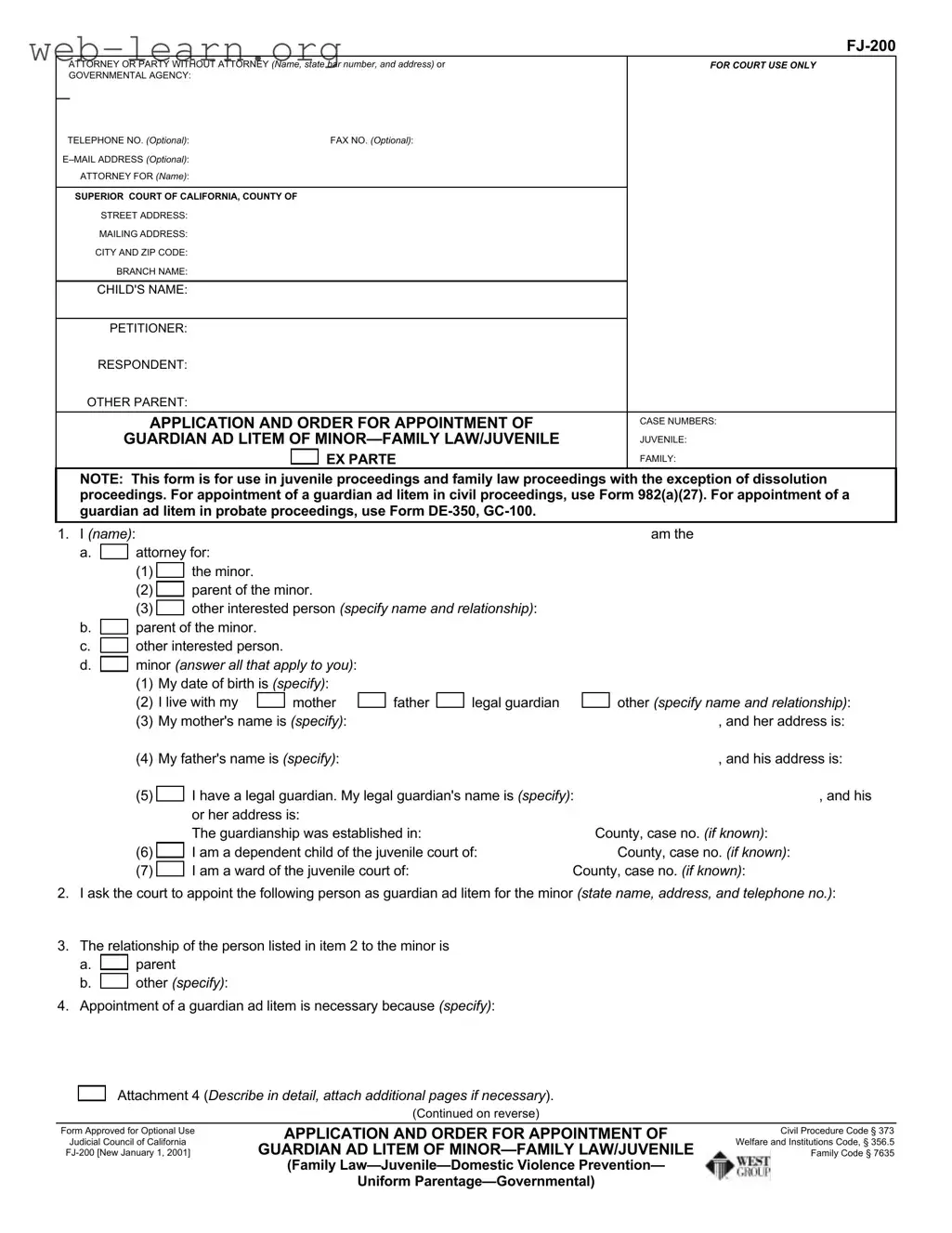
The California FJ 200 form serves a critical function within the legal landscape, particularly in family law and juvenile proceedings. This document facilitates the appointment of a guardian ad litem for minors involved in such cases, ensuring that their rights and interests are adequately represented. Designed for use in various contexts, the form is not applicable to dissolution proceedings, which underscores its specific focus on guardianship matters. The FJ 200 requires detailed information about the minor, the petitioner, and the proposed guardian, including names, addresses, and relationships. Additionally, it prompts the applicant to explain the necessity for appointing a guardian ad litem, which is crucial for the court's understanding and decision-making process. The form also includes sections for consent from the proposed guardian and, when applicable, from the minor themselves if they are 14 years or older. This comprehensive structure not only streamlines the application process but also reinforces the importance of safeguarding the welfare of minors in legal proceedings.


Sample - California Fj 200 Form

I ask the court to appoint the following person as guardian ad litem for the minor (state name, address, and telephone no.):
APPLICATION AND ORDER FOR APPOINTMENT OF
GUARDIAN AD LITEM OF MINOR—FAMILY LAW/JUVENILE
(Family Law—Juvenile—Domestic Violence Prevention—
Uniform Parentage—Governmental)
FOR COURT USE ONLY
CASE NUMBERS:
APPLICATION AND ORDER FOR APPOINTMENT OF
GUARDIAN AD LITEM OF MINOR—FAMILY LAW/JUVENILE
CITY AND ZIP CODE:
BRANCH NAME:
STREET ADDRESS:
MAILING ADDRESS:
FJ-200
PETITIONER:
RESPONDENT:
1.
Form Approved for Optional Use
Judicial Council of California
FJ-200 [New January 1, 2001]
SUPERIOR COURT OF CALIFORNIA, COUNTY OF
I (name):
the minor.
parent of the minor.
other interested person (specify name and relationship):
(1)
2.
4. Appointment of a guardian ad litem is necessary because (specify):
ATTORNEY OR PARTY WITHOUT ATTORNEY (Name, state bar number, and address) or
GOVERNMENTAL AGENCY:
am the
attorney for:a.
(2)
(3)
parent of the minor.b.
other interested person.c.
My date of birth is (specify):(1)
I live with my(2)
mother father legal guardian other (specify name and relationship):
My mother's name is (specify):(3) , and her address is:
My father's name is (specify):(4) , and his address is:
I have a legal guardian. My legal guardian's name is (specify):(5) , and his
or her address is:
I am a dependent child of the juvenile court of:(6) County, case no. (if known):
I am a ward of the juvenile court of:(7) County, case no. (if known):
The guardianship was established in: County, case no. (if known):
The relationship of the person listed in item 2 to the minor is
b.
a.
3.
parent
other (specify):
CHILD'S NAME:
JUVENILE:
FAMILY:
OTHER PARENT:
(Continued on reverse)
minor (answer all that apply to you):d.
EX PARTE
NOTE: This form is for use in juvenile proceedings and family law proceedings with the exception of dissolution
proceedings. For appointment of a guardian ad litem in civil proceedings, use Form 982(a)(27). For appointment of a
guardian ad litem in probate proceedings, use Form DE-350, GC-100.
Civil Procedure Code § 373
Welfare and Institutions Code, § 356.5
Family Code § 7635
Attachment 4 (Describe in detail, attach additional pages if necessary).
ATTORNEY FOR (Name):
TELEPHONE NO. (Optional): FAX NO. (Optional):
E–MAIL ADDRESS (Optional):
APPLICATION AND ORDER FOR APPOINTMENT OF
GUARDIAN AD LITEM OF MINOR—FAMILY LAW/JUVENILE
(Family Law—Juvenile)
I consent to the appointment as guardian ad litem, and agree to assume the responsibilities.
Date:
CONSENT TO ACT AS GUARDIAN AD LITEM
CASE NUMBERS:
PETITIONER:
RESPONDENT:
(TYPE OR PRINT NAME) (SIGNATURE OF PROPOSED GUARDIAN)
CONSENT TO GUARDIAN BY MINOR 14 YEARS OF AGE OR OLDER
I, (name): , am (specify age): years of age and hereby nominate
(name): to be my guardian ad litem to represent my interests for the
reasons set forth in items 4 and 5 of this application.
Date:
(TYPE OR PRINT NAME)
(SIGNATURE OF PETITIONER)
FJ-200 [New January 1, 2001]
Page two
ORDER
Date:
JUDICIAL OFFICER
THE COURT FINDS
It is reasonable and necessary to appoint a guardian ad litem for the person(s) named in the application, as requested above.
THE COURT ORDERS that (name): is hereby appointed guardian ad
litem of (name): for the purposes hereinabove set
forth in item 4 of the petition.
OTHER PARENT:
SIGNATURE FOLLOWS LAST ATTACHMENT
5. The proposed guardian ad litem is fully competent to understand and protect the rights of the minor and has no interest conflicting
with that of the minor.
JUVENILE:
FAMILY:
CHILD'S NAME:
Date:
(TYPE OR PRINT NAME) (SIGNATURE OF APPLICANT)
Application for an Appointment of Guardian ad Litem filed (date):
is denied.
is granted.
is set for hearing on (date): . at (time):
a.
b.
c.

Form Information

Fact Name Details
Purpose The FJ-200 form is used to request the appointment of a guardian ad litem for a minor in family law and juvenile proceedings.
Governing Laws This form is governed by Civil Procedure Code § 373, Welfare and Institutions Code § 356.5, and Family Code § 7635.
Exclusions The FJ-200 form cannot be used for dissolution proceedings.
Competency Requirement The proposed guardian must be competent to protect the minor's rights and have no conflicting interests.

Detailed Guide for Filling Out California Fj 200

Completing the California FJ 200 form is a critical step in the process of appointing a guardian ad litem for a minor in family law or juvenile proceedings. Ensure that all information is accurate and complete to avoid delays in processing. Follow these steps carefully to fill out the form correctly.

  1. At the top of the form, provide the name of the attorney or party without attorney, including the state bar number and address. If applicable, include the telephone number, fax number, and email address.
  2. Indicate the name of the attorney for the minor, if applicable.
  3. Fill in the details of the Superior Court of California, including the county, street address, mailing address, city, and zip code.
  4. Enter the child's name, the petitioner, the respondent, and the other parent.
  5. List the case numbers for both juvenile and family law, if applicable.
  6. In Section 1, identify yourself by stating your name and your relationship to the minor. Indicate whether you are the attorney, a parent, or another interested person.
  7. Provide the minor's date of birth and living arrangements. Specify the names and addresses of the minor's mother, father, and legal guardian, if applicable.
  8. State whether the minor is a dependent child or ward of the juvenile court, and provide the relevant county and case number if known.
  9. In Section 2, request the appointment of a specific person as the guardian ad litem, providing their name, address, and telephone number.
  10. In Section 3, specify the relationship of the proposed guardian ad litem to the minor.
  11. In Section 4, explain why the appointment of a guardian ad litem is necessary. Attach additional pages if needed.
  12. In Section 5, affirm that the proposed guardian ad litem is competent to protect the minor's rights and has no conflicting interests.
  13. Sign and date the form, including the printed name of the applicant.
  14. If applicable, include the consent of the proposed guardian ad litem, with their signature and printed name.
  15. If the minor is 14 years of age or older, include their consent to the appointment of the guardian ad litem, with their signature and printed name.
  16. In the order section, leave space for the judicial officer’s signature and any additional court findings or orders.

Obtain Answers on California Fj 200

  1. What is the purpose of the California FJ 200 form?

    The California FJ 200 form is designed for use in family law and juvenile court proceedings. Specifically, it facilitates the appointment of a guardian ad litem for a minor. A guardian ad litem is an individual appointed by the court to represent the best interests of a minor in legal matters. This form is not applicable for dissolution proceedings but is essential for cases involving custody, dependency, or other family law issues where the minor's welfare is at stake.

  2. Who can file the FJ 200 form?

    Any party interested in the welfare of the minor can file the FJ 200 form. This includes:

    • The minor themselves, if they are 14 years of age or older.
    • Parents of the minor.
    • Other interested persons, such as relatives or family friends.

    Each applicant must provide their relationship to the minor and relevant details to ensure the court understands the context of the request.

  3. What information is required on the form?

    The FJ 200 form requires several key pieces of information:

    • The name and contact details of the applicant.
    • The child's name and details about their living situation.
    • Information about the proposed guardian ad litem, including their relationship to the minor.
    • A detailed explanation of why the appointment of a guardian ad litem is necessary.

    This information helps the court assess the suitability of the proposed guardian and the necessity of the appointment.

  4. What happens after the form is submitted?

    Once the FJ 200 form is submitted to the court, the judicial officer will review the application. The court may either grant or deny the request for a guardian ad litem. If granted, the court will officially appoint the proposed guardian, allowing them to represent the minor's interests in the ongoing legal proceedings. If the application is denied, the court will provide reasons for the denial, which may help the applicant understand any deficiencies in their request.

Common mistakes

Filling out the California FJ-200 form can be a daunting task, and many individuals make common mistakes that can delay the process or lead to complications. One frequent error is failing to provide complete information about the minor. When individuals neglect to fill in the child's full name, date of birth, or living situation, it can create confusion and hinder the court's ability to process the application. Ensuring that all details are accurate and complete is essential for a smooth application process.

Another mistake often made is not specifying the relationship of the proposed guardian ad litem to the minor. This section is critical, as it helps the court understand the dynamics of the situation. If this relationship is unclear or omitted, the court may question the appropriateness of the guardian and could even delay the appointment. Clear and concise information is key to avoiding unnecessary delays.

People also frequently overlook the necessity of attaching detailed explanations when required. The form includes sections that ask for specific reasons why a guardian ad litem is needed. If applicants provide vague or insufficient explanations, the court may not fully grasp the urgency of the situation. Including detailed attachments can significantly strengthen the application and clarify the need for a guardian.

Lastly, many individuals fail to secure the necessary signatures. The form requires signatures from both the applicant and the proposed guardian ad litem. Without these signatures, the application is incomplete and cannot be processed. Double-checking for all required signatures can prevent the frustration of having to resubmit the form later.

Documents used along the form

The California FJ-200 form is a crucial document used in family law and juvenile proceedings to request the appointment of a guardian ad litem for a minor. Alongside this form, there are several other documents that may be necessary to ensure a comprehensive legal process. Below is a list of commonly used forms that often accompany the FJ-200.

  • Form 982(a)(27): This form is utilized for the appointment of a guardian ad litem in civil proceedings. It is important for cases outside of family law or juvenile matters.
  • Form DE-350: This document is used in probate proceedings to appoint a guardian ad litem. It is essential for protecting the interests of minors in matters of inheritance.
  • Form GC-100: Similar to Form DE-350, this form is also for probate cases. It specifically addresses the appointment of a guardian ad litem for minors in probate situations.
  • Form FL-300: This is a request for order form used in family law cases. It may be needed to address various issues, including custody and visitation, which can relate to the minor's welfare.
  • Form FL-150: This income and expense declaration is often required in family law cases. It provides the court with financial information that can impact decisions regarding child support and other financial matters.
  • Form FL-320: This form is a notice of motion and motion to modify a child custody order. It is relevant if there are changes in circumstances that affect the minor's living situation.
  • Form FL-341: This is a child custody and visitation order form. It outlines the arrangements for the minor's care and is essential for ensuring their best interests are met.

Understanding these forms can help navigate the complexities of family law and juvenile proceedings. Each document serves a specific purpose and contributes to the overall goal of protecting the rights and well-being of minors involved in legal matters.

Similar forms

The California FJ 200 form, which is used for appointing a guardian ad litem for a minor in family law and juvenile proceedings, shares similarities with several other legal documents. Below is a list of six such documents, highlighting their similarities.

  • Form 982(a)(27): This form is used for appointing a guardian ad litem in civil proceedings. Like the FJ 200, it aims to protect the interests of a minor, ensuring that their rights are represented in court.
  • Form DE-350: This document is utilized in probate proceedings for appointing a guardian ad litem. Similar to the FJ 200, it addresses the need for representation of minors or individuals unable to represent themselves legally.
  • Form GC-100: This form is also used in probate cases to appoint a guardian ad litem. It shares the same purpose as the FJ 200 in that it seeks to safeguard the legal rights of minors during judicial proceedings.
  • Form FL-320: This form pertains to the request for a guardian ad litem in family law cases. Like the FJ 200, it focuses on the welfare of minors and ensures their interests are adequately represented.
  • Form JV-295: This is a petition for the appointment of a guardian ad litem in juvenile court. It serves a similar function as the FJ 200, emphasizing the importance of having a representative for minors in legal matters.
  • Form FL-150: This form is used for financial disclosures in family law cases. While its primary focus is on financial matters, it is often accompanied by other forms like the FJ 200 when minors' interests are at stake, reinforcing the need for proper representation.

Dos and Don'ts

When filling out the California FJ-200 form, there are important considerations to keep in mind. Here are four things you should and shouldn’t do:

  • Do provide accurate information. Ensure that all names, addresses, and case numbers are correct to avoid delays.
  • Do follow the instructions carefully. Each section of the form has specific requirements. Pay close attention to what is being asked.
  • Do include all necessary signatures. Make sure that all required parties sign the form where indicated to validate the application.
  • Do attach additional pages if necessary. If more space is needed to explain any details, include additional sheets as attachments.
  • Don’t leave any sections blank. Incomplete forms may be rejected or delayed. Fill out every applicable part of the form.
  • Don’t use legal jargon. Write clearly and simply to ensure that your intentions are understood by the court.
  • Don’t forget to check for errors. Review the form for any mistakes before submission to prevent complications.
  • Don’t submit the form without a copy. Always keep a copy for your records in case you need to reference it later.

Misconceptions

There are several misconceptions about the California FJ 200 form. Understanding these can help you navigate the process more effectively. Here are seven common misunderstandings:

  • This form is only for family law cases. Many believe that the FJ 200 form is limited to family law. However, it is also applicable in juvenile proceedings.
  • Only attorneys can file this form. While attorneys often handle legal matters, any party involved, including parents or guardians, can submit the form.
  • Filing the form guarantees approval. Submitting the FJ 200 does not automatically mean the court will grant the request for a guardian ad litem. The court must review and approve it.
  • It’s the same as a guardianship application. The FJ 200 is specifically for appointing a guardian ad litem, which is different from a full guardianship application.
  • Age doesn’t matter for minors. If the minor is 14 years of age or older, they can nominate their own guardian ad litem, which is an important detail often overlooked.
  • All information must be provided at once. You can attach additional pages if you need more space to explain circumstances or provide necessary details.
  • Consent from the minor is not required. For minors aged 14 and older, their consent is necessary for the appointment of a guardian ad litem.

By clearing up these misconceptions, you can approach the FJ 200 form with greater confidence and understanding.

Key takeaways

When navigating the California FJ 200 form, it's essential to understand its purpose and requirements. Here are some key takeaways to keep in mind:

  • Purpose of the Form: The FJ 200 form is specifically designed for appointing a guardian ad litem for minors in family law and juvenile proceedings, excluding dissolution cases.
  • Eligibility: This form can be filled out by attorneys, parents, or other interested parties seeking to represent a minor's interests in court.
  • Information Required: You must provide detailed information about the minor, including their name, date of birth, and living arrangements.
  • Guardian Details: Clearly state the name, address, and relationship of the proposed guardian ad litem to the minor.
  • Justification: It is crucial to specify why the appointment of a guardian ad litem is necessary. Detailed explanations may require additional pages.
  • Consent: The proposed guardian must consent to the appointment and acknowledge their responsibilities by signing the form.
  • Minor's Consent: If the minor is 14 years of age or older, their consent is also required for the appointment of the guardian.
  • Filing Process: After completing the form, it must be filed with the court. Keep track of the filing date and any subsequent court orders related to the application.

Completing the FJ 200 form accurately is vital to ensure that the minor's rights are protected effectively. Make sure to review the form thoroughly before submission.