Homepage Blank California Fi 128 Form
Outline

The California Fi 128 form plays a crucial role in unlawful detainer proceedings, which are legal actions landlords take to evict tenants. This form includes various sections that guide both the asking party and the answering party through the process of submitting and responding to interrogatories. It requires essential information such as the names and addresses of involved parties, details about the rental unit in question, and the nature of the case. The form also outlines specific instructions for how to properly fill it out, including deadlines for responses and the importance of verifying answers. Notably, the Fi 128 includes definitions for key terms like "landlord," "rental unit," and "document," ensuring clarity in communication. Additionally, it provides a structured set of interrogatories that can be used to gather pertinent information, helping both parties to present their cases effectively. Understanding this form is vital for anyone involved in unlawful detainer actions, as it sets the stage for legal proceedings and can significantly impact the outcome of the case.

Sample - California Fi 128 Form

(c) In determining whether to use these or any interroga-
tories, you should be aware that abuse can be punished by
sanctions, including
fines and attorney fees. See Code of Civil
Procedure sections 128.5 and 128.7.
These are general instructions.
For time limitations,
requirements for service on other parties, and other details,
see Code of Civil Procedure section 2030 and the cases
construing it.
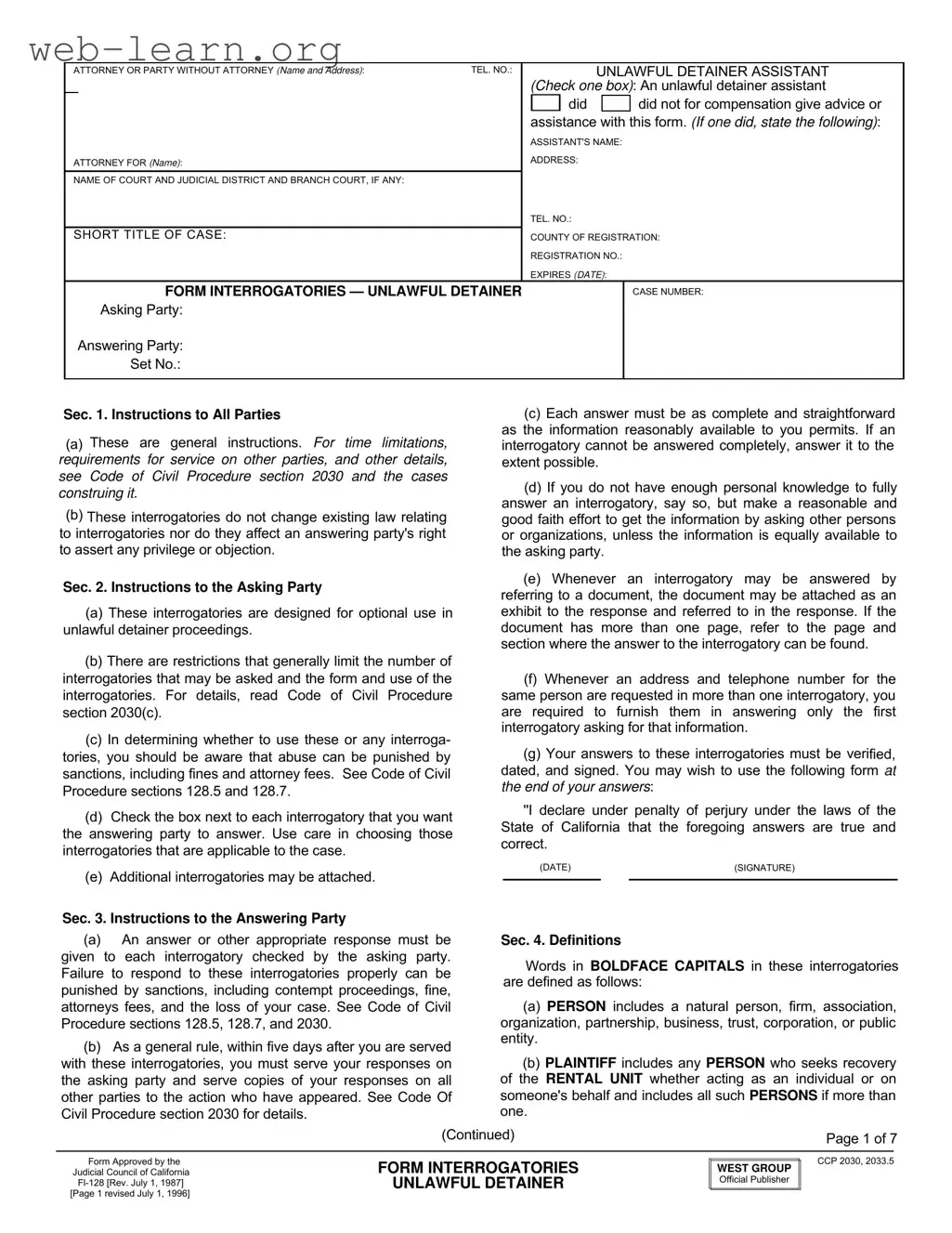
UNLAWFUL DETAINER ASSISTANT
TEL. NO.:
ATTORNEY OR PARTY WITHOUT ATTORNEY (Name and Address):
did did not for compensation give advice or
assistance with this form. (If one did, state the following):
ASSISTANT'S NAME:
ADDRESS:
ATTORNEY FOR (Name):
NAME OF COURT AND JUDICIAL DISTRICT AND BRANCH COURT, IF ANY:
SHORT TITLE OF CASE:
TEL. NO.:
COUNTY OF REGISTRATION:
REGISTRATION NO.:
EXPIRES (DATE):
FORM INTERROGATORIES — UNLAWFUL DETAINER
CASE NUMBER:
Answering Party:
Set No.:
(c) Each answer must be as complete and straightforward
as the information reasonably available to you permits. If an
interrogatory cannot be answered completely, answer it to the
extent possible.
Sec. 1. Instructions to All Parties
(d) If you do not have enough personal knowledge to fully
answer an interrogatory, say so, but make a reasonable and
good faith effort to get the information by asking other persons
or organizations, unless the information is equally available to
the asking party.
These interrogatories do not change existing law relating
to interrogatories nor do they affect an answering party's right
to assert any privilege or objection.
(e) Whenever an interrogatory may be answered by
refer
ring to a document, the document may be attached as an
exhibit to the response and referred to in the response. If the
document has more than one page, refer to the page and
section where the answer to the interrogatory can be found.
Sec. 2. Instructions to the Asking Party
(a) These interrogatories are designed for optional use in
unlawful detainer proceedings.
(b) There are restrictions that generally limit the number of
interrogatories that may be asked and the form and
use of the
interrogatories. For details, read Code of Civil Procedure
section 2030(c).
(f) Whenever an address and telephone number for the
same person are requested in more than one interrogatory, you
are required to furnish them in answering only the first
interrogatory asking for that information.
(g) Your answers to these interrogatories must be veri
fied,
dated, and signed. You may wish to use the following form
at
the end of your answers:
''I declare under penalty of perjury under the laws of the
State of California that the foregoing answers are true and
correct.
interrogatories that are applicable to the case.
(e) Additional interrogatories may be attached.
(DATE)
(SIGNATURE)
Sec. 3. Instructions to the Answering Party
(a) An answer or other appropriate response must be
given to each interrogatory checked by the asking party.
Failure to respond to these interrogatories properly can be
punished by sanctions, including contempt proceedings, fine,
attorneys fees, and the loss of your case. See Code of Civil
Procedure sections 128.5, 128.7, and 2030.
Sec. 4. Definitions
Words in BOLDFACE CAPITALS
in these interrogatories
are defined as follows:
(a) PERSON
includes a natural person, firm, association,
organization, partnership, business, trust, corporation, or public
entity.
(b) As a general rule, within five days after you are served
with these interrogatories, you must serve your responses on
the asking party and serve copies of your responses on all
other parties to the action who have appeared. See Code Of
Civil Procedure section 2030 for details.
(b) PLAINTIFF includes any PERSON
who seeks recovery
of the RENTAL UNIT
whether acting as an individual or on
someone's behalf and includes all such PERSONS
if more than
one.
(Continued)
Page 1 of 7
Form Approved by the
Judicial Council of California
Fl-128 [Rev. July 1, 1987]
[Page 1 revised July 1, 1996]
CCP 2030, 2033.5
FORM INTERROGATORIES
UNLAWFUL DETAINER
(Check one box): An unlawful detainer assistant
Asking Party:
(a)
(b)
WEST GROUP
Official Publisher
(c) LANDLORD includes any PERSON
who offered the
RENTAL UNIT for rent and any PERSON
on whose behalf the
RENTAL UNIT
was offered for rent and their successors in
interest. LANDLORD includes all PERSONS
who managed the
PROPERTY while defendant was in possession.
70.2 Is PLAINTIFF an owner of the RENTAL UNIT
? If so,
state:
(a) the nature and percentage of ownership interest;
(b) the date PLAINTIFF first acquired this ownership
interest.
(d) RENTAL UNIT is the premises PLAINTIFF
seeks to
recover.
70.3 Does PLAINTIFF
share ownership or lack
ownership? If so, state the name, the ADDRESS
, and the
nature and percentage of ownership interest of each
owner.
(e) PROPERTY
is the building or parcel (including common
areas) of which the RENTAL UNIT
is a part. (For example, if
PLAINTIFF
is seeking to recover possession of apartment
number 12 of a 20-unit building, the building is the
PROPERTY
and apartment 12 is the RENTAL UNIT. If PLAINTIFF
seeks
possession of cottage number 3 in a five-cottage court or
complex, the court or complex is the PROPERTY
and cottage 3
is the RENTAL UNIT.)
70.4 Does PLAINTIFF
claim the right to possession other
than as an owner of the RENTAL UNIT
? If so, state the
basis of the claim.
70.5 Has PLAINTIFF'S interest in the RENTAL
UNIT
changed since acquisition? If so, state the nature and
dates of each change.
(f) DOCUMENT
means a writing, as defined in Evidence
Code section 250, and includes the original or a copy of
handwriting, typewriting, printing, photostating, photographing,
and every other means of recording upon any tangible thing
and form of communicating or representation, including letters,
words, pictures, sounds, or symbols, or combinations of them.
70.6 Are there other rental units on the PROPERTY
? If
so, state how many.
70.7 During the 12 months before this proceeding was
filed, did PLAINTIFF
possess a permit or certificate of
occupancy for the RENTAL UNIT? If so, for each state:
(a) the name and ADDRESS of each PERSON named
on
(g) NOTICE TO QUIT
includes the original or copy of any
notice mentioned in Code of Civil Procedure section 1161
or
Civil Code section 1946, including a 3-day notice to pay rent
and quit the RENTAL UNIT
, a 3-day notice to perform
conditions or covenants or quit, a 3-day notice to quit, and a
30-day notice of termination.
(b) the dates of issuance and expiration;
(c) the permit or certificate number.
70.8 Has a last month's rent, security deposit, cleaning
fee, rental agency fee, credit check fee, key deposit, or
any other deposit been paid on the RENTAL UNIT
? If so,
for each item state:
(h) ADDRESS
means the street address, including the city,
state, and zip code.
the purpose of the payment;
the date paid;
Sec. 5. Interrogatories
the amount;
The following interrogatories have been approved by the
Judicial Council under section 2033.5 of the Code of Civil
Procedure for use in unlawful detainer proceedings:
the form of payment;
the name of the PERSON paying;
(the name of the PERSON to whom it was paid;
CONTENTS
(any DOCUMENT
which evidences payment and the
name, ADDRESS
, and telephone number of each
PERSON who has the DOCUMENT;
70.0 General
71.0 Notice
any adjustments or deductions including facts.
72.0 Service
73.0 Malicious Holding Over
70.9 State the date defendant first took possession of
the
RENTAL UNIT.
75.0 Breach of Warranty to Provide Habitable
Premises
70.10 State the date and all the terms of any rental
agreement between defendant and the PERSON
who
rented to defendant.
76.0 Waiver, Change, Withdrawal, or Cancellation of Notice
to Quit
77.0 Retaliation and Arbitrary Discrimination
70.11 For each agreement alleged in the pleadings:
78.0 Nonperformance of the Rental Agreement by Landlord
79.0 Offer of Rent by Defendant
identify all DOCUMENTS
that are part of the
agreement and for each state the name, ADDRESS
,
and telephone number of each PERSON
who has the
DOCUMENT;
80.0 Deduction from Rent for Necessary Repairs
81.0 Fair Market Rental Value
70.0 General
[Either party may ask any applicable question in this section.]
70.1 State the name, ADDRESS
, telephone number, and
relationship to you of each PERSON
who prepared or
assisted in the preparation of the responses to these
interrogatories. (Do not identify anyone who simply typed
or reproduced the responses.)
identify all DOCUMENTS that are part of each
modification to the agreement, and for each state
Page 2 of 7
(Continued)
Fl-128 [Rev. July 1, 1987]
74.0 Rent Control and Eviction Control
the permit or certificate;
state each part of the agreement not in writing, the
name ADDRESS
, and telephone number of each
PERSON
agreeing to that provision, and the date that
part of the agreement was made;
identify all DOCUMENTS
that evidence each part of
the agreement not in writing and for each state the
name, ADDRESS
, and telephone number of each
PERSON who has the DOCUMENT;
(a)
(b)
(c)
(d)
WEST GROUP
Official Publisher
(g)
(a)
(b)
(c)
(d)
(e)
(f)
(h)
(g)
the name, ADDRESS
, and telephone number of each
PERSON who has the DOCUMENT (see also § 71.5);
state the names, ADDRESSES
, and telephone
numbers of all PERSONS
who have knowledge of the
facts;
state each modification not in writing, the date, and the
name, ADDRESS
, and telephone number of the
PERSON
agreeing to the modification, and the date the
modification was made (see also § 71.5);
identify all DOCUMENTS
that support the facts and
state the name, ADDRESS
, and telephone number of
each PERSON who has each DOCUMENT.
71.3 List all rent payments and rent credits made or claimed
by or on behalf of defendant beginning 12 months before
the NOTICE TO QUIT
was served. For each payment or
credit state:
identify all DOCUMENTS
that evidence each modifica-
tion of the agreement not in writing and for each state
the name, ADDRESS
, and telephone number of each
PERSON who has the DOCUMENT (see also § 71.5).
the amount;
the date received;
the form in which any payment was made;70.12 Has any PERSON acting on the PLAINTIFF'S
behalf
been responsible for any aspect of managing or
maintaining the RENTAL UNIT or PROPERTY
? If so, for
each PERSON state:
the services performed or other basis for which a
credit is
the period covered;
the name, ADDRESS, and telephone number;
the name of each PERSON making the payment or earning
the dates the PERSON
managed or maintained the
RENTAL UNIT or PROPERTY;
the identity of all DOCUMENTS
evidencing the payment
or credit and for each state the name, ADDRESS
, and
telephone number of each PERSON
who has the
DOCUMENT.
70.13 For each PERSON
who occupies any part of the
RENTAL UNIT
(except occupants named in the complaint
and occupants' children under 17) state:
71.4 Did defendant ever fail to pay the rent on time?
If so,
for each late payment state:
(a) the name, ADDRESS, telephone number, and birthdate;
(a) the date;
(b) the amount of any late charge;
(b) the inclusive dates of occupancy;
the identity of all DOCUMENTS
recording the payment
and for each state the name, ADDRESS
, and telephone
number of each PERSON who has the DOCUMENT.
(c) a description of the portion of the RENTAL UNIT occupied;
(d) the amount paid, the term for which it was paid, and the
(e) the nature of the use of the RENTAL UNIT;
71.5 Since the beginning of defendant's t
enancy, has
PLAINTIFF
ever raised the rent? If so, for each rent
increase state:
(f) the name, ADDRESS, and telephone number of the p
er-
(a) the date the increase became effective;
(g) how occupancy was authorized, including failure of the
(b) the amount;
(c) the reasons for the rent increase;
(d) how and when defendant was notified of the increase;
70.14 Have you or anyone acting on your behalf obtained
any DOCUMENT
concerning the tenancy between any
occupant of the RENTAL UNIT and any PERSON
with an
ownership interest or managerial responsibility for the
RENTAL UNIT? If so, for each DOCUMENT state:
[See also section 70.11(d)–(f).]
the name, ADDRESS
, and telephone number of each
individual from whom the DOCUMENT was obtained;
71.6 During the 12 months before the
NOTICE TO QUIT
was served was there a period during which there was no
permit or certificate of occupancy for the RENTAL UNIT
? If
so, for each period state:
(a) the inclusive dates;
(b) the reasons.
the name, ADDRESS, and telephone number of
each
individual who obtained the DOCUMENT;
(c) the date the DOCUMENT was obtained;
the name, ADDRESS
, and telephone number of each
PERSON who has the DOCUMENT (original or copy).
71.7 Has any PERSON
ever reported any nuisance or
disturbance at or destruction of the RENTAL UNIT
or
PROPERTY
caused by defendant or other occupant of the
RENTAL UNIT or their guests? If so, for each report state;
71.0 Notice
[If a defense is based on allegations that the 3-day notice or
30-day NOTICE TO QUIT is
defective in form or content,
then either party may ask any applicable question in this
section.]
a description of the disturbance or destruction;
the date of the report;
the name of the PERSON who reported;
the name of the PERSON to whom the report was made;
71.1 Was the NOTICE TO QUIT on which PLAINTIFF
bases this proceeding attached to the complaint? If not,
state the contents of this notice.
what action was taken as a result of the report;
(f)
71.2 State all reasons that the NOTICE TO QUIT
was
served and for each reason:
the identity of all DOCUMENTS
evidencing the report
and for each state the name, ADDRESS
, and telephone
number of each PERSON who has each DOCUMENT.
(a) state all facts supporting PLAINTIFF'S decision to
terminate defendant's tenancy;
(Continued)
Page 3 of 7
Fl-128 [Rev. July 1, 1987]
(e)
(f)
person to whom it was paid;
son who authorized occupancy;
LANDLORD or PLAINTIFF
to protest after discovering
the occupancy.
(a)
(b)
(d)
(b)
(c)
claimed;
the credit;
(a)
(b)
(c)
(d)
(e)
(f)
(g)
(c)
the identity of all DOCUMENTS
evidencing the increase
and for each state the name, ADDRESS
, and telephone
number of each PERSON who has the DOCUMENT.
(e)
WEST GROUP
Official Publisher
(d)
(c)
(b)
(a)
(e)
(b)
(c)
the PERSON'S responsibilities.
(a)
73.0 Malicious Holding Over
71.8 Does the complaint allege violation of a term of a
rental agreement or lease (other than nonpayment of rent)?
If so, for each covenant:
[If a defendant denies allegations that defendant's continued
possession is malicious, then either party may ask any
applicable question in this section. Additional questions in
section 75.0 may also be applicable.]
(a) identify the covenant breached;
(b) state the facts supporting the allegation of a breach;
(c)
state the names, ADDRESSES
, and telephone numbers
of all PERSONS who have knowledge of the facts;
(d)
identify all DOCUMENTS
that support the facts and
state the name, ADDRESS
, and telephone number of
each PERSON who has each DOCUMENT.
73.2 Has defendant made any attempts to secure other
premises since the service of the NOTICE TO QUIT
or
since the service of the summons and complaint? If so,
for each attempt:
71.9 Does the complaint allege that the defendant has
been using the RENTAL UNIT
for an illegal purpose? If so,
for each purpose:
identify the illegal purpose;
state the names, ADDRESSES
, and telephone
numbers of all PERSONS
who have knowledge of
the facts;
(b)
(c)
identify all DOCUMENTS
that support the facts and
state the name, ADDRESS
, and telephone number
of each PERSON who has each DOCUMENT.
state the names, ADDRESSES
, and telephone numbers
of all PERSONS who have knowledge of the facts;
(d)
73.3 State the facts upon which PLAINTIFF
bases the
allegation of malice.
identify all DOCUMENTS
that support the facts and
state the name, ADDRESS
, and telephone number of
each PERSON who has each DOCUMENT.
[Additional interrogatories on this subject may be found in
sections 75.0, 78.0, 79.0, and 80.0.]
74.1 Is there an ordinance or other local law in this
jurisdiction which limits the right to evict tenants? If your
answer is no, you need not answer sections 74.2 through
74.6.
72.0 Service
[If a defense is based on allegations that the
NOTICE TO QUIT
was defectively served,
then either party may ask any
applicable question in this section.]
74.2 For the ordinance or other local law limiting the
right to evict tenants, state:
(a) the title or number of the law;
(b) the locality.
74.3 Do you contend that the RENTAL UNIT
is exempt
from the eviction provisions of the ordinance or other
local law identified in section 74.2? If so, state the facts
upon which you base your contention.
72.2 Does PLAINTIFF contend that the NOTICE TO
QUIT
referred to in the complaint was served? If so, state:
74.4 Is this proceeding based on allegations of a need to
recover the RENTAL UNIT for use of the LANDLORD
or
the landlord's relative? If so, for each intended occupant
state:
(a) the kind of notice;
(b) the date and time of service;
(a) the name;
(c) the manner of service;
the residence ADDRESSES
from three years ago to
the present;
(d) the name and ADDRESS of the person who served it:
the relationship to the LANDLORD;
all the intended occupant's reasons for occupancy;
a description of any DOCUMENT
or conversation
between defendant and the person who served the
notice.
72.3 Did any person receive the NOTICE TO QUIT
referred
to in the complaint? If so, for each copy of each notice
state:
74.5 Is the proceeding based on an allegation that the
LANDLORD wishes to remove the RENTAL UNIT
from
residential use temporarily or permanently (for example,
to rehabilitate, demolish, renovate, or convert)? If so,
state:
all rental units on the PROPERTY
that were vacated
within 60 days before and after the date the
NOTICE
TO QUIT was served.
(a) the name of the person who received it;
(b) the kind of notice;
(c) how it was delivered;
(d) the date received;
each reason for removing the RENTAL UNIT
from
residential use;
(e) where it was delivered;
what physical changes and renovation will be made to
the RENTAL UNIT;
the identity of all DOCUMENTS
evidencing the notice
and for each state the name, ADDRESS
, and telephone
number of each PERSON who has the DOCUMENT.
the date the work is to begin and end;
the number, date, and type of each permit for the
change or work;
(Continued)
Page 4 of 7
Fl-128 [Rev. July 1, 1987]
state the facts supporting the allegations of illegal use;
72.1 Does defendant contend (or base a defense or make
any allegations) that the NOTICE TO QUIT
was defectively
served? If the answer is "no," do not answer interrogatories
72.2 through 72.3.
(e)
(f)
73.1 If any rent called for by the rental agreement is
unpaid, state the reasons and the facts upon which the
reasons are based.
state all facts indicating the attempt to secure other
premises;
(a)
(b)
(c)
74.0 Rent Control and Eviction Control
(b)
(c)
(d)
(e)
(a)
(b)
(d)
WEST GROUP
Official Publisher
(c)
(a)
the response made to the notice;
the identity of each DOCUMENT
evidencing the
intended activity (for example, blueprints, plans,
applications for financing, construction contracts) and
the name, ADDRESS
, and telephone number of each
PERSON who has each DOCUMENT.
whether the PERSON
who gave notice was an
occupant of the PROPERTY
at the time of the
complaint.
75.4 During the period beginning 36 months before the
NOTICE TO QUIT
was served to the present, was the
RENTAL UNIT or PROPERTY
(including other rental
units) inspected for dilapidations or defective conditions
by a representative of any governmental agency? If so,
for each inspection state:
74.6 Is the proceeding based on any ground other than
those stated in sections 74.4 and 74.5? If so, for each:
state each fact supporting or opposing the ground;
state the names, ADDRESSES
, and telephone numbers
of all PERSONS who have knowledge of the facts;
the date;
the reason;
identify all DOCUMENTS
evidencing the facts and state
the name, ADDRESS
, and telephone number of each
PERSON who has each DOCUMENT.
the name, ADDRESS
, and telephone number of
each inspector;
75.0 Breach of Warranty to Provide Habitable Premises
the name of the governmental agency;
[If plaintiff alleges nonpayment of rent and defendant bases his
defense on allegations of implied or express breach of warranty
to provide habitable residential premises, then either party may
ask any applicable question in this section.]
the identity of each DOCUMEN
T evidencing each
inspection and the name, ADDRESS
, and telephone
number of each PERSON who has it.
75.5 During the period beginning 36 months before the
NOTICE TO QUIT
was served to the present, did
PLAINTIFF or LANDLORD
receive a notice or other
communication regarding the condition of the RENTAL
UNIT or PROPERTY
(including other rental units) from
a governmental agency? If so, for each notice or
communication state:
75.1 Do you know of any conditions in violation of state or
local building codes, housing codes, or health codes,
conditions of dilapidation, or other conditions in need of
repair in the RENTAL UNIT or on the PROPERTY
that
affected the RENTAL UNIT
at any time defendant has been
in possession? If so, state:
(a) the type of condition;
the date received;
the identity of all parties;
(b) the kind if corrections or repairs needed;
(c) how and when you learned of these conditions;
the substance of the notice or communication;
(d) how these conditions were caused;
the name, ADDRESS
, and telephone number of each
PERSON who has caused these conditions.
75.6 Was there any corrective action taken in response
to the inspection or notice or communication identified in
sections 75.4 and 75.5? If so, for each:
75.2 Have any corrections, repairs, or improvements been
made to the RENTAL UNIT since the RENTAL UNIT
was
rented to defendant? If so, for each correction, repair, or
improvement state:
identify the notice or communication;
identify the condition;
(a) a description giving the nature and location;
describe the corrective action;
(b) the date;
(d)
(c)
identify of each DOCUMENT
evidencing the
corrective action and the name, ADDRESS
, and
telephone number of each PERSON who has it.
(d) the cost;
the identity of any DOCUMENT evidencing the
repairs or
improvements;
75.7 Has the PROPERTY
been appraised for sale or loan
during the period beginning 36 months before the
NOTICE TO QUIT
was served to the present? If so, for
each appraisal state:
if a building permit was issued, state the issuing agencies
and the permit number of your copy.
the date;
the name, ADDRESS
, and telephone number of the
appraisal
75.3 Did defendant or any other PERSON
during 36 months
before the NOTICE TO QUIT
was served or during
defendant's possession of the RENTAL UNIT
notify the
LANDLORD
or his agent or employee about the condition of
the RENTAL UNIT or PROPERTY
? If so, for each written or
oral notice state:
the purpose of the appraisal;
the identity of each DOCUMENT
evidencing the
appraisal and the name, ADDRESS
, and telephone
number of each PERSON who has it.
75.8 Was any condition requiring repair or correction at
the PROPERTY or RENTAL UNIT
caused by
defendant or other occupant of the RENTAL UNIT
or
their guests? If so, state:
the substance;
when and how it was made;
the name and ADDRESS of each PERSON
to whom it
was made;
(a) the type and location of condition;
(b) the kind of corrections or repairs needed;
(c) how and when you learned of these conditions;
the name and ADDRESS
of each person who knows
about it;
the identity of each DOCUMENT
evidencing the and the
name, ADDRESS
, and telephone number of each
PERSON who has it;
(Continued)
Page 5 of 7
Fl-128 [Rev. July 1, 1987]
(e)
(a)
(b)
(c)
(e)
the name, ADDRESS
, and telephone number of each
PERSON who made the repairs or improvements;
(e)
(f)
(a)
who made it;
(b)
(c)
(d)
(e)
(f)
(g)
the efforts made to correct the conditions;
(h)
(i)
(a)
(b)
(c)
(d)
(e)
(a)
(b)
(c)
the identity of each DOCUMENT
evidencing the
notice or communication and the name, ADDRESS
,
and telephone number of each PERSON
who has
it.
(d)
(a)
(b)
(c)
(a)
(b)
(c)
(d)
how and when these conditions were caused;
the name, ADDRESS
, and telephone number of
each PERSON who caused these conditions;
(d)
(e)
WEST GROUP
Official Publisher
[If a defense is based on an offer of rent by a defendant
which was refused, then either party may ask any applicable
question in this section.]
(a)
when it was made;
whether it was written or oral;
the identity of each DOCUMENT
evidencing the repair
(or correction) and the name, ADDRESS
, and telephone
number of each PERSON who has it.
(d) by whom and to whom;
(e)
[See also section 71.0 for additional questions.]
the name and ADDRESS of each person who knows
about it;
(f)
76.0 Waiver, Change, Withdrawal, or Cancellation of Notice
to Quit
whether all promised repairs, alterations, or
improvements were completed or services provided;
(g) the reasons for any failure to perform;
[If a defense is based on waiver, change, withdrawal, or
cancellation of the NOTICE TO QUIT,
then either party may ask
any applicable question in this section.]
(h)
the identity of each DOCUMENT
evidencing the
agreement or promise and the name, ADDRESS
, and
telephone number of each PERSON who has it.
76.1 Did the PLAINTIFF or LANDLORD
or anyone acting on
his or her behalf do anything which is alleged to have been a
waiver, change, withdrawal, or cancellation of the
NOTICE
TO QUIT? If so:
78.2 Has PLAINTIFF or LANDLORD
or any resident of
the PROPERTY
ever committed disturbances or
interfered with the quiet enjoyment of the RENTAL UNIT
(including, for example, noise, acts which threaten the
loss of title to the property or loss of financing, etc.)? If so,
for each disturbance or interference, state:
state the facts supporting this allegation;
state the names, ADDRESSES
, and telephone numbers
of all PERSONS who have knowledge of these facts;
(a) a description of each act;
(c)
(c)
identify each DOCUMENT
that supports the fact sand
state the name, ADDRESS
, and telephone number of
each PERSON who has it.
the name, ADDRESS
, and telephone number of each
PERSON who acted;
(d)
the name, ADDRESS
, and telephone number of each
PERSON who witnessed each act and any
DOC-
UMENTS evidencing the person's knowledge;
76.2 Did the PLAINTIFF or LANDLORD
accept rent which
covered a period after the date for vacating the
RENTAL
UNIT as specified in the NOTICE TO QUIT? If so:
(e)
what action was taken by the PLAINTIFF or
LAND-
LORD to end or lessen the disturbance or interference.
state the facts;
(b)
79.0 Offer of Rent by Defendant
state the names, ADDRESSES
, and telephone numbers
of all PERSONS who have knowledge of the facts;
(c)
identify each DOCUMENT
that supports the facts and
state the name, ADDRESS
, and telephone number of
each PERSON who has it.
77.0 Retaliation and Arbitrary Discrimination
79.1 Has defendant or anyone acting on the defendant's
behalf offered any payments to PLAINTIFF
which
PLAINTIFF refused to accept? If so, for each offer state:
[If a defense is based on retaliation or arbitrary discrimination,
then either party may ask any applicable question in this
section.]
the amount;
the date;
purpose of offer;
the manner of the offer;
77.1 State all reasons that the NOTICE TO QUIT
was served
or that defendant's tenancy was not renewed and for each
reason:
the identity of the person making the offer;
the identity of the person refusing the offer;
the date of the refusal;
the reasons for the refusal.
state all facts supporting PLAINTIFF'S
decision to
terminate or not renew defendant's tenancy;
(b)
state the names, ADDRESSES
, and telephone numbers
of all PERSONS who have knowledge of the facts;
80.0 Deduction from Rent for Necessary Repairs
[If a defense to payment of rent or damages is based on claim
of retaliatory eviction, then either party may ask any
applicable question in this section. Additional questions in
section 75.0 may also be applicable.]
(c)
identify all DOCUMENTS
that support the facts and state
the name, ADDRESS
, and telephone number of each
PERSON who has it.
78.0 Nonperformance of the Rental Agreement by Landlord
80.1 Does defendant claim to have deducted from rent
any amount which was withheld to make repairs after
communication to the LANDLORD
of the need for the
repairs? If the answer is "no," do not answer
interrogatories 80.2 through 80.6.
[If a defense is based on nonperformance of the rental
agreement by the LANDLORD
or someone acting on the
LANDLORD'S behalf, then either party may ask any ap
plicable
question in this section.]
80.2 For each condition in need of repair for which a
deduction was made, state:
78.1 Did the LANDLORD
or anyone acting on the
LANDLORD'S
behalf agree to make repairs, alterations, or
improvements at any time or provide services to the
PROPERTY or RENTAL UNIT
? If so, for each agreement
state:
the nature of the condition;
the location;
the date the condition was discovered by defendant;
the date the condition was first known by LANDLORD
or PLAINTIFF;
(a) the substance of the agreement;
(Continued) Page 6 of 7
Fl-128 [Rev. July 1, 1987]
(b)
(a)
(a)
(b)
(c)
(b) the date of each act;
(a)
(b)
(c)
(d)
(e)
(f)
(g)
(h)
(a)
(b)
(c)
(d)
(f)
WEST GROUP
Official Publisher
(e)
81.0 Fair Market Rental Value
the dates and methods of each notice to the
LANDLORD or PLAINTIFF of the condition;
[If defendant denies PLAINTIFF
allegation on the fair market
rental value of the RENTAL UNIT,
then either party may ask
any applicable question in this section. If defendant claims that
the fair market rental value is less because of a breach of
warranty to provide habitable premises, then either party may
also ask any applicable question in section 75.0]
(f)
the response or action taken by the LANDLORD
or
PLAINTIFF to each notification;
(g)
the cost to remedy the condition and how the cost was
determined;
the identity of any bids obtained for the repairs and any
DOCUMENTS evidencing the bids.
81.1 Do you have an opinion on the fair market rental
value of the RENTAL UNIT? If so, state:
80.3 Did LANDLORD or PLAINTIFF
fail to respond within
a reasonable time after receiving a communication of a
need for repair? If so, for each communication state:
the substance of your opinion;
(b)
the factors upon which the fair market rental value is
based;
(c)
(a) the date it was made;
(b) how it was made;
the method used to calculate the fair market rental
value.
(c) the response and date;
(d) why the delay was unreasonable.
81.2 Has any other PERSON
ever expressed to you an
opinion on the fair market rental value of the RENTAL
UNIT? If so, for each PERSON:
state the name, ADDRESS, and telephone number;
state the substance of the PERSON's opinion;
80.4 Was there an insufficient period specified or actually
allowed between the time of notification and the time
repairs were begun by defendant to allow LANDLORD
or
PLAINTIFF
to make the repairs? If so, state all facts on
which the claim of insufficiency is based.
(c)
describe the conversation or identify all DOCUMENTS
in which the PERSON
expressed an opinion and state
the name, ADDRESS
, and telephone number of each
PERSON who has each DOCUMENT.
80.5 Does PLAINTIFF
contend that any of the items for
which rent deductions were taken were not allowable
under law? If so, for each item state all reasons and facts
on which you base your contention.
81.3 Do you know of any current violations of state or local
building codes, housing codes, or health codes, conditions
of dilapidation or other conditions in need of repair in the
RENTAL UNIT
or common areas that have affected the
RENTAL UNIT
at any time defendant has been in
possession? If so, state:
80.6 Has defendant vacated or does defendant anticipate
vacating the RENTAL UNIT
because repairs were
requested and not made within a reasonable time? If so,
state all facts on which defendant justifies having vacated
the RENTAL UNIT or anticipates vacating the rental unit.
the conditions in need of repair;
the kind of repairs needed;
(a)
(End)
Page 7 of 7
Fl-128 [Rev. July 1, 1987]
(h)
(b)
(a)
the name, ADDRESS
, and telephone number of each
PERSON who caused these conditions.
(a)
(c)
(b)
WEST GROUP
Official Publisher

Form Information

Fact Name Details
Form Purpose The California Fi 128 form is used for unlawful detainer proceedings, specifically to gather information through interrogatories from both the asking and answering parties.
Governing Laws This form is governed by the California Code of Civil Procedure, particularly sections 2030 and 2033.5, which outline the rules for interrogatories in civil cases.
Interrogatories The form includes a set of interrogatories that parties can use to obtain relevant information from each other regarding the unlawful detainer case.
Response Timeframe The answering party must respond to the interrogatories within five days of being served, ensuring timely communication between the parties.
Verification Requirement All answers provided must be verified, signed, and dated, emphasizing the importance of accuracy and accountability in the responses.
Potential Sanctions Failure to properly respond to the interrogatories can lead to sanctions, including fines, attorney fees, or even contempt proceedings.
Use of Additional Interrogatories Parties may attach additional interrogatories to the form, allowing for more comprehensive information gathering tailored to the specifics of the case.
Definitions Section The form includes a definitions section that clarifies key terms, such as "PERSON," "PLAINTIFF," and "RENTAL UNIT," ensuring all parties have a mutual understanding of the terminology used.

Detailed Guide for Filling Out California Fi 128

Filling out the California Fi 128 form is a crucial step in the unlawful detainer process. This form requires careful attention to detail, as it gathers essential information about the parties involved and the specifics of the case. Following the steps below will help ensure that you complete the form accurately and efficiently.

  1. Provide Your Information: In the section labeled "ATTORNEY OR PARTY WITHOUT ATTORNEY," fill in your name and address. Include your telephone number as well.
  2. Unlawful Detainer Assistant: Indicate whether an unlawful detainer assistant provided you with assistance. If yes, include the assistant's name.
  3. Attorney Information: If you have an attorney, write their name and address in the "ATTORNEY FOR" section.
  4. Court Information: Fill in the name of the court, judicial district, and branch court, if applicable. Include the court's telephone number.
  5. Case Title: Provide a short title for your case, which typically includes the names of the parties involved.
  6. County Registration: Enter the county of registration and the registration number, along with the expiration date.
  7. Case Number: In the "FORM INTERROGATORIES" section, write the case number associated with your unlawful detainer action.
  8. Identify Parties: Specify the asking party and answering party in the appropriate fields.
  9. Set Number: If applicable, indicate the set number for the interrogatories.
  10. Follow Instructions: Carefully read the instructions provided in the form. Pay attention to the guidelines for both the asking and answering parties.
  11. Complete Interrogatories: Check the boxes next to each interrogatory that you want the answering party to respond to. Ensure you select only those that are relevant to your case.
  12. Attach Additional Interrogatories: If needed, attach any additional interrogatories that you want to include.
  13. Verification: At the end of your responses, add a verification statement declaring that your answers are true and correct. Include your signature and the date.

After completing the form, review it for any errors or omissions. Properly serving the form to the involved parties is the next step in the process, so ensure that you follow the guidelines for service as outlined in the Code of Civil Procedure. This will help keep your case on track and avoid potential complications down the line.

Obtain Answers on California Fi 128

  1. What is the California Fi 128 form?

    The California Fi 128 form, also known as the Form Interrogatories for Unlawful Detainer, is a legal document used in eviction proceedings. It allows parties involved in an unlawful detainer case to ask specific questions related to the case, facilitating the exchange of information between the landlord and tenant.

  2. Who uses the Fi 128 form?

    This form is utilized by both landlords (plaintiffs) and tenants (defendants) involved in unlawful detainer actions. It serves as a tool for gathering pertinent information that may be relevant to the case, ensuring that both parties have the opportunity to present their sides effectively.

  3. What types of questions can be asked using the Fi 128 form?

    The form includes a variety of interrogatories covering topics such as:

    • Ownership and management of the rental unit
    • Details regarding rental agreements
    • Conditions of the rental unit
    • History of rent payments and any disputes
    • Notices served to terminate tenancy
  4. What are the time limits for responding to interrogatories?

    Generally, the answering party must respond to the interrogatories within five days after being served. This prompt response is crucial as failure to do so may result in sanctions, which could include fines or even contempt of court.

  5. Can additional questions be added to the Fi 128 form?

    Yes, parties may attach additional interrogatories to the Fi 128 form if they feel that further questions are necessary to clarify or support their case. However, care should be taken to ensure that these additional questions are relevant and do not constitute an abuse of the process.

  6. What happens if a party fails to respond to the interrogatories?

    Failure to respond properly to the interrogatories can lead to serious consequences. Sanctions may include fines, attorney fees, or even the possibility of losing the case. It is essential for parties to answer each interrogatory as completely and accurately as possible.

  7. Are there any specific definitions that need to be understood when using the Fi 128 form?

    Yes, the form includes definitions for key terms such as "person," "plaintiff," "landlord," "rental unit," and "document." Understanding these definitions is important for accurately completing the form and responding to the interrogatories.

  8. What should be included in the responses to the interrogatories?

    Responses should be complete and straightforward. If a party cannot fully answer an interrogatory, they should provide as much information as possible and indicate any limitations in their knowledge. Additionally, responses must be verified, dated, and signed to ensure their validity.

  9. How can parties ensure compliance with the Fi 128 form requirements?

    To comply with the requirements, parties should carefully read the instructions provided with the form, adhere to the timelines for responses, and ensure that all answers are clear and well-supported by evidence. Consulting with an attorney or legal expert may also be beneficial to navigate the process effectively.

Common mistakes

Filling out the California FI 128 form can be a daunting task, and many people make mistakes that can lead to delays or complications in their case. One common mistake is failing to provide complete and accurate information. For instance, if a party does not fully disclose their relationship to the rental unit or neglects to mention all relevant parties involved, it could result in confusion or even dismissal of the case. Accuracy is crucial, as even small errors can have significant consequences.

Another frequent error is not adhering to the specified timelines for responses. The form requires parties to respond within a certain period, typically five days after being served with interrogatories. Missing this deadline can lead to sanctions, including fines or losing the right to present a defense. Staying organized and aware of these deadlines is essential for a successful filing.

Many individuals also overlook the importance of verifying their answers. The California FI 128 form requires that all responses be signed and dated. Failing to do so can render the entire submission invalid. This verification acts as a declaration under penalty of perjury, emphasizing the need for honesty and integrity in the information provided. Neglecting this step is a mistake that can easily be avoided with a simple review before submission.

Lastly, some people do not take advantage of the option to attach additional documents that may support their answers. When a question can be answered by referring to a document, it is beneficial to attach that document as an exhibit. This not only strengthens the response but also provides clarity and context to the information being presented. Properly utilizing this option can help avoid misunderstandings and streamline the process.

Documents used along the form

The California FI 128 form is commonly used in unlawful detainer actions, which are legal proceedings for eviction. When filing or responding to such cases, several other forms and documents may accompany the FI 128. Each of these documents serves a specific purpose in the eviction process, ensuring that all parties are informed and that the proceedings follow legal protocols.

  • Notice to Quit: This document informs the tenant that they must vacate the rental unit. It typically specifies the reason for the eviction, such as non-payment of rent or violation of lease terms, and provides a deadline for the tenant to leave.
  • Summons: A summons is issued by the court to notify the tenant that a lawsuit has been filed against them. It includes important information about the court date and the nature of the complaint, allowing the tenant to prepare their defense.
  • Complaint: This is the formal document filed by the landlord outlining the reasons for the eviction. It details the facts of the case, the claims being made, and the relief sought by the landlord, such as possession of the rental unit.
  • Proof of Service: This document confirms that the tenant was properly served with the notice, summons, and complaint. It provides evidence that all required parties received the necessary documents, which is crucial for the court proceedings.

Understanding these accompanying documents can help both landlords and tenants navigate the eviction process more effectively. Each form plays a vital role in ensuring that the legal rights of all parties are respected and that the proceedings are conducted fairly.

Similar forms

The California Fi 128 form is a crucial document used in unlawful detainer proceedings, primarily to facilitate the exchange of information between parties involved in a landlord-tenant dispute. There are several other documents that serve similar purposes in legal proceedings, particularly in civil matters. Below is a list of five documents that share similarities with the California Fi 128 form, along with an explanation of how they are alike.

  • California Judicial Council Form Interrogatories (Form DISC-001): Like the Fi 128 form, this document provides a standardized set of questions that one party can send to another in a civil case. Both forms aim to gather pertinent information to clarify issues before a trial, ensuring that all parties have a clear understanding of the facts involved.
  • Request for Production of Documents (Form DISC-002): This document allows one party to request specific documents from another party relevant to the case. Similar to the Fi 128 form, it facilitates the discovery process, helping parties obtain necessary evidence to support their claims or defenses.
  • Notice of Deposition (Form DISC-003): A notice of deposition is used to inform a party that they must appear and testify under oath. Both this notice and the Fi 128 form are tools used in the discovery phase of litigation, aiming to gather information and clarify facts that may be disputed.
  • California Summons (Form SUM-100): The summons is a document that officially notifies a defendant that they are being sued and provides details about the lawsuit. Like the Fi 128 form, it is a fundamental document in legal proceedings, ensuring that all parties are aware of the actions being taken against them and the need to respond.
  • Complaint (Form PLD-001): A complaint is the initial document filed by a plaintiff to start a lawsuit. It outlines the plaintiff's claims and the relief sought. Both the complaint and the Fi 128 form serve as foundational documents in legal proceedings, establishing the framework for the case and prompting the necessary responses from the defendant.

Dos and Don'ts

When filling out the California FI 128 form, it is crucial to approach the task with care and attention to detail. Here is a list of things you should and shouldn't do to ensure a smooth process.

  • Do read the instructions thoroughly before starting. Understanding the requirements will help you avoid mistakes.
  • Do provide accurate and complete information. Ensure that all sections are filled out to the best of your ability.
  • Do double-check for any missing signatures or dates. An incomplete form can lead to delays or complications.
  • Do seek assistance if you are unsure about any part of the form. Consulting with a legal professional can provide clarity.
  • Do keep a copy of the completed form for your records. This will be helpful for future reference.
  • Don't rush through the form. Taking your time can prevent errors that may cost you later.
  • Don't leave any questions blank. If a question does not apply, indicate that clearly rather than skipping it.
  • Don't provide information that is not requested. Stick to what the form asks for to maintain clarity.
  • Don't forget to verify your answers. A simple mistake can lead to significant consequences.
  • Don't assume that the form is self-explanatory. If something is unclear, seek clarification.

By following these guidelines, individuals can navigate the complexities of the California FI 128 form with greater confidence and accuracy. Remember, attention to detail is key in legal matters.

Misconceptions

  • Misconception 1: The California Fi 128 form is only for landlords.
  • This form is designed for both landlords and tenants involved in unlawful detainer proceedings. It provides a structured way for either party to present their case, making it a crucial tool for all involved.

  • Misconception 2: Completing the Fi 128 form guarantees a win in court.
  • Filling out the form correctly does not ensure victory. It is merely a procedural step in the legal process. The outcome will depend on the merits of the case and the evidence presented.

  • Misconception 3: You can ignore the interrogatories if you don’t want to answer them.
  • Failure to respond to the interrogatories can lead to serious consequences, including sanctions. It’s essential to provide answers as required by the law.

  • Misconception 4: The form is too complicated for a layperson to understand.
  • While legal documents can be daunting, the Fi 128 form is structured to guide users through the process. With careful reading and attention to detail, anyone can navigate it.

  • Misconception 5: The form can be submitted without proper verification.
  • All answers on the Fi 128 must be verified, dated, and signed. Skipping this step can invalidate your responses and jeopardize your case.

  • Misconception 6: You can submit the form at any time during the eviction process.
  • There are specific timelines for submitting the Fi 128 form and responding to interrogatories. Missing these deadlines can have significant repercussions.

  • Misconception 7: Once the form is submitted, you don’t need to do anything else.
  • Submitting the form is just one part of the process. Continuous communication and compliance with court requirements are necessary to ensure your case progresses smoothly.

Key takeaways

  • Understand the Purpose: The California FI 128 form is primarily used in unlawful detainer proceedings, which are legal actions to regain possession of a rental unit.

  • Complete Information: Ensure that all required fields are filled out completely, including names, addresses, and contact information for all parties involved.

  • Interrogatories: Be mindful that the form includes interrogatories designed to gather information from the other party. Choose carefully which questions to include.

  • Timely Responses: Respond to interrogatories within five days of being served. Failing to do so can lead to sanctions, including fines or contempt of court.

  • Verification Required: All answers provided on the form must be verified, dated, and signed. This adds a layer of accountability to the information shared.

  • Document References: If any interrogatory can be answered by referring to a document, attach that document and indicate where the answer can be found.

  • Awareness of Sanctions: Be aware that misuse of the interrogatories can result in sanctions, including attorney fees. Understanding the limits and proper use is crucial.