Homepage Blank California Executive Clemency Form
Outline

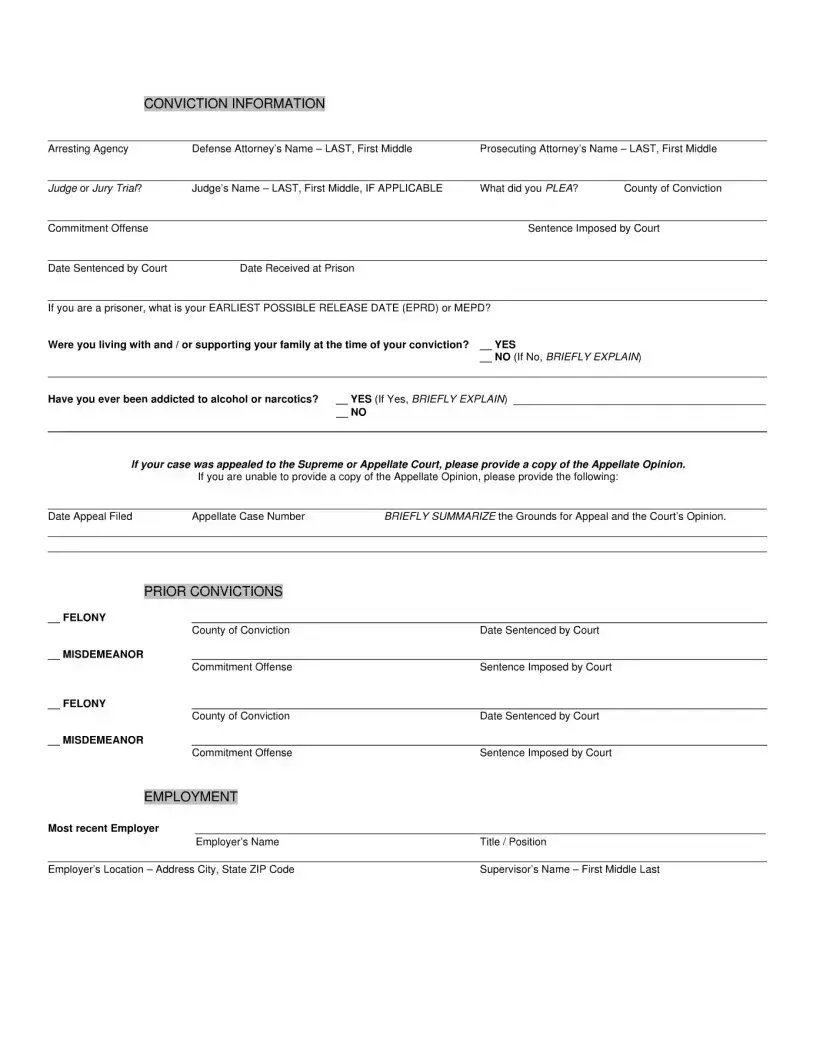
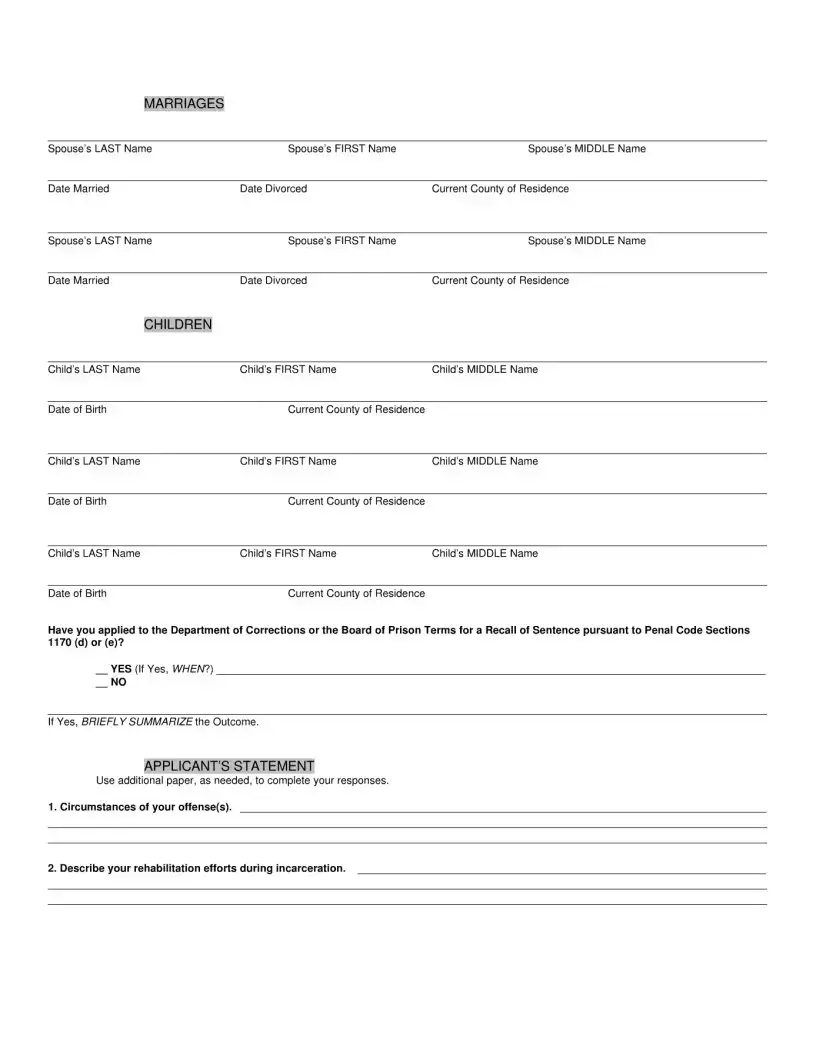
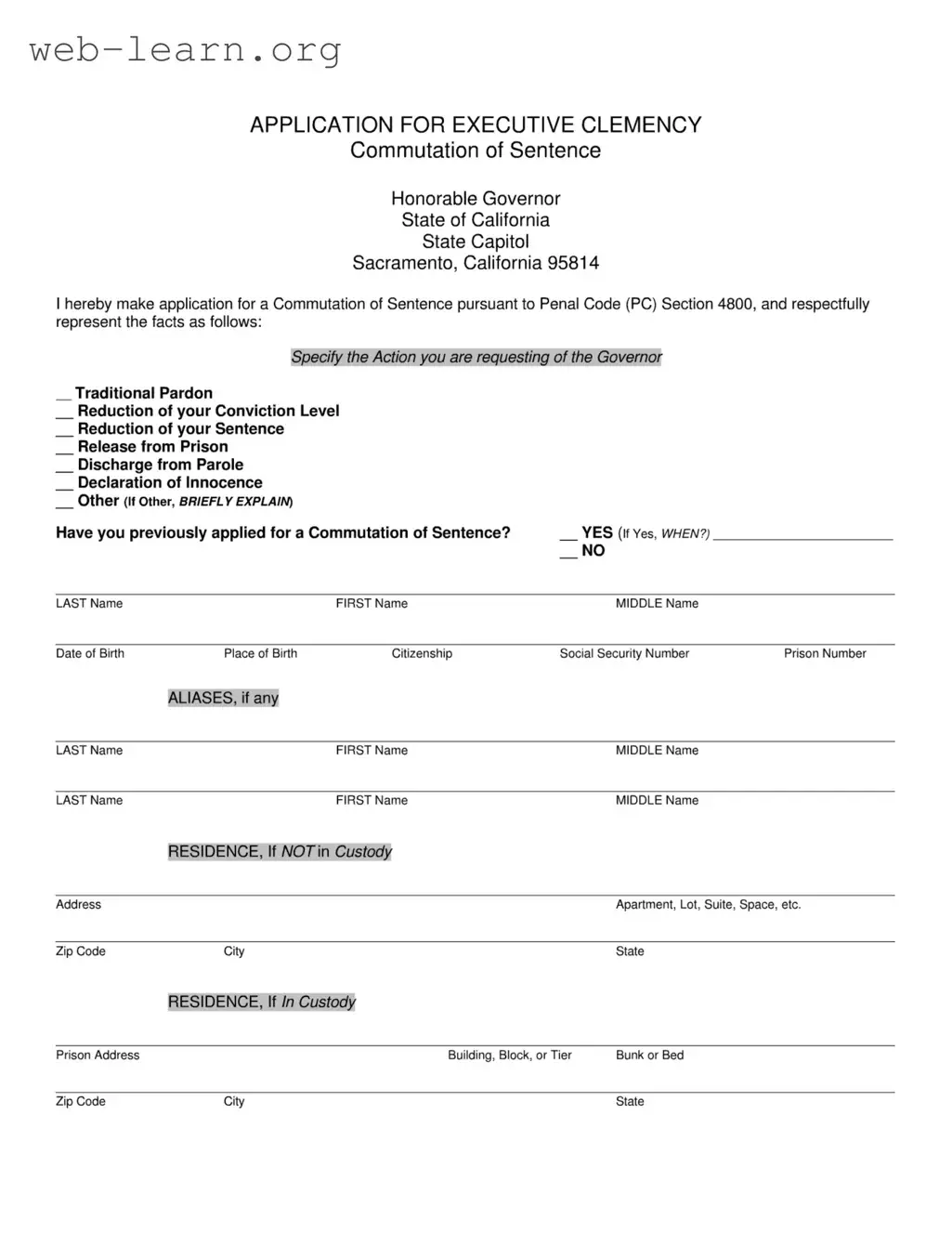
The California Executive Clemency form is a vital tool for individuals seeking to have their sentences modified or overturned by the Governor. This application allows individuals to request various forms of clemency, including a commutation of sentence, a traditional pardon, or even a declaration of innocence. The form requires applicants to provide personal information such as their name, date of birth, and prison number, as well as details about their conviction and sentencing. Additionally, it asks for information on prior convictions, employment history, and family circumstances, helping to paint a complete picture of the applicant’s life. The form also encourages applicants to share their rehabilitation efforts and any commendations received while incarcerated. It is essential to note that the application must be notarized and accompanied by a Notice of Intention to Apply for Executive Clemency, which must be sent to the relevant District Attorneys. By understanding the components of this form, individuals can better navigate the clemency process and increase their chances of receiving a favorable outcome.
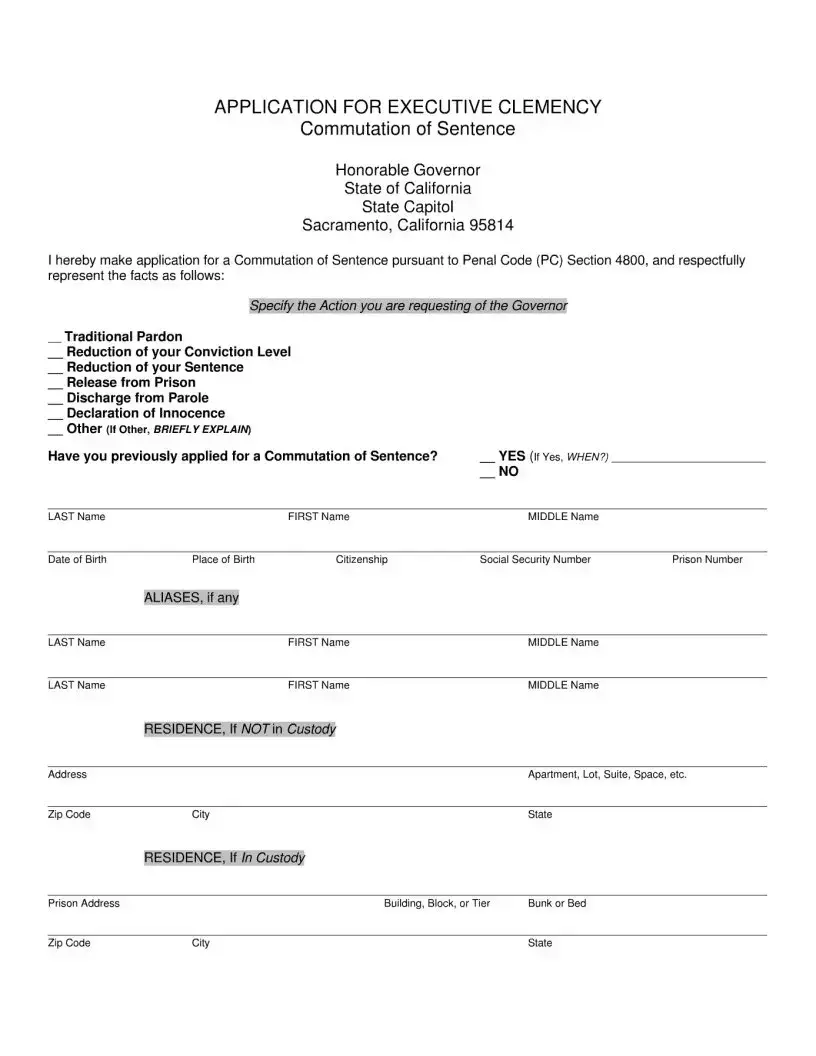
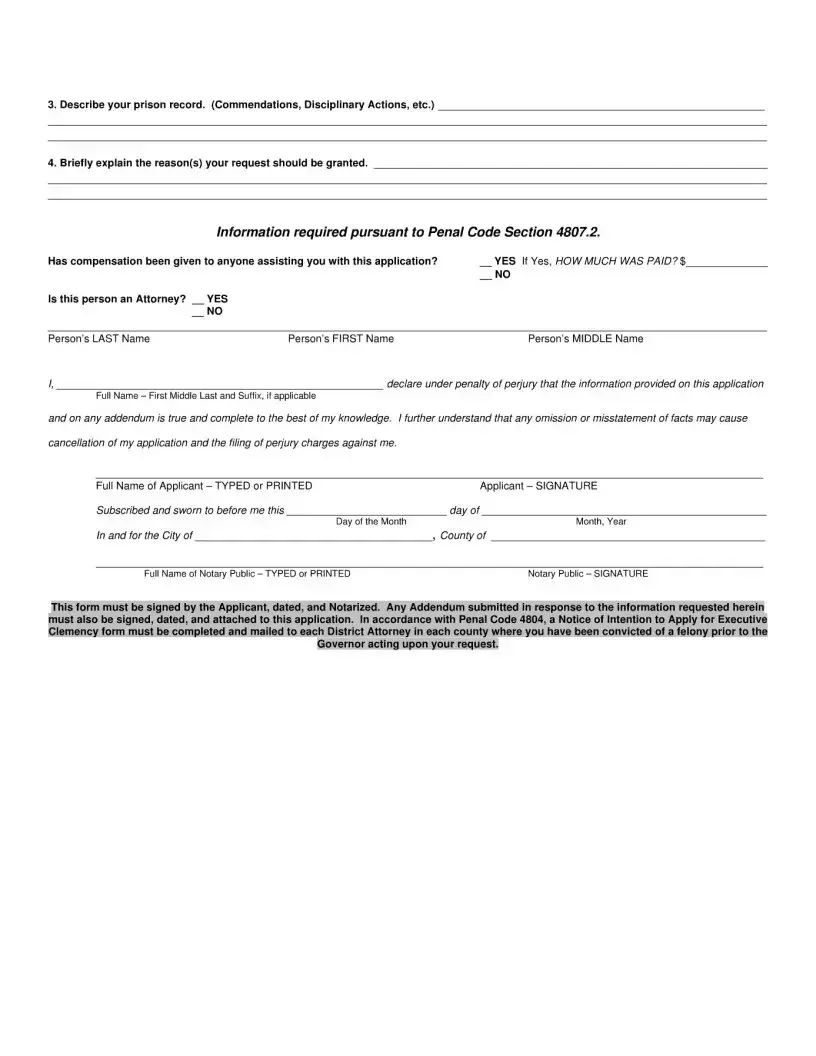
Sample - California Executive Clemency Form

Form Information

Fact Name Description
Governing Law The California Executive Clemency form is governed by Penal Code Section 4800.
Purpose This form is used to apply for a commutation of sentence, which can include various requests such as a traditional pardon or reduction of conviction level.
Application Requirements Applicants must provide personal information, including name, date of birth, and Social Security number, along with details about their conviction.
Prior Applications Applicants must disclose if they have previously applied for a commutation of sentence and provide the date if applicable.
Rehabilitation Evidence The application requires a description of rehabilitation efforts during incarceration, including prison records and commendations.
Family Support Applicants must indicate whether they were living with and supporting their family at the time of conviction.
Notarization Requirement The form must be signed by the applicant, dated, and notarized to be considered valid.
Notice of Intention Before the Governor acts on the request, a Notice of Intention to Apply for Executive Clemency must be sent to each District Attorney in counties of prior felony convictions.

Detailed Guide for Filling Out California Executive Clemency

After completing the California Executive Clemency form, you will need to submit it along with any required documentation. Ensure that all sections are filled out accurately, as any errors or omissions may delay the process or result in denial. Following the submission, the Governor's office will review your application, which may take some time. Keep in mind that you may need to provide additional information if requested.

  1. Obtain the Form: Download the California Executive Clemency form from the official website or request a hard copy.
  2. Fill Out Personal Information: Provide your last name, first name, middle name, date of birth, place of birth, citizenship, social security number, and prison number. Include any aliases.
  3. Specify Your Request: Indicate the action you are requesting from the Governor, such as a traditional pardon, reduction of conviction level, or discharge from parole. Briefly explain if you select "Other."
  4. Previous Applications: State whether you have previously applied for clemency. If yes, provide the date of your last application.
  5. Residence Information: Fill in your current address if not in custody, or your prison address if you are incarcerated.
  6. Conviction Information: Detail the arresting agency, trial type, commitment offense, sentencing date, defense attorney, prosecuting attorney, and judge’s name. Include your plea and county of conviction.
  7. Release Date: If you are a prisoner, indicate your earliest possible release date.
  8. Family Support: Answer whether you were living with or supporting your family at the time of your conviction.
  9. Addiction History: Disclose any history of alcohol or narcotics addiction, providing explanations if applicable.
  10. Appeal Information: If applicable, summarize the grounds for appeal and the court’s opinion. Include the date the appeal was filed and the appellate case number.
  11. Prior Convictions: List any prior felony or misdemeanor convictions, including the county, commitment offense, sentencing date, and sentence imposed.
  12. Employment History: Provide the name and location of your most recent employer, your job title, and your supervisor's name.
  13. Marriage Information: List your spouse’s names, dates married, and dates divorced, if applicable.
  14. Children’s Information: Include your children's names and dates of birth, along with their current counties of residence.
  15. Recall of Sentence: Indicate whether you have applied for a recall of sentence under specified Penal Code sections, providing details if yes.
  16. Applicant’s Statement: Use additional paper to describe the circumstances of your offense, your rehabilitation efforts, your prison record, and reasons for your request.
  17. Compensation Disclosure: If applicable, state whether anyone assisted you with your application and how much was paid.
  18. Signature and Notarization: Sign and date the application. Ensure it is notarized, along with any attached addenda.
  19. Notify District Attorneys: Complete and mail a Notice of Intention to Apply for Executive Clemency form to each District Attorney in counties where you have felony convictions.

Obtain Answers on California Executive Clemency

  1. What is the purpose of the California Executive Clemency form?

    The California Executive Clemency form is designed for individuals seeking a commutation of their sentence. This means that the person is asking the Governor to reduce their sentence or modify the terms of their conviction. The application can cover various requests, including a traditional pardon, reduction of conviction level, release from prison, or even a declaration of innocence. It provides a structured way for applicants to present their case and demonstrate their rehabilitation efforts and current circumstances.

  2. Who is eligible to apply for clemency?

    Eligibility for clemency in California generally includes individuals who have completed their prison sentence and are seeking a reduction or modification of their conviction. Applicants must provide details about their conviction, including the offense, sentencing information, and any prior convictions. Additionally, the application requires information about the applicant's rehabilitation efforts while incarcerated, as well as their current circumstances, such as family support and employment history.

  3. What information must be included in the application?

    The application requires comprehensive information about the applicant's personal history, including:

    • Full name, date of birth, and place of birth
    • Details about the conviction, including the arresting agency, trial details, and sentencing
    • Rehabilitation efforts during incarceration
    • Family background, including spouse and children
    • Employment history

    Additionally, applicants must provide a statement detailing the circumstances of their offense, their prison record, and reasons why their request should be granted. This information helps the Governor understand the applicant's journey and the rationale behind the clemency request.

  4. What happens after the application is submitted?

    Once the application is submitted, it undergoes a review process. A Notice of Intention to Apply for Executive Clemency must be sent to each District Attorney in every county where the applicant has a felony conviction. This allows the District Attorneys to provide input on the application. After reviewing all submitted materials and any feedback from the District Attorneys, the Governor will make a decision regarding the clemency request. The process can take time, so patience is essential during this period.

Common mistakes

Filling out the California Executive Clemency form can be a daunting task, and mistakes can lead to delays or even rejection of your application. One common error is failing to clearly specify the action you are requesting from the Governor. Whether you seek a traditional pardon, a reduction of your conviction level, or another form of relief, it is crucial to state your request explicitly. This clarity helps ensure that your application is directed to the appropriate process.

Another frequent mistake is neglecting to provide complete personal information. Incomplete details such as your full name, date of birth, or social security number can create confusion and hinder the review of your application. It is essential to double-check that all fields are filled out accurately and completely.

Many applicants also overlook the importance of summarizing their grounds for appeal. If your case was appealed, providing a brief summary of the grounds and the court’s opinion is vital. This information can significantly impact the Governor's decision, so take the time to articulate it clearly.

Some individuals mistakenly believe that their past behavior does not matter. However, your prison record—including commendations and disciplinary actions—plays a significant role in the evaluation of your application. Be honest and thorough when describing your rehabilitation efforts and any positive changes you have made during incarceration.

Another error is failing to disclose prior convictions. Whether they are felonies or misdemeanors, all prior convictions must be listed. Omitting this information can be seen as an attempt to hide your history, which may jeopardize your application.

In addition, applicants sometimes forget to provide information about their employment history. This section is important as it demonstrates your stability and contributions to society. Make sure to include your most recent employer and details about your position.

Another common oversight is not addressing family support at the time of conviction. The application asks whether you were living with and supporting your family during that time. Failing to answer this question, or providing an unclear response, can lead to misunderstandings about your situation.

Moreover, many applicants neglect to explain any history of addiction. If you have struggled with substance abuse, it is crucial to provide a brief explanation. This information can help the review board understand your journey toward rehabilitation.

Finally, ensure that your application is signed, dated, and notarized. An unsigned or improperly notarized application can be rejected outright. Take the time to follow all instructions carefully to avoid unnecessary setbacks in your clemency request.

Documents used along the form

The California Executive Clemency process involves several forms and documents that help support an application. Understanding these documents can streamline the process and improve the chances of a successful outcome. Below is a list of commonly used forms and documents that accompany the California Executive Clemency form.

  • Notice of Intention to Apply for Executive Clemency: This form notifies the District Attorneys in each county where the applicant has been convicted of a felony. It must be completed and mailed before the Governor considers the clemency request.
  • Application for Recall of Sentence: This document is used to request a reduction or recall of a previously imposed sentence under specific Penal Code sections. It highlights the reasons for seeking a change in sentencing.
  • Appellate Opinion: If the case was appealed, a copy of the Appellate Opinion provides insights into the grounds for the appeal and the court's decision. This document is crucial for understanding any legal challenges previously faced.
  • Statement of Rehabilitation: This statement details the efforts made by the applicant to rehabilitate during incarceration. It can include programs completed, skills learned, and personal growth achieved.
  • Character References: Letters from individuals who can attest to the applicant's character and rehabilitation efforts can be submitted. These references may include family, friends, or community members who support the application.
  • Employment Verification: Documentation from the applicant's most recent employer may be included to demonstrate stable employment and community ties post-incarceration.
  • Family Support Statements: These statements outline the support system the applicant has in place, including family members who can provide assistance and encouragement.
  • Financial Disclosure: This document provides an overview of the applicant's financial situation, including income, expenses, and any debts. It can help illustrate the applicant's stability.
  • Medical Records: If relevant, medical records can be submitted to show any health issues that may impact the applicant's ability to serve their sentence or justify a clemency request.
  • Affidavit of Support: This sworn statement may be provided by individuals who are willing to support the applicant during and after their transition back into society.

Having these documents ready can make the clemency application process more efficient. Each piece of information contributes to a comprehensive view of the applicant’s situation and supports their request for clemency. Preparing these forms carefully can enhance the likelihood of a favorable decision.

Similar forms

  • Application for a Pardon: Similar to the Executive Clemency form, this application requests forgiveness for a past crime. It often requires details about the conviction and reasons for seeking a pardon, just like the clemency application.
  • Application for Commutation of Sentence: This document specifically seeks a reduction in the length of a sentence. Like the Executive Clemency form, it includes personal information and details about the conviction.
  • Petition for Post-Conviction Relief: This petition is filed to challenge a conviction or sentence after the trial has concluded. It shares similarities with the clemency form in that it requires a clear explanation of the reasons for the request and supporting evidence.
  • Application for Expungement: This document seeks to remove a conviction from public records. Both the expungement application and the clemency form require information about the applicant's criminal history and the rationale for the request.
  • Request for Sentence Modification: This request aims to change the terms of a sentence, such as probation conditions. Like the Executive Clemency form, it necessitates a detailed account of the circumstances surrounding the original sentence and the reasons for the modification.

Dos and Don'ts

When filling out the California Executive Clemency form, it’s essential to approach the process thoughtfully. Here are five things you should and shouldn't do to ensure your application is as strong as possible.

  • Do provide accurate information. Ensure that all details, including names, dates, and circumstances, are correct. Inaccuracies can lead to delays or denial.
  • Do explain your rehabilitation efforts. Clearly describe any steps you have taken to improve yourself during your incarceration. This can make a significant impact on your application.
  • Do include supporting documents. If applicable, attach any relevant documents, such as court opinions or evidence of commendations, to strengthen your case.
  • Don't rush the application. Take your time to fill out the form thoroughly. A well-prepared application is more likely to be favorably reviewed.
  • Don't omit any required information. Ensure that you answer every question on the form. Missing information can result in your application being rejected.

By following these guidelines, you can enhance your chances of a successful application for clemency. Approach the process with care and attention to detail, and remember that your story matters.

Misconceptions

Misconceptions about the California Executive Clemency form can lead to confusion and hinder the application process. Here are seven common misconceptions:

  • All applications are automatically granted. Many believe that submitting an application guarantees a favorable outcome. In reality, each application is reviewed on a case-by-case basis, and approval is not assured.
  • Only violent offenders can apply. Some individuals think that clemency is reserved solely for those convicted of violent crimes. However, anyone with a felony conviction can apply, regardless of the nature of the offense.
  • There is a quick turnaround time for decisions. A common belief is that the Governor will respond quickly to applications. The review process can take considerable time, often months or even years, due to the volume of applications and the complexity of each case.
  • Legal representation is mandatory. Many assume that hiring an attorney is necessary to submit an application. While legal assistance can be beneficial, individuals can apply without an attorney if they feel confident in their ability to complete the form accurately.
  • Prior applications disqualify future ones. Some applicants think that if they have previously applied and been denied, they cannot apply again. This is not true; individuals can submit multiple applications if they can present new information or circumstances.
  • The form is the only requirement. Some believe that submitting the clemency form is sufficient for consideration. In fact, applicants must also complete a Notice of Intention to Apply for Executive Clemency form and notify relevant District Attorneys.
  • Only the Governor reviews applications. Many think that the Governor alone makes the final decision. In reality, the application undergoes a thorough review process involving various state agencies before reaching the Governor’s desk.

Key takeaways

Filling out the California Executive Clemency form can be a significant step towards obtaining relief from a sentence. Here are some key takeaways to keep in mind:

  • Understand the Purpose: The form is used to request a commutation of sentence from the Governor of California.
  • Specify Your Request: Clearly state what action you are seeking, such as a pardon, reduction of conviction level, or release from prison.
  • Provide Accurate Information: Fill in all personal details accurately, including your name, date of birth, and social security number.
  • Include Conviction Details: List the conviction information, including the arresting agency and the sentence imposed by the court.
  • Summarize Rehabilitation Efforts: Describe your efforts to rehabilitate during incarceration. This can strengthen your application.
  • Attach Necessary Documents: If applicable, include any appellate opinions or documents related to previous appeals.
  • Be Honest: Disclose any prior convictions and provide truthful answers to questions about your past.
  • Get Notarized: Ensure that the application is signed, dated, and notarized. This step is crucial for the validity of your submission.

By following these guidelines, you can improve your chances of a successful application for clemency.