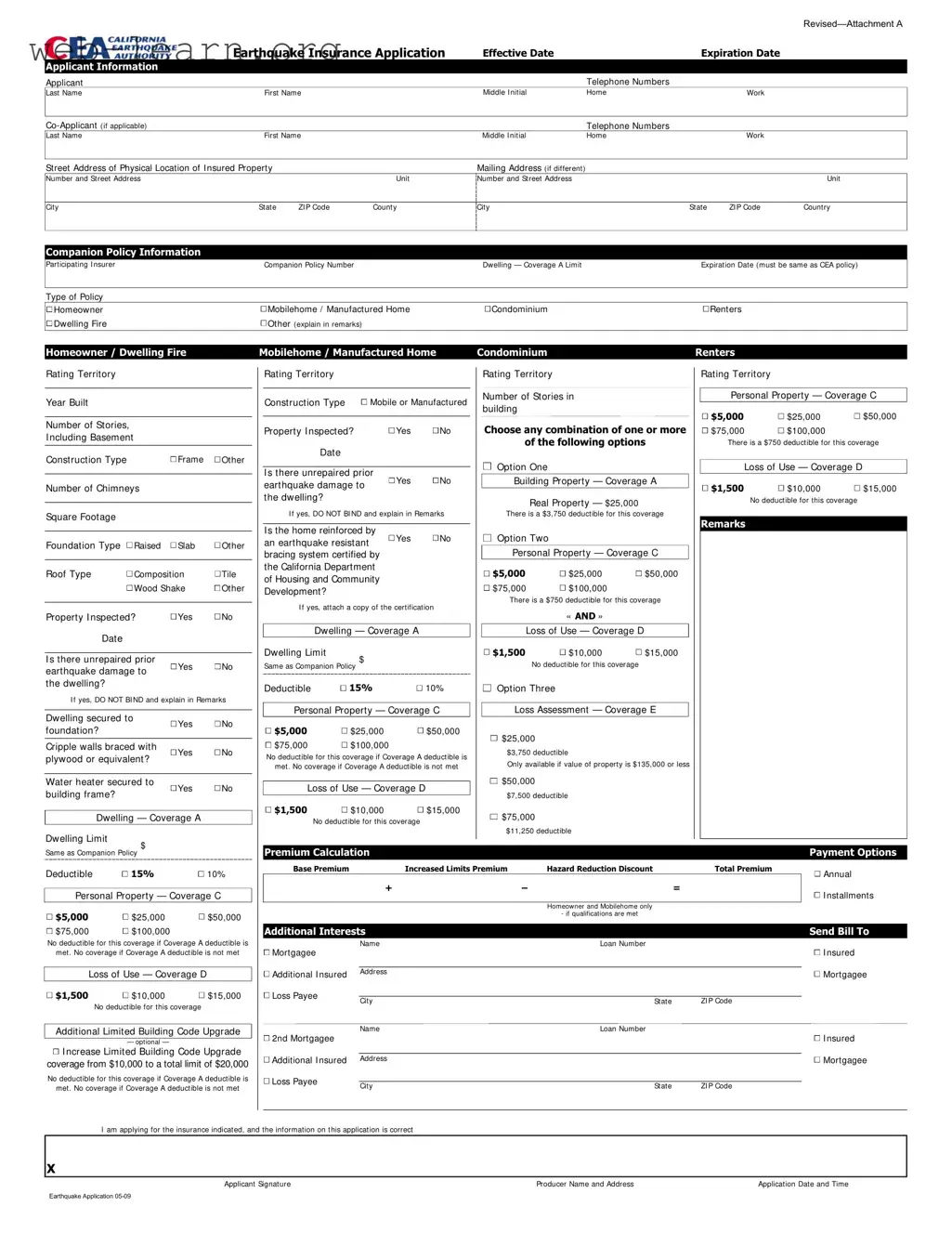
Homepage Blank California Earthquake Authority Form
Outline

The California Earthquake Authority (CEA) form is an essential document for individuals seeking earthquake insurance in California. This application gathers crucial information about the applicant and the property to ensure adequate coverage. Key sections of the form include applicant details, such as names and contact information, along with specifics about the insured property, including its address and type. The form also requires information about any companion policies, which are typically homeowner or renter policies that align with the CEA coverage. Applicants must provide details about the property’s construction type, age, and any previous earthquake damage. Additionally, the form outlines various coverage options and limits, allowing applicants to customize their insurance according to their needs. Premium calculations and payment options are also included, ensuring transparency in costs. Finally, the form emphasizes the importance of signatures and additional interests, such as mortgagees, to complete the application process effectively.
Sample - California Earthquake Authority Form

Effective Date Expiration Date
Earthquake Insurance Application
Applicant
Telephone Numbers
Last Name First Name
Middle I nitial Home
Work
Last Name First Name Middle I nitial
Co-Applicant (if applicable)
Street Address of Physical Location of I nsured Property
Number and Street Address
City St ate ZIP Code Count y
Unit
Applicant Information
Participating I nsurer
Expiration Date (must be same as CEA policy)
Type of Policy
Homeowner / Dwelling Fire
Companion Policy Information
Mobilehome / Manufactured Home Condominium Renters
Rating Territory
Year Built
Number of Stories,
Including Basement
Construction Type
Number of Chimneys
Square Footage
Foundation Type
Roof Type
Property I nspected?
Date
Is there unrepaired prior
earthquake damage to
the dwelling?
If yes, DO NOT BIND and explain in Remarks
Dwelling secured to
foundation?
Cripple walls braced with
plywood or equivalent?
Water heater secured to
building frame?
Number and Street Address
City
Mailing Address (if different)
Telephone Numbers
Dwelling Coverage A
Dwelling Limit
Deductible
Personal Property Coverage C
No deductible for this coverage if Coverage A deductible is
met. No coverage if Coverage A deductible is not met
Loss of Use — Coverage D
No deductible for this coverage
Additional Limited Building Code Upgrade
Increase Limited Building Code Upgrade
coverage from $10,000 to a total limit of $20,000
$
No deductible for this coverage if Coverage A deductible is
met. No coverage if Coverage A deductible is not met
X
Rating Territory
Mobile or Manufactured
Is the home reinforced by
an earthquake resistant
bracing system certified by
the California Department
of Housing and Community
Development?
If yes, attach a copy of the certification
Rating Territory
Number of Stories in
building
Choose any combination of one or more
of the following options
Building Property Coverage A
Real Property $25,000
Personal Property Coverage C
There is a $750 deductible for this coverage
Loss Assessment — Coverage E
Option One
There is a $3,750 deductible for this coverage
I am applying for the insurance indicated, and the information on this application is correct
Applicant Signature
Tile
Other Raised Slab
Composition
Wood Shake
Other
Frame
10% 15%
$50,000
$5,000
$75,000
$25,000
$100,000
$1,500 $15,000 $10,000
Dwelling Coverage A
Personal Property Coverage C
Loss of Use — Coverage D
No deductible for this coverage
$50,000
$25,000
Rating Territory
Personal Property Coverage C
There is a $750 deductible for this coverage
Loss of Use — Coverage D
Option Two
Option Three
$3,750 deductible
Only available if value of property is $135,000 or less
$7,500 deductible
Premium Calculation
Base Premium
Increased Limits Premium Total Premium
Hazard Reduction Discount
Homeowner and Mobilehome only
- if qualifications are met
Additional Interests
Mortgagee
Additional I nsured
2nd Mortgagee
Loss Payee
Name
Address
Payment Options
Annual
Installments
Send Bill To
Insured
Mortgagee
Loan Number
Producer Name and Address Application Date and Time
Remarks
Homeowner
Dwelling Fire
Mobilehome / Manufactured Home Condominium Renters
+
=
« AND »
Other (explain in remarks)
Companion Policy Number Dwelling — Coverage A Limit
— optional
Same as Companion Policy
City ZIP Code
State
Name
Address
Loan Number
City
ZIP Code State
No Yes
No Yes
No Yes
No Yes
No Yes
Other
Insured
Mortgagee
$50,000
$5,000
$75,000
$25,000
$100,000
$1,500 $15,000 $10,000
$50,000
$5,000
$75,000
$25,000
$100,000
No deductible for this coverage
$1,500 $15,000 $10,000
Construction Type
Property I nspected?
Date
Is there unrepaired prior
earthquake damage to
the dwelling?
If yes, DO NOT BIND and explain in Remarks
No Yes
No Yes
No Yes
Dwelling Limit
$
Same as Companion Policy
Deductible
10% 15%
No deductible for this coverage if Coverage A deductible is
met. No coverage if Coverage A deductible is not met
$50,000
$5,000
$75,000
$25,000
$100,000
No deductible for this coverage
$1,500 $15,000 $10,000
Home Work
State ZIP Code Country
Unit
Additional I nsured
Loss Payee
Earthquake Application 05-09
$75,000
$11,250 deductible
Revised—Attachment A
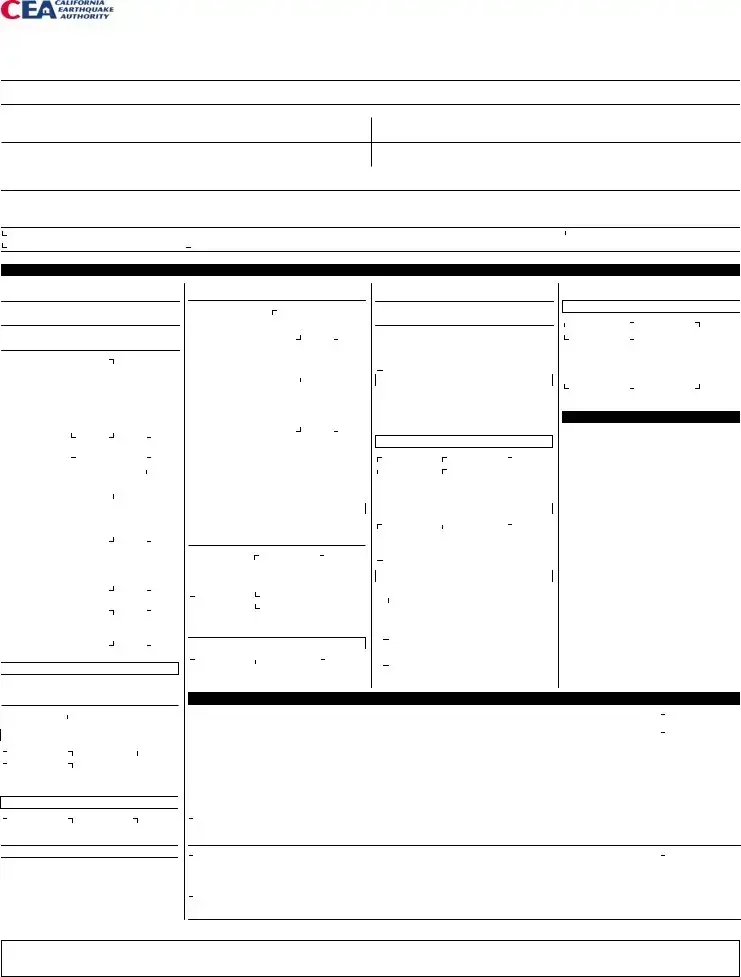
Attachment A – Page 2
CALIFORNIA EARTHQUAKE AUTHORITY
EARTHQUAKE INSURANCE APPLICATION – 05/09 Edition
INSTRUCTIONS
POLICY EFFECTIVE DATE AND EXPIRATION DATE
Provide CEA policy effective date and expiration date. Expiration date must be the same as the
expiration date of the companion policy.
APPLICANT
Complete all requested information for applicant(s) including:
Name(s)
Telephone number(s)
Street address of physical location of insured property
Mailing address (if different from street address of property’s physical location)
COMPANION POLICY INFORMATION
Complete all requested information for companion policy including:
Name of Participating Insurer
Policy number of companion policy
Dwelling limit (i.e., Coverage A) of companion policy (if companion policy has dwelling limit)
Expiration date of companion policy
Type of companion policy
POLICY TYPE –RATING AND COVERAGE INFORMATION
Identify CEA policy type based on the type of companion policy as follows:
Homeowner (Companion policy must be either a Homeowners (HO-1, 2, 3, 5, or 8),
Dwelling Fire (building), Landlord (building), or Mobilehome policy.)
o Mobilehome/Manufactured Home
(Written on CEA Homeowner Policy
form; however, requires unique rating information.)
Condominium (i.e. Common Interest Development)
(Companion policy must be a Condominium
Unit Owners (HO-6) policy.)
Renters
(Companion policy must be a Renters (HO-4) , Mobilehome (tenant policy),
Dwelling Fire (contents only), or Landlord (contents only) policy.)
Complete all information requested under the applicable CEA policy type. Answer all questions and select desired
CEA policy limits and coverage options.
PREMIUM CALCULATION
Provide premium calculations.
PAYMENT OPTIONS
Select payment option:
Annual; or
Installments
SEND BILL TO
Select who should receive the bill:
Insured; or
Mortgagee
ADDITIONAL INTERESTS
Complete information requested for each additional interest, including:
Type:
o Mortgagee;
o Additional insured; or
o Loss payee
Name and address
Loan number (if applicable)
REMARKS
Include any additional remarks as needed.
SIGNATURE
Secure the applicant’s signature on the application.
Provide the producer’s name and address.
Provide the date and time the application is completed.

Form Information

Fact Name Details
Governing Laws The California Earthquake Authority operates under California Insurance Code Section 10089 et seq.
Effective and Expiration Dates The application requires both an effective date and an expiration date, which must match the companion policy's expiration date.
Applicant Information Complete details about the applicant, including names, contact numbers, and addresses, are mandatory on the form.
Companion Policy Requirements Information regarding the companion policy, such as the insurer's name and policy number, must be provided to validate coverage.
Coverage Options The form allows selection of various coverage options, including limits for dwelling, personal property, and loss of use, among others.

Detailed Guide for Filling Out California Earthquake Authority

Completing the California Earthquake Authority form is a crucial step in obtaining earthquake insurance. The following steps outline the process for filling out the application accurately and efficiently. Ensure that all required information is provided, as incomplete forms may delay the application process.

  1. Policy Effective Date and Expiration Date: Enter the CEA policy effective date and ensure the expiration date matches that of the companion policy.
  2. Applicant Information: Fill in all requested details for the applicant, including last name, first name, middle initial, and telephone numbers (home and work). Include the street address of the insured property and the mailing address if it differs.
  3. Co-Applicant Information: If applicable, provide the co-applicant's information, including their last name, first name, middle initial, and telephone numbers.
  4. Companion Policy Information: Complete the details for the companion policy, including the name of the participating insurer, policy number, dwelling limit, and expiration date.
  5. Policy Type, Rating, and Coverage Information: Identify the CEA policy type based on the companion policy. Provide information on the rating territory, year built, number of stories, construction type, and other relevant details.
  6. Inspection and Damage Information: Indicate whether the property has been inspected and if there is any unrepaired prior earthquake damage. Answer questions regarding the dwelling's security and reinforcement.
  7. Coverage Limits: Specify the desired coverage limits for dwelling, personal property, and loss of use. Choose from the available options and indicate any additional coverage desired.
  8. Premium Calculation: Calculate the premium based on the selected coverage and payment options. Indicate whether the payment will be made annually or in installments.
  9. Additional Interests: Provide information for any additional interests, such as mortgagees or loss payees, including names, addresses, and loan numbers.
  10. Remarks: Include any additional remarks as necessary.
  11. Signature: Ensure the applicant signs the application. Include the producer's name and address, as well as the date and time of application completion.

Obtain Answers on California Earthquake Authority

  1. What is the purpose of the California Earthquake Authority form?

    The California Earthquake Authority (CEA) form is used to apply for earthquake insurance coverage. This form collects essential information about the applicant, the property to be insured, and any existing companion policies. It helps ensure that applicants receive appropriate coverage based on their specific needs and circumstances.

  2. What information is required from the applicant?

    Applicants must provide several details, including:

    • Full name (first, middle initial, and last)
    • Contact telephone numbers (home and work)
    • Physical address of the property being insured
    • Mailing address, if different from the physical address

    If applicable, information about a co-applicant is also required. This includes their name and contact information.

  3. What is a companion policy, and why is it important?

    A companion policy is an existing insurance policy that covers the same property. It is crucial because the CEA policy relies on the details of this companion policy to determine coverage limits and eligibility. Applicants must provide information about the participating insurer, policy number, and coverage limits of the companion policy.

  4. What types of properties can be insured under this form?

    The form accommodates various types of properties, including:

    • Homeowners
    • Mobilehomes or manufactured homes
    • Condominiums
    • Renters
    • Dwelling fire policies

    Applicants must select the appropriate type based on their existing insurance coverage.

  5. How are premiums calculated?

    Premiums are calculated based on several factors, including the base premium, any increased limits, and applicable discounts for hazard reduction. The total premium will reflect these calculations. Applicants can choose to pay the premium annually or in installments.

  6. What should I do if there is unrepaired prior earthquake damage?

    If there is any unrepaired earthquake damage to the dwelling, applicants should indicate this on the form. It is essential to note that if there is unrepaired damage, the application cannot be bound, and an explanation must be provided in the remarks section.

  7. What is the significance of the applicant's signature on the form?

    The applicant's signature is a confirmation that the information provided in the application is accurate and complete. It also signifies the applicant's intent to apply for the insurance coverage indicated. Additionally, the signature ensures that the applicant understands the terms and conditions associated with the policy.

Common mistakes

Filling out the California Earthquake Authority form can be straightforward, but many make mistakes that can delay their application or lead to complications later. One common error is failing to provide complete applicant information. It's essential to include all requested details, such as last names, first names, and telephone numbers. Missing even one piece of information can result in processing delays.

Another mistake involves the companion policy information. Applicants often overlook the requirement to match the expiration date of the CEA policy with that of the companion policy. If these dates do not align, it could lead to issues with coverage when an earthquake occurs.

Many people also misidentify the type of policy they are applying for. The form requires specific information based on whether the property is a homeowner, mobilehome, condominium, or renter's policy. Providing incorrect information can lead to inadequate coverage or denial of the application.

Inadequate attention to the property details is another frequent issue. Applicants sometimes fail to specify the number of stories, construction type, or foundation type. These details are crucial for determining risk and appropriate coverage. If this information is missing or incorrect, it may affect the premium calculation.

Some applicants neglect to answer critical questions regarding prior earthquake damage or property inspections. If there is unrepaired damage, the form specifically states, "DO NOT BIND," and applicants must explain this in the remarks section. Ignoring this can lead to complications in the underwriting process.

Premium calculations can also trip up applicants. It's vital to ensure that all calculations are accurate and that the correct payment option is selected. Errors here can lead to billing issues or even cancellation of the policy.

Lastly, many forget to sign the application. The applicant's signature is necessary to confirm that the information provided is accurate. Without this, the application is incomplete and will not be processed. Ensuring all sections are filled out correctly and thoroughly can help avoid these common pitfalls.

Documents used along the form

The California Earthquake Authority form is an essential document for anyone seeking earthquake insurance in California. However, it is often accompanied by other important forms and documents that help ensure comprehensive coverage and accurate processing. Below is a list of commonly used documents that may be required alongside the California Earthquake Authority form.

  • Homeowners Insurance Policy: This document outlines the terms and conditions of the homeowner's insurance coverage. It typically includes details about the property, coverage limits, and any exclusions. Having this policy is crucial, as it often serves as a companion to the earthquake insurance application.
  • Disclosure Statement: This statement provides important information about the insurance policy, including coverage limits, deductibles, and any specific exclusions. It ensures that the applicant is fully informed about what is and isn't covered under their policy.
  • Proof of Property Ownership: This document verifies that the applicant is the legal owner of the property being insured. It may include a deed or title document and is necessary to establish eligibility for earthquake insurance.
  • Inspection Report: An inspection report may be required to assess the property's condition and any potential vulnerabilities to earthquake damage. This report can help the insurance provider determine appropriate coverage and premiums.
  • Mortgage Information: If the property is financed, the lender's information must be included. This document ensures that the mortgagee is informed about the insurance coverage and can make claims if necessary.
  • Additional Interests Form: This form is used to list any additional parties that have a financial interest in the property, such as co-owners or mortgage holders. Including this information helps protect all parties involved in the property.

Understanding these documents and their purposes can greatly enhance your experience when applying for earthquake insurance. Each plays a vital role in ensuring that you have the necessary coverage and that your application is processed smoothly. Always double-check that you have all required documents ready to avoid any delays in obtaining your policy.

Similar forms

  • Homeowners Insurance Application: Similar to the California Earthquake Authority form, this document collects personal information about the applicant and details about the property to be insured. It also requires information about coverage limits and types of policies.
  • Flood Insurance Application: Like the earthquake form, this application gathers applicant information and property details. It also includes questions about prior damage and coverage options, ensuring the applicant understands the terms of the policy.
  • Auto Insurance Application: This document requires personal and vehicle information, similar to the earthquake application. Both forms ask for details about previous claims and policy limits, ensuring adequate coverage for the insured party.
  • Renters Insurance Application: This form is akin to the California Earthquake Authority form in that it collects personal information and details about the insured property. It also includes options for coverage limits and deductibles.
  • Commercial Property Insurance Application: This document parallels the earthquake form by requiring information about the business, property details, and coverage options. Both forms aim to assess risk and determine appropriate premiums.
  • Condominium Insurance Application: Similar to the California Earthquake Authority form, this application gathers information about the unit and the owner. It also includes options for coverage and limits, reflecting the specific needs of condominium owners.

Dos and Don'ts

When filling out the California Earthquake Authority form, it is essential to follow specific guidelines to ensure accuracy and completeness. Here are eight things you should and shouldn't do:

  • Do provide accurate applicant information, including names and contact numbers.
  • Do ensure the effective and expiration dates are the same as the companion policy.
  • Do select the correct type of policy based on your companion policy.
  • Do indicate whether the property has been inspected and if there is any prior earthquake damage.
  • Don't leave any sections blank; all requested information must be completed.
  • Don't forget to include details about additional interests, like mortgagees or loss payees.
  • Don't submit the application without the applicant's signature.
  • Don't forget to calculate premiums accurately and select a payment option.

Misconceptions

Understanding the California Earthquake Authority (CEA) form can be challenging. Here are ten common misconceptions that people often have about this important document:

  1. The CEA form is only for homeowners. Many believe that only homeowners can apply for earthquake insurance. However, renters, mobilehome owners, and condominium owners can also use this form to obtain coverage.
  2. All earthquake damage is automatically covered. Some assume that all types of earthquake damage are included in the policy. In reality, coverage may depend on specific conditions and limits stated in the form.
  3. Filing the form guarantees immediate coverage. Many think that submitting the application instantly secures insurance. Coverage only begins once the application is processed and approved.
  4. The form is the same for all insurance companies. Some believe that the CEA form is uniform across all insurers. In fact, while the form is standardized, details may vary depending on the participating insurer's requirements.
  5. Earthquake insurance is unnecessary if you live in a low-risk area. Some individuals think that if they reside in a less earthquake-prone region, they do not need coverage. However, earthquakes can occur unexpectedly anywhere in California.
  6. You can skip questions if you think they don’t apply. Some applicants may feel it's acceptable to leave questions unanswered. It's crucial to complete all sections to avoid delays in processing.
  7. There’s no need to provide proof of prior damage. Many believe that they can apply without disclosing any past earthquake damage. However, the form requires full disclosure to ensure proper coverage.
  8. All policies have the same deductible. Some applicants assume that the deductible is fixed. The deductible can vary based on the chosen coverage limits and options.
  9. Coverage limits can be adjusted after submission. A common misconception is that applicants can change their coverage limits after the application is submitted. Changes typically require a new application or amendment.
  10. The form does not require a signature. Some think that a signature is optional. In reality, the applicant's signature is essential for the application to be valid.

Being aware of these misconceptions can help individuals navigate the CEA form more effectively and ensure they secure the right coverage for their needs.

Key takeaways

When filling out the California Earthquake Authority (CEA) form, there are several important points to keep in mind:

  • Effective and Expiration Dates: Ensure that the effective date and expiration date of the CEA policy match those of the companion policy.
  • Complete Applicant Information: Fill out all required fields for the applicant, including names, telephone numbers, and addresses for both the insured property and mailing address if different.
  • Companion Policy Details: Provide accurate information about the companion policy, including the name of the participating insurer, policy number, dwelling limit, and type of policy.
  • Policy Type Identification: Choose the correct CEA policy type based on the companion policy, such as homeowner, mobilehome, condominium, or renters.
  • Premium Calculations: Calculate the total premium, including base premium, increased limits, and any applicable discounts.
  • Payment Options: Select a payment option that suits your needs, either annual or installments.
  • Signature Requirement: Ensure the applicant signs the application. Include the producer’s name and address, along with the date and time of completion.

Each of these steps is crucial for ensuring that the application is processed correctly and efficiently.