Homepage Blank California Ea 250 Form
Outline

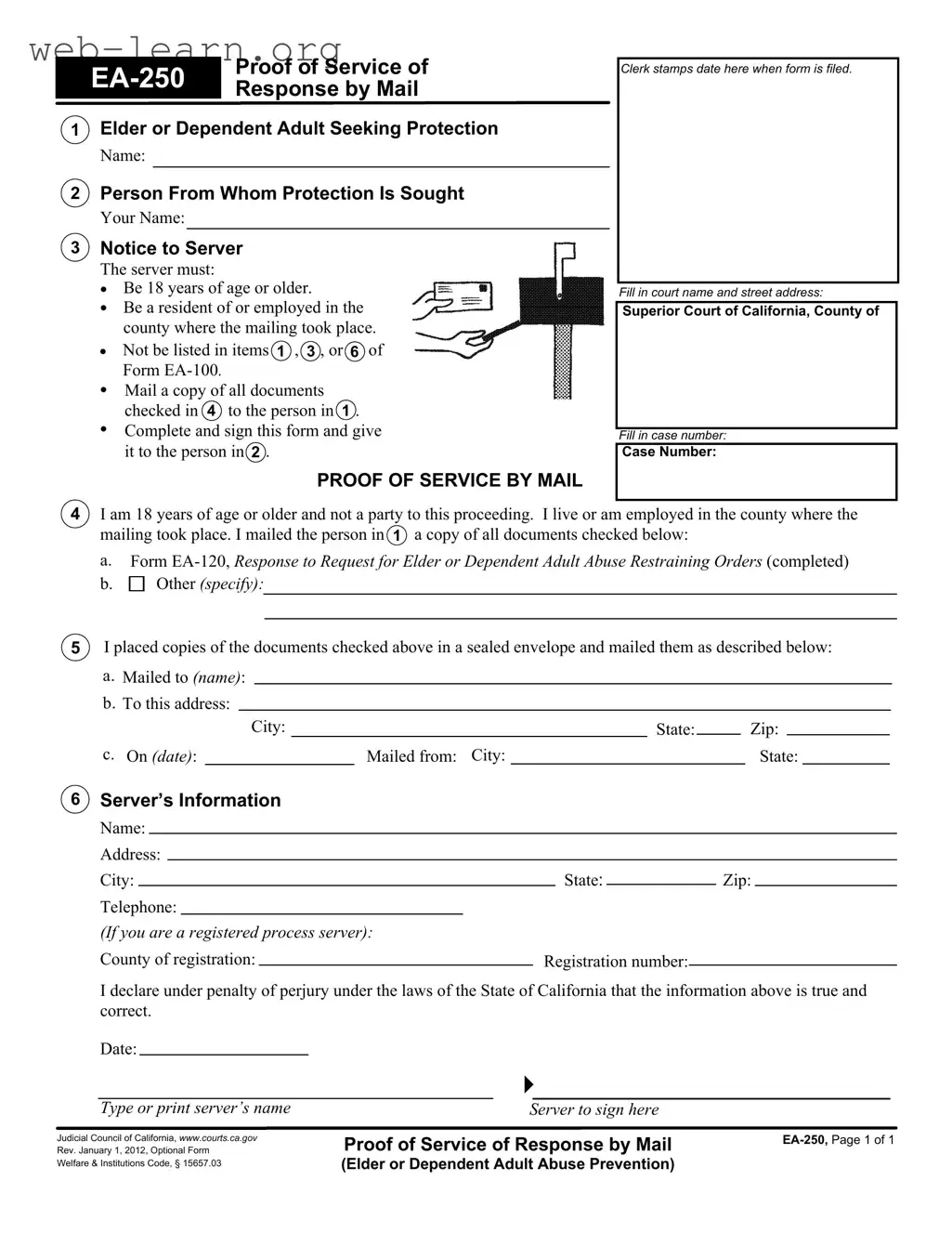
The California EA-250 form plays a crucial role in the process of seeking protection for elders or dependent adults facing abuse. This form is specifically designed to document the proof of service of a response by mail, ensuring that all parties involved are properly notified. It requires the name and address of both the elder or dependent adult seeking protection and the person from whom protection is sought. Additionally, the form outlines the responsibilities of the server, who must be at least 18 years old and a resident or employed in the county where the mailing occurs. Importantly, the server cannot be a party to the case. The EA-250 also includes sections for the server to confirm that they have mailed copies of relevant documents, such as the Response to Request for Elder or Dependent Adult Abuse Restraining Orders, to the appropriate parties. By completing and signing this form, the server affirms that the information provided is true and correct, thus fulfilling a vital step in the legal process aimed at protecting vulnerable individuals.
Sample - California Ea 250 Form

EA-250, Page 1 of 1
Proof of Service of Response by Mail
(Elder or Dependent Adult Abuse Prevention)
EA-250
Proof of Service of
Response by Mail
Judicial Council of California, www.courts.ca.gov
Rev. January 1, 2012, Optional Form
Welfare & Institutions Code, § 15657.03
The server must:
Notice to Server
I am 18 years of age or older and not a party to this proceeding. I live or am employed in the county where the
mailing took place. I mailed the person in a copy of all documents checked below:
Form EA-120, Response to Request for Elder or Dependent Adult Abuse Restraining Orders (completed)
I declare under penalty of perjury under the laws of the State of California that the information above is true and
correct.
Other (specify):
Clerk stamps date here when form is filed.
PROOF OF SERVICE BY MAIL
3
4
1
Fill in court name and street address:
Superior Court of California, County of
Case Number:
Fill in case number:
Server’s Information
Name:
Address:
Zip:
State:City:
Telephone:
(If you are a registered process server):
Registration number:
County of registration:
6
Date:
Type or print server’s name
Server to sign here
Name:
1
2
Person From Whom Protection Is Sought
Your Name:
Elder or Dependent Adult Seeking Protection
b.
a.
5
Be 18 years of age or older.
Mail a copy of all documents
checked in to the person in .
Complete and sign this form and give
it to the person in .
14
2
Be a resident of or employed in the
county where the mailing took place.
Not be listed in items , , or of
Form EA-100.
1
3
6
I placed copies of the documents checked above in a sealed envelope and mailed them as described below:
Zip:
State:
City:
Mailed to (name):
On (date): Mailed from:
City:
State:
To this address:
a.
c.
b.

Form Information

Fact Name Description
Purpose The EA-250 form is used to provide proof of service of a response by mail in cases involving elder or dependent adult abuse protection.
Eligibility Requirements The server must be at least 18 years old, reside or be employed in the county where mailing occurs, and not be a party to the case.
Documents Required The server must mail a copy of the completed EA-120 form along with any other specified documents to the individual seeking protection.
Governing Law This form is governed by the Welfare & Institutions Code, § 15657.03 in the State of California.

Detailed Guide for Filling Out California Ea 250

After completing the California EA 250 form, you will be ready to submit it to the court. This step is crucial for ensuring that the necessary parties are notified properly. Follow these steps to fill out the form accurately.

  1. Begin by entering your name in the designated field labeled "Name."
  2. Next, fill in your address, including street, city, and state.
  3. Provide your telephone number in the space provided.
  4. If you are a registered process server, indicate the county of registration.
  5. In the section for "Elder or Dependent Adult Seeking Protection," write the name of the individual seeking protection.
  6. In the "Person From Whom Protection Is Sought" section, write your name again.
  7. Read the "Notice to Server" section. Ensure the server meets all requirements.
  8. Fill in the court name and street address: "Superior Court of California, County of."
  9. Enter the case number in the provided space.
  10. In the next section, confirm that you are 18 years of age or older and not a party to this proceeding.
  11. Indicate whether you mailed a copy of all documents checked in the list below.
  12. Check the box next to "Form EA-120, Response to Request for Elder or Dependent Adult Abuse Restraining Orders (completed)" and any other relevant documents.
  13. Fill in the name of the person you mailed the documents to in the "Mailed to (name)" field.
  14. Provide the full address, including city, state, and zip code, of the recipient.
  15. Write the date you mailed the documents and the city and state from which they were mailed.
  16. Complete the "Server’s Information" section by entering your state and zip code.
  17. If applicable, provide your registration number.
  18. Sign the form to declare that the information provided is true and correct.
  19. Finally, type or print your name where indicated.

Obtain Answers on California Ea 250

  1. What is the purpose of the California EA-250 form?

    The California EA-250 form is used to prove that a response to a request for elder or dependent adult abuse restraining orders has been served by mail. It ensures that the individual seeking protection is notified of the response, which is crucial in legal proceedings.

  2. Who can serve documents using the EA-250 form?

    The server must meet specific criteria:

    • Be at least 18 years old.
    • Be a resident or employed in the county where the mailing occurs.
    • Not be a party to the case or listed in certain items of Form EA-100.

    These requirements help ensure that the service is conducted fairly and legally.

  3. What documents need to be mailed using the EA-250 form?

    The server is responsible for mailing a copy of all documents checked in section 4 of the form. Typically, this includes:

    • Form EA-120, which is the Response to Request for Elder or Dependent Adult Abuse Restraining Orders.
    • Any other relevant documents as specified by the server.
  4. How should the documents be mailed?

    The server must place the documents in a sealed envelope and send them to the individual seeking protection. The form requires the server to provide details about the mailing, including the name and address of the recipient, the date of mailing, and the city and state from which it was mailed.

  5. What happens after the documents are mailed?

    Once the documents have been mailed, the server must complete and sign the EA-250 form. This signed form serves as proof of service and should be submitted to the court. The court will then stamp the date when the form is filed, ensuring that there is a record of the service.

  6. Is there a penalty for providing false information on the EA-250 form?

    Yes, the server must declare under penalty of perjury that the information provided is true and correct. Providing false information can lead to serious legal consequences, including potential criminal charges.

Common mistakes

When filling out the California EA 250 form, many people make common mistakes that can lead to delays or complications in their case. One frequent error is failing to provide complete information in the Name and Address sections. It is essential to ensure that all details are accurate and legible. Omitting information or providing incorrect details can hinder the process of serving documents.

Another mistake involves the Server’s Information. Individuals often forget to include their registration number or fail to sign the form. This information is critical for validating the proof of service. Without a signature, the court may not accept the document, leading to unnecessary setbacks.

People also tend to overlook the requirements for the server. The form clearly states that the server must be 18 years of age or older and not a party to the case. Failing to meet these criteria can invalidate the service, meaning the documents may not be considered properly served.

Additionally, many individuals neglect to double-check the mailing address where the documents are sent. Errors in the address can result in the documents not reaching the intended recipient. It is crucial to verify that the name, street address, city, state, and zip code are all correct before mailing.

Another common oversight is not checking the documents being mailed. The form requires that a copy of all documents checked in section 4 be sent. Forgetting to include any required documents can lead to complications in the case. Always review the list of documents to ensure everything is accounted for.

Lastly, individuals often fail to keep a record of the mailing date and the city from which the documents were sent. This information is vital for tracking the timeline of the service. Without it, proving that the documents were mailed correctly can become challenging. Keeping a detailed record can save time and avoid confusion later on.

Documents used along the form

The California EA-250 form is a crucial document used in legal proceedings involving elder or dependent adult abuse. It serves as proof that a response to a request for a restraining order has been properly served by mail. In addition to this form, several other documents are often utilized in conjunction with it. Understanding these documents can provide clarity and ensure that all necessary steps are followed in the legal process.

  • EA-120: Response to Request for Elder or Dependent Adult Abuse Restraining Orders - This form is completed by the person from whom protection is sought. It allows them to respond formally to the allegations and outline their side of the story.
  • EA-100: Request for Elder or Dependent Adult Abuse Restraining Orders - This document initiates the process. It is filed by the elder or dependent adult seeking protection and details the nature of the abuse and the requested relief.
  • EA-130: Elder or Dependent Adult Abuse Restraining Order - Once a hearing is conducted, this form may be issued by the court if it finds sufficient evidence of abuse. It outlines the terms of the restraining order and the protections granted to the victim.
  • EA-140: Temporary Restraining Order - This form provides immediate protection before a full hearing can be held. It is often issued on an emergency basis and remains in effect until the court can make a final decision.
  • EA-200: Proof of Service of Request for Elder or Dependent Adult Abuse Restraining Orders - This document confirms that the request for a restraining order has been served to the person from whom protection is sought. It is essential for ensuring that the legal process is properly followed.

Each of these documents plays a vital role in the legal framework designed to protect vulnerable individuals. By ensuring that all forms are correctly filled out and filed, individuals can navigate the complexities of the legal system more effectively, thereby enhancing their chances of obtaining the necessary protection.

Similar forms

The California EA 250 form serves a specific purpose in legal proceedings involving elder or dependent adult abuse. However, there are several other documents that share similarities in function or process. Below are five documents that are comparable to the EA 250 form, along with explanations of how they are alike.

  • Form EA-120: Response to Request for Elder or Dependent Adult Abuse Restraining Orders - This form is directly related to the EA 250 as it is often the document being served. It outlines the respondent's position regarding the request for protection and must be filed with the court.
  • Form FL-330: Proof of Service by Mail - Similar to the EA 250, this form is used in family law cases to demonstrate that legal documents were mailed to the involved parties. It requires information about the sender, recipient, and the documents sent.
  • Form DV-250: Proof of Service of Response - In domestic violence cases, this form is used to confirm that a response to a restraining order was served by mail. Like the EA 250, it requires the server to provide details about the mailing process.
  • Form CIV-100: Proof of Service - This general proof of service form is used in civil cases to verify that documents have been properly served. It shares the same fundamental purpose of confirming that parties received important legal information.
  • Form UD-120: Proof of Service of Summons - This form is utilized in unlawful detainer (eviction) cases. It serves to document that the summons and complaint were delivered, paralleling the EA 250's role in confirming service of responses in elder abuse cases.

Dos and Don'ts

When filling out the California EA-250 form, follow these guidelines to ensure accuracy and compliance.

  • Do ensure that all names and addresses are filled out correctly. Double-check for typos.
  • Do confirm that the server meets all requirements, such as age and residency.
  • Do include all necessary documents in the mailing, as indicated on the form.
  • Do sign and date the form before submitting it to the court.
  • Don't leave any sections blank. Every part of the form must be completed.
  • Don't use a server who does not meet the eligibility criteria outlined in the instructions.
  • Don't forget to mail the documents to the correct address. Verify it beforehand.
  • Don't submit the form without ensuring that all information is true and correct.

Misconceptions

  • Misconception 1: The EA-250 form can be filled out by anyone.
  • This is not true. Only individuals who are 18 years or older, and not parties to the case, can fill out this form. This ensures that the server is impartial and meets the legal requirements.

  • Misconception 2: The server must be a licensed process server.
  • While it is common for licensed process servers to handle such tasks, it is not a requirement. Any eligible person who meets the age and residency criteria can serve the documents.

  • Misconception 3: You can mail the documents to any address.
  • The documents must be mailed to the specific address of the person from whom protection is sought. Accuracy in addressing is crucial for the process to be valid.

  • Misconception 4: The EA-250 form does not need to be signed.
  • This form requires a signature from the server. Signing the form is a declaration that the information provided is true and correct, which is legally important.

  • Misconception 5: The court does not need to be notified of the mailing.
  • The EA-250 form serves as proof of service. It must be filed with the court to confirm that the documents were properly mailed to the necessary parties.

  • Misconception 6: Once the form is submitted, no further action is needed.
  • Submitting the EA-250 form is just one step in the process. It is essential to follow up and ensure that all required actions are completed for the case to proceed smoothly.

Key takeaways

Here are key takeaways for filling out and using the California EA 250 form:

  • The form is used to prove that documents were mailed to the elder or dependent adult seeking protection.
  • Ensure the server is at least 18 years old and not a party involved in the case.
  • The server must reside or be employed in the county where the mailing occurs.
  • Complete all required fields, including names, addresses, and case number.
  • Check all documents that were mailed, such as the EA-120 form.
  • Mail documents in a sealed envelope to the specified recipient.
  • Provide accurate details about the mailing, including the date and location.
  • The server must sign the form, affirming the truthfulness of the information provided.
  • File the completed form with the court to ensure compliance with legal requirements.